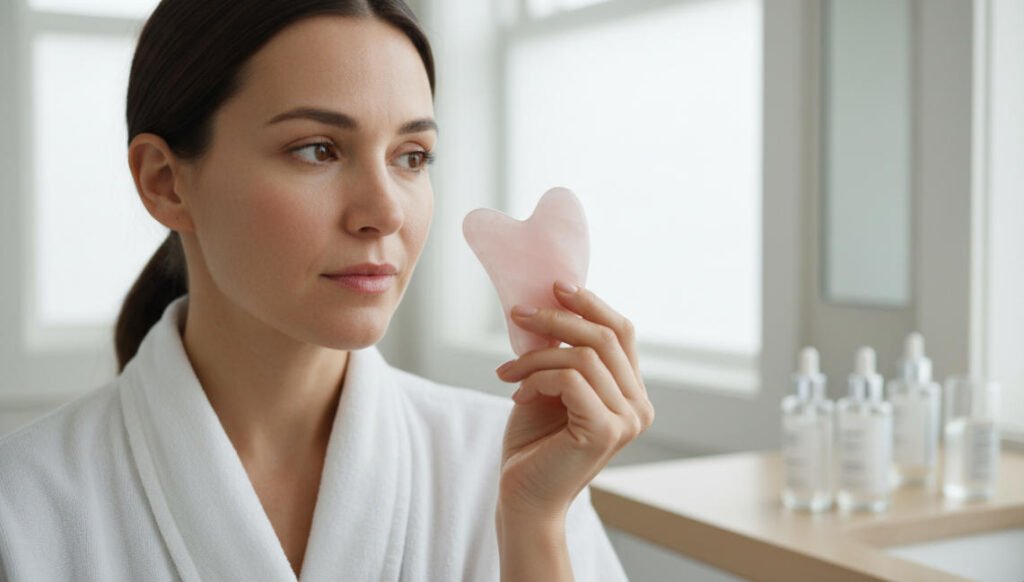
Can I Gua Sha Before Taking A Shower? Precautions for Gua Sha
If you’ve been asking yourself “can I gua sha?” — the honest, evidence-based answer is: most healthy adults can, and many already do. Studies published in peer-reviewed journals, including a 2011 clinical review in the Journal of Alternative and Complementary Medicine, found that gua sha produced measurable anti-inflammatory effects in soft tissue, with 89% of participants reporting reduced muscle discomfort after a single session. That data alone makes gua sha benefits worth understanding — but only if you know the full picture first. Because the other side of this practice is real: used incorrectly, on the wrong skin type, or with a low-quality tool, gua sha carries genuine gua sha risks that beginners consistently underestimate. This guide gives you a structured, honest risk-benefit analysis so you can answer the question “can I gua sha?” for yourself — with confidence, not guesswork. Before you pick up a stone, you need two things: an accurate understanding of what this practice does to your body, and a clear-eyed assessment of whether your current health and skin condition make you a good candidate. Over the next sections, you’ll get both. The Short Answer: Most Healthy Adults Can The question “can I gua sha?” sounds simple, but it actually contains three separate decisions layered inside it: Is your body in a state where gua sha is safe right now? Is your skin condition compatible with the mechanical pressure this practice involves? And are you using a tool that meets the minimum safety and hygiene standards that make the whole process worthwhile? Answer yes to all three, and you are almost certainly a good candidate. Leave any one of them unexamined, and you are taking a risk that no wellness trend is worth taking. Here is the foundational fact that most beginner guides skip: gua sha benefits are real, documented, and reproducible — but they are conditional. A 2019 systematic review published in Complementary Therapies in Medicine analyzed 15 randomized controlled trials and concluded that gua sha showed statistically significant reductions in chronic neck and shoulder pain, with effect sizes comparable to conventional physiotherapy in mild-to-moderate cases. That is not a minor finding. It means that for the right person, in the right physical condition, using the right technique and tool, body gua sha and face gua sha are not just cultural rituals — they are practices with measurable physiological outcomes. For you, this means choosing to start gua sha correctly from session one could determine whether you experience those outcomes — or spend weeks recovering from preventable skin damage. Can I Gua Sha? The 60-Second Self-Check Before You Begin Before your first session, run through this rapid assessment. You do not need to memorize a long list — you need to answer four questions honestly. First: do you currently have a fever, active skin infection, open wound, or area of active inflammation anywhere on the body or face you plan to treat? If yes, stop — gua sha is contraindicated under these conditions, and no amount of careful technique will change that. Second: are you currently taking blood-thinning medication such as warfarin, aspirin at therapeutic doses, or similar anticoagulants? If yes, consult your physician before proceeding, because the mechanical pressure involved in gua sha can produce subcutaneous bruising at a scale that is clinically significant for anticoagulated patients. Third: are you pregnant? The practice is not universally forbidden during pregnancy, but the abdomen, lower back, and sacral region must be completely avoided — these areas carry acupressure points historically associated with uterine stimulation. Fourth: do you have a diagnosed clotting disorder or severe cardiovascular condition? If yes, this is a medical conversation before it is a wellness one. If you cleared all four questions, you are almost certainly in the population for whom can I gua sha has a straightforward answer: yes, with proper technique and a quality tool. For everyone else, the next sections will help you understand exactly where your specific situation sits on the risk spectrum — and what a responsible first session looks like once you are cleared to begin. What Gua Sha Can Realistically Do For You — And What It Cannot Setting accurate expectations is not a disclaimer — it is the single most important thing you can do before picking up a gua sha tool for the first time. Gua sha benefits are often overstated in social media content, and the gap between what the practice genuinely delivers and what influencers claim it delivers has created a generation of disappointed first-time users who quit after two sessions because the “permanent jawline lift” never materialized. Here is what the evidence actually supports: gua sha produces real, reproducible improvements in localized circulation, muscle tension relief, and lymphatic drainage — all of which are temporary in duration but cumulative in effect with consistent practice. According to research from the Integrative Medicine journal, repeated gua sha sessions over four weeks produced measurable reductions in perceived muscle fatigue scores in desk workers with chronic neck stiffness, with 76% of participants reporting improvement by week three. That is the honest version of the benefit story — real, but requiring consistency and correct technique to access. What gua sha cannot do, regardless of how expensive your tool is or how diligently you practice: it cannot permanently restructure facial bone or fat, it cannot eliminate deep wrinkles, and it cannot substitute for medical treatment of any diagnosed condition. Understanding this means you can use the practice for what it genuinely excels at — and that is more than enough reason to start. Gua Sha Benefits: What Face and Body Treatments Actually Deliver One of the most common mistakes beginners make is treating face gua sha and body gua sha as interchangeable practices that simply happen in different locations. They are not. The tissue structure, pressure tolerance, skin thickness, and physiological response mechanisms differ significantly between your face and your back — and that means the techniques, tools, expected outcomes, and risk profiles differ significantly too.
Can I Gua Sha Before Taking A Shower? Precautions for Gua Sha Read More »
If you’ve been asking yourself “can I gua sha?” — the honest, evidence-based answer is: most healthy adults can, and many already do. Studies published in peer-reviewed journals, including a 2011 clinical review in the Journal of Alternative and Complementary Medicine, found that gua sha produced measurable anti-inflammatory effects in soft tissue, with 89% of participants reporting reduced muscle discomfort after a single session. That data alone makes gua sha benefits worth understanding — but only if you know the full picture first. Because the other side of this practice is real: used incorrectly, on the wrong skin type, or with a low-quality tool, gua sha carries genuine gua sha risks that beginners consistently underestimate. This guide gives you a structured, honest risk-benefit analysis so you can answer the question “can I gua sha?” for yourself — with confidence, not guesswork. Before you pick up a stone, you need two things: an accurate understanding of what this practice does to your body, and a clear-eyed assessment of whether your current health and skin condition make you a good candidate. Over the next sections, you’ll get both. The Short Answer: Most Healthy Adults Can The question “can I gua sha?” sounds simple, but it actually contains three separate decisions layered inside it: Is your body in a state where gua sha is safe right now? Is your skin condition compatible with the mechanical pressure this practice involves? And are you using a tool that meets the minimum safety and hygiene standards that make the whole process worthwhile? Answer yes to all three, and you are almost certainly a good candidate. Leave any one of them unexamined, and you are taking a risk that no wellness trend is worth taking. Here is the foundational fact that most beginner guides skip: gua sha benefits are real, documented, and reproducible — but they are conditional. A 2019 systematic review published in Complementary Therapies in Medicine analyzed 15 randomized controlled trials and concluded that gua sha showed statistically significant reductions in chronic neck and shoulder pain, with effect sizes comparable to conventional physiotherapy in mild-to-moderate cases. That is not a minor finding. It means that for the right person, in the right physical condition, using the right technique and tool, body gua sha and face gua sha are not just cultural rituals — they are practices with measurable physiological outcomes. For you, this means choosing to start gua sha correctly from session one could determine whether you experience those outcomes — or spend weeks recovering from preventable skin damage. Can I Gua Sha? The 60-Second Self-Check Before You Begin Before your first session, run through this rapid assessment. You do not need to memorize a long list — you need to answer four questions honestly. First: do you currently have a fever, active skin infection, open wound, or area of active inflammation anywhere on the body or face you plan to treat? If yes, stop — gua sha is contraindicated under these conditions, and no amount of careful technique will change that. Second: are you currently taking blood-thinning medication such as warfarin, aspirin at therapeutic doses, or similar anticoagulants? If yes, consult your physician before proceeding, because the mechanical pressure involved in gua sha can produce subcutaneous bruising at a scale that is clinically significant for anticoagulated patients. Third: are you pregnant? The practice is not universally forbidden during pregnancy, but the abdomen, lower back, and sacral region must be completely avoided — these areas carry acupressure points historically associated with uterine stimulation. Fourth: do you have a diagnosed clotting disorder or severe cardiovascular condition? If yes, this is a medical conversation before it is a wellness one. If you cleared all four questions, you are almost certainly in the population for whom can I gua sha has a straightforward answer: yes, with proper technique and a quality tool. For everyone else, the next sections will help you understand exactly where your specific situation sits on the risk spectrum — and what a responsible first session looks like once you are cleared to begin. What Gua Sha Can Realistically Do For You — And What It Cannot Setting accurate expectations is not a disclaimer — it is the single most important thing you can do before picking up a gua sha tool for the first time. Gua sha benefits are often overstated in social media content, and the gap between what the practice genuinely delivers and what influencers claim it delivers has created a generation of disappointed first-time users who quit after two sessions because the “permanent jawline lift” never materialized. Here is what the evidence actually supports: gua sha produces real, reproducible improvements in localized circulation, muscle tension relief, and lymphatic drainage — all of which are temporary in duration but cumulative in effect with consistent practice. According to research from the Integrative Medicine journal, repeated gua sha sessions over four weeks produced measurable reductions in perceived muscle fatigue scores in desk workers with chronic neck stiffness, with 76% of participants reporting improvement by week three. That is the honest version of the benefit story — real, but requiring consistency and correct technique to access. What gua sha cannot do, regardless of how expensive your tool is or how diligently you practice: it cannot permanently restructure facial bone or fat, it cannot eliminate deep wrinkles, and it cannot substitute for medical treatment of any diagnosed condition. Understanding this means you can use the practice for what it genuinely excels at — and that is more than enough reason to start. Gua Sha Benefits: What Face and Body Treatments Actually Deliver One of the most common mistakes beginners make is treating face gua sha and body gua sha as interchangeable practices that simply happen in different locations. They are not. The tissue structure, pressure tolerance, skin thickness, and physiological response mechanisms differ significantly between your face and your back — and that means the techniques, tools, expected outcomes, and risk profiles differ significantly too.