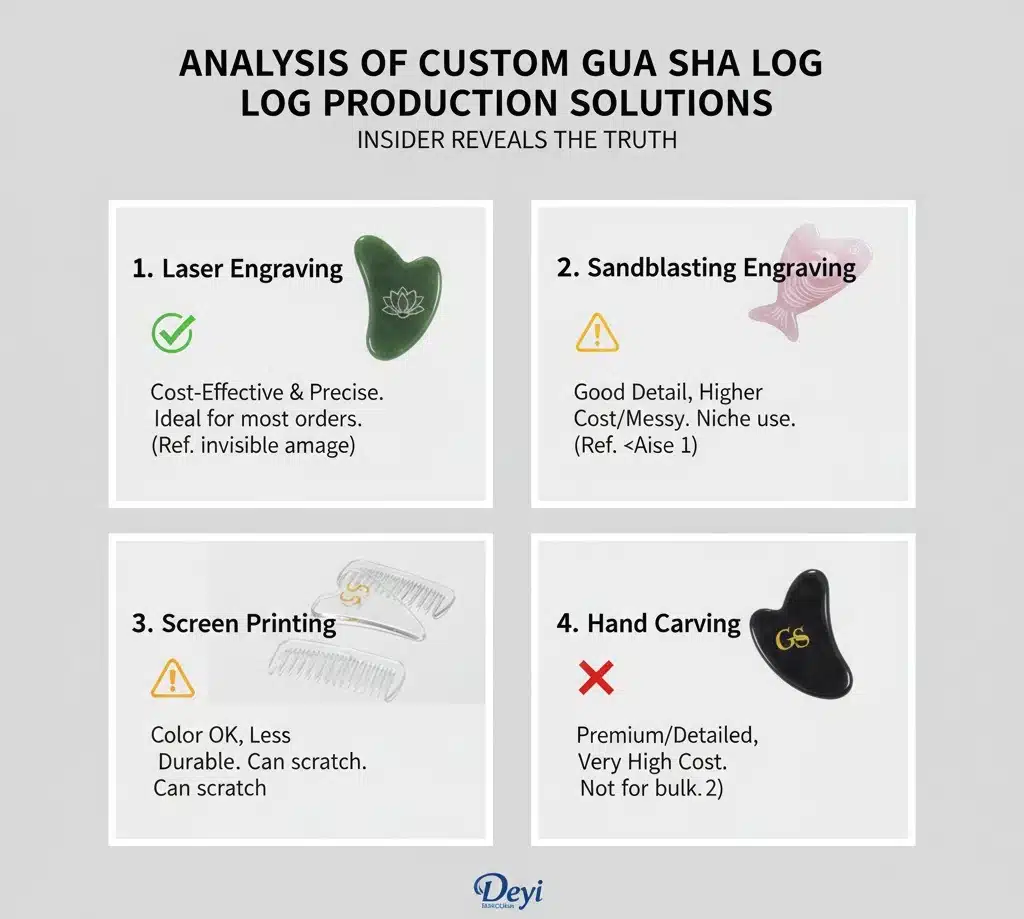
Analysis of Custom Gua Sha Logo Production Solutions – Insider Reveals the Truth
In our article, “The Complete Guide to Custom Gua Sha Tools – Insights from a Gua Sha Factory” we detailed the entire Gua Sha customization process, including market research, customization standards, payment terms, and shipping methods. However, there are still many details that can be added. This article will focus on explaining the logo customization aspect of Gua Sha tools. Through this information, you will gain a better understanding of Gua Sha customization and be able to make more informed choices for your order. 1. Detailed Explanation of the Custom Gua Sha Logo Technology Customizing a Gua Sha logo is the most cost-effective option among Gua Sha customization solutions, offering low pricing and small minimum order quantities. However, there is more than one way to produce a Gua Sha logo, and each method comes with its own advantages and limitations. Today, we have selected four of the most representative logo production methods for your reference. 1.1 Laser Engraving This is the most commonly used logo production method for Gua Sha custom orders. It works by directing a high–energy–density laser beam onto specific areas of a material’s surface. When the surface is exposed to the laser, a series of changes occur—such as vaporization, carbonization, or other physical and chemical reactions—leaving a precise pattern on the surface. When applied to Gua Sha tools, this process creates permanent engraved indentations. Materials suitable for laser engraving include natural materials, plastics, metals, coated metals, as well as stone and glass. Source of laser-engraving materials: Wikipedia – Laser engraving Advantage: Disadvantage: Insider Tips: Laser engraving is the most widely used logo production method in the Gua Sha industry, accounting for over 80% of our total orders. Its key advantages are low cost and low minimum order quantities, making it suitable for both large brands and small buyers. However, because different materials can produce different final results, we strongly recommend obtaining a physical sample before placing a formal order 1.2 Sandblasting Engraving This method works by using compressed air to propel abrasive particles at high speed onto the surface of an object, creating indentations or a matte, frosted effect through surface impact. There are many types of sandblasting, and the technique used for Gua Sha logo engraving falls under micro-sandblasting. Source: Wikipedia – Micro sandblasting Advantages: Disadvantages: Insider Tips: Sandblasting is generally not used for engraving logos on Gua Sha tools, for several reasons: 1.3 Screen Printing Screen printing has a long history, originating from Chinese woodblock printing. It was introduced to the West around the 1770s and gradually gained widespread acceptance and use. The technical principle of screen printing involves transferring ink or paint onto a substrate through a mesh screen. The screen blocks ink in non-logo areas, while the logo area is designed as a stencil to allow ink passage. Ink is applied onto the screen, and a squeegee is used to move the ink across it. The ink passes through the open areas of the stencil onto the substrate, leaving the desired design. Source: Wikipedia – Screen printing Advantages: Disadvantages: Insider Tips: For Gua Sha products, we rarely use screen printing on the tools themselves unless specifically requested by the customer. In addition to the issues mentioned above, such as minimum order quantity and precision, another reason is related to the nature of the tools. During use, Gua Sha tools inevitably come into contact with the logo area. Over time, the ink applied to the tool may wear off, resulting in logo damage. Therefore, screen printing is more commonly used on product packaging or gift boxes rather than on the tools themselves. 1.4 Hand Carving Hand carving involves using a craft knife to engrave patterns or text onto the surface of a product. This method is commonly seen in the creation of seals and stamps. Hand carving has a long history and is applied across a wide range of industries. Advantages: Disadvantages: Insider Tips: Hand-carved logos are not suitable for large-scale Gua Sha production. They are better suited for niche audiences who value cultural significance and uniqueness. Alternatively, you can leverage the distinctiveness of a hand-carved logo to create a truly one-of-a-kind gift for someone special in your life, such as your mother or partner. In addition to the four logo production methods mentioned above, there are several other techniques available, including: Considering that the logo production methods listed above are rarely used in the Gua Sha industry, we will not provide detailed introductions. Unless specifically requested by a customer, these methods are not our primary options. Insider Tips:Our primary recommendation for creating your logo is laser engraving. For Gua Sha products, laser engraving is the most balanced and effective logo production method. Its key advantages are: 2. How to Determine if a Custom Gua Sha Logo Meets Quality Standards The quality of a custom Gua Sha logo should be evaluated from multiple dimensions, and the criteria may vary depending on the production method. Common aspects to consider include: For specific production methods, additional factors may also be relevant, such as the thickness and adhesion of the ink. 2.1 Custom Gua Sha Logo Color Difference Standards 2.1.1 Color Difference Standard Our factory uses the internationally recognized ΔE (Delta E) metric to evaluate whether a logo’s color deviation meets quality standards. To ensure consistent logo color on Gua Sha tools, we adhere to a standard of ΔE ≤ 3, meaning that any color difference is imperceptible to the naked eye. 2.1.2 Color Codes & Pre-Production Samples In addition to checking color deviation after production, another crucial step in ensuring the accuracy of a Gua Sha logo’s color is confirming a pre-production sample. We’ve observed two common issues in this process: Pantone colors, on the other hand, are pre-mixed inks and provide the most reliable printing results. They ensure consistent brand colors across packaging, printed materials, websites, and product manufacturing.Source: learn.g2.com – What Is Pantone? Insider Tips: To prevent the color deviation issues mentioned above, you can take the following two measures: Typically, significant color deviations are rare within the
Analysis of Custom Gua Sha Logo Production Solutions – Insider Reveals the Truth Read More »
In our article, “The Complete Guide to Custom Gua Sha Tools – Insights from a Gua Sha Factory” we detailed the entire Gua Sha customization process, including market research, customization standards, payment terms, and shipping methods. However, there are still many details that can be added. This article will focus on explaining the logo customization aspect of Gua Sha tools. Through this information, you will gain a better understanding of Gua Sha customization and be able to make more informed choices for your order. 1. Detailed Explanation of the Custom Gua Sha Logo Technology Customizing a Gua Sha logo is the most cost-effective option among Gua Sha customization solutions, offering low pricing and small minimum order quantities. However, there is more than one way to produce a Gua Sha logo, and each method comes with its own advantages and limitations. Today, we have selected four of the most representative logo production methods for your reference. 1.1 Laser Engraving This is the most commonly used logo production method for Gua Sha custom orders. It works by directing a high–energy–density laser beam onto specific areas of a material’s surface. When the surface is exposed to the laser, a series of changes occur—such as vaporization, carbonization, or other physical and chemical reactions—leaving a precise pattern on the surface. When applied to Gua Sha tools, this process creates permanent engraved indentations. Materials suitable for laser engraving include natural materials, plastics, metals, coated metals, as well as stone and glass. Source of laser-engraving materials: Wikipedia – Laser engraving Advantage: Disadvantage: Insider Tips: Laser engraving is the most widely used logo production method in the Gua Sha industry, accounting for over 80% of our total orders. Its key advantages are low cost and low minimum order quantities, making it suitable for both large brands and small buyers. However, because different materials can produce different final results, we strongly recommend obtaining a physical sample before placing a formal order 1.2 Sandblasting Engraving This method works by using compressed air to propel abrasive particles at high speed onto the surface of an object, creating indentations or a matte, frosted effect through surface impact. There are many types of sandblasting, and the technique used for Gua Sha logo engraving falls under micro-sandblasting. Source: Wikipedia – Micro sandblasting Advantages: Disadvantages: Insider Tips: Sandblasting is generally not used for engraving logos on Gua Sha tools, for several reasons: 1.3 Screen Printing Screen printing has a long history, originating from Chinese woodblock printing. It was introduced to the West around the 1770s and gradually gained widespread acceptance and use. The technical principle of screen printing involves transferring ink or paint onto a substrate through a mesh screen. The screen blocks ink in non-logo areas, while the logo area is designed as a stencil to allow ink passage. Ink is applied onto the screen, and a squeegee is used to move the ink across it. The ink passes through the open areas of the stencil onto the substrate, leaving the desired design. Source: Wikipedia – Screen printing Advantages: Disadvantages: Insider Tips: For Gua Sha products, we rarely use screen printing on the tools themselves unless specifically requested by the customer. In addition to the issues mentioned above, such as minimum order quantity and precision, another reason is related to the nature of the tools. During use, Gua Sha tools inevitably come into contact with the logo area. Over time, the ink applied to the tool may wear off, resulting in logo damage. Therefore, screen printing is more commonly used on product packaging or gift boxes rather than on the tools themselves. 1.4 Hand Carving Hand carving involves using a craft knife to engrave patterns or text onto the surface of a product. This method is commonly seen in the creation of seals and stamps. Hand carving has a long history and is applied across a wide range of industries. Advantages: Disadvantages: Insider Tips: Hand-carved logos are not suitable for large-scale Gua Sha production. They are better suited for niche audiences who value cultural significance and uniqueness. Alternatively, you can leverage the distinctiveness of a hand-carved logo to create a truly one-of-a-kind gift for someone special in your life, such as your mother or partner. In addition to the four logo production methods mentioned above, there are several other techniques available, including: Considering that the logo production methods listed above are rarely used in the Gua Sha industry, we will not provide detailed introductions. Unless specifically requested by a customer, these methods are not our primary options. Insider Tips:Our primary recommendation for creating your logo is laser engraving. For Gua Sha products, laser engraving is the most balanced and effective logo production method. Its key advantages are: 2. How to Determine if a Custom Gua Sha Logo Meets Quality Standards The quality of a custom Gua Sha logo should be evaluated from multiple dimensions, and the criteria may vary depending on the production method. Common aspects to consider include: For specific production methods, additional factors may also be relevant, such as the thickness and adhesion of the ink. 2.1 Custom Gua Sha Logo Color Difference Standards 2.1.1 Color Difference Standard Our factory uses the internationally recognized ΔE (Delta E) metric to evaluate whether a logo’s color deviation meets quality standards. To ensure consistent logo color on Gua Sha tools, we adhere to a standard of ΔE ≤ 3, meaning that any color difference is imperceptible to the naked eye. 2.1.2 Color Codes & Pre-Production Samples In addition to checking color deviation after production, another crucial step in ensuring the accuracy of a Gua Sha logo’s color is confirming a pre-production sample. We’ve observed two common issues in this process: Pantone colors, on the other hand, are pre-mixed inks and provide the most reliable printing results. They ensure consistent brand colors across packaging, printed materials, websites, and product manufacturing.Source: learn.g2.com – What Is Pantone? Insider Tips: To prevent the color deviation issues mentioned above, you can take the following two measures: Typically, significant color deviations are rare within the