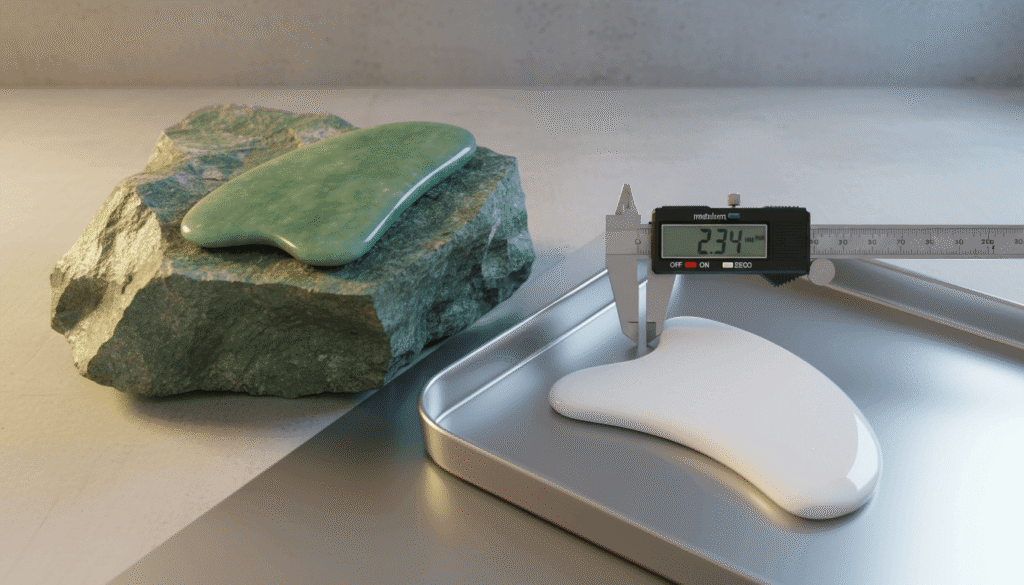
Ceramic Gua Sha vs. Jade Gua Sha — From the Production and User Perspectives
As an editor at Deyi Gems and someone who has worked in the gua sha and beauty-tool supply chain for years, I’ve seen both jade and ceramic gua sha rise in popularity. Both are common on spa shelves and in influencer feeds, yet they come from very different material families and manufacturing processes — which affects how they perform, how they feel, how long they last, and how they should be cared for. In this deep-dive comparison, we’ll examine jade and ceramic gua sha from two angles: the production side (sourcing, shaping, finishing, quality control, costs, and sustainability) and the user side (thermal feel, glide, durability, hygiene, and results). Along the way I’ll point to authoritative sources so you can verify the technical claims and make an informed choice for your brand, salon or personal routine. Why the keywords matter What “jade gua sha” signals When suppliers or customers say “jade gua sha,” they usually mean tools cut from natural jade stone — most often nephrite or jadeite. These are true gemstones with geological and gemological attributes (hardness, density, toughness) that influence carving, finish and long-term wear. Because jade is a recognized gemstone in jewelry and art markets, authenticity and provenance matter to both producers and buyers. GIA — Jade care, properties and Mohs hardness (useful for sourcing and authenticity checks). What “ceramic gua sha” signals “Ceramic gua sha” refers to tools manufactured from fired clay bodies — typically porcelain or high-fired ceramic — and finished with a smooth glazed surface. Ceramics are engineered in a kiln: raw materials are blended, shaped, fired at high temperatures, and then often glazed and refired. This production route makes ceramic tools highly controllable in form, texture and color, while also allowing features such as thin edges and repeatable molds. Sowelab / ceramic gua sha product notes — ceramic properties and manufacturing notes. Material science and production (the factory perspective) Jade — geology, sourcing, and stone preparation Jade used for gua sha primarily comes in two mineral types: nephrite and jadeite. They differ subtly in chemical makeup, density and hardness: nephrite is typically around Mohs 6–6.5, while jadeite sits around Mohs 6.5–7. That range matters to a factory because harder stone may take longer to cut and polish but can achieve finer polish and sheen. Mining locations, slab quality, and the presence of fractures or inclusions determine yield: high-quality, isotropic slabs (without many veins) are rarer and costlier. Gemological care and testing (e.g., to rule out dyed or polymer-impregnated fakes) are routine for reputable suppliers. Jade — shaping, tooling, and finish Working jade is a craft. Common production steps include slab splitting, rough sawing to shape blanks, CNC or hand-shaping, multi-stage grinding, and progressively finer polishing to bring out luster. For larger orders, factories often combine machine cutting with manual finishing to maintain consistent shapes while preserving stone integrity. Quality control focuses on edge tolerances, polish uniformity, and chip-free surfaces. For premium jade, additional steps like ultrasonic cleaning and hand-polishing are used to reduce micro-abrasions that could irritate facial skin. “How top gua sha factories produce” — practical step-by-step production workflow for stone tools. Ceramic — materials, forming and firing Ceramic gua sha production is more industrially repeatable. A porcelain or ceramic body is formulated to flow and vitrify predictably in a kiln. Tools can be slip-cast, pressed, or machine-cut from molded blanks. After an initial bisque firing, surfaces are glazed and fired again at controlled temperatures to create the final hard, glass-like surface. This process gives manufacturers excellent control over thickness, edge radius and surface smoothness, and it supports consistent color and patterning across large runs. Ceramic tooling requires investment in molds and kiln capacity but scales efficiently. Ceramic — finishing and surface properties A well-formulated glaze can yield an ultrafine, non-porous surface that feels silky on skin and resists staining. Some ceramic makers advertise thermoregulatory properties (a neutral feel against skin) and antibacterial benefits derived from a fully vitrified, non-porous surface. In practice, ceramic’s surface chemistry makes cleaning straightforward because oils and serums don’t penetrate the body as they might with unfinished natural stones. However, chips can expose raw ceramic body and create roughness if dropped. Quality control, testing and regulatory considerations Authenticity and material testing for jade From a factory standpoint, testing is non-negotiable. Reputable suppliers perform gemological checks: specific gravity, refractive indices when necessary, and — increasingly — spectroscopic or lab reports for higher-value jadeite pieces. The market has many treated, dyed or polymer-impregnated “jade-like” products; therefore, certification helps brands avoid reputational risk and regulatory headaches in export markets. Moreover, for wholesale clients who will sell under a brand, traceability and consistent batch documentation are competitive advantages. Consistency and safety for ceramic Ceramic production requires materials testing to verify firing schedules and glaze compatibility, particularly to ensure there are no heavy metals leaching from certain glazes. Lead- or cadmium-containing glazes are rare in modern cosmetic tools, but buyers should still request certificates of analysis (CoA) and test reports. A ceramics factory’s process control (recipe logs, kiln records, and glaze testing) is the equivalent of a gem lab report for jade: it proves consistency and safety. How the tools perform in real use (the user perspective) Thermal feel and immediate tactile impression One of the most commonly cited reasons people choose jade is its perceived “coolness.” Jade does tend to feel cool to the touch, which can enhance the sensory experience during facial gua sha. That cool feel comes from the stone’s thermal mass and conductivity. Ceramic, depending on firing and glazing, may feel neutral and less icy than jade; however, some consumers prefer the milder temperature because it’s less likely to create sudden sensations on sensitive skin. Both materials are often chilled in the fridge by at-home users or therapists to amplify de-puffing effects. Glide, friction and the role of surface finish A critical factor in user experience is how smoothly the tool moves across skin when used with oil or serum. A high-polish jade tool, when properly finished,
Ceramic Gua Sha vs. Jade Gua Sha — From the Production and User Perspectives Read More »
As an editor at Deyi Gems and someone who has worked in the gua sha and beauty-tool supply chain for years, I’ve seen both jade and ceramic gua sha rise in popularity. Both are common on spa shelves and in influencer feeds, yet they come from very different material families and manufacturing processes — which affects how they perform, how they feel, how long they last, and how they should be cared for. In this deep-dive comparison, we’ll examine jade and ceramic gua sha from two angles: the production side (sourcing, shaping, finishing, quality control, costs, and sustainability) and the user side (thermal feel, glide, durability, hygiene, and results). Along the way I’ll point to authoritative sources so you can verify the technical claims and make an informed choice for your brand, salon or personal routine. Why the keywords matter What “jade gua sha” signals When suppliers or customers say “jade gua sha,” they usually mean tools cut from natural jade stone — most often nephrite or jadeite. These are true gemstones with geological and gemological attributes (hardness, density, toughness) that influence carving, finish and long-term wear. Because jade is a recognized gemstone in jewelry and art markets, authenticity and provenance matter to both producers and buyers. GIA — Jade care, properties and Mohs hardness (useful for sourcing and authenticity checks). What “ceramic gua sha” signals “Ceramic gua sha” refers to tools manufactured from fired clay bodies — typically porcelain or high-fired ceramic — and finished with a smooth glazed surface. Ceramics are engineered in a kiln: raw materials are blended, shaped, fired at high temperatures, and then often glazed and refired. This production route makes ceramic tools highly controllable in form, texture and color, while also allowing features such as thin edges and repeatable molds. Sowelab / ceramic gua sha product notes — ceramic properties and manufacturing notes. Material science and production (the factory perspective) Jade — geology, sourcing, and stone preparation Jade used for gua sha primarily comes in two mineral types: nephrite and jadeite. They differ subtly in chemical makeup, density and hardness: nephrite is typically around Mohs 6–6.5, while jadeite sits around Mohs 6.5–7. That range matters to a factory because harder stone may take longer to cut and polish but can achieve finer polish and sheen. Mining locations, slab quality, and the presence of fractures or inclusions determine yield: high-quality, isotropic slabs (without many veins) are rarer and costlier. Gemological care and testing (e.g., to rule out dyed or polymer-impregnated fakes) are routine for reputable suppliers. Jade — shaping, tooling, and finish Working jade is a craft. Common production steps include slab splitting, rough sawing to shape blanks, CNC or hand-shaping, multi-stage grinding, and progressively finer polishing to bring out luster. For larger orders, factories often combine machine cutting with manual finishing to maintain consistent shapes while preserving stone integrity. Quality control focuses on edge tolerances, polish uniformity, and chip-free surfaces. For premium jade, additional steps like ultrasonic cleaning and hand-polishing are used to reduce micro-abrasions that could irritate facial skin. “How top gua sha factories produce” — practical step-by-step production workflow for stone tools. Ceramic — materials, forming and firing Ceramic gua sha production is more industrially repeatable. A porcelain or ceramic body is formulated to flow and vitrify predictably in a kiln. Tools can be slip-cast, pressed, or machine-cut from molded blanks. After an initial bisque firing, surfaces are glazed and fired again at controlled temperatures to create the final hard, glass-like surface. This process gives manufacturers excellent control over thickness, edge radius and surface smoothness, and it supports consistent color and patterning across large runs. Ceramic tooling requires investment in molds and kiln capacity but scales efficiently. Ceramic — finishing and surface properties A well-formulated glaze can yield an ultrafine, non-porous surface that feels silky on skin and resists staining. Some ceramic makers advertise thermoregulatory properties (a neutral feel against skin) and antibacterial benefits derived from a fully vitrified, non-porous surface. In practice, ceramic’s surface chemistry makes cleaning straightforward because oils and serums don’t penetrate the body as they might with unfinished natural stones. However, chips can expose raw ceramic body and create roughness if dropped. Quality control, testing and regulatory considerations Authenticity and material testing for jade From a factory standpoint, testing is non-negotiable. Reputable suppliers perform gemological checks: specific gravity, refractive indices when necessary, and — increasingly — spectroscopic or lab reports for higher-value jadeite pieces. The market has many treated, dyed or polymer-impregnated “jade-like” products; therefore, certification helps brands avoid reputational risk and regulatory headaches in export markets. Moreover, for wholesale clients who will sell under a brand, traceability and consistent batch documentation are competitive advantages. Consistency and safety for ceramic Ceramic production requires materials testing to verify firing schedules and glaze compatibility, particularly to ensure there are no heavy metals leaching from certain glazes. Lead- or cadmium-containing glazes are rare in modern cosmetic tools, but buyers should still request certificates of analysis (CoA) and test reports. A ceramics factory’s process control (recipe logs, kiln records, and glaze testing) is the equivalent of a gem lab report for jade: it proves consistency and safety. How the tools perform in real use (the user perspective) Thermal feel and immediate tactile impression One of the most commonly cited reasons people choose jade is its perceived “coolness.” Jade does tend to feel cool to the touch, which can enhance the sensory experience during facial gua sha. That cool feel comes from the stone’s thermal mass and conductivity. Ceramic, depending on firing and glazing, may feel neutral and less icy than jade; however, some consumers prefer the milder temperature because it’s less likely to create sudden sensations on sensitive skin. Both materials are often chilled in the fridge by at-home users or therapists to amplify de-puffing effects. Glide, friction and the role of surface finish A critical factor in user experience is how smoothly the tool moves across skin when used with oil or serum. A high-polish jade tool, when properly finished,