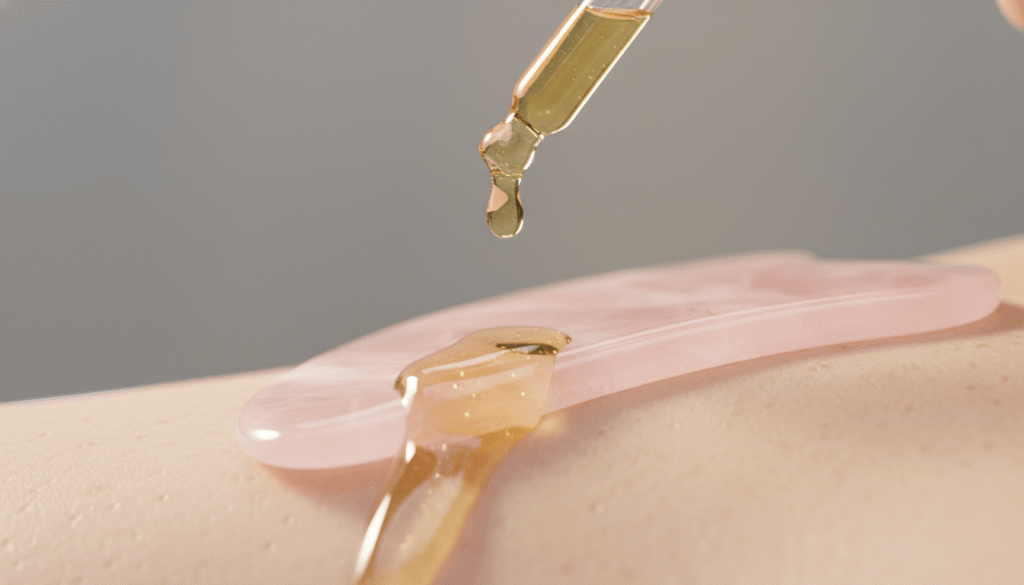
What Oil to Use with Gua Sha – Gua Sha Use Guide
Gua sha has evolved from a traditional East Asian therapy into a global beauty and wellness ritual. While modern users often focus on tool shape or material—jade, rose quartz, or ceramic—the oil use with gua sha plays an equally critical role. Without the right oil, even the most premium gua sha tool can cause drag, irritation, or ineffective results. Moreover, facial skin and body skin behave very differently. Facial gua sha emphasizes lymphatic drainage, microcirculation, and fascia relaxation, whereas body gua sha focuses more on muscle release, detoxification, and deeper tissue stimulation. As a result, the oil suitable for facial gua sha may not be ideal for body gua sha, especially when considering skin type, allergies, and absorption speed. From a professional skincare and wellness perspective, gua sha should be understood as a supportive self-care technique rather than a medical treatment. While it has been widely adopted in modern beauty routines, its effectiveness and safety depend heavily on proper technique, appropriate pressure, and correct product pairing. In particular, using a suitable oil with gua sha is essential to minimize friction, protect the skin barrier, and ensure a smooth, controlled movement of the tool. When performed gently and consistently, gua sha can complement skincare routines without compromising skin health. This guide is written from a professional production and application perspective at Deyi Gems, combining long-term industry experience with dermatological and cosmetic science references. Throughout this article, we will explain what oil to use with gua sha in a practical, accessible way, while also supporting recommendations with authoritative external sources. Understanding the Role of Oil in Gua Sha How Oil Improves Gua Sha Effectiveness At its core, oil reduces friction between the gua sha tool and the skin. However, friction control is only the surface-level function. A properly chosen oil allows consistent pressure, ensuring that the gua sha strokes stimulate circulation without damaging the skin barrier. In addition, oils act as active carriers. Many plant-based oils contain fatty acids, antioxidants, and vitamins that enhance skin elasticity during massage. According to the American Academy of Dermatology, maintaining the skin barrier during massage is critical to preventing transepidermal water loss and irritation (https://www.aad.org). Oil vs. Serum vs. Cream for Gua Sha Although serums and creams are sometimes used with gua sha, oils remain the most reliable option. Serums often absorb too quickly, increasing drag mid-session. Creams, on the other hand, may contain emulsifiers that pill under repeated strokes. Oils provide a stable glide throughout the session, especially when gua sha strokes last longer than five minutes. Dermatological research published by the National Institutes of Health highlights that lipid-based products offer longer-lasting occlusion and lubrication compared to water-based formulas (https://www.ncbi.nlm.nih.gov). Facial Gua Sha: Choosing the Right Oil Why Facial Skin Requires Special Consideration Facial skin is thinner, more vascular, and more reactive than body skin. Therefore, the oil used with facial gua sha must be lightweight, non-comedogenic, and low in allergens. Heavy or occlusive oils can clog pores, while fragranced oils may trigger sensitivity. Facial gua sha also emphasizes lymphatic drainage rather than muscle scraping. This means that smoothness and consistency matter more than deep penetration. Because facial skin is thinner and more vascularized than body skin, excessive pressure or insufficient lubrication may increase the risk of irritation or barrier disruption, particularly around delicate areas such as the under-eye zone and jawline. The American Academy of Dermatology emphasizes that repeated mechanical friction on compromised skin barriers can lead to redness, sensitivity, or flare-ups, especially for individuals with reactive or acne-prone skin. Best Oils for Facial Gua Sha Jojoba Oil for Balanced Skin Jojoba oil is chemically similar to human sebum, making it one of the safest choices for facial gua sha. It provides excellent slip without feeling greasy and helps regulate oil production in both dry and oily skin types. Clinical cosmetic studies show that jojoba oil supports skin barrier repair and has a low irritation profile, making it suitable even for sensitive skin (https://www.ncbi.nlm.nih.gov/pmc/articles/PMC5796020). Rosehip Oil for Mature or Dull Skin Rosehip oil is rich in linoleic acid and vitamin A derivatives, which support skin regeneration. When used with gua sha, it enhances glow while maintaining sufficient glide. However, rosehip oil absorbs faster than jojoba oil. For longer gua sha sessions, users may need to reapply a small amount to maintain smooth strokes. Squalane for Acne-Prone Skin Squalane is a hydrogenated version of squalene, naturally found in skin lipids. It is non-comedogenic and extremely lightweight, making it ideal for acne-prone or combination skin. According to research published in the International Journal of Cosmetic Science, squalane significantly improves skin smoothness without increasing acne risk (https://onlinelibrary.wiley.com). Oils to Avoid for Facial Gua Sha Certain oils are technically safe but less suitable for facial gua sha. Coconut oil, for example, provides excellent slip but has a high comedogenic rating. Essential oils, unless heavily diluted, can cause irritation and photosensitivity. The Environmental Working Group (EWG) warns that undiluted essential oils are among the most common causes of cosmetic-related contact dermatitis (https://www.ewg.org). Facial Gua Sha and Skin Type Matching Dry and Dehydrated Skin Dry skin benefits from oils with higher oleic acid content, such as avocado oil or sweet almond oil. These oils provide longer-lasting glide and reduce micro-tearing during gua sha strokes. However, facial gua sha users with dry skin should still prioritize oils labeled as cosmetic-grade and cold-pressed to avoid impurities. Oily and Combination Skin Contrary to popular belief, oily skin still needs oil during gua sha. The key is choosing lightweight, fast-absorbing oils such as grapeseed or squalane. These oils reduce friction without overwhelming the sebaceous glands. Studies from the Journal of Cosmetic Dermatology confirm that lightweight oils can help balance oil production rather than increase it (https://onlinelibrary.wiley.com). Sensitive and Allergy-Prone Skin For individuals with sensitive or allergy-prone skin, single-ingredient, fragrance-free oils are strongly recommended when performing gua sha. Oils with minimal processing, such as jojoba oil or sunflower seed oil, tend to have lower allergenic potential. The American Contact Dermatitis Society advises patch testing
What Oil to Use with Gua Sha – Gua Sha Use Guide Read More »
Gua sha has evolved from a traditional East Asian therapy into a global beauty and wellness ritual. While modern users often focus on tool shape or material—jade, rose quartz, or ceramic—the oil use with gua sha plays an equally critical role. Without the right oil, even the most premium gua sha tool can cause drag, irritation, or ineffective results. Moreover, facial skin and body skin behave very differently. Facial gua sha emphasizes lymphatic drainage, microcirculation, and fascia relaxation, whereas body gua sha focuses more on muscle release, detoxification, and deeper tissue stimulation. As a result, the oil suitable for facial gua sha may not be ideal for body gua sha, especially when considering skin type, allergies, and absorption speed. From a professional skincare and wellness perspective, gua sha should be understood as a supportive self-care technique rather than a medical treatment. While it has been widely adopted in modern beauty routines, its effectiveness and safety depend heavily on proper technique, appropriate pressure, and correct product pairing. In particular, using a suitable oil with gua sha is essential to minimize friction, protect the skin barrier, and ensure a smooth, controlled movement of the tool. When performed gently and consistently, gua sha can complement skincare routines without compromising skin health. This guide is written from a professional production and application perspective at Deyi Gems, combining long-term industry experience with dermatological and cosmetic science references. Throughout this article, we will explain what oil to use with gua sha in a practical, accessible way, while also supporting recommendations with authoritative external sources. Understanding the Role of Oil in Gua Sha How Oil Improves Gua Sha Effectiveness At its core, oil reduces friction between the gua sha tool and the skin. However, friction control is only the surface-level function. A properly chosen oil allows consistent pressure, ensuring that the gua sha strokes stimulate circulation without damaging the skin barrier. In addition, oils act as active carriers. Many plant-based oils contain fatty acids, antioxidants, and vitamins that enhance skin elasticity during massage. According to the American Academy of Dermatology, maintaining the skin barrier during massage is critical to preventing transepidermal water loss and irritation (https://www.aad.org). Oil vs. Serum vs. Cream for Gua Sha Although serums and creams are sometimes used with gua sha, oils remain the most reliable option. Serums often absorb too quickly, increasing drag mid-session. Creams, on the other hand, may contain emulsifiers that pill under repeated strokes. Oils provide a stable glide throughout the session, especially when gua sha strokes last longer than five minutes. Dermatological research published by the National Institutes of Health highlights that lipid-based products offer longer-lasting occlusion and lubrication compared to water-based formulas (https://www.ncbi.nlm.nih.gov). Facial Gua Sha: Choosing the Right Oil Why Facial Skin Requires Special Consideration Facial skin is thinner, more vascular, and more reactive than body skin. Therefore, the oil used with facial gua sha must be lightweight, non-comedogenic, and low in allergens. Heavy or occlusive oils can clog pores, while fragranced oils may trigger sensitivity. Facial gua sha also emphasizes lymphatic drainage rather than muscle scraping. This means that smoothness and consistency matter more than deep penetration. Because facial skin is thinner and more vascularized than body skin, excessive pressure or insufficient lubrication may increase the risk of irritation or barrier disruption, particularly around delicate areas such as the under-eye zone and jawline. The American Academy of Dermatology emphasizes that repeated mechanical friction on compromised skin barriers can lead to redness, sensitivity, or flare-ups, especially for individuals with reactive or acne-prone skin. Best Oils for Facial Gua Sha Jojoba Oil for Balanced Skin Jojoba oil is chemically similar to human sebum, making it one of the safest choices for facial gua sha. It provides excellent slip without feeling greasy and helps regulate oil production in both dry and oily skin types. Clinical cosmetic studies show that jojoba oil supports skin barrier repair and has a low irritation profile, making it suitable even for sensitive skin (https://www.ncbi.nlm.nih.gov/pmc/articles/PMC5796020). Rosehip Oil for Mature or Dull Skin Rosehip oil is rich in linoleic acid and vitamin A derivatives, which support skin regeneration. When used with gua sha, it enhances glow while maintaining sufficient glide. However, rosehip oil absorbs faster than jojoba oil. For longer gua sha sessions, users may need to reapply a small amount to maintain smooth strokes. Squalane for Acne-Prone Skin Squalane is a hydrogenated version of squalene, naturally found in skin lipids. It is non-comedogenic and extremely lightweight, making it ideal for acne-prone or combination skin. According to research published in the International Journal of Cosmetic Science, squalane significantly improves skin smoothness without increasing acne risk (https://onlinelibrary.wiley.com). Oils to Avoid for Facial Gua Sha Certain oils are technically safe but less suitable for facial gua sha. Coconut oil, for example, provides excellent slip but has a high comedogenic rating. Essential oils, unless heavily diluted, can cause irritation and photosensitivity. The Environmental Working Group (EWG) warns that undiluted essential oils are among the most common causes of cosmetic-related contact dermatitis (https://www.ewg.org). Facial Gua Sha and Skin Type Matching Dry and Dehydrated Skin Dry skin benefits from oils with higher oleic acid content, such as avocado oil or sweet almond oil. These oils provide longer-lasting glide and reduce micro-tearing during gua sha strokes. However, facial gua sha users with dry skin should still prioritize oils labeled as cosmetic-grade and cold-pressed to avoid impurities. Oily and Combination Skin Contrary to popular belief, oily skin still needs oil during gua sha. The key is choosing lightweight, fast-absorbing oils such as grapeseed or squalane. These oils reduce friction without overwhelming the sebaceous glands. Studies from the Journal of Cosmetic Dermatology confirm that lightweight oils can help balance oil production rather than increase it (https://onlinelibrary.wiley.com). Sensitive and Allergy-Prone Skin For individuals with sensitive or allergy-prone skin, single-ingredient, fragrance-free oils are strongly recommended when performing gua sha. Oils with minimal processing, such as jojoba oil or sunflower seed oil, tend to have lower allergenic potential. The American Contact Dermatitis Society advises patch testing