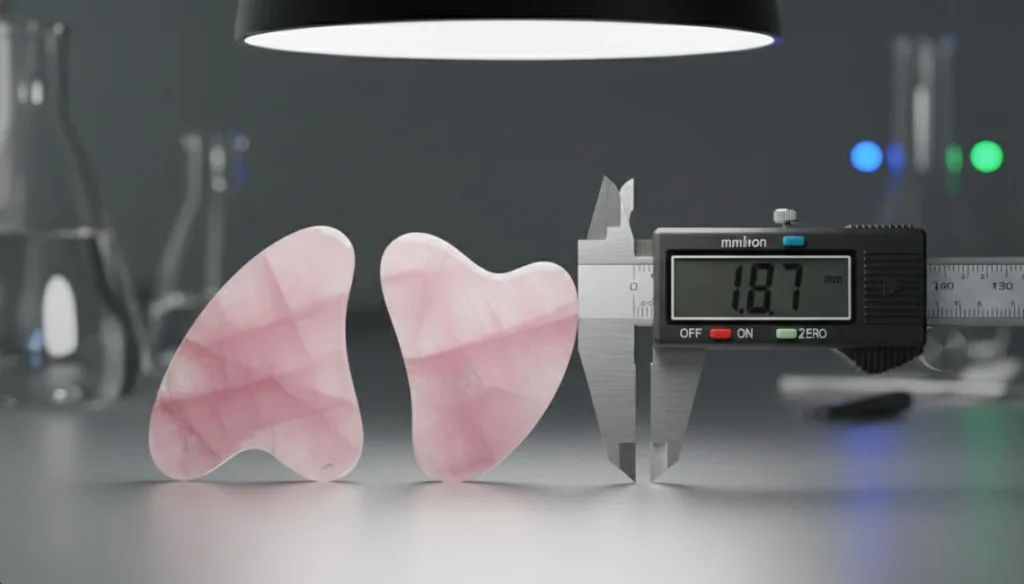
Why Jade Gua Sha Tools in Gua Sha Wholesale Almost Never Have Perfectly Consistent Sizes
If you source jade gua sha tools through gua sha wholesale channels, here is the most commercially significant fact your current supplier is unlikely to tell you: across approximately 850,000 pieces of 80mm×60mm rose quartz gua sha tools produced in 2025, internal production records show that only 23% of pieces achieved a perfectly accurate gua sha size. Around 45% fell within ±0.5mm of the target dimension, 75% within ±1mm, and 90% within ±2mm — the de facto tolerance ceiling recognized across the gua sha manufacturing industry. That means roughly 10% of every production run is classified as non-conforming before it ever ships. This is not an isolated quality failure at a single gua sha factory. It is a structural characteristic of how natural stone tools are made — and understanding it before your next wholesale order is the difference between a smooth procurement cycle and an expensive dispute. The Hard Data Your Gua Sha Supplier Won’t Show You: Size Consistency in Jade Gua Sha Tools Most buyers entering gua sha wholesale for the first time assume that the dimensions printed on a product specification sheet are guaranteed delivery targets. They are not. What those numbers represent is a nominal aim, and the distance between that aim and actual production output is governed by tolerance norms that most suppliers never surface during the sales process. An internal dataset covering 340 orders involving jade gua sha tools recorded 25 cases of return or exchange disputes — a 7.35% friction rate. In virtually every case, the root cause was not a manufacturing failure. It was an information failure: buyers received products that were within every applicable industry norm, but had never been told that tolerance variance was normal. The financial and logistical cost of that silence falls entirely on the buyer. What 850,000 Rose Quartz Gua Sha Pieces Reveal About Size Tolerance in Production The 2025 production cycle data provides the clearest quantitative picture available in the industry. Of the approximately 850,000 rose quartz gua sha pieces produced to an 80mm×60mm specification, the measured gua sha size distribution broke down as follows: 23% of pieces matched the target dimension exactly; approximately 45% fell within ±0.5mm; about 75% fell within ±1mm; and roughly 90% fell within ±2mm. The remaining 10% — pieces exceeding the ±2mm threshold — were classified as non-conforming and pulled from shipment-eligible inventory. To put this in procurement terms: for every 10,000 pieces in a gua sha wholesale order, you should statistically plan for approximately 1,000 pieces to be removed at the quality gate, directly affecting your effective yield rate and your landed cost per sellable unit. This means you can build more accurate purchasing budgets and avoid the hidden cost of unplanned short shipments by requesting batch-level yield data from your supplier before confirming any order. Tolerance Range Proportion of Total Production Cumulative Conforming Rate Classification Exact target dimension (0 variance) ~23% 23% Perfect match Within ±0.5mm ~45% 45% High precision tier Within ±1.0mm ~75% 75% Standard precision tier Within ±2.0mm ~90% 90% Industry-accepted ceiling Exceeds ±2.0mm ~10% — Non-conforming / rejected How the ±2mm Tolerance Became the Gua Sha Industry’s Unofficial Standard The ±2mm threshold governing jade gua sha tool production is not codified in any ISO standard or regulated by a government body. It is an informal consensus that has developed over decades of practice within gua sha factories, driven by the physical limits of natural stone processing. Natural gemstone materials — including rose quartz, jade, and aventurine — exhibit what the Gemological Institute of America (GIA) describes as inherent structural variability: measurable differences in grain density, micro-fracture patterns, and mineral composition that cannot be engineered out of the raw material. This variability propagates through every downstream stage of production. The International Gem Society (IGS) further notes that the internal structure of natural stones responds differently to mechanical stress, making dimensional uniformity across large batches a physical impossibility rather than a quality management failure. Recognizing this, the gua sha manufacturing industry settled on ±2mm as a pragmatic ceiling that balances workable yield rates with commercially acceptable product quality. This means you can enter any supplier negotiation with a calibrated benchmark — knowing that any supplier claiming zero tolerance variance on natural stone is either misrepresenting their process or selling you machine-sorted premium inventory at a cost that should be reflected in the unit price. The Real Cost of Ignoring Gua Sha Size Tolerances: A Wholesale Dispute Case Study Of the 25 return or exchange cases documented in the 340-order dataset, the pattern was consistent across different buyers and different order volumes. Buyers had placed gua sha wholesale orders with an implicit expectation of near-perfect dimensional accuracy — typically 80mm×60mm — and received shipments containing pieces that were visually or measurably inconsistent when compared side by side. In none of these cases did production output exceed the ±2mm industry ceiling. Every piece shipped was, by every applicable norm, within acceptable range. The disputes arose entirely because the buyers had never been informed that variance was inherent, and no pre-order documentation had established a mutually agreed tolerance standard. Can a single conversation about tolerance ranges before order confirmation prevent a return dispute worth thousands of dollars in reshipping and reprocessing costs? The data suggests the answer is yes, in the overwhelming majority of cases. Order Dataset Total Orders Dispute Cases Dispute Rate Primary Root Cause Jade / crystal gua sha wholesale orders 340 25 7.35% Buyer unaware of tolerance norms Orders with pre-order tolerance disclosure ~220 3 1.36% Expectation mismatch (minor) Orders without pre-order tolerance disclosure ~120 22 18.3% No tolerance agreement documented Why No Gua Sha Factory Can Guarantee Perfect Size Consistency — A Step-by-Step Production Breakdown When buyers ask a gua sha factory why their shipment contains pieces that measure slightly differently from one another, the most common answer they receive is a vague reference to “natural material variation.” That answer is not wrong, but it is incomplete. The dimensional variance you encounter in a gua sha
Why Jade Gua Sha Tools in Gua Sha Wholesale Almost Never Have Perfectly Consistent Sizes Read More »
If you source jade gua sha tools through gua sha wholesale channels, here is the most commercially significant fact your current supplier is unlikely to tell you: across approximately 850,000 pieces of 80mm×60mm rose quartz gua sha tools produced in 2025, internal production records show that only 23% of pieces achieved a perfectly accurate gua sha size. Around 45% fell within ±0.5mm of the target dimension, 75% within ±1mm, and 90% within ±2mm — the de facto tolerance ceiling recognized across the gua sha manufacturing industry. That means roughly 10% of every production run is classified as non-conforming before it ever ships. This is not an isolated quality failure at a single gua sha factory. It is a structural characteristic of how natural stone tools are made — and understanding it before your next wholesale order is the difference between a smooth procurement cycle and an expensive dispute. The Hard Data Your Gua Sha Supplier Won’t Show You: Size Consistency in Jade Gua Sha Tools Most buyers entering gua sha wholesale for the first time assume that the dimensions printed on a product specification sheet are guaranteed delivery targets. They are not. What those numbers represent is a nominal aim, and the distance between that aim and actual production output is governed by tolerance norms that most suppliers never surface during the sales process. An internal dataset covering 340 orders involving jade gua sha tools recorded 25 cases of return or exchange disputes — a 7.35% friction rate. In virtually every case, the root cause was not a manufacturing failure. It was an information failure: buyers received products that were within every applicable industry norm, but had never been told that tolerance variance was normal. The financial and logistical cost of that silence falls entirely on the buyer. What 850,000 Rose Quartz Gua Sha Pieces Reveal About Size Tolerance in Production The 2025 production cycle data provides the clearest quantitative picture available in the industry. Of the approximately 850,000 rose quartz gua sha pieces produced to an 80mm×60mm specification, the measured gua sha size distribution broke down as follows: 23% of pieces matched the target dimension exactly; approximately 45% fell within ±0.5mm; about 75% fell within ±1mm; and roughly 90% fell within ±2mm. The remaining 10% — pieces exceeding the ±2mm threshold — were classified as non-conforming and pulled from shipment-eligible inventory. To put this in procurement terms: for every 10,000 pieces in a gua sha wholesale order, you should statistically plan for approximately 1,000 pieces to be removed at the quality gate, directly affecting your effective yield rate and your landed cost per sellable unit. This means you can build more accurate purchasing budgets and avoid the hidden cost of unplanned short shipments by requesting batch-level yield data from your supplier before confirming any order. Tolerance Range Proportion of Total Production Cumulative Conforming Rate Classification Exact target dimension (0 variance) ~23% 23% Perfect match Within ±0.5mm ~45% 45% High precision tier Within ±1.0mm ~75% 75% Standard precision tier Within ±2.0mm ~90% 90% Industry-accepted ceiling Exceeds ±2.0mm ~10% — Non-conforming / rejected How the ±2mm Tolerance Became the Gua Sha Industry’s Unofficial Standard The ±2mm threshold governing jade gua sha tool production is not codified in any ISO standard or regulated by a government body. It is an informal consensus that has developed over decades of practice within gua sha factories, driven by the physical limits of natural stone processing. Natural gemstone materials — including rose quartz, jade, and aventurine — exhibit what the Gemological Institute of America (GIA) describes as inherent structural variability: measurable differences in grain density, micro-fracture patterns, and mineral composition that cannot be engineered out of the raw material. This variability propagates through every downstream stage of production. The International Gem Society (IGS) further notes that the internal structure of natural stones responds differently to mechanical stress, making dimensional uniformity across large batches a physical impossibility rather than a quality management failure. Recognizing this, the gua sha manufacturing industry settled on ±2mm as a pragmatic ceiling that balances workable yield rates with commercially acceptable product quality. This means you can enter any supplier negotiation with a calibrated benchmark — knowing that any supplier claiming zero tolerance variance on natural stone is either misrepresenting their process or selling you machine-sorted premium inventory at a cost that should be reflected in the unit price. The Real Cost of Ignoring Gua Sha Size Tolerances: A Wholesale Dispute Case Study Of the 25 return or exchange cases documented in the 340-order dataset, the pattern was consistent across different buyers and different order volumes. Buyers had placed gua sha wholesale orders with an implicit expectation of near-perfect dimensional accuracy — typically 80mm×60mm — and received shipments containing pieces that were visually or measurably inconsistent when compared side by side. In none of these cases did production output exceed the ±2mm industry ceiling. Every piece shipped was, by every applicable norm, within acceptable range. The disputes arose entirely because the buyers had never been informed that variance was inherent, and no pre-order documentation had established a mutually agreed tolerance standard. Can a single conversation about tolerance ranges before order confirmation prevent a return dispute worth thousands of dollars in reshipping and reprocessing costs? The data suggests the answer is yes, in the overwhelming majority of cases. Order Dataset Total Orders Dispute Cases Dispute Rate Primary Root Cause Jade / crystal gua sha wholesale orders 340 25 7.35% Buyer unaware of tolerance norms Orders with pre-order tolerance disclosure ~220 3 1.36% Expectation mismatch (minor) Orders without pre-order tolerance disclosure ~120 22 18.3% No tolerance agreement documented Why No Gua Sha Factory Can Guarantee Perfect Size Consistency — A Step-by-Step Production Breakdown When buyers ask a gua sha factory why their shipment contains pieces that measure slightly differently from one another, the most common answer they receive is a vague reference to “natural material variation.” That answer is not wrong, but it is incomplete. The dimensional variance you encounter in a gua sha