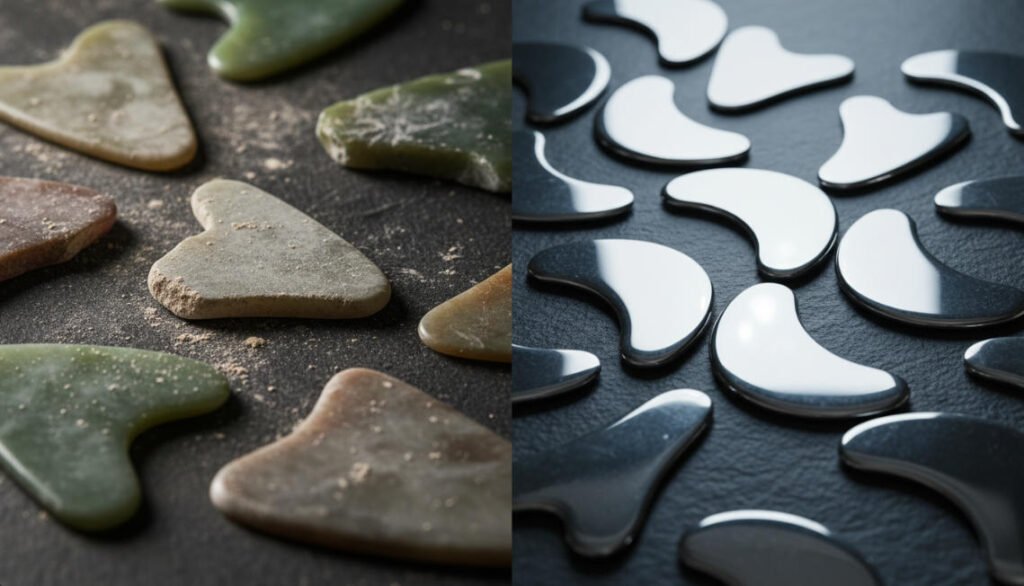
Stainless Steel Gua Sha Tools vs. Jade Gua Sha Tools: The Manufacturing Advantage Every Wholesale Buyer Must Understand in 2026
Right now, if your supply chain depends on jade gua sha tools sourced from Guangdong province, you are already exposed to a risk that has materialized. In March 2026, the Huizhou municipal government — the production epicenter of China’s gua sha manufacturing industry — launched a post-Chinese-New-Year environmental compliance enforcement campaign targeting stone and crystal processing facilities. The result was immediate: jade and crystal gua sha production capacity across the Guangdong region dropped by approximately 52% within one to two months, and average lead times extended by more than 60%. These figures come from Deyi Gems’ direct supplier network and peer-manufacturer data collected on the ground in Huizhou in March 2026. Stainless steel gua sha tools were entirely unaffected. If you are evaluating your gua sha wholesale sourcing strategy — whether as a distributor, private-label brand, or importer — the manufacturing data in this article gives you the factual foundation to make a decision you can defend. Data Methodology and Transparency Note Before presenting the manufacturing comparison in this article, it is important to be explicit about where the data comes from, how it was collected, and what its limitations are. Every data point cited below should be read with this context in mind — and you are actively encouraged to cross-reference each figure against your own supplier contacts. How the Production and Capacity Data Was Collected The production capacity, yield rate, lead time, and price volatility figures cited throughout this article are derived from two primary internal sources at Deyi Gems. The first is Deyi Gems’ own manufacturing records, covering production runs from January 2024 through December 2025, encompassing monthly output logs, quality control rejection records, material purchasing invoices, and delivery confirmation timestamps across a representative sample of wholesale orders. The second source is a structured informal survey of peer manufacturers conducted through direct contact with more than twelve independent gua sha production operations in the Huizhou and surrounding Guangdong region during Q1 2026. Survey respondents were asked to report current production capacity, recent lead time changes, and yield rate ranges for their primary product categories. Responses were aggregated anonymously, and the capacity decline figure of approximately 52% represents a weighted average across respondents who reported enforcement-related output disruption in March 2026. What This Data Cannot Tell You — and What It Can This is proprietary and peer-network data — it is not a statistically representative industry census, and it has not been independently audited or published in a peer-reviewed trade journal. The figures should be treated as directional indicators grounded in direct manufacturing experience, not as regulatory-grade statistics. What this data can tell you is whether the directional claim — that stainless steel gua sha tools outperform jade gua sha tools on supply reliability, throughput, yield, and price stability — is consistent across independent manufacturing operations. The answer, across all data points collected, is yes. You are encouraged to run the same questions past your own current suppliers and compare. The verification steps at the end of this article give you a concrete framework for doing so. The Huizhou Enforcement Crisis: Why Jade Gua Sha Supply Just Became Significantly Riskier The Regulatory Framework Behind the Enforcement Action The March 2026 enforcement campaign did not emerge without regulatory precedent. China’s Ministry of Ecology and Environment (MEE) — the national authority responsible for environmental compliance enforcement — has progressively tightened industrial pollution controls across manufacturing regions since the revision of China’s Environmental Protection Law in 2015. Stone cutting, crystal grinding, and jade processing operations generate wastewater containing fine silica particulate, stone-cutting slurry, and chemical polishing residues that require compliant treatment systems to manage within regulated discharge standards. Small-scale workshops — the predominant facility type among jade gua sha producers — frequently lack the capital investment required to build and maintain compliant wastewater and dust-control infrastructure. When Huizhou municipal authorities conducted their post-CNY 2026 inspection sweep, these operations were the most structurally exposed. The enforcement action was consistent with the MEE’s documented pattern of intensifying compliance activity in the weeks following the Chinese New Year holiday period, when manufacturing resumes and inspection teams deploy. What Actually Happened — and Why Most Jade Factories Were Unprepared The Huizhou district of Guangdong province is not merely one of several jade gua sha production regions — it is the dominant one. A disproportionate share of the world’s jade gua sha tools, crystal gua sha tools, and related stone wellness products are manufactured within a tightly concentrated cluster of operations in this region. The structural problem is this: a large portion of these operations are small-scale workshops — artisan units that expanded organically alongside demand for stone gua sha products without formalizing their environmental infrastructure. When inspections began in March 2026, facilities lacking compliant wastewater treatment systems, dust-suppression equipment, and proper stone-cutting effluent management were ordered to halt or curtail production. Only manufacturers operating within designated industrial parks — where environmental infrastructure meets regulated government standards — were permitted to continue at full output capacity. This means you cannot assume your jade gua sha supplier is among the unaffected minority without explicitly verifying their facility classification. Can your current supplier document their industrial park registration and most recent environmental compliance certificate? If not, your lead times are already longer than they were three months ago — and you may not have been told. The Numbers: 52% Capacity Decline and 60%+ Longer Lead Times Based on supplier-network and peer-manufacturer data aggregated by Deyi Gems in March 2026, jade and crystal gua sha production capacity in Guangdong fell by approximately 52% within the first one to two months of enforcement activity. Lead times — which were already longer than those of stainless steel gua sha tools under normal operating conditions — extended by more than 60% on average across affected suppliers. To translate this into practical terms: if your jade gua sha supplier previously quoted a four-week production window, you should now plan for six to seven weeks at minimum — if they can fulfill the
Right now, if your supply chain depends on jade gua sha tools sourced from Guangdong province, you are already exposed to a risk that has materialized. In March 2026, the Huizhou municipal government — the production epicenter of China’s gua sha manufacturing industry — launched a post-Chinese-New-Year environmental compliance enforcement campaign targeting stone and crystal processing facilities. The result was immediate: jade and crystal gua sha production capacity across the Guangdong region dropped by approximately 52% within one to two months, and average lead times extended by more than 60%. These figures come from Deyi Gems’ direct supplier network and peer-manufacturer data collected on the ground in Huizhou in March 2026. Stainless steel gua sha tools were entirely unaffected. If you are evaluating your gua sha wholesale sourcing strategy — whether as a distributor, private-label brand, or importer — the manufacturing data in this article gives you the factual foundation to make a decision you can defend. Data Methodology and Transparency Note Before presenting the manufacturing comparison in this article, it is important to be explicit about where the data comes from, how it was collected, and what its limitations are. Every data point cited below should be read with this context in mind — and you are actively encouraged to cross-reference each figure against your own supplier contacts. How the Production and Capacity Data Was Collected The production capacity, yield rate, lead time, and price volatility figures cited throughout this article are derived from two primary internal sources at Deyi Gems. The first is Deyi Gems’ own manufacturing records, covering production runs from January 2024 through December 2025, encompassing monthly output logs, quality control rejection records, material purchasing invoices, and delivery confirmation timestamps across a representative sample of wholesale orders. The second source is a structured informal survey of peer manufacturers conducted through direct contact with more than twelve independent gua sha production operations in the Huizhou and surrounding Guangdong region during Q1 2026. Survey respondents were asked to report current production capacity, recent lead time changes, and yield rate ranges for their primary product categories. Responses were aggregated anonymously, and the capacity decline figure of approximately 52% represents a weighted average across respondents who reported enforcement-related output disruption in March 2026. What This Data Cannot Tell You — and What It Can This is proprietary and peer-network data — it is not a statistically representative industry census, and it has not been independently audited or published in a peer-reviewed trade journal. The figures should be treated as directional indicators grounded in direct manufacturing experience, not as regulatory-grade statistics. What this data can tell you is whether the directional claim — that stainless steel gua sha tools outperform jade gua sha tools on supply reliability, throughput, yield, and price stability — is consistent across independent manufacturing operations. The answer, across all data points collected, is yes. You are encouraged to run the same questions past your own current suppliers and compare. The verification steps at the end of this article give you a concrete framework for doing so. The Huizhou Enforcement Crisis: Why Jade Gua Sha Supply Just Became Significantly Riskier The Regulatory Framework Behind the Enforcement Action The March 2026 enforcement campaign did not emerge without regulatory precedent. China’s Ministry of Ecology and Environment (MEE) — the national authority responsible for environmental compliance enforcement — has progressively tightened industrial pollution controls across manufacturing regions since the revision of China’s Environmental Protection Law in 2015. Stone cutting, crystal grinding, and jade processing operations generate wastewater containing fine silica particulate, stone-cutting slurry, and chemical polishing residues that require compliant treatment systems to manage within regulated discharge standards. Small-scale workshops — the predominant facility type among jade gua sha producers — frequently lack the capital investment required to build and maintain compliant wastewater and dust-control infrastructure. When Huizhou municipal authorities conducted their post-CNY 2026 inspection sweep, these operations were the most structurally exposed. The enforcement action was consistent with the MEE’s documented pattern of intensifying compliance activity in the weeks following the Chinese New Year holiday period, when manufacturing resumes and inspection teams deploy. What Actually Happened — and Why Most Jade Factories Were Unprepared The Huizhou district of Guangdong province is not merely one of several jade gua sha production regions — it is the dominant one. A disproportionate share of the world’s jade gua sha tools, crystal gua sha tools, and related stone wellness products are manufactured within a tightly concentrated cluster of operations in this region. The structural problem is this: a large portion of these operations are small-scale workshops — artisan units that expanded organically alongside demand for stone gua sha products without formalizing their environmental infrastructure. When inspections began in March 2026, facilities lacking compliant wastewater treatment systems, dust-suppression equipment, and proper stone-cutting effluent management were ordered to halt or curtail production. Only manufacturers operating within designated industrial parks — where environmental infrastructure meets regulated government standards — were permitted to continue at full output capacity. This means you cannot assume your jade gua sha supplier is among the unaffected minority without explicitly verifying their facility classification. Can your current supplier document their industrial park registration and most recent environmental compliance certificate? If not, your lead times are already longer than they were three months ago — and you may not have been told. The Numbers: 52% Capacity Decline and 60%+ Longer Lead Times Based on supplier-network and peer-manufacturer data aggregated by Deyi Gems in March 2026, jade and crystal gua sha production capacity in Guangdong fell by approximately 52% within the first one to two months of enforcement activity. Lead times — which were already longer than those of stainless steel gua sha tools under normal operating conditions — extended by more than 60% on average across affected suppliers. To translate this into practical terms: if your jade gua sha supplier previously quoted a four-week production window, you should now plan for six to seven weeks at minimum — if they can fulfill the