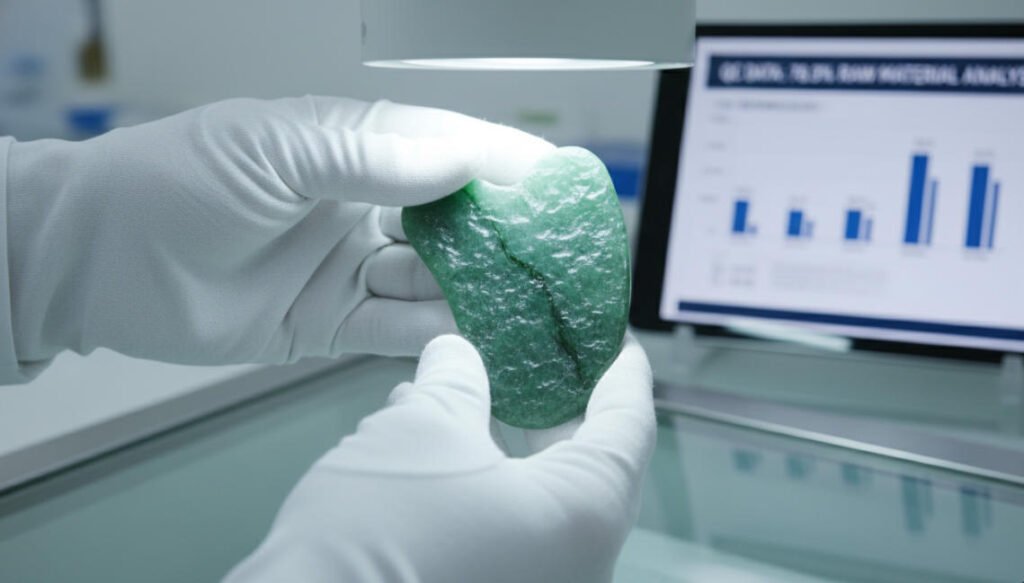
Cracking in Gua Sha Production: Root Causes, Real Data, and How Manufacturers Actually Fix It
If you have ever opened a shipment of stone tools only to find hairline fractures running across the surface, you already know the problem this article addresses. Cracking is the single most damaging quality failure in gua sha production — and according to internal manufacturing data from Deyi Gems, a gua sha manufacturer with over 12 years of jade and crystal processing experience, approximately 3,000 units in a single month of production were affected by cracking across all stages of the process. What makes this number worth studying is not its size, but its breakdown: 78.3% of those failures originated in the raw material stage — before a single blade made contact. That means the majority of cracking in gua sha wholesale supply chains is determined before production even begins. This article does not offer reassurance. It offers a structural analysis. Every cracking risk in gua sha factory operations — from the quarry to the shipping box — will be examined in the order of its statistical weight. By the end, you will have a working framework for evaluating any manufacturer’s quality control process, and a set of questions that will tell you more about a supplier’s reliability than any product catalog ever could. Why Cracking in Gua Sha Manufacturing Cannot Be Fully Eliminated, But Can Be Systematically Controlled Why “Zero Cracking” Is a Claim No Credible Gua Sha Manufacturer Should Make When a supplier tells you their production process guarantees zero cracking, that statement itself is a data point — and not a reassuring one. Stone is a natural material. Its internal structure is neither uniform nor predictable, and no manufacturing process, regardless of equipment precision or operator skill, can fully override what geology has already decided. The question is never whether cracking will occur. The question is how well a gua sha manufacturer understands where it comes from and what percentage of it is preventable at each stage. According to research on natural gemstone and mineral integrity published by the Gemological Institute of America (GIA), the internal structure of crystalline materials frequently contains pre-existing fracture planes and stress concentrations that are invisible under normal inspection conditions. These characteristics are not manufacturing defects — they are geological realities that every stone processor must account for. A manufacturer who denies their existence is not managing them. That gap in acknowledgment is where quality failures begin. What separates a capable gua sha factory from a less capable one is not the absence of cracking. It is the ability to identify which cracking is controllable, which is not, and how resources should be allocated across each risk category. This is a data management problem as much as it is a manufacturing problem. A Risk Map: Where Cracking Actually Happens in Gua Sha Production Before examining each risk factor individually, it is useful to understand their relative weight. The internal production data referenced throughout this article covers a single calendar month of gua sha production and includes approximately 3,000 units affected by cracking across all stages. The distribution breaks down as follows: raw material defects account for 2,350 units (78.3%), manufacturing process failures account for 360 units (12%), polishing-stage failures account for 120 units (4%), structural design flaws account for 105 units (3.5%), and shipping damage accounts for 65 units (2.2%). This distribution is not presented as an industry benchmark. It is presented because it reflects a pattern that is consistent with what material science tells us about crystalline and jade-type stone behavior under mechanical stress. The International Gem Society (IGS) notes that natural gemstones with directional cleavage — a category that includes many crystal varieties used in gua sha wholesale — are inherently more susceptible to stress-induced fracture than non-directional minerals. The implication for buyers is direct: if your supplier cannot tell you what percentage of their cracking originates at the raw material stage, they are not measuring the right thing. The sections that follow are arranged in descending order of risk weight. You will find that the solutions with the highest return on investment are concentrated in the first two categories. This is where your supplier evaluation should start. Raw Material Defects, the Source of 78.3% of All Cracking in Gua Sha Production Why the Biggest Quality Risk Arrives Before Production Starts Most quality control conversations in gua sha factory operations focus on what happens during manufacturing — blade speed, grinding pressure, operator technique. These are legitimate concerns, but they address a fraction of the actual risk. The data is unambiguous: in the monthly production sample analyzed for this article, 2,350 out of approximately 3,000 cracked units were attributable to defects that existed in the raw material before any processing began. You can optimize every downstream variable with precision, and still lose nearly eight out of ten cracked units to a problem that entered your supply chain at the quarry. This is not a reflection of poor manufacturing. It is a reflection of how stone behaves. Natural jade and crystal are not homogeneous materials. Their internal structure is shaped by millions of years of geological pressure, temperature variation, and mineral interaction — and that structure carries consequences that affect every stage of gua sha production. Two Categories of Structural Defect Hidden Inside Raw Stone The raw material risk in gua sha manufacturing originates from two distinct sources, and understanding the difference between them matters for how you screen and grade incoming material. The first category is naturally occurring structural defects. These include cleavage planes — pre-existing fracture surfaces along which a crystal will preferentially break when stress is applied — as well as grain boundaries in polycrystalline materials like jade, where different mineral regions meet at structurally weak interfaces. The GIA’s gemological research division documents cleavage as a fundamental physical property of many mineral species, noting that stones with perfect or good cleavage in one or more directions require significantly different handling protocols than those without. For crystal-type materials commonly used in gua sha wholesale — including quartz varieties and
If you have ever opened a shipment of stone tools only to find hairline fractures running across the surface, you already know the problem this article addresses. Cracking is the single most damaging quality failure in gua sha production — and according to internal manufacturing data from Deyi Gems, a gua sha manufacturer with over 12 years of jade and crystal processing experience, approximately 3,000 units in a single month of production were affected by cracking across all stages of the process. What makes this number worth studying is not its size, but its breakdown: 78.3% of those failures originated in the raw material stage — before a single blade made contact. That means the majority of cracking in gua sha wholesale supply chains is determined before production even begins. This article does not offer reassurance. It offers a structural analysis. Every cracking risk in gua sha factory operations — from the quarry to the shipping box — will be examined in the order of its statistical weight. By the end, you will have a working framework for evaluating any manufacturer’s quality control process, and a set of questions that will tell you more about a supplier’s reliability than any product catalog ever could. Why Cracking in Gua Sha Manufacturing Cannot Be Fully Eliminated, But Can Be Systematically Controlled Why “Zero Cracking” Is a Claim No Credible Gua Sha Manufacturer Should Make When a supplier tells you their production process guarantees zero cracking, that statement itself is a data point — and not a reassuring one. Stone is a natural material. Its internal structure is neither uniform nor predictable, and no manufacturing process, regardless of equipment precision or operator skill, can fully override what geology has already decided. The question is never whether cracking will occur. The question is how well a gua sha manufacturer understands where it comes from and what percentage of it is preventable at each stage. According to research on natural gemstone and mineral integrity published by the Gemological Institute of America (GIA), the internal structure of crystalline materials frequently contains pre-existing fracture planes and stress concentrations that are invisible under normal inspection conditions. These characteristics are not manufacturing defects — they are geological realities that every stone processor must account for. A manufacturer who denies their existence is not managing them. That gap in acknowledgment is where quality failures begin. What separates a capable gua sha factory from a less capable one is not the absence of cracking. It is the ability to identify which cracking is controllable, which is not, and how resources should be allocated across each risk category. This is a data management problem as much as it is a manufacturing problem. A Risk Map: Where Cracking Actually Happens in Gua Sha Production Before examining each risk factor individually, it is useful to understand their relative weight. The internal production data referenced throughout this article covers a single calendar month of gua sha production and includes approximately 3,000 units affected by cracking across all stages. The distribution breaks down as follows: raw material defects account for 2,350 units (78.3%), manufacturing process failures account for 360 units (12%), polishing-stage failures account for 120 units (4%), structural design flaws account for 105 units (3.5%), and shipping damage accounts for 65 units (2.2%). This distribution is not presented as an industry benchmark. It is presented because it reflects a pattern that is consistent with what material science tells us about crystalline and jade-type stone behavior under mechanical stress. The International Gem Society (IGS) notes that natural gemstones with directional cleavage — a category that includes many crystal varieties used in gua sha wholesale — are inherently more susceptible to stress-induced fracture than non-directional minerals. The implication for buyers is direct: if your supplier cannot tell you what percentage of their cracking originates at the raw material stage, they are not measuring the right thing. The sections that follow are arranged in descending order of risk weight. You will find that the solutions with the highest return on investment are concentrated in the first two categories. This is where your supplier evaluation should start. Raw Material Defects, the Source of 78.3% of All Cracking in Gua Sha Production Why the Biggest Quality Risk Arrives Before Production Starts Most quality control conversations in gua sha factory operations focus on what happens during manufacturing — blade speed, grinding pressure, operator technique. These are legitimate concerns, but they address a fraction of the actual risk. The data is unambiguous: in the monthly production sample analyzed for this article, 2,350 out of approximately 3,000 cracked units were attributable to defects that existed in the raw material before any processing began. You can optimize every downstream variable with precision, and still lose nearly eight out of ten cracked units to a problem that entered your supply chain at the quarry. This is not a reflection of poor manufacturing. It is a reflection of how stone behaves. Natural jade and crystal are not homogeneous materials. Their internal structure is shaped by millions of years of geological pressure, temperature variation, and mineral interaction — and that structure carries consequences that affect every stage of gua sha production. Two Categories of Structural Defect Hidden Inside Raw Stone The raw material risk in gua sha manufacturing originates from two distinct sources, and understanding the difference between them matters for how you screen and grade incoming material. The first category is naturally occurring structural defects. These include cleavage planes — pre-existing fracture surfaces along which a crystal will preferentially break when stress is applied — as well as grain boundaries in polycrystalline materials like jade, where different mineral regions meet at structurally weak interfaces. The GIA’s gemological research division documents cleavage as a fundamental physical property of many mineral species, noting that stones with perfect or good cleavage in one or more directions require significantly different handling protocols than those without. For crystal-type materials commonly used in gua sha wholesale — including quartz varieties and