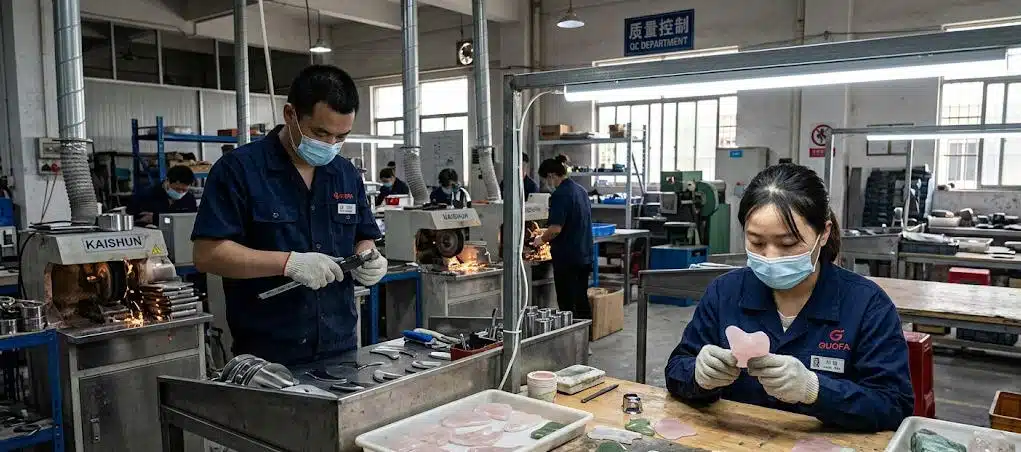
Gua Sha Manufacturer About Stainless Steel Gua Sha and Stone Gua Sha QC Different.
Ask any gua sha manufacturer a single question before you sign a wholesale order: do you run one quality system, or two? If the answer is “one,” that is your first warning sign. A jade or quartz blade sits around 7 on the Mohs hardness scale, according to the International Gem Society, while a stainless steel blade is judged by tensile strength instead — 304-grade steel must clear a minimum of 515 MPa under ASTM A240. Those are two separate sciences, tested with two separate toolkits, yet plenty of factories still run them through one checklist to save time on gua sha production. That shortcut is exactly where cracked stone, sharp steel edges, and failed nickel-release tests slip past inspection. You are not buying “a gua sha tool.” You are buying either a graded natural mineral or an engineered metal part, and the gua sha qc behind each one should look almost nothing alike. This article walks through where the two systems diverge, what each is built to catch, and which questions actually separate a documented gua sha factory from one that is guessing. Why a Careful Gua Sha Manufacturer Keeps Them Separate Stone and steel fail in opposite directions, and that single fact is the entire reason gua sha production cannot run on one checklist. Natural stone — jade, rose quartz, black obsidian, agate — carries stress from the mountain it came from long before it ever reaches a cutting wheel. A hidden fissure inside a rose quartz blank does not announce itself; it waits until the beveling stage, then splits without warning. Stainless steel carries a completely different risk profile centered on dimensional tolerance, edge burrs, and plating adhesion, not internal cracking. A gua sha qc protocol written for one material is close to useless on the other, which is exactly why asking a supplier “do you check for cracks?” without specifying the material gets you an answer that tells you nothing useful. This means you can screen out a weak supplier in under two minutes just by asking whether their quality manual has one section or two — a single combined checklist is usually the tell. The Stone Risk Line: What Nature Doesn’t Disclose Upfront Every block of rose quartz, jade, or black obsidian carries a geological history that no spec sheet can capture. Color banding, mineral inclusions, and micro-fissures form under pressure over thousands of years, and no two blocks behave identically once a blade or grinding wheel touches them. A stone gua sha wholesale shipment can look flawless under normal light and still hide a fracture line that only a strong-light lamp or a 10x loupe will reveal — the same 10x magnification standard the GIA uses for clarity grading on colored gemstones. Skip that step, and the crack tends to surface after your customer has already used the tool once or twice, not during your incoming inspection. This means your return-rate exposure on stone gua sha sits almost entirely in what happened to the material before it ever reached a lathe, not in anything your packaging team did. The Steel Risk Line: Where a Machine Still Needs a Human Check Stainless steel removes the geological guesswork, but it brings in a different kind of risk — one measured in millimeters and microns instead of mineral grade. A stainless steel gua sha wholesale order depends on whether the mill actually shipped 304 or 316 as certified, whether sheet thickness matches the drawing, and whether the edge was deburred enough to pass a bare-hand safety pass without being polished so much that it loses massage pressure. None of that is guesswork — it is measurable with a caliper, a micrometer, and a roughness gauge. You are not trusting an artisan’s eye on this side of the line; you are trusting a number on a mill certificate, and that number is only as reliable as whoever actually checked it before signing off. This means a five-minute review of a mill test certificate tells you more about steel batch consistency than an hour of visual inspection ever could. How a Responsible Gua Sha Manufacturer Verifies Every Blade A gua sha qc bench for stone starts with three instruments, and none of them are exotic or expensive. The first is a strong-light lamp or a small transillumination light box: shine it through a rose quartz or amethyst blank and internal fissures, voids, and inclusion clusters show up as shadows that no amount of surface polish will ever hide. The second is a 10x loupe, the same magnification level GIA uses for gemstone clarity grading, which catches hairline cracks and near-surface flaws that a strong light alone can miss on darker or more opaque stones like black obsidian. The third is a simple pairing of an electronic scale and a water-displacement density tester, which does two jobs at once — it flags resin-composite fakes passed off as natural mineral, and it keeps weight variation inside a controlled range across a production batch. This means you can ask any stone gua sha wholesale supplier for a batch density spread report before shipment, and a wide spread on that single number is often the first sign that a “jade” lot is not what the label claims. Why Hardness Data From GIA and IGS Belongs on Your Spec Sheet Hardness is not a marketing detail — it is a production variable. According to hardness charts published by the International Gem Society, quartz varieties sit around 7 on the Mohs scale, nephrite jade runs closer to 6 to 6.5, and black obsidian falls near 5 to 5.5. That spread changes which polishing wheel grit a gua sha factory should be using, how quickly a tool blunts during grinding, and — just as importantly — how well the finished blade resists scratching once it is sitting in a customer’s bathroom drawer for a year. Softer stone polishes to a high shine faster and at lower cost, but it also scratches sooner, which shows up
Gua Sha Manufacturer About Stainless Steel Gua Sha and Stone Gua Sha QC Different. Read More »
Ask any gua sha manufacturer a single question before you sign a wholesale order: do you run one quality system, or two? If the answer is “one,” that is your first warning sign. A jade or quartz blade sits around 7 on the Mohs hardness scale, according to the International Gem Society, while a stainless steel blade is judged by tensile strength instead — 304-grade steel must clear a minimum of 515 MPa under ASTM A240. Those are two separate sciences, tested with two separate toolkits, yet plenty of factories still run them through one checklist to save time on gua sha production. That shortcut is exactly where cracked stone, sharp steel edges, and failed nickel-release tests slip past inspection. You are not buying “a gua sha tool.” You are buying either a graded natural mineral or an engineered metal part, and the gua sha qc behind each one should look almost nothing alike. This article walks through where the two systems diverge, what each is built to catch, and which questions actually separate a documented gua sha factory from one that is guessing. Why a Careful Gua Sha Manufacturer Keeps Them Separate Stone and steel fail in opposite directions, and that single fact is the entire reason gua sha production cannot run on one checklist. Natural stone — jade, rose quartz, black obsidian, agate — carries stress from the mountain it came from long before it ever reaches a cutting wheel. A hidden fissure inside a rose quartz blank does not announce itself; it waits until the beveling stage, then splits without warning. Stainless steel carries a completely different risk profile centered on dimensional tolerance, edge burrs, and plating adhesion, not internal cracking. A gua sha qc protocol written for one material is close to useless on the other, which is exactly why asking a supplier “do you check for cracks?” without specifying the material gets you an answer that tells you nothing useful. This means you can screen out a weak supplier in under two minutes just by asking whether their quality manual has one section or two — a single combined checklist is usually the tell. The Stone Risk Line: What Nature Doesn’t Disclose Upfront Every block of rose quartz, jade, or black obsidian carries a geological history that no spec sheet can capture. Color banding, mineral inclusions, and micro-fissures form under pressure over thousands of years, and no two blocks behave identically once a blade or grinding wheel touches them. A stone gua sha wholesale shipment can look flawless under normal light and still hide a fracture line that only a strong-light lamp or a 10x loupe will reveal — the same 10x magnification standard the GIA uses for clarity grading on colored gemstones. Skip that step, and the crack tends to surface after your customer has already used the tool once or twice, not during your incoming inspection. This means your return-rate exposure on stone gua sha sits almost entirely in what happened to the material before it ever reached a lathe, not in anything your packaging team did. The Steel Risk Line: Where a Machine Still Needs a Human Check Stainless steel removes the geological guesswork, but it brings in a different kind of risk — one measured in millimeters and microns instead of mineral grade. A stainless steel gua sha wholesale order depends on whether the mill actually shipped 304 or 316 as certified, whether sheet thickness matches the drawing, and whether the edge was deburred enough to pass a bare-hand safety pass without being polished so much that it loses massage pressure. None of that is guesswork — it is measurable with a caliper, a micrometer, and a roughness gauge. You are not trusting an artisan’s eye on this side of the line; you are trusting a number on a mill certificate, and that number is only as reliable as whoever actually checked it before signing off. This means a five-minute review of a mill test certificate tells you more about steel batch consistency than an hour of visual inspection ever could. How a Responsible Gua Sha Manufacturer Verifies Every Blade A gua sha qc bench for stone starts with three instruments, and none of them are exotic or expensive. The first is a strong-light lamp or a small transillumination light box: shine it through a rose quartz or amethyst blank and internal fissures, voids, and inclusion clusters show up as shadows that no amount of surface polish will ever hide. The second is a 10x loupe, the same magnification level GIA uses for gemstone clarity grading, which catches hairline cracks and near-surface flaws that a strong light alone can miss on darker or more opaque stones like black obsidian. The third is a simple pairing of an electronic scale and a water-displacement density tester, which does two jobs at once — it flags resin-composite fakes passed off as natural mineral, and it keeps weight variation inside a controlled range across a production batch. This means you can ask any stone gua sha wholesale supplier for a batch density spread report before shipment, and a wide spread on that single number is often the first sign that a “jade” lot is not what the label claims. Why Hardness Data From GIA and IGS Belongs on Your Spec Sheet Hardness is not a marketing detail — it is a production variable. According to hardness charts published by the International Gem Society, quartz varieties sit around 7 on the Mohs scale, nephrite jade runs closer to 6 to 6.5, and black obsidian falls near 5 to 5.5. That spread changes which polishing wheel grit a gua sha factory should be using, how quickly a tool blunts during grinding, and — just as importantly — how well the finished blade resists scratching once it is sitting in a customer’s bathroom drawer for a year. Softer stone polishes to a high shine faster and at lower cost, but it also scratches sooner, which shows up