White Jade vs. White Quartz Gua Sha: A Manufacturer’s Risk Disclosure for Wholesale Buyers
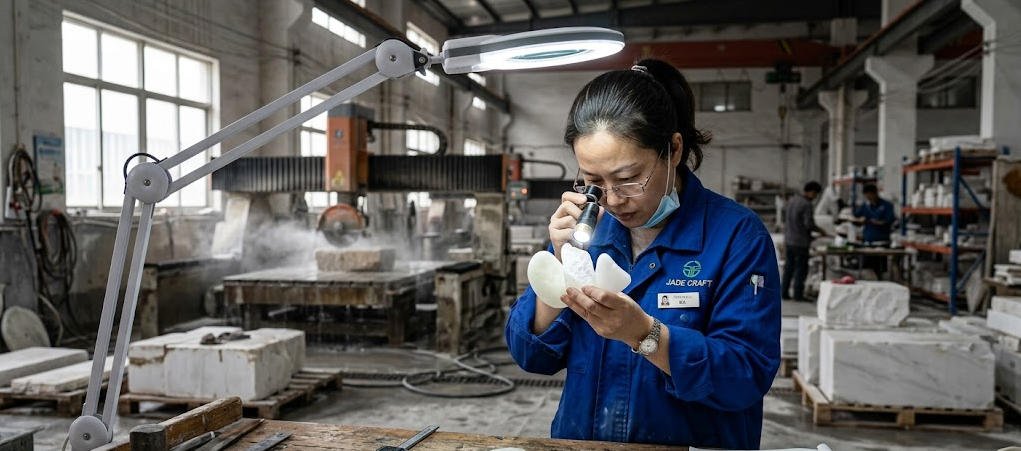
If you buy gua sha wholesale in bulk, here is the disclosure you need before your next purchase order goes out: almost none of the “white jade” boards moving through catalogs today are actual nephrite. After more than 12 years cutting, grading, and polishing white stone for gua sha production, we’ve watched this pattern repeat order after order. A lower-cost substitute stone ships under the jade name, and under bright light, at a thinned edge, some batches of that substitute look close enough to white quartz gua sha wholesale stock that even experienced buyers second-guess themselves. This isn’t automatically a fraud story. It’s a structural one — and once you understand the physics behind it, you stop guessing from a listing photo and start buying on evidence. That distinction matters more than most sourcing guides admit. You can lose margin two different ways here: paying a jade price for a stone that never was jade, or rejecting a genuinely dense, well-processed batch because it happens to glow like quartz under your inspection lamp. Neither mistake is really about honesty. Both come down to whether you know what you’re looking at on a structural level, which is the gap this disclosure is built to close. Why White Jade Gua Sha Can Look Like White Quartz Two Different Ways Light Moves Through Stone Here’s the part most wholesale conversations skip entirely. White quartz gua sha wholesale material is a single continuous crystal. Silicon and oxygen atoms lock into one repeating lattice, so when light enters the stone it keeps traveling in a fairly consistent direction before it exits. GIA’s own gemological documentation on quartz describes this as an open, ordered atomic framework, and that ordering is exactly why rock crystal quartz tends to show ice-like cracking, cloud-like zoning, and directional light bands rather than an even, all-over glow. White stone used as a jade substitute works on a completely different principle. It’s a granular aggregate — thousands of tiny mineral grains packed together rather than one continuous lattice. GIA’s material on jadeite structure notes that this kind of interlocking, fine-grained texture is what scatters light and produces jade’s smooth, waxy look rather than a crystal’s directional shine, and you can read their breakdown of that texture-to-luster relationship directly on GIA’s jade quality page. Each grain in that structure reflects and scatters light independently. There’s no single path for light to follow, so instead of a directional shine you get a soft, even, pearl-like glow. So what does that mean at the workbench, not just in a textbook? It means the “transparency test” your quality control team has probably been using is the wrong test entirely. Translucency alone tells you almost nothing about whether a board is quartz or jade-substitute white stone — both can be genuinely see-through. The question that actually separates them is whether the light inside the stone travels with direction and continuity, or whether it scatters into a flat, pearly haze. This single reframe is the difference between a QC checklist that catches mislabeled batches and one that just measures how much light gets through, which every polished stone will pass regardless of what it actually is. Why Some Gua Sha Wholesale Batches Develop a Crystal-Like Glow If the difference between quartz and jade-substitute white stone really is structural, the next question is practical: why does that difference get blurry on the factory floor and in a trade-show showroom? The answer sits in two places — the raw block before it’s ever touched by a wheel, and the polish grade applied afterward. Both stages decide whether a gua sha wholesale batch ends up looking chalky and flat, or develops the icy, semi-transparent glow that gets mistaken for quartz. Raw Material Grading Decides Almost Everything Before Polishing Starts Not all white stone entering a workshop is equal, and this is where most buyers lose visibility once material changes hands through a middleman. The blocks that end up looking closest to quartz share four traits: fine mineral grain, high density, low impurity content, and an even white base with no gray or yellow undertone. A GIA study on nephrite from Italy’s Val Malenco district measured individual tremolite fibers packed at roughly 10 to 20 micrometers, bundled in dense, randomly oriented clusters — a useful reference point for just how fine “fine-grained” actually means at the mineral level, and you can review that data directly in GIA’s Gems & Gemology archive. Coarser, more porous blocks never reach that glow no matter how they’re finished afterward. This is exactly the grading step that separates ordinary construction-grade white stone from gua sha material worth cutting into a finished tool. So what does that mean for your purchase order? It means the visual difference you’re judging on a sample photo was largely decided weeks earlier, at the quarry sorting table, long before anyone picked up a polishing wheel — which is also why two batches labeled identically by a trading company can perform completely differently once they reach your customers. The Polish Grade That Creates the Illusion Grading gets you halfway there; the finishing step does the rest. Once a dense, fine-grained block is polished at a high grit count, light entering the stone scatters internally between grains, bounces back as a soft pearl-like reflection, and transmits through as a diffuse, milky glow rather than a sharp shine. The International Gem Society’s material on quartz varieties notes how differently structured quartz types — from milky to aventurescent — each interact with light in distinct, recognizable ways, which is a useful comparison point when you’re trying to separate a true white quartz gua sha wholesale batch from a stone dressed to resemble one; their full breakdown is available on IGS’s quartz reference page. This is precisely why the same raw stone can look completely different depending on where you inspect it. Thin edges, curved surfaces, and bright showroom lighting all amplify that scattered-glow effect, which is why a board that looked convincingly “crystal” on the
If you buy gua sha wholesale in bulk, here is the disclosure you need before your next purchase order goes out: almost none of the “white jade” boards moving through catalogs today are actual nephrite. After more than 12 years cutting, grading, and polishing white stone for gua sha production, we’ve watched this pattern repeat order after order. A lower-cost substitute stone ships under the jade name, and under bright light, at a thinned edge, some batches of that substitute look close enough to white quartz gua sha wholesale stock that even experienced buyers second-guess themselves. This isn’t automatically a fraud story. It’s a structural one — and once you understand the physics behind it, you stop guessing from a listing photo and start buying on evidence. That distinction matters more than most sourcing guides admit. You can lose margin two different ways here: paying a jade price for a stone that never was jade, or rejecting a genuinely dense, well-processed batch because it happens to glow like quartz under your inspection lamp. Neither mistake is really about honesty. Both come down to whether you know what you’re looking at on a structural level, which is the gap this disclosure is built to close. Why White Jade Gua Sha Can Look Like White Quartz Two Different Ways Light Moves Through Stone Here’s the part most wholesale conversations skip entirely. White quartz gua sha wholesale material is a single continuous crystal. Silicon and oxygen atoms lock into one repeating lattice, so when light enters the stone it keeps traveling in a fairly consistent direction before it exits. GIA’s own gemological documentation on quartz describes this as an open, ordered atomic framework, and that ordering is exactly why rock crystal quartz tends to show ice-like cracking, cloud-like zoning, and directional light bands rather than an even, all-over glow. White stone used as a jade substitute works on a completely different principle. It’s a granular aggregate — thousands of tiny mineral grains packed together rather than one continuous lattice. GIA’s material on jadeite structure notes that this kind of interlocking, fine-grained texture is what scatters light and produces jade’s smooth, waxy look rather than a crystal’s directional shine, and you can read their breakdown of that texture-to-luster relationship directly on GIA’s jade quality page. Each grain in that structure reflects and scatters light independently. There’s no single path for light to follow, so instead of a directional shine you get a soft, even, pearl-like glow. So what does that mean at the workbench, not just in a textbook? It means the “transparency test” your quality control team has probably been using is the wrong test entirely. Translucency alone tells you almost nothing about whether a board is quartz or jade-substitute white stone — both can be genuinely see-through. The question that actually separates them is whether the light inside the stone travels with direction and continuity, or whether it scatters into a flat, pearly haze. This single reframe is the difference between a QC checklist that catches mislabeled batches and one that just measures how much light gets through, which every polished stone will pass regardless of what it actually is. Why Some Gua Sha Wholesale Batches Develop a Crystal-Like Glow If the difference between quartz and jade-substitute white stone really is structural, the next question is practical: why does that difference get blurry on the factory floor and in a trade-show showroom? The answer sits in two places — the raw block before it’s ever touched by a wheel, and the polish grade applied afterward. Both stages decide whether a gua sha wholesale batch ends up looking chalky and flat, or develops the icy, semi-transparent glow that gets mistaken for quartz. Raw Material Grading Decides Almost Everything Before Polishing Starts Not all white stone entering a workshop is equal, and this is where most buyers lose visibility once material changes hands through a middleman. The blocks that end up looking closest to quartz share four traits: fine mineral grain, high density, low impurity content, and an even white base with no gray or yellow undertone. A GIA study on nephrite from Italy’s Val Malenco district measured individual tremolite fibers packed at roughly 10 to 20 micrometers, bundled in dense, randomly oriented clusters — a useful reference point for just how fine “fine-grained” actually means at the mineral level, and you can review that data directly in GIA’s Gems & Gemology archive. Coarser, more porous blocks never reach that glow no matter how they’re finished afterward. This is exactly the grading step that separates ordinary construction-grade white stone from gua sha material worth cutting into a finished tool. So what does that mean for your purchase order? It means the visual difference you’re judging on a sample photo was largely decided weeks earlier, at the quarry sorting table, long before anyone picked up a polishing wheel — which is also why two batches labeled identically by a trading company can perform completely differently once they reach your customers. The Polish Grade That Creates the Illusion Grading gets you halfway there; the finishing step does the rest. Once a dense, fine-grained block is polished at a high grit count, light entering the stone scatters internally between grains, bounces back as a soft pearl-like reflection, and transmits through as a diffuse, milky glow rather than a sharp shine. The International Gem Society’s material on quartz varieties notes how differently structured quartz types — from milky to aventurescent — each interact with light in distinct, recognizable ways, which is a useful comparison point when you’re trying to separate a true white quartz gua sha wholesale batch from a stone dressed to resemble one; their full breakdown is available on IGS’s quartz reference page. This is precisely why the same raw stone can look completely different depending on where you inspect it. Thin edges, curved surfaces, and bright showroom lighting all amplify that scattered-glow effect, which is why a board that looked convincingly “crystal” on the