Gua Sha Wholesale Batch Variation: How Does Deyi Gems Enhance Batch Consistency?
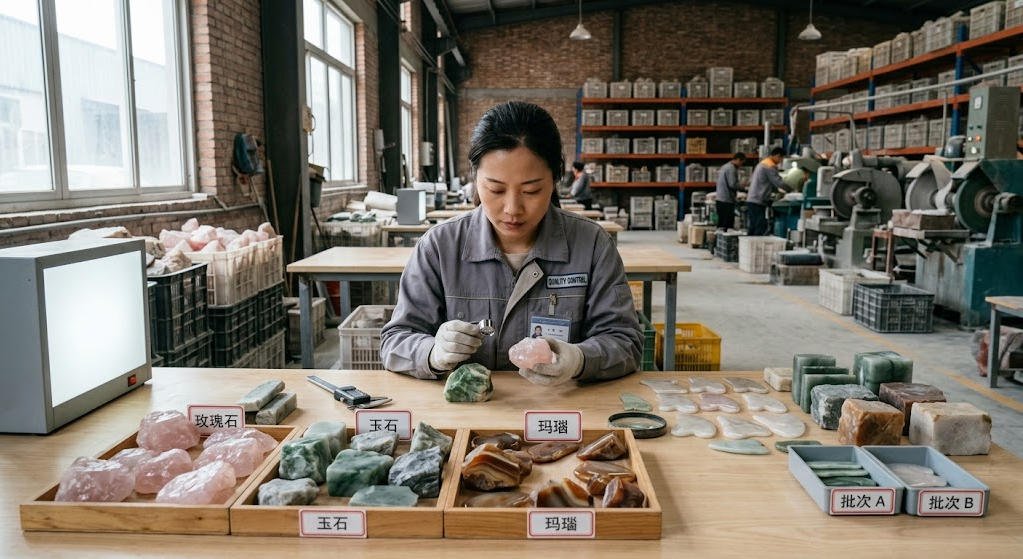
If you have ever placed a gua sha wholesale order and received a shipment that looked slightly different from the sample on your desk, you are not dealing with a defect. You are dealing with a physical reality of natural stone: even from the same mine, the same supplier, and even after more than 12 years of running natural crystal and jade production lines, no two batches of rose quartz, jade, or agate come out chemically identical. Independent gemological references such as the GIA rose quartz overview note that color and clarity in natural quartz shift from stone to stone because inclusions, mineral traces, and crystal growth are never uniform — a fact that applies directly to the raw material behind every gua sha manufacturer‘s production line. This is the first thing worth knowing before your next order goes out: the real question in gua sha wholesale sourcing was never “will there be variation,” it’s “can your supplier keep that variation inside a range you can plan around.” That distinction is what separates a controlled gua sha wholesale risks profile from an unpredictable one, and it’s what this article breaks down, section by section, from the mine to your shelf. 3 Things to Confirm Before You Place a Gua Sha Wholesale Order Before you compare price sheets or minimum order quantities, you need three answers. Get them first, because they change how every other conversation with a gua sha manufacturer goes. Same Material Name Does Not Mean Same Batch “White crystal” is not a specification. It’s a starting point. One batch might come out with high clarity and a visible crystalline structure, while another batch of the same white quartz reads as cloudier and more opaque — both are genuine material, and both are correctly labeled. You need the batch description to go further than the stone’s common name, because the name alone tells you almost nothing about what will arrive at your dock. This means you can stop treating “same material” as a guarantee and start treating it as the beginning of a specification, not the end of one. Material Grade Decides More Than the Name on the Invoice A supplier filling a boutique brand’s order and a supplier filling a bulk gua sha wholesale order may pull from the same quarry but not the same pile of rough. Higher-grade rough gets reserved for orders that specify tighter color and clarity tolerances; commercial-grade rough, with its natural texture and minor variation, goes to standard bulk runs. Neither grade is “wrong” — they are simply built for different buyer expectations. So what does this mean for your purchase order? It means the grade you request, in writing, has more influence on consistency than the number of pieces you order or the price per unit you negotiate. What a Reliable Guasha Tools Manufacturer Should Tell You Upfront A factory that understands its own material will tell you, before you sign anything, which of the variations above apply to your specific order — color range, translucency range, and expected natural texture. If a guasha tools manufacturer cannot describe these ranges without vague language like “mostly consistent” or “very similar,” that’s a signal worth noting, not ignoring. You deserve a written description you can hold the shipment against, not a verbal reassurance you can’t reference later. It also helps to ask whether gua sha production happens on the same site as material sorting, because a guasha tools manufacturer that grades and cuts under one roof can answer your questions about a specific batch in hours, while a factory that outsources cutting to a third party often has to relay your question and wait for a reply before it can tell you anything useful. Why Gua Sha Wholesale Batches Vary Even From the Same Source Here’s the part most buyers skip past, and it’s the part that actually explains the invoice you received last quarter. Natural stone forms underground, over long timescales, under conditions that are never perfectly repeated — not even within the same deposit. Rough Stone Cannot Be Copied, Only Selected Every piece of rough quartz, jade, or agate carries the fingerprint of the geological conditions where it formed: mineral ratio, crystallization pattern, inclusion density, and internal texture all vary by location within a single deposit, sometimes by a few meters. A gua sha manufacturer cannot manufacture uniformity into rough stone the way a plastics factory can mold identical polymer pellets. What a factory can do is select rough that fits a target range — which is a very different, and more honest, promise than “identical every time.” This means you can expect natural variation within a defined band, not a flat, factory-molded sameness that natural stone was never built to deliver. The Rough-Buying Stage Already Decides the Outcome Here’s a detail most buyers never see: gua sha production doesn’t start with a finished-goods order sheet, it starts with a rough-material purchase, often weeks or months earlier. Rough bought in March and rough bought in September from the same mine can carry different color depth, different transparency, and a different number of natural fissures, because rough purchasing follows what the quarry produces that month, not a catalog. By the time your purchase order is written, the color range of your batch has already been set at the rough stage — production only reveals it. So what’s the practical takeaway? Ask your supplier when the rough for your order was purchased and whether it came from a single lot, because that single fact predicts more about your shipment’s consistency than any spec sheet. Natural Stone Has No Pantone Chart, and Cutting Adds a Second Layer Industrial products lean on Pantone or RGB codes for color matching, but natural stone doesn’t have that option — a “white” batch might land anywhere from icy white to milky white to a faint grey-white, and all of it is accurately called white quartz. On top of that, processing choices compound the picture: polishing duration affects surface
Gua Sha Wholesale Batch Variation: How Does Deyi Gems Enhance Batch Consistency? Read More »
If you have ever placed a gua sha wholesale order and received a shipment that looked slightly different from the sample on your desk, you are not dealing with a defect. You are dealing with a physical reality of natural stone: even from the same mine, the same supplier, and even after more than 12 years of running natural crystal and jade production lines, no two batches of rose quartz, jade, or agate come out chemically identical. Independent gemological references such as the GIA rose quartz overview note that color and clarity in natural quartz shift from stone to stone because inclusions, mineral traces, and crystal growth are never uniform — a fact that applies directly to the raw material behind every gua sha manufacturer‘s production line. This is the first thing worth knowing before your next order goes out: the real question in gua sha wholesale sourcing was never “will there be variation,” it’s “can your supplier keep that variation inside a range you can plan around.” That distinction is what separates a controlled gua sha wholesale risks profile from an unpredictable one, and it’s what this article breaks down, section by section, from the mine to your shelf. 3 Things to Confirm Before You Place a Gua Sha Wholesale Order Before you compare price sheets or minimum order quantities, you need three answers. Get them first, because they change how every other conversation with a gua sha manufacturer goes. Same Material Name Does Not Mean Same Batch “White crystal” is not a specification. It’s a starting point. One batch might come out with high clarity and a visible crystalline structure, while another batch of the same white quartz reads as cloudier and more opaque — both are genuine material, and both are correctly labeled. You need the batch description to go further than the stone’s common name, because the name alone tells you almost nothing about what will arrive at your dock. This means you can stop treating “same material” as a guarantee and start treating it as the beginning of a specification, not the end of one. Material Grade Decides More Than the Name on the Invoice A supplier filling a boutique brand’s order and a supplier filling a bulk gua sha wholesale order may pull from the same quarry but not the same pile of rough. Higher-grade rough gets reserved for orders that specify tighter color and clarity tolerances; commercial-grade rough, with its natural texture and minor variation, goes to standard bulk runs. Neither grade is “wrong” — they are simply built for different buyer expectations. So what does this mean for your purchase order? It means the grade you request, in writing, has more influence on consistency than the number of pieces you order or the price per unit you negotiate. What a Reliable Guasha Tools Manufacturer Should Tell You Upfront A factory that understands its own material will tell you, before you sign anything, which of the variations above apply to your specific order — color range, translucency range, and expected natural texture. If a guasha tools manufacturer cannot describe these ranges without vague language like “mostly consistent” or “very similar,” that’s a signal worth noting, not ignoring. You deserve a written description you can hold the shipment against, not a verbal reassurance you can’t reference later. It also helps to ask whether gua sha production happens on the same site as material sorting, because a guasha tools manufacturer that grades and cuts under one roof can answer your questions about a specific batch in hours, while a factory that outsources cutting to a third party often has to relay your question and wait for a reply before it can tell you anything useful. Why Gua Sha Wholesale Batches Vary Even From the Same Source Here’s the part most buyers skip past, and it’s the part that actually explains the invoice you received last quarter. Natural stone forms underground, over long timescales, under conditions that are never perfectly repeated — not even within the same deposit. Rough Stone Cannot Be Copied, Only Selected Every piece of rough quartz, jade, or agate carries the fingerprint of the geological conditions where it formed: mineral ratio, crystallization pattern, inclusion density, and internal texture all vary by location within a single deposit, sometimes by a few meters. A gua sha manufacturer cannot manufacture uniformity into rough stone the way a plastics factory can mold identical polymer pellets. What a factory can do is select rough that fits a target range — which is a very different, and more honest, promise than “identical every time.” This means you can expect natural variation within a defined band, not a flat, factory-molded sameness that natural stone was never built to deliver. The Rough-Buying Stage Already Decides the Outcome Here’s a detail most buyers never see: gua sha production doesn’t start with a finished-goods order sheet, it starts with a rough-material purchase, often weeks or months earlier. Rough bought in March and rough bought in September from the same mine can carry different color depth, different transparency, and a different number of natural fissures, because rough purchasing follows what the quarry produces that month, not a catalog. By the time your purchase order is written, the color range of your batch has already been set at the rough stage — production only reveals it. So what’s the practical takeaway? Ask your supplier when the rough for your order was purchased and whether it came from a single lot, because that single fact predicts more about your shipment’s consistency than any spec sheet. Natural Stone Has No Pantone Chart, and Cutting Adds a Second Layer Industrial products lean on Pantone or RGB codes for color matching, but natural stone doesn’t have that option — a “white” batch might land anywhere from icy white to milky white to a faint grey-white, and all of it is accurately called white quartz. On top of that, processing choices compound the picture: polishing duration affects surface