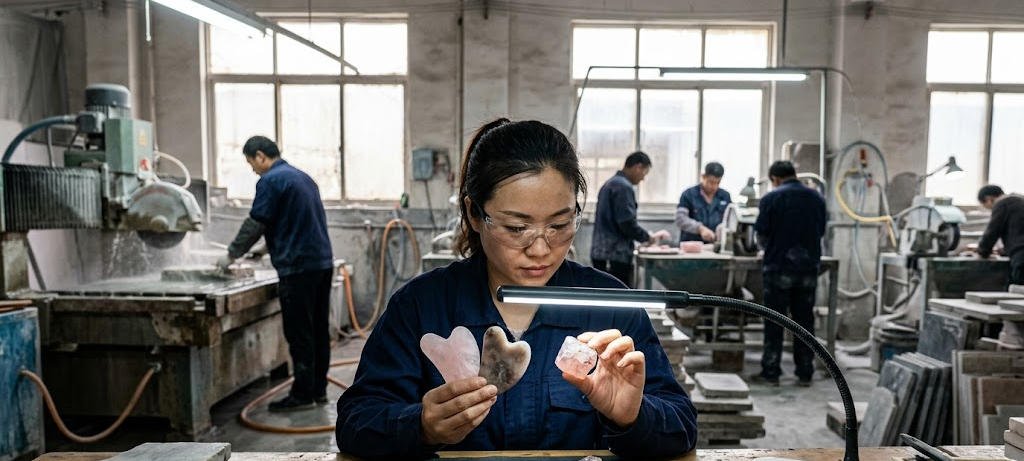
For Gua Sha Tool Manufacturer, Which Part is The Most Difficult?
If you’ve ever opened two boxes of Rose Quartz Gua Sha tools from the same order and noticed one piece looks pale and glassy while the other looks cloudy and almost white, you’ve already run into the single hardest problem in natural stone production. Ask any experienced gua sha tool manufacturer and you’ll get a consistent answer: color consistency, not crack detection, not polishing, sits at the top of the difficulty ranking, rated the highest-risk variable across the six production stages that factory quality control tracks on every run. That ranking isn’t a guess. It comes from comparing how often each variable causes rejected batches, delayed shipments, or customer complaints across real production data. Mineral composition decides the final color before a single tool gets cut, and no amount of machine precision can override what the raw stone already carries inside it. Understanding this order changes how you evaluate a gua sha supplier, because it tells you which questions to ask before you place a deposit, not after a shipment arrives looking different from the sample you approved. Color Consistency in Natural Stone Manufacturing: The First Wall Every Gua Sha Tool Manufacturer Hits Rose quartz gets its pink tone from trace amounts of titanium, iron, or manganese sitting inside the crystal structure, plus microscopic fiber-like inclusions that GIA’s own gemological research links directly to the stone’s hazy, uneven appearance (GIA, Rose Quartz Quality Factors). None of that is something a factory adds or corrects afterward. It’s built into the mineral before it ever reaches a cutting table, which is exactly why two bags of rough labeled identically by the same mine can still produce visibly different finished pieces once they’re shaped into gua sha boards. A single batch of rose quartz rough sourced from one supplier can still yield pieces ranging from a nearly clear, high-transparency pink through pale rose, milky pink-white, and even a faint lavender cast, depending on which layer of the deposit each piece came from. Stone pulled from the same mine but extracted months apart can carry a noticeably different tone, too. Picture two production runs both correctly labeled “Rose Quartz Gua Sha”: one batch comes out pale pink with high clarity, the next comes out cloudier with visible white streaking running through it. Both are genuine rose quartz. Neither is defective. That’s the part buyers most often misread as a quality failure when it’s actually a mineralogical fact about how the stone formed underground. This means you can stop treating every shade variation as a manufacturing defect and start asking a more useful question: how does your gua sha supplier grade raw material before it enters production? A facility that skips grading will mix five different shades into a single order without telling you. A facility that grades material by tone, clarity, and transparency before cutting can tell you in advance which grade tier your order falls into, and hold that grade consistent from piece one through piece one thousand. How a Gua Sha Tool Manufacturer Grades Raw Material Instead of Chasing Uniformity No properly run gua sha tool manufacturer promises 100% color uniformity on natural stone, and it’s worth treating any claim of perfect uniformity with some suspicion. What a disciplined facility does instead is sort incoming rough into tiers before cutting starts, typically separating stone with even tone, high transparency, and minimal visible inclusions from material with lighter or slightly uneven coloring, and again from rough carrying obvious banding or heavier internal texture. Orders then get filled from a single tier rather than blending tiers together at random. IGS’s clarity classification framework follows similar logic industry-wide, grouping colored gemstones into clarity types before individual grading even starts, precisely because expecting uniform clarity across a natural material ignores how that material actually forms (International Gem Society, GIA Gem Clarity Grading Codes). This means you can specify a grade tier when you place a gua sha wholesale order instead of hoping for consistency you can’t verify until the box lands on your desk. Ask for tier-matched production instead of a vague promise, and color control shifts from a guessing game into a documented specification both sides can point back to. At Deyi Gems, incoming rose quartz, agate, and jade rough gets sorted into grade tiers before a single piece touches a cutting wheel, and a customer’s purchase order gets tied to one tier for the full run, not a rotating mix. That single change is often the difference between a reorder that matches the first shipment and one that quietly doesn’t. Crack Control: The Highest-Risk Step for Any Gua Sha Tool Manufacturer How much of a factory’s rejected inventory is actually a hidden crack problem wearing a different label? Cracks cause more scrapped inventory than any other single defect category in natural stone gua sha production, and the frustrating part is that most of them aren’t visible until it’s too late to do anything but discard the piece. A rough stone can look completely clean on the outside, pass a casual visual check, and still reveal a hairline internal fracture the moment it gets sliced open. Sometimes the crack doesn’t even show up during cutting. It shows up weeks later, after polishing is finished, during transport, when vibration from shipping finally causes a hidden weak point to fail. That failure pattern is exactly why crack control ranks as the single highest-risk step from a factory floor perspective, even above color matching, once a gua sha tool manufacturer starts measuring risk by potential batch loss instead of by complaint volume alone. A cracked piece isn’t a cosmetic issue you can grade around and still sell. It’s dead stock, full cost, zero revenue. This means you can expect crack-related rejection rates to be one of the most closely tracked internal metrics inside any serious production facility, even if that number rarely gets shared outside the factory walls. Raw Material Cracks vs. Processing Cracks Cracks generally come from two different places, and knowing the difference matters if
For Gua Sha Tool Manufacturer, Which Part is The Most Difficult? Read More »
If you’ve ever opened two boxes of Rose Quartz Gua Sha tools from the same order and noticed one piece looks pale and glassy while the other looks cloudy and almost white, you’ve already run into the single hardest problem in natural stone production. Ask any experienced gua sha tool manufacturer and you’ll get a consistent answer: color consistency, not crack detection, not polishing, sits at the top of the difficulty ranking, rated the highest-risk variable across the six production stages that factory quality control tracks on every run. That ranking isn’t a guess. It comes from comparing how often each variable causes rejected batches, delayed shipments, or customer complaints across real production data. Mineral composition decides the final color before a single tool gets cut, and no amount of machine precision can override what the raw stone already carries inside it. Understanding this order changes how you evaluate a gua sha supplier, because it tells you which questions to ask before you place a deposit, not after a shipment arrives looking different from the sample you approved. Color Consistency in Natural Stone Manufacturing: The First Wall Every Gua Sha Tool Manufacturer Hits Rose quartz gets its pink tone from trace amounts of titanium, iron, or manganese sitting inside the crystal structure, plus microscopic fiber-like inclusions that GIA’s own gemological research links directly to the stone’s hazy, uneven appearance (GIA, Rose Quartz Quality Factors). None of that is something a factory adds or corrects afterward. It’s built into the mineral before it ever reaches a cutting table, which is exactly why two bags of rough labeled identically by the same mine can still produce visibly different finished pieces once they’re shaped into gua sha boards. A single batch of rose quartz rough sourced from one supplier can still yield pieces ranging from a nearly clear, high-transparency pink through pale rose, milky pink-white, and even a faint lavender cast, depending on which layer of the deposit each piece came from. Stone pulled from the same mine but extracted months apart can carry a noticeably different tone, too. Picture two production runs both correctly labeled “Rose Quartz Gua Sha”: one batch comes out pale pink with high clarity, the next comes out cloudier with visible white streaking running through it. Both are genuine rose quartz. Neither is defective. That’s the part buyers most often misread as a quality failure when it’s actually a mineralogical fact about how the stone formed underground. This means you can stop treating every shade variation as a manufacturing defect and start asking a more useful question: how does your gua sha supplier grade raw material before it enters production? A facility that skips grading will mix five different shades into a single order without telling you. A facility that grades material by tone, clarity, and transparency before cutting can tell you in advance which grade tier your order falls into, and hold that grade consistent from piece one through piece one thousand. How a Gua Sha Tool Manufacturer Grades Raw Material Instead of Chasing Uniformity No properly run gua sha tool manufacturer promises 100% color uniformity on natural stone, and it’s worth treating any claim of perfect uniformity with some suspicion. What a disciplined facility does instead is sort incoming rough into tiers before cutting starts, typically separating stone with even tone, high transparency, and minimal visible inclusions from material with lighter or slightly uneven coloring, and again from rough carrying obvious banding or heavier internal texture. Orders then get filled from a single tier rather than blending tiers together at random. IGS’s clarity classification framework follows similar logic industry-wide, grouping colored gemstones into clarity types before individual grading even starts, precisely because expecting uniform clarity across a natural material ignores how that material actually forms (International Gem Society, GIA Gem Clarity Grading Codes). This means you can specify a grade tier when you place a gua sha wholesale order instead of hoping for consistency you can’t verify until the box lands on your desk. Ask for tier-matched production instead of a vague promise, and color control shifts from a guessing game into a documented specification both sides can point back to. At Deyi Gems, incoming rose quartz, agate, and jade rough gets sorted into grade tiers before a single piece touches a cutting wheel, and a customer’s purchase order gets tied to one tier for the full run, not a rotating mix. That single change is often the difference between a reorder that matches the first shipment and one that quietly doesn’t. Crack Control: The Highest-Risk Step for Any Gua Sha Tool Manufacturer How much of a factory’s rejected inventory is actually a hidden crack problem wearing a different label? Cracks cause more scrapped inventory than any other single defect category in natural stone gua sha production, and the frustrating part is that most of them aren’t visible until it’s too late to do anything but discard the piece. A rough stone can look completely clean on the outside, pass a casual visual check, and still reveal a hairline internal fracture the moment it gets sliced open. Sometimes the crack doesn’t even show up during cutting. It shows up weeks later, after polishing is finished, during transport, when vibration from shipping finally causes a hidden weak point to fail. That failure pattern is exactly why crack control ranks as the single highest-risk step from a factory floor perspective, even above color matching, once a gua sha tool manufacturer starts measuring risk by potential batch loss instead of by complaint volume alone. A cracked piece isn’t a cosmetic issue you can grade around and still sell. It’s dead stock, full cost, zero revenue. This means you can expect crack-related rejection rates to be one of the most closely tracked internal metrics inside any serious production facility, even if that number rarely gets shared outside the factory walls. Raw Material Cracks vs. Processing Cracks Cracks generally come from two different places, and knowing the difference matters if