Why Polishing Time Decides Gua Sha Tool Quality: An Industry Risk Disclosure
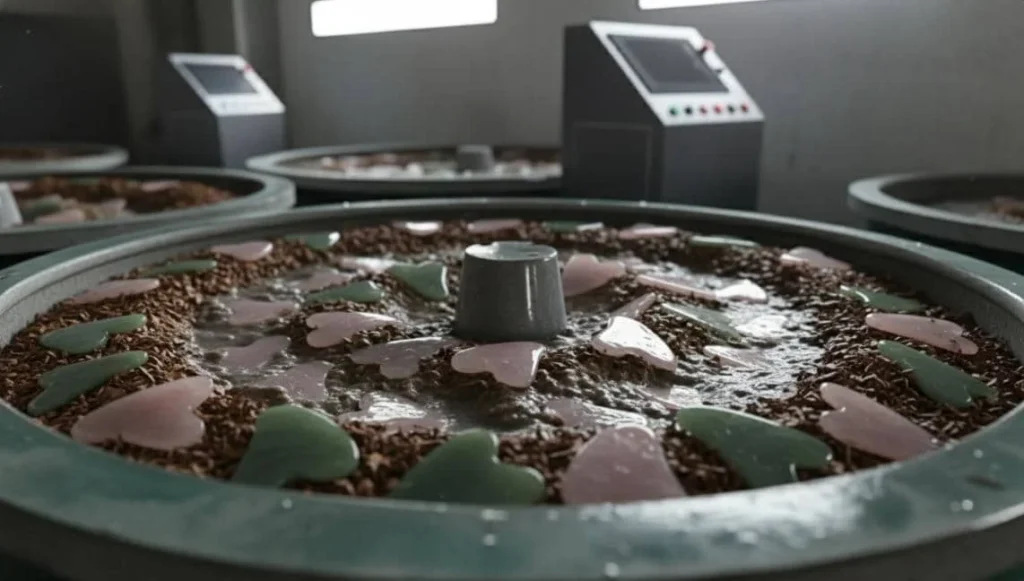
If you’ve ever compared two natural crystal gua sha tools that look identical in photos but feel completely different in your hand, the difference almost never comes down to the raw material. It comes down to gua sha polishing. A competent gua sha manufacturer builds quality into a sequence most buyers never see: a grit progression that typically runs through six or more stages, from 400 grit rough grinding up to 5000 grit before a final polish. Skip a stage, rush the timing, or push it too far, and the same rose quartz or jade blank can end up dull, warped, or carrying hairline stress it didn’t have going in. This isn’t a cosmetic detail. It’s the single gua sha production variable most responsible for whether a batch clears inspection or comes back as a claim. As a source-factory gua sha supplier that has run polishing lines for natural stone tools for more than a decade, Deyi Gems wants to walk you through exactly where this process goes right, where it goes wrong, and what you should be asking any gua sha manufacturer before your next order leaves the workshop floor. What Every Gua Sha Manufacturer Learns About Polishing Time the Hard Way Polishing sits at the very end of the production line, right after rough shaping, and it’s the step that decides whether a stone tool reads as refined or unfinished. The physics behind it is simple enough: coarse grinding leaves microscopic scratches and a sugary, sandblasted texture across the surface. Gua sha polishing removes that texture layer by layer until light passes through cleanly instead of scattering off every scratch mark. But timing this step is a balancing act, not a fixed formula, and that balance is exactly where the gap between an experienced gua sha manufacturer and a general lapidary shop becomes obvious. Get it wrong in either direction, and the real cost of the mistake shows up later — either in a return shipment or in an OEM client’s rejected batch from an underprepared gua sha factory. Under-Polishing: The Silent Defect Gua Sha Buyers Discover Too Late When polishing time runs short, the fine scratches left by grinding never fully disappear. They sit just below a thin gloss layer, so a piece can look acceptable under warehouse lighting yet turn cloudy, grey, or streaky the moment it reaches daylight or a customer’s hand. This effect shows up most in translucent materials like clear quartz, rose quartz, and amethyst, where light is supposed to travel into the stone and bounce back rather than scatter off a rough surface. Gemological references from the International Gem Society confirm that surface finish quality affects how a stone reads visually, independent of the material’s intrinsic color and clarity — a point any experienced gua sha manufacturer will tell you matters more than the raw carat weight of the rough. There’s a second, less obvious cost too: under-polished edges feel gritty against skin, which matters enormously for a tool designed to glide across a face or neck. This means you can end up with a tool that photographs fine for a product listing but fails the moment a real customer runs it across their jawline — and that gap between sample and shipment is precisely what erodes repeat orders with your gua sha supplier over time. Over-Polishing: When a Gua Sha Manufacturer Trades Quality for Speed The opposite mistake during gua sha polishing is less visible on a spec sheet but often more expensive. Every extra minute under a polishing wheel removes material, so pushing the process too far shaves thickness, drops weight, and drifts the tool’s dimensions away from the original drawing. For OEM orders where a gua sha board has to sit flush inside a printed box insert or match a paired accessory, even a small dimensional shift means packaging that no longer closes cleanly. A gua sha manufacturer that skips this check on a full production run is the one absorbing the repacking cost later, not you. Edges and curves soften too, so the crisp lapidary profile a gua sha manufacturer originally cut gets rounded off, and piece-to-piece consistency across a gua sha production run starts to slip. For jade and other stones prized for a soft, oil-like luster rather than a mirror finish, over-polishing pushes the surface toward an artificial glassy shine that reads as lower quality to an experienced buyer, not higher. This means longer polishing cycles don’t automatically protect your order — past a certain point, they actively work against it, adding labor cost while degrading the exact dimensional accuracy your specification called for. Where a Gua Sha Manufacturer Draws the Line So how does a reliable gua sha manufacturer find the right stopping point? In practice, it’s rarely a single fixed time. It’s a target defined by material hardness, piece size, and the finish level a given order calls for, checked against the physical piece rather than the clock. A quartz gua sha board destined for a premium retail line needs a longer, more controlled polish than a basic wholesale set meant to move in bulk through a busy gua sha factory. Rushing either one to hit a shipping date is how defects slip through, and stretching either one past its target burns labor hours without adding value. This is the judgment call that defines a serious gua sha manufacturer, order after order, far more than any single machine on the floor. If a gua sha manufacturer can’t explain why their polishing time is set where it is for a specific material, that’s usually a sign they’re running one generic process across every stone type. That’s the first thing worth asking about before you commit volume to an order. The Grit Progression a Reliable Gua Sha Factory Should Never Skip Polishing time is only half of the equation. The other half is sequence — the order and spacing of abrasive grit sizes used to move from a rough-cut blank to a finished surface. A
Why Polishing Time Decides Gua Sha Tool Quality: An Industry Risk Disclosure Read More »
If you’ve ever compared two natural crystal gua sha tools that look identical in photos but feel completely different in your hand, the difference almost never comes down to the raw material. It comes down to gua sha polishing. A competent gua sha manufacturer builds quality into a sequence most buyers never see: a grit progression that typically runs through six or more stages, from 400 grit rough grinding up to 5000 grit before a final polish. Skip a stage, rush the timing, or push it too far, and the same rose quartz or jade blank can end up dull, warped, or carrying hairline stress it didn’t have going in. This isn’t a cosmetic detail. It’s the single gua sha production variable most responsible for whether a batch clears inspection or comes back as a claim. As a source-factory gua sha supplier that has run polishing lines for natural stone tools for more than a decade, Deyi Gems wants to walk you through exactly where this process goes right, where it goes wrong, and what you should be asking any gua sha manufacturer before your next order leaves the workshop floor. What Every Gua Sha Manufacturer Learns About Polishing Time the Hard Way Polishing sits at the very end of the production line, right after rough shaping, and it’s the step that decides whether a stone tool reads as refined or unfinished. The physics behind it is simple enough: coarse grinding leaves microscopic scratches and a sugary, sandblasted texture across the surface. Gua sha polishing removes that texture layer by layer until light passes through cleanly instead of scattering off every scratch mark. But timing this step is a balancing act, not a fixed formula, and that balance is exactly where the gap between an experienced gua sha manufacturer and a general lapidary shop becomes obvious. Get it wrong in either direction, and the real cost of the mistake shows up later — either in a return shipment or in an OEM client’s rejected batch from an underprepared gua sha factory. Under-Polishing: The Silent Defect Gua Sha Buyers Discover Too Late When polishing time runs short, the fine scratches left by grinding never fully disappear. They sit just below a thin gloss layer, so a piece can look acceptable under warehouse lighting yet turn cloudy, grey, or streaky the moment it reaches daylight or a customer’s hand. This effect shows up most in translucent materials like clear quartz, rose quartz, and amethyst, where light is supposed to travel into the stone and bounce back rather than scatter off a rough surface. Gemological references from the International Gem Society confirm that surface finish quality affects how a stone reads visually, independent of the material’s intrinsic color and clarity — a point any experienced gua sha manufacturer will tell you matters more than the raw carat weight of the rough. There’s a second, less obvious cost too: under-polished edges feel gritty against skin, which matters enormously for a tool designed to glide across a face or neck. This means you can end up with a tool that photographs fine for a product listing but fails the moment a real customer runs it across their jawline — and that gap between sample and shipment is precisely what erodes repeat orders with your gua sha supplier over time. Over-Polishing: When a Gua Sha Manufacturer Trades Quality for Speed The opposite mistake during gua sha polishing is less visible on a spec sheet but often more expensive. Every extra minute under a polishing wheel removes material, so pushing the process too far shaves thickness, drops weight, and drifts the tool’s dimensions away from the original drawing. For OEM orders where a gua sha board has to sit flush inside a printed box insert or match a paired accessory, even a small dimensional shift means packaging that no longer closes cleanly. A gua sha manufacturer that skips this check on a full production run is the one absorbing the repacking cost later, not you. Edges and curves soften too, so the crisp lapidary profile a gua sha manufacturer originally cut gets rounded off, and piece-to-piece consistency across a gua sha production run starts to slip. For jade and other stones prized for a soft, oil-like luster rather than a mirror finish, over-polishing pushes the surface toward an artificial glassy shine that reads as lower quality to an experienced buyer, not higher. This means longer polishing cycles don’t automatically protect your order — past a certain point, they actively work against it, adding labor cost while degrading the exact dimensional accuracy your specification called for. Where a Gua Sha Manufacturer Draws the Line So how does a reliable gua sha manufacturer find the right stopping point? In practice, it’s rarely a single fixed time. It’s a target defined by material hardness, piece size, and the finish level a given order calls for, checked against the physical piece rather than the clock. A quartz gua sha board destined for a premium retail line needs a longer, more controlled polish than a basic wholesale set meant to move in bulk through a busy gua sha factory. Rushing either one to hit a shipping date is how defects slip through, and stretching either one past its target burns labor hours without adding value. This is the judgment call that defines a serious gua sha manufacturer, order after order, far more than any single machine on the floor. If a gua sha manufacturer can’t explain why their polishing time is set where it is for a specific material, that’s usually a sign they’re running one generic process across every stone type. That’s the first thing worth asking about before you commit volume to an order. The Grit Progression a Reliable Gua Sha Factory Should Never Skip Polishing time is only half of the equation. The other half is sequence — the order and spacing of abrasive grit sizes used to move from a rough-cut blank to a finished surface. A