Gua Sha Custom Manufacturing: How Close Can a Finished Piece Really Get to Your 3D Design?
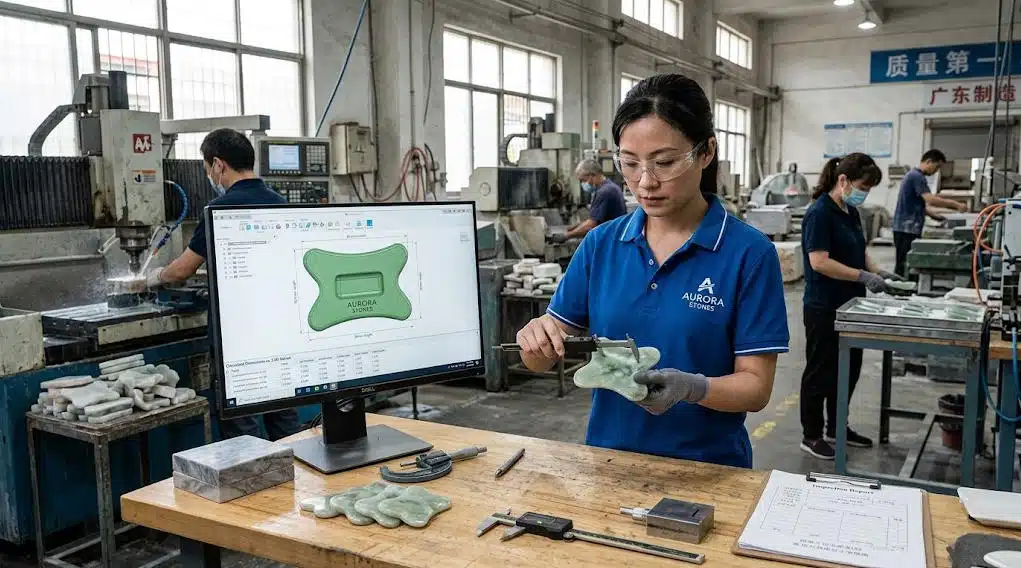
If you’ve ever placed a gua sha custom order and lined the finished stone up next to your 3D rendering, you already know the honest answer to “will it look exactly like the picture?” Geometry can match almost perfectly. Color and internal texture almost never will — and that gap is not a manufacturing defect, it’s physics. On a CNC-machined gua sha custom order, overall shape, dimensional ratios, and logo placement can typically be held within roughly ±0.05mm to ±0.13mm of the CAD file, a tolerance band consistent with standard CNC machining benchmarks published by Protolabs and Modus Advanced. What almost never lines up 1:1 is the color, cloud pattern, and translucency inside a piece of natural stone. This article lays out exactly what you can expect, what you can’t, and how a gua sha manufacturer actually closes that gap before your order enters mass production. What “Matching the 3D Design” Actually Means in Gua Sha Custom Manufacturing Where Gua Sha Custom Precision Is Guaranteed You can reasonably expect five things to line up closely between your render and your finished gua sha custom piece: overall silhouette, dimensional ratios, logo or text placement, general surface finish, and — with much less certainty — color and internal texture. Shape and proportion are controllable because CNC toolpaths and mold cavities follow your CAD file directly, not an artist’s interpretation of it. Logo and text placement can be positioned to sub-millimeter accuracy because it’s driven by the same coordinate system as the rest of the cut. Surface finish sits a notch below that, since polishing is a semi-manual process and the final gloss depends on how long and how evenly a piece is buffed. Dimensional ratios follow the same logic: if your design calls for a 2:1 length-to-width ratio, a properly toleranced gua sha custom drawing will hold that ratio across the whole production run, not just on the first sample. This means you can treat shape, size, and logo placement as commitments a factory should stand behind in writing, while treating color and texture as a documented range rather than a guarantee. Where Natural Material Sets the Real Limit Color and texture behave differently because they aren’t manufactured — they’re mined. Two blocks of rose quartz or jade cut from the same rough batch can still show different depth of color, cloud density, or clarity, simply because that’s how the mineral grew. This isn’t a guasha tools custom processing error; it’s the same natural variability that gemological labs spend their careers documenting. So what does that mean for your order? It means the geometry line item on your gua sha custom quote is a hard commitment, and the color/texture line item is a documented range you should sign off on before tooling — not an afterthought you discover on delivery. Why a 3D Rendering Is Not a Risk-Free Promise for Gua Sha Custom Orders The Physics Behind Natural Stone Color and Texture Rendering software can control color saturation, transparency, gloss, internal texture, lighting, shadow, and reflection with total precision — because none of that is real. A render can show a jade gua sha board as flawlessly even and glassy because the artist told it to be. Real crystal, jade, and agate carry depth variation, cloud-like inclusions, cotton, ice-crack patterns, internal texture, and zones of differing transparency, and none of that shows up until the rough is actually cut. GIA’s own gemology research points out that natural inclusion patterns are distinct from manufactured ones — natural stones show transparent, partially healed fracture textures that no rendering engine or lab-grown process quite reproduces. In plain terms: natural material looks natural precisely because it’s inconsistent, and that inconsistency is the entire reason your gua sha custom piece feels different from a mass-produced acrylic version. What GIA and IGS Say About Natural Variation This isn’t a fringe opinion inside the stone trade — it’s documented industry knowledge. GIA’s research on colored stone value factors explains color zoning as an uneven distribution of color within a gemstone caused by temperature shifts or uneven trace-element uptake during formation, common enough that stones like ametrine and multicolored tourmaline are prized specifically for it. On the processing side, the International Gem Society has documented real cases where a color zone inside natural rough created internal stress that fractured the stone mid-polish, even when the cutter had spotted the zone in advance and planned around it. That’s a useful data point for you as a buyer: yield loss on natural material isn’t always a quality-control failure, it can be the stone itself. If perfectly uniform color across a wholesale batch matters more to you than the material being 100% natural, resin, acrylic, or engineered stone will get you closer to the render than jade or crystal ever will on a gua sha custom order — and a manufacturer should tell you that upfront rather than let you find out after tooling. From 3D File to Production-Ready Gua Sha Custom Package What a Real Gua Sha Custom Spec Package Includes A polished 3D render usually can’t tell a factory which dimensions are critical, how thick the wall needs to be, how large the edge radius can go, how deep a groove should cut, how the curved surfaces blend into each other, how deep the logo engraving runs, whether a chamfer is allowed, which zones need mirror polish versus a matte finish, or what tolerance applies to each of those numbers. A render is a picture. A production package is instructions. For a gua sha custom order to actually reach the accuracy your render implies, it needs to be converted into five separate documents: a 3D CAD model, a 2D engineering drawing, a material specification, a surface treatment requirement, and a tolerance sheet, plus a vector logo file if branding is involved. The Cost of Skipping the Engineering Drawing Step Skipping straight from render to production sounds faster, and sometimes it is — for the first sample. It rarely stays faster
If you’ve ever placed a gua sha custom order and lined the finished stone up next to your 3D rendering, you already know the honest answer to “will it look exactly like the picture?” Geometry can match almost perfectly. Color and internal texture almost never will — and that gap is not a manufacturing defect, it’s physics. On a CNC-machined gua sha custom order, overall shape, dimensional ratios, and logo placement can typically be held within roughly ±0.05mm to ±0.13mm of the CAD file, a tolerance band consistent with standard CNC machining benchmarks published by Protolabs and Modus Advanced. What almost never lines up 1:1 is the color, cloud pattern, and translucency inside a piece of natural stone. This article lays out exactly what you can expect, what you can’t, and how a gua sha manufacturer actually closes that gap before your order enters mass production. What “Matching the 3D Design” Actually Means in Gua Sha Custom Manufacturing Where Gua Sha Custom Precision Is Guaranteed You can reasonably expect five things to line up closely between your render and your finished gua sha custom piece: overall silhouette, dimensional ratios, logo or text placement, general surface finish, and — with much less certainty — color and internal texture. Shape and proportion are controllable because CNC toolpaths and mold cavities follow your CAD file directly, not an artist’s interpretation of it. Logo and text placement can be positioned to sub-millimeter accuracy because it’s driven by the same coordinate system as the rest of the cut. Surface finish sits a notch below that, since polishing is a semi-manual process and the final gloss depends on how long and how evenly a piece is buffed. Dimensional ratios follow the same logic: if your design calls for a 2:1 length-to-width ratio, a properly toleranced gua sha custom drawing will hold that ratio across the whole production run, not just on the first sample. This means you can treat shape, size, and logo placement as commitments a factory should stand behind in writing, while treating color and texture as a documented range rather than a guarantee. Where Natural Material Sets the Real Limit Color and texture behave differently because they aren’t manufactured — they’re mined. Two blocks of rose quartz or jade cut from the same rough batch can still show different depth of color, cloud density, or clarity, simply because that’s how the mineral grew. This isn’t a guasha tools custom processing error; it’s the same natural variability that gemological labs spend their careers documenting. So what does that mean for your order? It means the geometry line item on your gua sha custom quote is a hard commitment, and the color/texture line item is a documented range you should sign off on before tooling — not an afterthought you discover on delivery. Why a 3D Rendering Is Not a Risk-Free Promise for Gua Sha Custom Orders The Physics Behind Natural Stone Color and Texture Rendering software can control color saturation, transparency, gloss, internal texture, lighting, shadow, and reflection with total precision — because none of that is real. A render can show a jade gua sha board as flawlessly even and glassy because the artist told it to be. Real crystal, jade, and agate carry depth variation, cloud-like inclusions, cotton, ice-crack patterns, internal texture, and zones of differing transparency, and none of that shows up until the rough is actually cut. GIA’s own gemology research points out that natural inclusion patterns are distinct from manufactured ones — natural stones show transparent, partially healed fracture textures that no rendering engine or lab-grown process quite reproduces. In plain terms: natural material looks natural precisely because it’s inconsistent, and that inconsistency is the entire reason your gua sha custom piece feels different from a mass-produced acrylic version. What GIA and IGS Say About Natural Variation This isn’t a fringe opinion inside the stone trade — it’s documented industry knowledge. GIA’s research on colored stone value factors explains color zoning as an uneven distribution of color within a gemstone caused by temperature shifts or uneven trace-element uptake during formation, common enough that stones like ametrine and multicolored tourmaline are prized specifically for it. On the processing side, the International Gem Society has documented real cases where a color zone inside natural rough created internal stress that fractured the stone mid-polish, even when the cutter had spotted the zone in advance and planned around it. That’s a useful data point for you as a buyer: yield loss on natural material isn’t always a quality-control failure, it can be the stone itself. If perfectly uniform color across a wholesale batch matters more to you than the material being 100% natural, resin, acrylic, or engineered stone will get you closer to the render than jade or crystal ever will on a gua sha custom order — and a manufacturer should tell you that upfront rather than let you find out after tooling. From 3D File to Production-Ready Gua Sha Custom Package What a Real Gua Sha Custom Spec Package Includes A polished 3D render usually can’t tell a factory which dimensions are critical, how thick the wall needs to be, how large the edge radius can go, how deep a groove should cut, how the curved surfaces blend into each other, how deep the logo engraving runs, whether a chamfer is allowed, which zones need mirror polish versus a matte finish, or what tolerance applies to each of those numbers. A render is a picture. A production package is instructions. For a gua sha custom order to actually reach the accuracy your render implies, it needs to be converted into five separate documents: a 3D CAD model, a 2D engineering drawing, a material specification, a surface treatment requirement, and a tolerance sheet, plus a vector logo file if branding is involved. The Cost of Skipping the Engineering Drawing Step Skipping straight from render to production sounds faster, and sometimes it is — for the first sample. It rarely stays faster