Why Gua Sha Wholesale Orders Get Delayed: A Manufacturer’s Field Guide to Lead Times and Risk
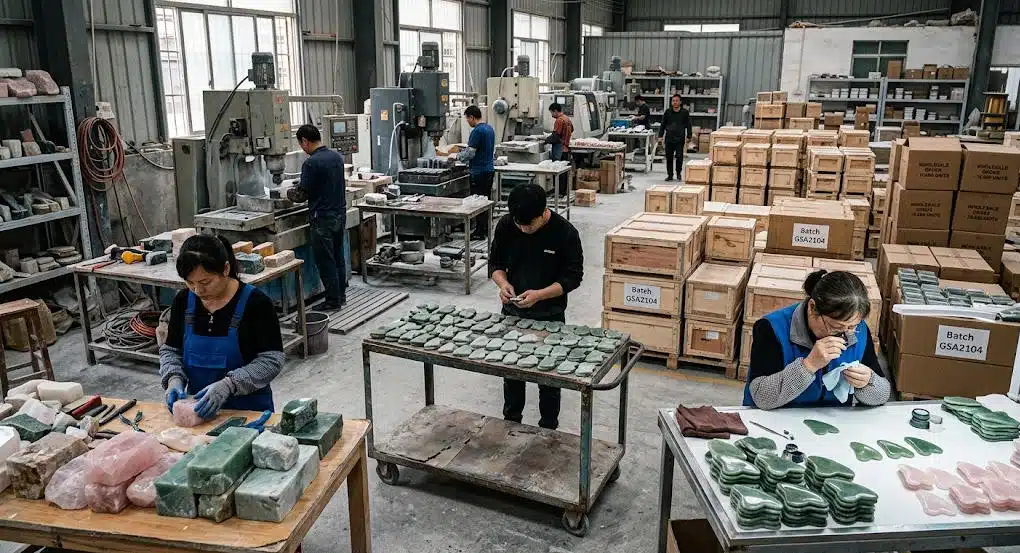
In gua sha wholesale sourcing, a “10-day production” quote almost never means your order lands on your dock 10 days after you place it. Pull apart a typical order and the real number usually runs between 23 and 49 days once material sourcing, sampling, quality control, packaging, and freight are all counted honestly. That gap between what buyers hear and what actually happens is where most gua sha wholesale risks live, and it is rarely caused by a factory simply “being slow.” From the production floor, a missed date is almost always the sum of several smaller, measurable problems — raw material variability, sample-approval delays, scheduling pressure from other orders, and quality standards that were never written down clearly enough to hold anyone to. This article breaks those problems apart one at a time, from the perspective of a working gua sha manufacturer, so you can plan around a realistic timeline instead of a hopeful sales quote. What “Late” Really Means in Gua Sha Wholesale Production Before you can manage a delay, you need to know what “delivery” is actually made of. A single gua sha wholesale order does not move in one block from “ordered” to “shipped.” It passes through seven distinct stages: order confirmation, raw material preparation, sampling and approval, mass production, quality control, packaging, and finally shipment. Skip any one of these when you’re building your own project calendar, and the calendar is wrong before production even starts. The Seven Stages Behind Every Gua Sha Wholesale Shipment Most buyers hear “production takes 10 days” and assume that number covers the entire journey from PO to delivery. In practice, that figure usually describes only the mass-production stage — the part where raw blanks are actually shaped, ground, and polished. It does not include the 5 to 10 days a gua sha manufacturer typically needs to source and pre-sort raw material, the 3 to 7 days sampling and your own approval require, the 2 to 5 days quality control and rework take, or the 3 to 7 days packaging needs once the pieces themselves are done. Add freight on top of that, and a “10-day” order can easily stretch into a 23 to 49 day total. This means any quoted “production time” should be treated as one slice of the calendar, not the whole thing. A Realistic Lead-Time Breakdown, Stage by Stage Written out as a formula, total lead time equals preparation time, plus production time, plus quality control and rework time, plus packaging time, plus shipping time. Each of those five components carries its own risk, and in gua sha wholesale work the first one — material preparation — is usually the least predictable, because it depends on geology rather than machinery. A stainless-steel or injection-molded tool has almost no material variability once the mold is cut and approved. A jade or crystal piece does, and that single difference is the biggest reason natural-stone guasha tools wholesale programs run later than standardized ones on average. Buyers who plan their launch date around the production number alone are, in effect, working from a partial schedule and calling it complete. The 9 Real Reasons Behind Late Gua Sha Wholesale Deliveries A missed date on a gua sha wholesale order is rarely caused by one single failure. It’s usually two or three of the following nine issues stacking on top of each other, and knowing which ones apply to your order lets you ask sharper questions than a vague “why are you late.” Because gua sha production touches raw material, machinery, and people all at once, a single weak link anywhere in that chain can delay the entire batch. Raw Material Yield Rate: The Hidden Variable in Gua Sha Wholesale Risks Natural jade and crystal rough varies by color, texture, internal fracture pattern, size, and clarity, and a gua sha manufacturer genuinely cannot know how many finished pieces a batch of rough will yield until cutting begins. According to the International Gem Society, factory-cut yields from rough gem material typically fall between 15% and 25%, with custom cutting reaching 25% to 33% in better cases — and gua sha blanks, cut from irregular rough rather than pre-formed slabs, often sit toward the lower end of that range. If a batch yields 60% instead of the 70% used to quote the order, a 1,000-piece order suddenly needs roughly 1,667 workable units instead of 1,429, and the factory has to return to the material market mid-schedule. That single gap can turn a 20-day production plan into 20 days of production plus 7 more days of resourcing. This means your gua sha wholesale quote should always ask what yield rate the factory used to size your order, not just what the finished production time is. This is also why a gua sha manufacturer with steady raw-material relationships, the kind Deyi Gems maintains across its jade and crystal suppliers, tends to absorb yield swings faster than one sourcing spot-market rough order by order. One recent example from our own scheduling logs: a 3,000-piece rose quartz program was quoted against a 65% yield estimate; the actual batch came in closer to 55%, and resourcing the shortfall added nine days to a program originally quoted at nineteen. That gap is exactly the kind of thing a milestone schedule catches early instead of on the ship date. Slow Sample Approval Quietly Eats Your Gua Sha Wholesale Timeline Every custom gua sha wholesale order needs a confirmed sample before mass production can start, and the clock on that step belongs to both sides, not just the factory. If a factory sends sample photos on August 1st and the buyer doesn’t sign off until August 5th, real production can’t begin until August 6th at the earliest, no matter what the original quote assumed. Asking for a delivery date measured from final approval, rather than from the day you first sent an inquiry, removes one of the most common sources of gua sha wholesale risks disputes before it can even
In gua sha wholesale sourcing, a “10-day production” quote almost never means your order lands on your dock 10 days after you place it. Pull apart a typical order and the real number usually runs between 23 and 49 days once material sourcing, sampling, quality control, packaging, and freight are all counted honestly. That gap between what buyers hear and what actually happens is where most gua sha wholesale risks live, and it is rarely caused by a factory simply “being slow.” From the production floor, a missed date is almost always the sum of several smaller, measurable problems — raw material variability, sample-approval delays, scheduling pressure from other orders, and quality standards that were never written down clearly enough to hold anyone to. This article breaks those problems apart one at a time, from the perspective of a working gua sha manufacturer, so you can plan around a realistic timeline instead of a hopeful sales quote. What “Late” Really Means in Gua Sha Wholesale Production Before you can manage a delay, you need to know what “delivery” is actually made of. A single gua sha wholesale order does not move in one block from “ordered” to “shipped.” It passes through seven distinct stages: order confirmation, raw material preparation, sampling and approval, mass production, quality control, packaging, and finally shipment. Skip any one of these when you’re building your own project calendar, and the calendar is wrong before production even starts. The Seven Stages Behind Every Gua Sha Wholesale Shipment Most buyers hear “production takes 10 days” and assume that number covers the entire journey from PO to delivery. In practice, that figure usually describes only the mass-production stage — the part where raw blanks are actually shaped, ground, and polished. It does not include the 5 to 10 days a gua sha manufacturer typically needs to source and pre-sort raw material, the 3 to 7 days sampling and your own approval require, the 2 to 5 days quality control and rework take, or the 3 to 7 days packaging needs once the pieces themselves are done. Add freight on top of that, and a “10-day” order can easily stretch into a 23 to 49 day total. This means any quoted “production time” should be treated as one slice of the calendar, not the whole thing. A Realistic Lead-Time Breakdown, Stage by Stage Written out as a formula, total lead time equals preparation time, plus production time, plus quality control and rework time, plus packaging time, plus shipping time. Each of those five components carries its own risk, and in gua sha wholesale work the first one — material preparation — is usually the least predictable, because it depends on geology rather than machinery. A stainless-steel or injection-molded tool has almost no material variability once the mold is cut and approved. A jade or crystal piece does, and that single difference is the biggest reason natural-stone guasha tools wholesale programs run later than standardized ones on average. Buyers who plan their launch date around the production number alone are, in effect, working from a partial schedule and calling it complete. The 9 Real Reasons Behind Late Gua Sha Wholesale Deliveries A missed date on a gua sha wholesale order is rarely caused by one single failure. It’s usually two or three of the following nine issues stacking on top of each other, and knowing which ones apply to your order lets you ask sharper questions than a vague “why are you late.” Because gua sha production touches raw material, machinery, and people all at once, a single weak link anywhere in that chain can delay the entire batch. Raw Material Yield Rate: The Hidden Variable in Gua Sha Wholesale Risks Natural jade and crystal rough varies by color, texture, internal fracture pattern, size, and clarity, and a gua sha manufacturer genuinely cannot know how many finished pieces a batch of rough will yield until cutting begins. According to the International Gem Society, factory-cut yields from rough gem material typically fall between 15% and 25%, with custom cutting reaching 25% to 33% in better cases — and gua sha blanks, cut from irregular rough rather than pre-formed slabs, often sit toward the lower end of that range. If a batch yields 60% instead of the 70% used to quote the order, a 1,000-piece order suddenly needs roughly 1,667 workable units instead of 1,429, and the factory has to return to the material market mid-schedule. That single gap can turn a 20-day production plan into 20 days of production plus 7 more days of resourcing. This means your gua sha wholesale quote should always ask what yield rate the factory used to size your order, not just what the finished production time is. This is also why a gua sha manufacturer with steady raw-material relationships, the kind Deyi Gems maintains across its jade and crystal suppliers, tends to absorb yield swings faster than one sourcing spot-market rough order by order. One recent example from our own scheduling logs: a 3,000-piece rose quartz program was quoted against a 65% yield estimate; the actual batch came in closer to 55%, and resourcing the shortfall added nine days to a program originally quoted at nineteen. That gap is exactly the kind of thing a milestone schedule catches early instead of on the ship date. Slow Sample Approval Quietly Eats Your Gua Sha Wholesale Timeline Every custom gua sha wholesale order needs a confirmed sample before mass production can start, and the clock on that step belongs to both sides, not just the factory. If a factory sends sample photos on August 1st and the buyer doesn’t sign off until August 5th, real production can’t begin until August 6th at the earliest, no matter what the original quote assumed. Asking for a delivery date measured from final approval, rather than from the day you first sent an inquiry, removes one of the most common sources of gua sha wholesale risks disputes before it can even