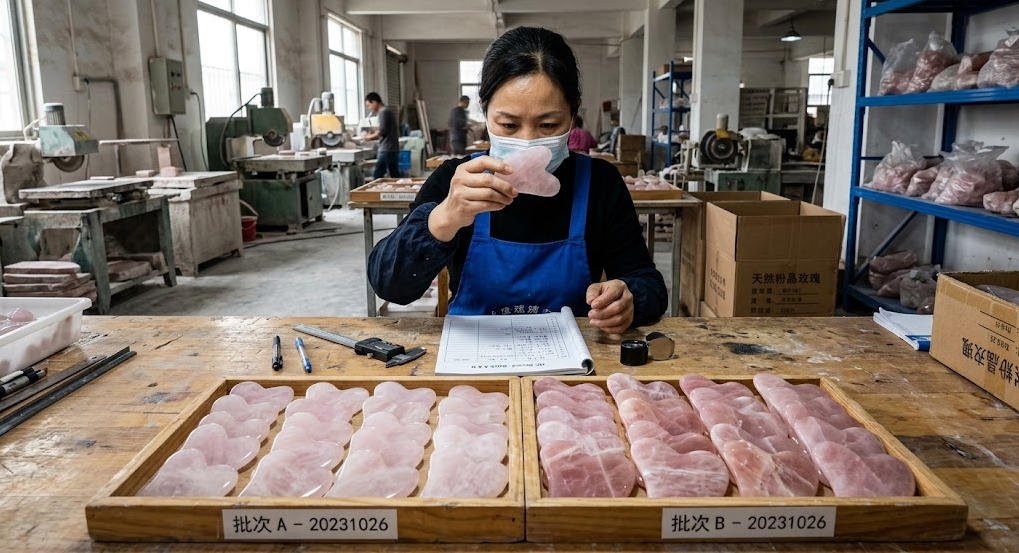
Why the Same Gua Sha Wholesale Order Can Look, Cost, and Ship Differently Over Time
In gua sha wholesale sourcing, buyers regularly run into something a spec sheet cannot explain: the same product code, from the same guasha factory, in the same quantity, arrives one time with a slightly different surface appearance, a different unit price, or a longer delivery window than the previous order. This is not automatically a sign that a gua sha manufacturer has changed the design or cut corners. In natural-stone production — rose quartz, jade, agate, and similar gemstone tools — a fixed SKU defines a target geometry and material category. It does not freeze the exact input conditions of every production run. Raw material batches, machine and tooling wear, order backlog, and internal quality thresholds all shift over a calendar year, and each of these variables feeds into final price, visual consistency, and lead time. The practical risk for a wholesale buyer is treating “same SKU” as a guarantee of “same outcome” on every reorder. Without a shared tolerance range and a documented gua sha quality check standard agreed with the gua sha supplier, that assumption can turn into an unplanned cost increase, a rejected shipment, or a missed retail launch date. Raw Material Batch Variation Is the Largest Source of Difference Natural stone is not a standardized industrial input in the way injection-molded plastic or extruded aluminum profile is. Even when a buyer specifies the same material category — for example, rose quartz — different mining locations, different extraction periods, and even different layers within the same deposit can produce rough material with different color saturation, internal texture, mineral inclusions, fracture density, hardness, brittleness, and usable yield. A guasha factory buying the same material grade from the same mine two purchasing cycles apart can still receive rough that behaves noticeably differently once it reaches the cutting stage. This is not a claim unique to gua sha manufacturing, and it is one of the most common comparisons gua sha wholesale buyers make when two shipments are placed side by side. The Gemological Institute of America notes that rose quartz gets its pink hue from microscopic mineral inclusions, and that color zoning is common in this quartz variety, with some lots showing richer, more uniform color and others showing lighter or more textured material (GIA, Rose Quartz Quality Factors; GIA, Rose Quartz Description). In production, this is exactly what shows up when rough material is opened and cut: two lots purchased under the same nominal grade can separate very differently once cutting begins, because inclusion density and internal fracturing are not fully visible from the outside of the rough stone. That variability moves through the entire production chain in a fairly direct line: color and texture consistency affects how many pieces from a batch look uniform enough to be graded together, which affects the yield of first-grade output, which affects how many pieces get rejected during gua sha quality check, which in turn affects unit cost and how long it takes to assemble a complete, matched order. So the practical implication for a buyer is straightforward — a visible difference between two shipments of the same SKU is often a raw-material batch effect, not evidence that the gua sha production process itself has degraded. Raw Material Cost Adds Another Layer to Gua Sha Wholesale Pricing The cost of a natural-stone gua sha tool is not fixed the way a plastic-molded product’s cost tends to be. Rough material pricing responds to mine output and extraction conditions, buyer demand across the broader gemstone and crystal market, supplier inventory positions, seasonal purchasing cycles, international freight rates, currency movement, and upstream labor and energy costs — the same forces that make gua sha wholesale price lists a moving target rather than a fixed catalog number. The U.S. Geological Survey tracks global supply and demand patterns for gemstone materials for exactly this reason — gemstone markets are subject to meaningful year-to-year and even month-to-month shifts in availability and pricing (USGS, Gemstones Statistics and Information). As an industry practice observation rather than a fixed figure, raw material typically represents a substantial share of the total cost structure for natural-stone gua sha tools, often more than the labor or finishing steps combined. When that means a gua sha supplier requotes the same SKU at a different price a few months later, the change is frequently a pass-through of material cost movement rather than a margin adjustment. A buyer who assumes pricing should stay flat indefinitely on a natural-material product is working from an incorrect baseline; the more useful question to ask a gua sha supplier is not “why did the price change,” but “what portion of this change is material cost versus processing cost.” Machine and Process Condition Drift Inside the Guasha Factory A single guasha factory does not run in an identical state every day. CNC machines are shared across multiple customer orders and get booked in different sequences from month to month. Abrasive wheels and polishing pads wear down with use and get replaced on a schedule, not instantly. Different operators, with different levels of experience, may be assigned to a given gua sha production run. Equipment goes down for scheduled or unscheduled maintenance, and process parameters sometimes get fine-tuned in response to a prior batch’s results. These factors matter more than they might appear to on paper. During grinding, a worn abrasive wheel removes material less predictably than a fresh one, which can produce slightly uneven edge rounding or minor thickness variation even when the CNC program itself has not changed. This is a mechanical reality of subtractive processing — cutting, rough grinding, fine grinding, and polishing each depend on the condition of a consumable tool, not only on the digital file behind the part. Where dimensions are not called out with a specific tolerance on the drawing, many machine shops — including those working in stone and hard mineral processing — default to a general tolerance framework such as ISO 2768, which defines acceptable deviation ranges for linear and angular dimensions across
Why the Same Gua Sha Wholesale Order Can Look, Cost, and Ship Differently Over Time Read More »
In gua sha wholesale sourcing, buyers regularly run into something a spec sheet cannot explain: the same product code, from the same guasha factory, in the same quantity, arrives one time with a slightly different surface appearance, a different unit price, or a longer delivery window than the previous order. This is not automatically a sign that a gua sha manufacturer has changed the design or cut corners. In natural-stone production — rose quartz, jade, agate, and similar gemstone tools — a fixed SKU defines a target geometry and material category. It does not freeze the exact input conditions of every production run. Raw material batches, machine and tooling wear, order backlog, and internal quality thresholds all shift over a calendar year, and each of these variables feeds into final price, visual consistency, and lead time. The practical risk for a wholesale buyer is treating “same SKU” as a guarantee of “same outcome” on every reorder. Without a shared tolerance range and a documented gua sha quality check standard agreed with the gua sha supplier, that assumption can turn into an unplanned cost increase, a rejected shipment, or a missed retail launch date. Raw Material Batch Variation Is the Largest Source of Difference Natural stone is not a standardized industrial input in the way injection-molded plastic or extruded aluminum profile is. Even when a buyer specifies the same material category — for example, rose quartz — different mining locations, different extraction periods, and even different layers within the same deposit can produce rough material with different color saturation, internal texture, mineral inclusions, fracture density, hardness, brittleness, and usable yield. A guasha factory buying the same material grade from the same mine two purchasing cycles apart can still receive rough that behaves noticeably differently once it reaches the cutting stage. This is not a claim unique to gua sha manufacturing, and it is one of the most common comparisons gua sha wholesale buyers make when two shipments are placed side by side. The Gemological Institute of America notes that rose quartz gets its pink hue from microscopic mineral inclusions, and that color zoning is common in this quartz variety, with some lots showing richer, more uniform color and others showing lighter or more textured material (GIA, Rose Quartz Quality Factors; GIA, Rose Quartz Description). In production, this is exactly what shows up when rough material is opened and cut: two lots purchased under the same nominal grade can separate very differently once cutting begins, because inclusion density and internal fracturing are not fully visible from the outside of the rough stone. That variability moves through the entire production chain in a fairly direct line: color and texture consistency affects how many pieces from a batch look uniform enough to be graded together, which affects the yield of first-grade output, which affects how many pieces get rejected during gua sha quality check, which in turn affects unit cost and how long it takes to assemble a complete, matched order. So the practical implication for a buyer is straightforward — a visible difference between two shipments of the same SKU is often a raw-material batch effect, not evidence that the gua sha production process itself has degraded. Raw Material Cost Adds Another Layer to Gua Sha Wholesale Pricing The cost of a natural-stone gua sha tool is not fixed the way a plastic-molded product’s cost tends to be. Rough material pricing responds to mine output and extraction conditions, buyer demand across the broader gemstone and crystal market, supplier inventory positions, seasonal purchasing cycles, international freight rates, currency movement, and upstream labor and energy costs — the same forces that make gua sha wholesale price lists a moving target rather than a fixed catalog number. The U.S. Geological Survey tracks global supply and demand patterns for gemstone materials for exactly this reason — gemstone markets are subject to meaningful year-to-year and even month-to-month shifts in availability and pricing (USGS, Gemstones Statistics and Information). As an industry practice observation rather than a fixed figure, raw material typically represents a substantial share of the total cost structure for natural-stone gua sha tools, often more than the labor or finishing steps combined. When that means a gua sha supplier requotes the same SKU at a different price a few months later, the change is frequently a pass-through of material cost movement rather than a margin adjustment. A buyer who assumes pricing should stay flat indefinitely on a natural-material product is working from an incorrect baseline; the more useful question to ask a gua sha supplier is not “why did the price change,” but “what portion of this change is material cost versus processing cost.” Machine and Process Condition Drift Inside the Guasha Factory A single guasha factory does not run in an identical state every day. CNC machines are shared across multiple customer orders and get booked in different sequences from month to month. Abrasive wheels and polishing pads wear down with use and get replaced on a schedule, not instantly. Different operators, with different levels of experience, may be assigned to a given gua sha production run. Equipment goes down for scheduled or unscheduled maintenance, and process parameters sometimes get fine-tuned in response to a prior batch’s results. These factors matter more than they might appear to on paper. During grinding, a worn abrasive wheel removes material less predictably than a fresh one, which can produce slightly uneven edge rounding or minor thickness variation even when the CNC program itself has not changed. This is a mechanical reality of subtractive processing — cutting, rough grinding, fine grinding, and polishing each depend on the condition of a consumable tool, not only on the digital file behind the part. Where dimensions are not called out with a specific tolerance on the drawing, many machine shops — including those working in stone and hard mineral processing — default to a general tolerance framework such as ISO 2768, which defines acceptable deviation ranges for linear and angular dimensions across