Stainless Steel Gua Sha Manufacturer vs. Stone Gua Sha Manufacturer: An Industry Risk Disclosure for B2B Buyers
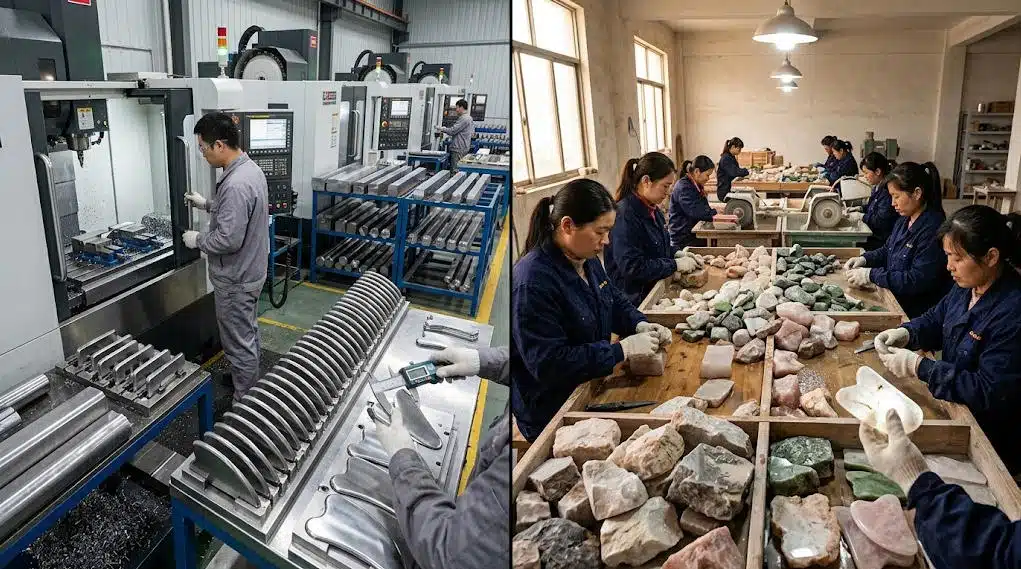
If you’re comparing quotes from a stainless steel gua sha manufacturer and a natural crystal supplier, you’re not comparing two versions of the same factory — you’re comparing two different manufacturing systems that happen to produce a similar-looking tool. A steel workshop can hold ±0.10mm across 5,000 pieces using CNC and stamping dies, while a stone gua sha manufacturer working the same order size might see color and clarity shift piece to piece, batch to batch, because the raw material itself was never designed to be identical. This single fact — engineered material versus natural material — decides almost everything else in your sourcing decision: your MOQ, your lead time, your quality control checklist, and how much room you should leave in your budget for rejects. Before you sign a purchase order with any gua sha factory — whether it’s a single sample run or a full gua sha wholesale shipment — it helps to understand which system you’re actually buying into, because the questions you should ask a metal workshop are not the questions you should ask a stone workshop. The Core Difference: What a Stainless Steel Gua Sha Manufacturer Builds vs. What a Stone Factory Selects Look at a stainless steel gua sha board and a rose quartz gua sha board side by side, and they can appear nearly identical — same curve, same edge, same size. But walk into the two factories that made them, and you’d see almost nothing in common. A metal workshop runs what is essentially an engineering operation: 316L sheet or bar stock goes in, and CNC machining, stamping, laser cutting, and precision grinding turn it into an identical shape thousands of times over. A quartz guasha manufacturer or jade gua sha manufacturer runs a selection-and-shaping operation instead: rough rose quartz, jade, or amethyst comes in with its own color, its own internal fractures, its own density of inclusions, and the job is to cut around those variables until the finished piece looks close enough to an agreed reference sample. Neither approach is better than the other — they’re solving completely different problems. This means you should expect two different sets of trade-offs from the two supply chains, not two versions of the same trade-off dressed up in different marketing language. Where the Cost Structure and Order Terms Split Because a metal workshop buys a standardized input, its cost model is comparatively easy to build: material price per kilogram, machine-hour cost, and a yield rate that barely moves between batches. A stone workshop’s cost model has to absorb the price of rough material that was purchased before anyone knew exactly how much usable, gem-quality area was hiding inside it, so cost per finished piece can only be estimated once cutting and grading are already underway. Dimensional control follows the same split: stamping dies and CNC toolpaths keep steel parts inside a tight, repeatable band, while a crystal’s internal cracks and color zoning can force a cutter to change direction mid-cut and sacrifice material nobody planned to lose. Surface and material QC diverge too — steel inspection checks for burrs, scratches, and deformation against a fixed spec sheet, while stone inspection checks for fractures, color drift, and inclusions against a physical reference sample, because no spec sheet can fully describe a natural gemstone’s appearance. So what does this mean for you as a buyer? It means the same purchase order template does not work for both product types on a gua sha wholesale contract, and asking a stone supplier to quote like a steel supplier — or the reverse — sets up a conflict before production even starts. Raw Material Is Where a Stainless Steel Gua Sha Manufacturer and a Quartz Guasha Manufacturer Part Ways The single biggest driver of every downstream difference — tolerance, yield, QC, price — traces back to one decision made before either factory touches a tool: what raw material did they start with? Such a workshop typically works from certified 316L stock, an alloy whose chemical composition, hardness, and mechanical properties are already fixed by international specification before it ever reaches the workshop floor. According to the ASTM A240 specification, chromium-nickel stainless plate and sheet must meet defined chemistry and mechanical-property windows for each named grade, which is exactly why two coils of 316L bought a year apart still behave the same way under a stamping press. That predictability is what lets a metal workshop promise you the same product on order fifty that you approved on order one, whether that order is a single trial batch or a full gua sha wholesale shipment. 316L Steel vs. Natural Rose Quartz: Two Different Starting Points A quartz guasha manufacturer starts from the opposite position. Even within a single variety like rose quartz, rough material can vary in tone, cloudiness, cotton-like inclusions, ice cracks, and color banding — differences the Gemological Institute of America documents as typical for this stone, since its pastel pink color and hazy translucence come from microscopic mineral inclusions that no two rough pieces share in exactly the same pattern. A jade gua sha manufacturer faces a similar reality with jade’s internal texture and natural color bands. This is not a processing flaw; it is the physical nature of a mineral that formed underground over geologic time rather than in a rolling mill. This means that when you order 1,000 pieces of rose quartz gua sha, you are not ordering 1,000 identical units — you are ordering 1,000 units cut from material a factory has pre-sorted to fall within a color and clarity range you agreed to in advance. That sorting step is invisible on a spec sheet but consumes real time and real material inside any gua sha factory working with rough stone. A steel workshop’s process reads simply: stock in, stamp, grind, polish, inspect, ship. A stone workshop’s process reads: rough in, sort, cut, sort again, shape, inspect for cracks, polish, inspect again — because a flaw invisible at the rough stage can surface
If you’re comparing quotes from a stainless steel gua sha manufacturer and a natural crystal supplier, you’re not comparing two versions of the same factory — you’re comparing two different manufacturing systems that happen to produce a similar-looking tool. A steel workshop can hold ±0.10mm across 5,000 pieces using CNC and stamping dies, while a stone gua sha manufacturer working the same order size might see color and clarity shift piece to piece, batch to batch, because the raw material itself was never designed to be identical. This single fact — engineered material versus natural material — decides almost everything else in your sourcing decision: your MOQ, your lead time, your quality control checklist, and how much room you should leave in your budget for rejects. Before you sign a purchase order with any gua sha factory — whether it’s a single sample run or a full gua sha wholesale shipment — it helps to understand which system you’re actually buying into, because the questions you should ask a metal workshop are not the questions you should ask a stone workshop. The Core Difference: What a Stainless Steel Gua Sha Manufacturer Builds vs. What a Stone Factory Selects Look at a stainless steel gua sha board and a rose quartz gua sha board side by side, and they can appear nearly identical — same curve, same edge, same size. But walk into the two factories that made them, and you’d see almost nothing in common. A metal workshop runs what is essentially an engineering operation: 316L sheet or bar stock goes in, and CNC machining, stamping, laser cutting, and precision grinding turn it into an identical shape thousands of times over. A quartz guasha manufacturer or jade gua sha manufacturer runs a selection-and-shaping operation instead: rough rose quartz, jade, or amethyst comes in with its own color, its own internal fractures, its own density of inclusions, and the job is to cut around those variables until the finished piece looks close enough to an agreed reference sample. Neither approach is better than the other — they’re solving completely different problems. This means you should expect two different sets of trade-offs from the two supply chains, not two versions of the same trade-off dressed up in different marketing language. Where the Cost Structure and Order Terms Split Because a metal workshop buys a standardized input, its cost model is comparatively easy to build: material price per kilogram, machine-hour cost, and a yield rate that barely moves between batches. A stone workshop’s cost model has to absorb the price of rough material that was purchased before anyone knew exactly how much usable, gem-quality area was hiding inside it, so cost per finished piece can only be estimated once cutting and grading are already underway. Dimensional control follows the same split: stamping dies and CNC toolpaths keep steel parts inside a tight, repeatable band, while a crystal’s internal cracks and color zoning can force a cutter to change direction mid-cut and sacrifice material nobody planned to lose. Surface and material QC diverge too — steel inspection checks for burrs, scratches, and deformation against a fixed spec sheet, while stone inspection checks for fractures, color drift, and inclusions against a physical reference sample, because no spec sheet can fully describe a natural gemstone’s appearance. So what does this mean for you as a buyer? It means the same purchase order template does not work for both product types on a gua sha wholesale contract, and asking a stone supplier to quote like a steel supplier — or the reverse — sets up a conflict before production even starts. Raw Material Is Where a Stainless Steel Gua Sha Manufacturer and a Quartz Guasha Manufacturer Part Ways The single biggest driver of every downstream difference — tolerance, yield, QC, price — traces back to one decision made before either factory touches a tool: what raw material did they start with? Such a workshop typically works from certified 316L stock, an alloy whose chemical composition, hardness, and mechanical properties are already fixed by international specification before it ever reaches the workshop floor. According to the ASTM A240 specification, chromium-nickel stainless plate and sheet must meet defined chemistry and mechanical-property windows for each named grade, which is exactly why two coils of 316L bought a year apart still behave the same way under a stamping press. That predictability is what lets a metal workshop promise you the same product on order fifty that you approved on order one, whether that order is a single trial batch or a full gua sha wholesale shipment. 316L Steel vs. Natural Rose Quartz: Two Different Starting Points A quartz guasha manufacturer starts from the opposite position. Even within a single variety like rose quartz, rough material can vary in tone, cloudiness, cotton-like inclusions, ice cracks, and color banding — differences the Gemological Institute of America documents as typical for this stone, since its pastel pink color and hazy translucence come from microscopic mineral inclusions that no two rough pieces share in exactly the same pattern. A jade gua sha manufacturer faces a similar reality with jade’s internal texture and natural color bands. This is not a processing flaw; it is the physical nature of a mineral that formed underground over geologic time rather than in a rolling mill. This means that when you order 1,000 pieces of rose quartz gua sha, you are not ordering 1,000 identical units — you are ordering 1,000 units cut from material a factory has pre-sorted to fall within a color and clarity range you agreed to in advance. That sorting step is invisible on a spec sheet but consumes real time and real material inside any gua sha factory working with rough stone. A steel workshop’s process reads simply: stock in, stamp, grind, polish, inspect, ship. A stone workshop’s process reads: rough in, sort, cut, sort again, shape, inspect for cracks, polish, inspect again — because a flaw invisible at the rough stage can surface