What Determines the Surface Smoothness of Gua Sha Tools? A Gua Sha Manufacturer’s Risk Disclosure Guide
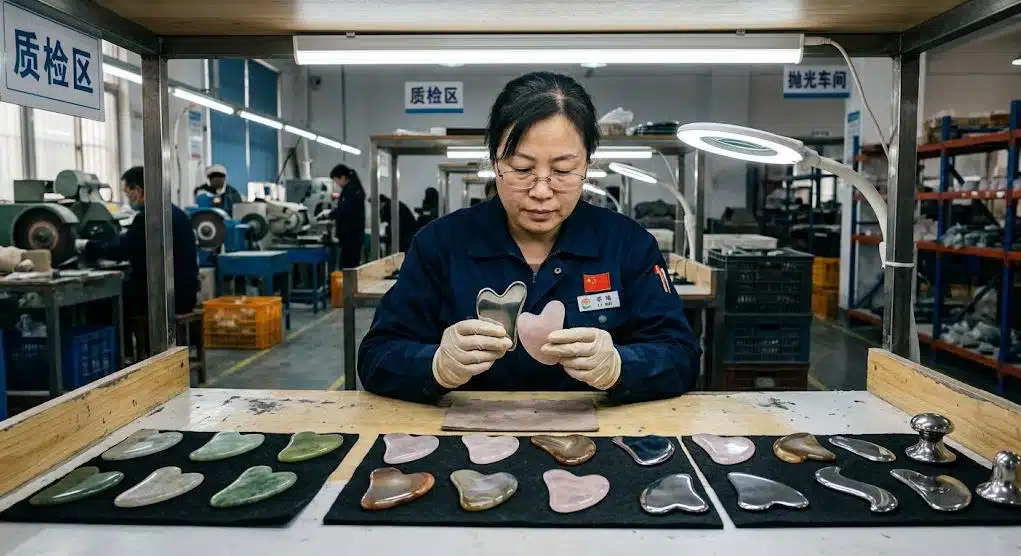
If you’ve ever compared two gua sha stones side by side and wondered why one glides while the other catches slightly under your fingertip, the answer is rarely a single polishing step. As a gua sha manufacturer working with both natural stone and stainless steel, here is the core number worth knowing before your next order: quartz-family stones such as rose quartz and agate sit at roughly 7 on the Mohs hardness scale, jade-family stones can run as low as 6 to 6.5, and surgical-grade stainless steel does not register on that scale at all because it is not a mineral. That hardness gap is the single biggest reason two tools polished on the same line can still finish with different surface results. If you buy gua sha wholesale without knowing which side of that gap your order sits on, you risk judging “smooth enough” by the wrong standard entirely. The Material Ceiling: Why Every Gua Sha Manufacturer Starts With Raw Stone, Not Polish Natural material is where most buyers underestimate the problem, and it’s also where most disputes start. Quartz, jade, and agate aren’t manufactured to a spec sheet the way steel is; every block carries its own hardness distribution, crystal structure, grain size, and microscopic cracks or pockets of softer mineral. Run identical parameters on two blocks from the same quarry and you can still get two different surface results, because the raw material was never identical to begin with. This isn’t a processing error in gua sha production — it’s geology. When a stone contains a softer pocket, mechanical polishing tends to leave that spot looking dull, slightly sunken, or textured like orange peel next to the surrounding gloss. You aren’t looking at a defect the factory introduced — you’re looking at the stone’s own internal map. Natural stone carries a smoothness ceiling that no amount of extra buffing time will remove, while 316 stainless steel, being metallurgically uniform, gives a guasha factory a much easier baseline to hold steady across a full gua sha production run. Hardness, Crystal Structure, and the Smoothness Ranking You Should Know Based on comparable polishing cycles, the typical smoothness ranking across common gua sha materials runs stainless steel, then obsidian, then rose quartz, then agate, then xiuyan jade — closely tracking the Mohs hardness order these minerals occupy. Obsidian, as volcanic glass with no crystal grain at all, polishes almost as evenly as steel despite sitting lower on the hardness scale. Xiuyan jade, by contrast, is a fibrous mineral aggregate rather than a single crystal, so it holds a slightly lower ceiling almost by definition. Material Approx. Mohs Hardness Typical Surface Behavior Stainless steel Not mineral-rated Most uniform, highest achievable polish Obsidian 5–5.5 Glassy, no grain, very even Rose quartz 7 Even, but batch-dependent Agate 6.5–7 Banding can affect uniformity Xiuyan jade 6–6.5 Fibrous structure, lower ceiling This means you can use this order as a rough sourcing filter: if a supplier quotes an unusually high polish grade on jade, ask for a sample before committing to a full container. What This Tells You When You Compare a Gua Sha Manufacturer‘s Samples When two samples from two suppliers look different under the same light, your first question shouldn’t be “which factory has worse equipment,” but “are these even the same grade of stone.” A gua sha manufacturer quoting rose quartz at one price and obsidian at a similar finish level isn’t comparing like with like, even if both photos look glossy in a listing. Ask any gua sha manufacturer you’re vetting to confirm the exact material grade behind a sample, not just the material name, because “rose quartz” alone tells you almost nothing about which quarry — and therefore which hardness profile — you’re actually buying. Upstream Processing and Grit Progression: The Hidden Cost Behind Gua Sha Production Polishing never starts from a perfectly flat surface, whatever a spec sheet implies. Before a blank reaches a buffing wheel, it has already been through cutting, rough grinding, shaping, CNC profiling, and fine grinding — and each step can leave its own signature behind. CNC tool marks, coarse grinding scratches, uneven height across a face, chipped edges, and chatter-vibration marks are the five defects that show up most often in a gua sha manufacturer‘s upstream audit. None of these are visible in product photos, which is exactly why they cause disputes after the container has already shipped. Why a Gua Sha Manufacturer Can’t Just “Polish Longer” to Fix Deep Scratches Here’s a principle worth writing down before your next quality argument: polishing removes shallow surface defects, but it can’t reliably remove deep ones left by an earlier grinding stage. If a scratch was cut into the surface during rough grinding, extra minutes on the polishing wheel will smooth the edges of that scratch without eliminating it — the tool will simply look shinier around a mark that’s still there. So what does that mean for you? When a gua sha manufacturer promises to “polish more” to fix a rejected sample, ask which upstream step actually caused the mark, because polishing time alone rarely solves a grinding-stage problem. How Gua Sha Polishing Is Actually Built, Step by Step Surface smoothness is built in stages, not produced in one pass. A typical sequence runs coarse grinding, then medium grinding, then fine grinding, then superfine grinding, and only then final polishing, with each stage shrinking the scratch depth left by the one before it. Jump straight from coarse grinding to a fine polishing compound and you can end up with a surface that looks glossy under normal light but reveals a network of fine scratches the moment you tilt it under a raking light. Ask your supplier to show you a mid-process piece at each grit stage, not just the finished sample — the transition between grits is where most gua sha polishing quality is actually won or lost, and it’s also where a rushed guasha factory quote tends to cut corners first. Polishing Parameters,
If you’ve ever compared two gua sha stones side by side and wondered why one glides while the other catches slightly under your fingertip, the answer is rarely a single polishing step. As a gua sha manufacturer working with both natural stone and stainless steel, here is the core number worth knowing before your next order: quartz-family stones such as rose quartz and agate sit at roughly 7 on the Mohs hardness scale, jade-family stones can run as low as 6 to 6.5, and surgical-grade stainless steel does not register on that scale at all because it is not a mineral. That hardness gap is the single biggest reason two tools polished on the same line can still finish with different surface results. If you buy gua sha wholesale without knowing which side of that gap your order sits on, you risk judging “smooth enough” by the wrong standard entirely. The Material Ceiling: Why Every Gua Sha Manufacturer Starts With Raw Stone, Not Polish Natural material is where most buyers underestimate the problem, and it’s also where most disputes start. Quartz, jade, and agate aren’t manufactured to a spec sheet the way steel is; every block carries its own hardness distribution, crystal structure, grain size, and microscopic cracks or pockets of softer mineral. Run identical parameters on two blocks from the same quarry and you can still get two different surface results, because the raw material was never identical to begin with. This isn’t a processing error in gua sha production — it’s geology. When a stone contains a softer pocket, mechanical polishing tends to leave that spot looking dull, slightly sunken, or textured like orange peel next to the surrounding gloss. You aren’t looking at a defect the factory introduced — you’re looking at the stone’s own internal map. Natural stone carries a smoothness ceiling that no amount of extra buffing time will remove, while 316 stainless steel, being metallurgically uniform, gives a guasha factory a much easier baseline to hold steady across a full gua sha production run. Hardness, Crystal Structure, and the Smoothness Ranking You Should Know Based on comparable polishing cycles, the typical smoothness ranking across common gua sha materials runs stainless steel, then obsidian, then rose quartz, then agate, then xiuyan jade — closely tracking the Mohs hardness order these minerals occupy. Obsidian, as volcanic glass with no crystal grain at all, polishes almost as evenly as steel despite sitting lower on the hardness scale. Xiuyan jade, by contrast, is a fibrous mineral aggregate rather than a single crystal, so it holds a slightly lower ceiling almost by definition. Material Approx. Mohs Hardness Typical Surface Behavior Stainless steel Not mineral-rated Most uniform, highest achievable polish Obsidian 5–5.5 Glassy, no grain, very even Rose quartz 7 Even, but batch-dependent Agate 6.5–7 Banding can affect uniformity Xiuyan jade 6–6.5 Fibrous structure, lower ceiling This means you can use this order as a rough sourcing filter: if a supplier quotes an unusually high polish grade on jade, ask for a sample before committing to a full container. What This Tells You When You Compare a Gua Sha Manufacturer‘s Samples When two samples from two suppliers look different under the same light, your first question shouldn’t be “which factory has worse equipment,” but “are these even the same grade of stone.” A gua sha manufacturer quoting rose quartz at one price and obsidian at a similar finish level isn’t comparing like with like, even if both photos look glossy in a listing. Ask any gua sha manufacturer you’re vetting to confirm the exact material grade behind a sample, not just the material name, because “rose quartz” alone tells you almost nothing about which quarry — and therefore which hardness profile — you’re actually buying. Upstream Processing and Grit Progression: The Hidden Cost Behind Gua Sha Production Polishing never starts from a perfectly flat surface, whatever a spec sheet implies. Before a blank reaches a buffing wheel, it has already been through cutting, rough grinding, shaping, CNC profiling, and fine grinding — and each step can leave its own signature behind. CNC tool marks, coarse grinding scratches, uneven height across a face, chipped edges, and chatter-vibration marks are the five defects that show up most often in a gua sha manufacturer‘s upstream audit. None of these are visible in product photos, which is exactly why they cause disputes after the container has already shipped. Why a Gua Sha Manufacturer Can’t Just “Polish Longer” to Fix Deep Scratches Here’s a principle worth writing down before your next quality argument: polishing removes shallow surface defects, but it can’t reliably remove deep ones left by an earlier grinding stage. If a scratch was cut into the surface during rough grinding, extra minutes on the polishing wheel will smooth the edges of that scratch without eliminating it — the tool will simply look shinier around a mark that’s still there. So what does that mean for you? When a gua sha manufacturer promises to “polish more” to fix a rejected sample, ask which upstream step actually caused the mark, because polishing time alone rarely solves a grinding-stage problem. How Gua Sha Polishing Is Actually Built, Step by Step Surface smoothness is built in stages, not produced in one pass. A typical sequence runs coarse grinding, then medium grinding, then fine grinding, then superfine grinding, and only then final polishing, with each stage shrinking the scratch depth left by the one before it. Jump straight from coarse grinding to a fine polishing compound and you can end up with a surface that looks glossy under normal light but reveals a network of fine scratches the moment you tilt it under a raking light. Ask your supplier to show you a mid-process piece at each grit stage, not just the finished sample — the transition between grits is where most gua sha polishing quality is actually won or lost, and it’s also where a rushed guasha factory quote tends to cut corners first. Polishing Parameters,