
Why Do Gua Sha Manufacturers Set a MOQ for Custom Orders? An Industry Experience and Risk Disclosure
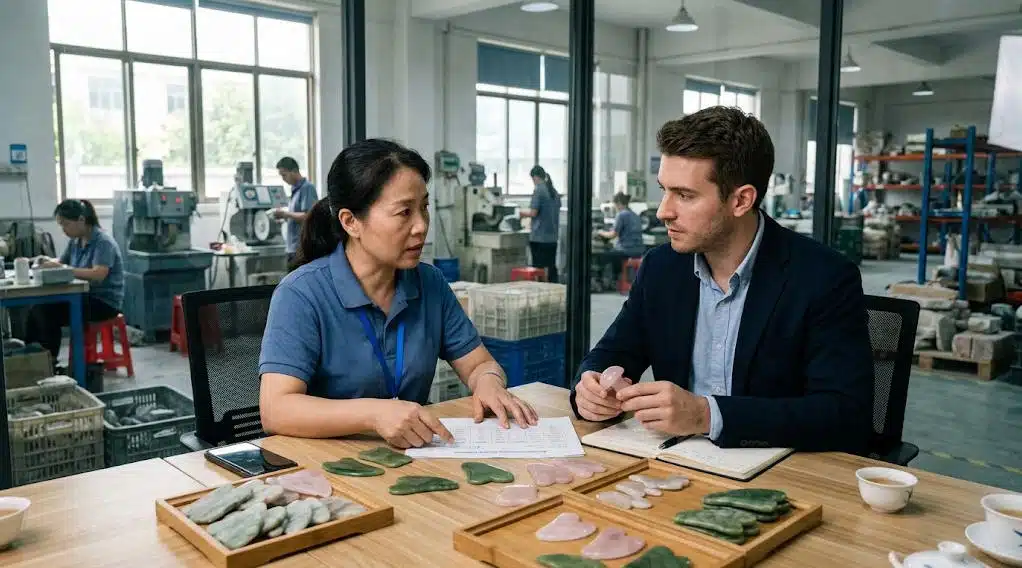
A gua sha custom order carries a setup cost that every piece you buy has to share. On a custom tool Deyi Gems developed in April 2025, mold cost plus raw-material loss came to about $300, which adds $0.60 to each piece at 500 pieces and $0.15 at 2,000. A gua sha manufacturer does not set a minimum to push you into a bigger purchase. Mold work, material loss, programming and first-piece inspection cost the same whether you order 100 pieces or 2,000. The good news is that you control more of this than you think. If you choose a gua sha logo custom job on an existing shape, use stock materials and accept standard packaging, you can often bring a private label gua sha order down to a size that fits a first market test. The sections below give you the real numbers, the risks and the steps for your gua sha custom order. The Math Behind Every Gua Sha Custom MOQ What You Pay for Before the First Gua Sha Custom Piece Exists Before a single tool leaves the line, the factory has already spent money on work that has nothing to do with your quantity. Someone reviews your drawing, writes the CNC program, tests the machine settings and inspects the first piece. Sample making comes next, and every one of these steps takes hours from skilled staff. None of it shrinks because you ordered 100 pieces instead of 1,000. This means you can read a gua sha custom MOQ as a cost-recovery number rather than a sales target. A stock product works differently. It already has proven tooling, tested machining parameters and a packing method, so you pick a style and a quantity and the factory ships from inventory or schedules a run. Change even one dimension and part of that preparation starts again. That is why 100 stock pieces and 100 brand-new custom gua sha tools are two different orders, even when the headcount on the purchase order looks identical. This means you can expect lower minimums when you stay close to a design the factory already runs. A $300 Setup Fee Spread Across 100 to 2,000 Pieces In April 2025, Deyi Gems developed a custom tool for a client, and the mold cost plus raw-material loss came to about $300. That figure belongs to one project, not a price list, because setup depends on the shape, the material and the finish you ask for. The tool’s materials and labor cost about $1.30 per piece. Here is how the $300 spreads, and what each piece costs once it is added: Order quantity Setup cost Setup cost per piece Unit cost per piece (materials, labor and setup) 100 pieces* $300 $3.00 $4.30 500 pieces $300 $0.60 $1.90 1,000 pieces $300 $0.30 $1.60 2,000 pieces $300 $0.15 $1.45 *The 100-piece row is calculated from the same $300. The other rows are the project’s actual figures. Going from 100 to 1,000 pieces cuts the setup share of each piece by 90%, from $3.00 to $0.30. At 500 pieces the setup is 32% of the unit cost, and at 2,000 pieces it is 10%. This is why a factory may accept 1,000 pieces at one unit price and refuse to make 100 pieces at the same price. This means you can ask any supplier to quote two quantities side by side and see the setup gap for yourself. What a Gua Sha Custom MOQ Does to Your Unit Cost Look at what the table does to the price you pay. A 100-piece order costs $4.30 per piece, 2.7 times the $1.60 of a 1,000-piece order, and moving from 500 to 2,000 pieces cuts the unit cost from $1.90 to $1.45, a drop of 24%. The wholesale price on this project was set at the unit cost plus 30%, which gives you $2.47 per piece at 500, $2.08 at 1,000 and $1.89 at 2,000. The lowest MOQ is not automatically the cheapest way to launch a private label gua sha line, and the highest MOQ is not automatically the safest one. This means you can compare total cash out against units you can realistically sell in the first few months. Risk Disclosure: When a Gua Sha Custom Order Costs You More A lower unit price on a gua sha custom order only helps if you sell the extra stock. Would you rather pay $2.70 more per piece on 100 tools than on 1,000, or hold 900 extra pieces you committed to buy? Setup cost also varies by shape, material and finishing method, so treat the $300 above as one project’s result and ask your supplier for yours in writing. Natural stone adds a second variable to custom gua sha tools. The Gemological Institute of America (GIA) describes jade as a generic term for nephrite, jadeite and, under certain conditions, green omphacite, so two boards sold as “jade” can be different minerals with different color and texture. GIA also lists color and texture among the main value factors for jade, which is why a sample you approve may not match every piece in the batch. This means you can protect yourself by asking which exact material your sample uses and what color and texture range you accept before you pay a deposit on your gua sha custom run. Need Only 100 Pieces? 4 Ways to Lower a Gua Sha Custom MOQ Many brands that ask about gua sha custom orders want to start at 100 pieces, because 100 pieces is what a market test can afford. At that size the $300 setup from the previous section adds $3.00 to every tool. A flat refusal solves nothing for either side, so the useful question is how to shrink the preparation work or change who carries it. The four routes below do exactly that, and you can stack them. This means you can walk into a quote request with options instead of a single fixed number. Step 1: Order Gua Sha Logo Custom
A gua sha custom order carries a setup cost that every piece you buy has to share. On a custom tool Deyi Gems developed in April 2025, mold cost plus raw-material loss came to about $300, which adds $0.60 to each piece at 500 pieces and $0.15 at 2,000. A gua sha manufacturer does not set a minimum to push you into a bigger purchase. Mold work, material loss, programming and first-piece inspection cost the same whether you order 100 pieces or 2,000. The good news is that you control more of this than you think. If you choose a gua sha logo custom job on an existing shape, use stock materials and accept standard packaging, you can often bring a private label gua sha order down to a size that fits a first market test. The sections below give you the real numbers, the risks and the steps for your gua sha custom order. The Math Behind Every Gua Sha Custom MOQ What You Pay for Before the First Gua Sha Custom Piece Exists Before a single tool leaves the line, the factory has already spent money on work that has nothing to do with your quantity. Someone reviews your drawing, writes the CNC program, tests the machine settings and inspects the first piece. Sample making comes next, and every one of these steps takes hours from skilled staff. None of it shrinks because you ordered 100 pieces instead of 1,000. This means you can read a gua sha custom MOQ as a cost-recovery number rather than a sales target. A stock product works differently. It already has proven tooling, tested machining parameters and a packing method, so you pick a style and a quantity and the factory ships from inventory or schedules a run. Change even one dimension and part of that preparation starts again. That is why 100 stock pieces and 100 brand-new custom gua sha tools are two different orders, even when the headcount on the purchase order looks identical. This means you can expect lower minimums when you stay close to a design the factory already runs. A $300 Setup Fee Spread Across 100 to 2,000 Pieces In April 2025, Deyi Gems developed a custom tool for a client, and the mold cost plus raw-material loss came to about $300. That figure belongs to one project, not a price list, because setup depends on the shape, the material and the finish you ask for. The tool’s materials and labor cost about $1.30 per piece. Here is how the $300 spreads, and what each piece costs once it is added: Order quantity Setup cost Setup cost per piece Unit cost per piece (materials, labor and setup) 100 pieces* $300 $3.00 $4.30 500 pieces $300 $0.60 $1.90 1,000 pieces $300 $0.30 $1.60 2,000 pieces $300 $0.15 $1.45 *The 100-piece row is calculated from the same $300. The other rows are the project’s actual figures. Going from 100 to 1,000 pieces cuts the setup share of each piece by 90%, from $3.00 to $0.30. At 500 pieces the setup is 32% of the unit cost, and at 2,000 pieces it is 10%. This is why a factory may accept 1,000 pieces at one unit price and refuse to make 100 pieces at the same price. This means you can ask any supplier to quote two quantities side by side and see the setup gap for yourself. What a Gua Sha Custom MOQ Does to Your Unit Cost Look at what the table does to the price you pay. A 100-piece order costs $4.30 per piece, 2.7 times the $1.60 of a 1,000-piece order, and moving from 500 to 2,000 pieces cuts the unit cost from $1.90 to $1.45, a drop of 24%. The wholesale price on this project was set at the unit cost plus 30%, which gives you $2.47 per piece at 500, $2.08 at 1,000 and $1.89 at 2,000. The lowest MOQ is not automatically the cheapest way to launch a private label gua sha line, and the highest MOQ is not automatically the safest one. This means you can compare total cash out against units you can realistically sell in the first few months. Risk Disclosure: When a Gua Sha Custom Order Costs You More A lower unit price on a gua sha custom order only helps if you sell the extra stock. Would you rather pay $2.70 more per piece on 100 tools than on 1,000, or hold 900 extra pieces you committed to buy? Setup cost also varies by shape, material and finishing method, so treat the $300 above as one project’s result and ask your supplier for yours in writing. Natural stone adds a second variable to custom gua sha tools. The Gemological Institute of America (GIA) describes jade as a generic term for nephrite, jadeite and, under certain conditions, green omphacite, so two boards sold as “jade” can be different minerals with different color and texture. GIA also lists color and texture among the main value factors for jade, which is why a sample you approve may not match every piece in the batch. This means you can protect yourself by asking which exact material your sample uses and what color and texture range you accept before you pay a deposit on your gua sha custom run. Need Only 100 Pieces? 4 Ways to Lower a Gua Sha Custom MOQ Many brands that ask about gua sha custom orders want to start at 100 pieces, because 100 pieces is what a market test can afford. At that size the $300 setup from the previous section adds $3.00 to every tool. A flat refusal solves nothing for either side, so the useful question is how to shrink the preparation work or change who carries it. The four routes below do exactly that, and you can stack them. This means you can walk into a quote request with options instead of a single fixed number. Step 1: Order Gua Sha Logo Custom