
Stainless Steel Gua Sha Manufacturer Disclosure: Industry Experience and Finish Risks to Know Before You Order
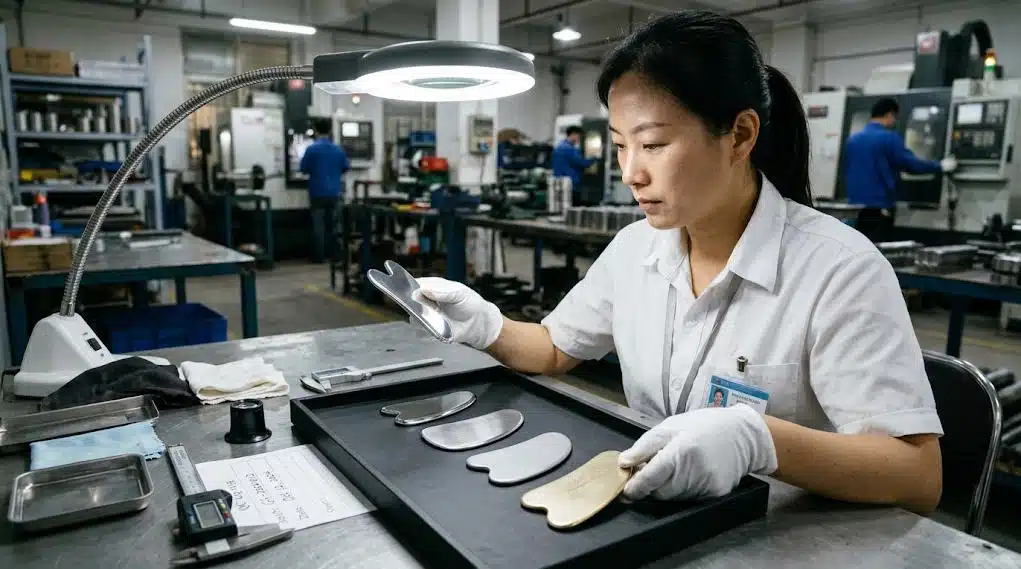
After more than 12 years of making jade, crystal and metal gua sha tools, one pattern keeps repeating: buyers lose money on the finish, not on the steel. A stainless steel gua sha manufacturer can deliver four finish families (mirror, brushed, matte and PVD color), yet PVD sits on top of the other three and cannot repair a scratch beneath it. That single fact decides most metal gua sha wholesale outcomes. This guide gives you five inspection points and a six-item quote checklist, so your stainless steel gua sha custom order arrives in the color you approved. This means you can start your next supplier call knowing which questions protect your margin. A quick disclosure from a stainless steel gua sha manufacturer: everything below comes from production experience and the public standards linked in the text. It contains no invented test results. Where a number depends on your product shape, your volume or your lab, you will see a note telling you to confirm it with your supplier. What Should You Decide First When Briefing a Stainless Steel Gua Sha Manufacturer? Every brief you send to a stainless steel gua sha manufacturer contains two decisions, not one. The first is the surface the bare steel will have. The second is whether that surface receives a colored coating. Mixing the two up is the most common reason a sample looks right on screen and wrong in your hand, so how do you keep them apart? Why a Stainless Steel Gua Sha Manufacturer Quotes Base Finish and Color Separately Mirror, brushed and matte describe how light behaves on bare steel. PVD, short for physical vapor deposition, is a vacuum coating process that deposits a thin colored film on top of that surface. In the stainless steel gua sha process, a gold mirror tool is therefore two jobs: polish the steel to a mirror, then coat it gold. A black brushed tool is also two jobs: build a consistent grain, then coat it black. This means you can ask your stainless steel gua sha manufacturer to price and inspect each job on its own line. The split matters because the film follows whatever sits underneath it. A pit or a deep scratch on a polished base shows up again in gold or black, and the coating does not fill it. Stainless steel is defined by at least 10.5% chromium, according to World Stainless, but that number describes corrosion resistance, not smoothness. This means you can add a separate base-surface approval before any coating run starts, and ask your stainless steel gua sha manufacturer to show you that approval record. Which Finish Fits Entry-Level, Gift-Tier and Differentiated Lines? Three product tiers cover most metal gua sha wholesale catalogs. Entry-level lines usually suit a silver brushed or fine matte finish, because both read as clean metal and the grain or low reflection makes some fine marks less visible, depending on grain direction. Gift-tier lines usually pair gold or rose gold PVD with a mirror base, which looks striking but exposes every defect under the film. Differentiated lines often pair black PVD with a brushed or fine matte base, which looks modern but needs checks for fingerprints, polished-through spots from rubbing and edge wear. This means you can pick one finish per tier and know in advance what a stainless steel gua sha manufacturer can hold consistent across a batch. One rule applies to all three tiers: treat photos and screens as mood references, never as a color standard. Color shifts with the steel grade, the base texture, the coating system and the equipment settings, so only a physical golden sample settles it. Before you sign off, ask your stainless steel gua sha manufacturer which steel grade made the sample and whether the production batch will match it. This means you can protect a stainless steel gua sha custom program from the “it looked different in the photo” dispute. Why Does a Stainless Steel Gua Sha Manufacturer Warn You That PVD Cannot Hide Defects? Here is the uncomfortable part of the job. A stainless steel gua sha manufacturer regularly gets briefs that say “just coat it gold, the polish doesn’t matter.” It matters more than anything else in the chain, because PVD does not replace polishing and does not repair damage. So what does the coating actually do, and what does it leave untouched? How Thin Is a Decorative PVD Film, and Why Does That Matter? The Society of Vacuum Coaters notes that decorative PVD coatings are generally about 0.2 to 0.5 microns thick and replicate the surface finish they are deposited on. A film that thin follows every pit, scratch and polishing wave beneath it. A polished base stays bright under the film, and a honed or blasted base stays matte. This means you can judge the final look of a coated tool by inspecting the uncoated base under the same light. The thin film also explains why color moves from batch to batch. Steel grade, base texture, coating system and equipment settings all shift the result, which is why gold on a mirror base and gold on a brushed base never look identical. Skipping base inspection is the costliest shortcut in the stainless steel gua sha process, because the film locks every flaw in place. This means you can request a separate golden sample for each base-and-color pairing instead of assuming one approval covers both. What a Stainless Steel Gua Sha Manufacturer Checks Before Coating Starts A mirror base needs the most checking because it amplifies defects instead of hiding them. The sequence runs from forming and deburring through coarse, medium and fine grinding, then polishing compound, cleaning and inspection, and each step should erase the marks the previous one left. Inspectors look for pinholes, pits, waviness and uneven reflection, and they spend the most time on contours, curved transitions and grooves. This means you can ask your stainless steel gua sha manufacturer for base-surface photos taken before the coating run, so a […]
After more than 12 years of making jade, crystal and metal gua sha tools, one pattern keeps repeating: buyers lose money on the finish, not on the steel. A stainless steel gua sha manufacturer can deliver four finish families (mirror, brushed, matte and PVD color), yet PVD sits on top of the other three and cannot repair a scratch beneath it. That single fact decides most metal gua sha wholesale outcomes. This guide gives you five inspection points and a six-item quote checklist, so your stainless steel gua sha custom order arrives in the color you approved. This means you can start your next supplier call knowing which questions protect your margin. A quick disclosure from a stainless steel gua sha manufacturer: everything below comes from production experience and the public standards linked in the text. It contains no invented test results. Where a number depends on your product shape, your volume or your lab, you will see a note telling you to confirm it with your supplier. What Should You Decide First When Briefing a Stainless Steel Gua Sha Manufacturer? Every brief you send to a stainless steel gua sha manufacturer contains two decisions, not one. The first is the surface the bare steel will have. The second is whether that surface receives a colored coating. Mixing the two up is the most common reason a sample looks right on screen and wrong in your hand, so how do you keep them apart? Why a Stainless Steel Gua Sha Manufacturer Quotes Base Finish and Color Separately Mirror, brushed and matte describe how light behaves on bare steel. PVD, short for physical vapor deposition, is a vacuum coating process that deposits a thin colored film on top of that surface. In the stainless steel gua sha process, a gold mirror tool is therefore two jobs: polish the steel to a mirror, then coat it gold. A black brushed tool is also two jobs: build a consistent grain, then coat it black. This means you can ask your stainless steel gua sha manufacturer to price and inspect each job on its own line. The split matters because the film follows whatever sits underneath it. A pit or a deep scratch on a polished base shows up again in gold or black, and the coating does not fill it. Stainless steel is defined by at least 10.5% chromium, according to World Stainless, but that number describes corrosion resistance, not smoothness. This means you can add a separate base-surface approval before any coating run starts, and ask your stainless steel gua sha manufacturer to show you that approval record. Which Finish Fits Entry-Level, Gift-Tier and Differentiated Lines? Three product tiers cover most metal gua sha wholesale catalogs. Entry-level lines usually suit a silver brushed or fine matte finish, because both read as clean metal and the grain or low reflection makes some fine marks less visible, depending on grain direction. Gift-tier lines usually pair gold or rose gold PVD with a mirror base, which looks striking but exposes every defect under the film. Differentiated lines often pair black PVD with a brushed or fine matte base, which looks modern but needs checks for fingerprints, polished-through spots from rubbing and edge wear. This means you can pick one finish per tier and know in advance what a stainless steel gua sha manufacturer can hold consistent across a batch. One rule applies to all three tiers: treat photos and screens as mood references, never as a color standard. Color shifts with the steel grade, the base texture, the coating system and the equipment settings, so only a physical golden sample settles it. Before you sign off, ask your stainless steel gua sha manufacturer which steel grade made the sample and whether the production batch will match it. This means you can protect a stainless steel gua sha custom program from the “it looked different in the photo” dispute. Why Does a Stainless Steel Gua Sha Manufacturer Warn You That PVD Cannot Hide Defects? Here is the uncomfortable part of the job. A stainless steel gua sha manufacturer regularly gets briefs that say “just coat it gold, the polish doesn’t matter.” It matters more than anything else in the chain, because PVD does not replace polishing and does not repair damage. So what does the coating actually do, and what does it leave untouched? How Thin Is a Decorative PVD Film, and Why Does That Matter? The Society of Vacuum Coaters notes that decorative PVD coatings are generally about 0.2 to 0.5 microns thick and replicate the surface finish they are deposited on. A film that thin follows every pit, scratch and polishing wave beneath it. A polished base stays bright under the film, and a honed or blasted base stays matte. This means you can judge the final look of a coated tool by inspecting the uncoated base under the same light. The thin film also explains why color moves from batch to batch. Steel grade, base texture, coating system and equipment settings all shift the result, which is why gold on a mirror base and gold on a brushed base never look identical. Skipping base inspection is the costliest shortcut in the stainless steel gua sha process, because the film locks every flaw in place. This means you can request a separate golden sample for each base-and-color pairing instead of assuming one approval covers both. What a Stainless Steel Gua Sha Manufacturer Checks Before Coating Starts A mirror base needs the most checking because it amplifies defects instead of hiding them. The sequence runs from forming and deburring through coarse, medium and fine grinding, then polishing compound, cleaning and inspection, and each step should erase the marks the previous one left. Inspectors look for pinholes, pits, waviness and uneven reflection, and they spend the most time on contours, curved transitions and grooves. This means you can ask your stainless steel gua sha manufacturer for base-surface photos taken before the coating run, so a […]