
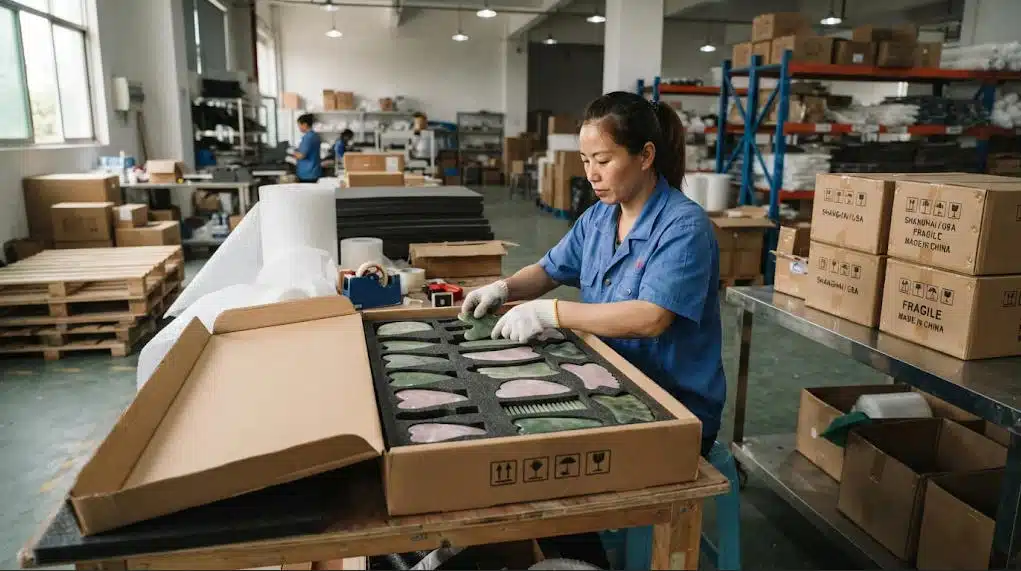
How Gua Sha Factory Reduce Gua Sha Wholesale Shipping Breakage
Breakage on a gua sha wholesale order drops when you combine four protective layers with pre-shipment testing: foam slots matched to each board’s thickness, a carton rated for the load, sealed top and bottom seams, and a stable pallet. In an illustrative 2,000-piece example, spending $0.10 more per piece on gua sha packaging ($0.25 instead of $0.15) cuts expected damaged pieces from 60 to 10. That is $200 of extra spend against 50 saved pieces, so the plan pays back whenever one broken piece costs you more than $4.00 in replacement, freight and gua sha after sale handling. Inside a gua sha factory, the fix starts at the packing table, and production-line experience from any guasha manufacturer points the same way: more foam alone rarely solves the problem. The sections below show you how to make your cargo gua sha shipping safe, one layer at a time. (All cost and breakage figures in this article are illustrative assumptions, not measured shipment statistics.) How Much Can Better Gua Sha Packaging Save on a Gua Sha Wholesale Order? Packaging cost is easy to see on a quote, while breakage cost hides in later invoices. If you compare only the per-piece packaging line, the cheaper carton usually wins the quote and loses the shipment. The figures below are built around a 2,000-piece order, so you can see where the break-even point sits. Any gua sha wholesale buyer can run this math in five minutes, and you can replace the inputs with your own product value and freight rates. Is Reinforced Packaging Worth $0.10 More Per Piece on a Gua Sha Wholesale Order? Take two options for the same 2,000 pieces. Plan A uses standard packing at $0.15 per piece, which totals $300, and assumes 3% breakage, or 60 damaged pieces. Plan B uses reinforced packing at $0.25 per piece, which totals $500, and assumes 0.5% breakage, or 10 damaged pieces. Both breakage rates are assumptions chosen to demonstrate the arithmetic, not statistics from a specific shipping lane. The extra spend is $200 and the saving is 50 pieces, so the break-even value is $4.00 per damaged piece ($200 ÷ 50). If one replacement costs you more than $4.00 once production cost, second freight and handling time are added, Plan B is the cheaper plan. On a gua sha wholesale order of natural crystal or jade boards, that threshold is worth checking against your own cost sheet. This means you can judge any packaging quote by total expected loss instead of by the line item alone. Hidden Costs Beyond the Carton: Replacement, Freight and Gua Sha After Sale Handling A damaged piece triggers more than one expense. You pay for a replacement board, a second shipment (often by air, because your restock date has not moved), and the staff time spent on photos, claims and customer replies. Your own retail buyers may also pause reorders after a chipped delivery, and that cost never appears on an invoice. Which of these items is already in your budget? Often, none of them is, which is why gua sha after sale terms matter before the order ships, not after. A guasha manufacturer that writes down its packing specification and breakage-handling steps in advance lets you price the risk instead of discovering it later. This means you can agree on a replacement budget and a claim process before production starts. Matching Packaging Spend to Your Gua Sha Wholesale Route and Product Value Not every shipment needs the same specification. Long sea routes with several transfers, heavy cartons and natural stone boards justify the reinforced option, while a short run of low-value pieces may not. Material matters too: GIA describes both jadeite and nephrite as very tough, and IGS points out that hardness alone does not predict how a stone wears, because tenacity and cleavage also count. Quartz, for example, has no cleavage but breaks with a shell-shaped conchoidal fracture, the same pattern seen in glass. In practice, a thin finished board with sharp corners concentrates stress even when the raw material is tough. A gua sha factory that tests each shape separately, rather than applying one packing plan to every SKU, spends reinforcement money only where the risk sits. Ask for the packing specification by SKU, and ask how each one is made gua sha shipping safe for your route. This means you can fund stronger packaging on the products that carry the risk and keep the rest lean. How Do You Verify a Gua Sha Wholesale Shipment Is Gua Sha Shipping Safe Before It Leaves the Factory? A package that looks sturdy proves nothing until it has been shaken, dropped and loaded. Testing turns packing opinions into pass-or-fail records you can read. For a gua sha wholesale shipment, the goal is to prove the carton is gua sha shipping safe: boards stay put, cartons keep their shape, and seams stay closed. Here is how you can check each point yourself or ask your supplier to show it. Six Pre-Shipment Checks for Every Gua Sha Wholesale Carton Six checks cover the failure points that matter most, and each one answers a different question about the carton. Check What it tells you Shake and vibration Whether boards move inside their foam slots or touch each other Drop Whether the carton and foam absorb a handling fall Stacking Whether the carton holds its shape under repeated load Compression Whether the box keeps protective space when pressed Seal inspection Whether top and bottom tape seams are fully bonded Pallet stability Whether wrap, corner boards and straps hold the load together The International Safe Transit Association (ISTA) publishes standard test procedures for this work. Its Procedure 3A simulates parcel shipments for packaged products up to 70 kg (150 lb), and Procedure 3E covers unitized loads such as pallets. A factory can run the first four checks in-house, but a published procedure gives you and your supplier the same pass-or-fail language. This means you can write “passes ISTA-style drop and vibration checks” […]
How Gua Sha Factory Reduce Gua Sha Wholesale Shipping Breakage Read More »
Breakage on a gua sha wholesale order drops when you combine four protective layers with pre-shipment testing: foam slots matched to each board’s thickness, a carton rated for the load, sealed top and bottom seams, and a stable pallet. In an illustrative 2,000-piece example, spending $0.10 more per piece on gua sha packaging ($0.25 instead of $0.15) cuts expected damaged pieces from 60 to 10. That is $200 of extra spend against 50 saved pieces, so the plan pays back whenever one broken piece costs you more than $4.00 in replacement, freight and gua sha after sale handling. Inside a gua sha factory, the fix starts at the packing table, and production-line experience from any guasha manufacturer points the same way: more foam alone rarely solves the problem. The sections below show you how to make your cargo gua sha shipping safe, one layer at a time. (All cost and breakage figures in this article are illustrative assumptions, not measured shipment statistics.) How Much Can Better Gua Sha Packaging Save on a Gua Sha Wholesale Order? Packaging cost is easy to see on a quote, while breakage cost hides in later invoices. If you compare only the per-piece packaging line, the cheaper carton usually wins the quote and loses the shipment. The figures below are built around a 2,000-piece order, so you can see where the break-even point sits. Any gua sha wholesale buyer can run this math in five minutes, and you can replace the inputs with your own product value and freight rates. Is Reinforced Packaging Worth $0.10 More Per Piece on a Gua Sha Wholesale Order? Take two options for the same 2,000 pieces. Plan A uses standard packing at $0.15 per piece, which totals $300, and assumes 3% breakage, or 60 damaged pieces. Plan B uses reinforced packing at $0.25 per piece, which totals $500, and assumes 0.5% breakage, or 10 damaged pieces. Both breakage rates are assumptions chosen to demonstrate the arithmetic, not statistics from a specific shipping lane. The extra spend is $200 and the saving is 50 pieces, so the break-even value is $4.00 per damaged piece ($200 ÷ 50). If one replacement costs you more than $4.00 once production cost, second freight and handling time are added, Plan B is the cheaper plan. On a gua sha wholesale order of natural crystal or jade boards, that threshold is worth checking against your own cost sheet. This means you can judge any packaging quote by total expected loss instead of by the line item alone. Hidden Costs Beyond the Carton: Replacement, Freight and Gua Sha After Sale Handling A damaged piece triggers more than one expense. You pay for a replacement board, a second shipment (often by air, because your restock date has not moved), and the staff time spent on photos, claims and customer replies. Your own retail buyers may also pause reorders after a chipped delivery, and that cost never appears on an invoice. Which of these items is already in your budget? Often, none of them is, which is why gua sha after sale terms matter before the order ships, not after. A guasha manufacturer that writes down its packing specification and breakage-handling steps in advance lets you price the risk instead of discovering it later. This means you can agree on a replacement budget and a claim process before production starts. Matching Packaging Spend to Your Gua Sha Wholesale Route and Product Value Not every shipment needs the same specification. Long sea routes with several transfers, heavy cartons and natural stone boards justify the reinforced option, while a short run of low-value pieces may not. Material matters too: GIA describes both jadeite and nephrite as very tough, and IGS points out that hardness alone does not predict how a stone wears, because tenacity and cleavage also count. Quartz, for example, has no cleavage but breaks with a shell-shaped conchoidal fracture, the same pattern seen in glass. In practice, a thin finished board with sharp corners concentrates stress even when the raw material is tough. A gua sha factory that tests each shape separately, rather than applying one packing plan to every SKU, spends reinforcement money only where the risk sits. Ask for the packing specification by SKU, and ask how each one is made gua sha shipping safe for your route. This means you can fund stronger packaging on the products that carry the risk and keep the rest lean. How Do You Verify a Gua Sha Wholesale Shipment Is Gua Sha Shipping Safe Before It Leaves the Factory? A package that looks sturdy proves nothing until it has been shaken, dropped and loaded. Testing turns packing opinions into pass-or-fail records you can read. For a gua sha wholesale shipment, the goal is to prove the carton is gua sha shipping safe: boards stay put, cartons keep their shape, and seams stay closed. Here is how you can check each point yourself or ask your supplier to show it. Six Pre-Shipment Checks for Every Gua Sha Wholesale Carton Six checks cover the failure points that matter most, and each one answers a different question about the carton. Check What it tells you Shake and vibration Whether boards move inside their foam slots or touch each other Drop Whether the carton and foam absorb a handling fall Stacking Whether the carton holds its shape under repeated load Compression Whether the box keeps protective space when pressed Seal inspection Whether top and bottom tape seams are fully bonded Pallet stability Whether wrap, corner boards and straps hold the load together The International Safe Transit Association (ISTA) publishes standard test procedures for this work. Its Procedure 3A simulates parcel shipments for packaged products up to 70 kg (150 lb), and Procedure 3E covers unitized loads such as pallets. A factory can run the first four checks in-house, but a published procedure gives you and your supplier the same pass-or-fail language. This means you can write “passes ISTA-style drop and vibration checks” […]