
Why Gua Sha Production Water Stains Decide Whether Your Order Passes Inspection
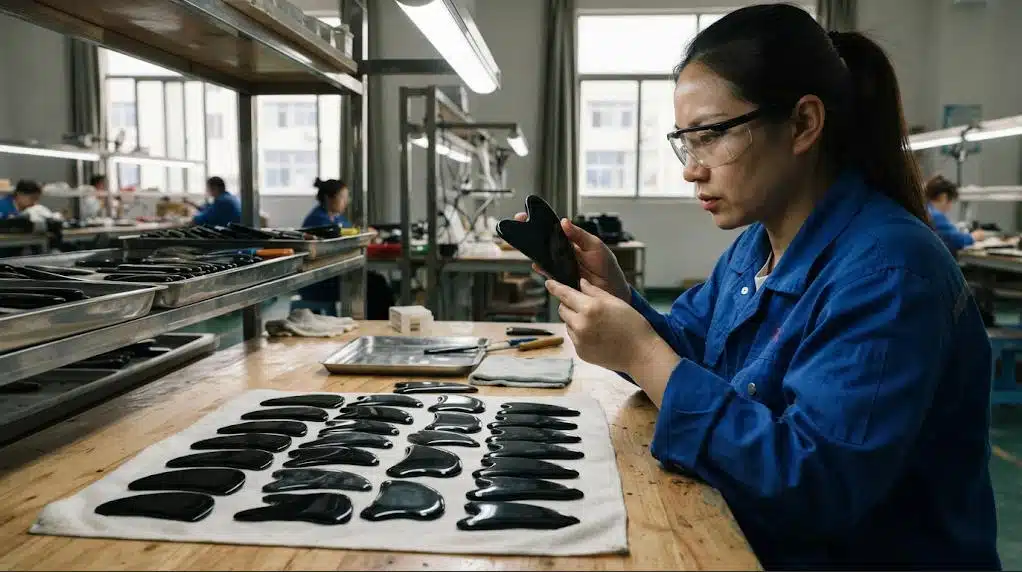
If you buy polished stone tools, water stains are the defect you will meet first. In gua sha production, tap water above 180 mg/L of hardness, which the USGS classes as “very hard,” leaves mineral deposits behind whenever a wet board dries. After more than 12 years on the workshop floor, Yan Cheng ranks obsidian as the material where those marks show up most, followed by crystal, agate and serpentine jade. This article lays out where those marks come from, what a controlled gua sha process looks like, and which questions you should ask any gua sha manufacturer before a guasha wholesale order. Think of it as a walk through the workshop with a colleague: plain talk, real numbers, no sales pitch. Ready to see what your supplier might be missing? How Do You Keep Water Stains Out of Gua Sha Production? A Five-Stage Control System The short answer is that you control five points, in order: process water, the first wash after polishing, the final rinse, drying, and the inspection before packing. Miss one and the stain returns, because each stage removes a different cause. A gua sha factory that documents all five gives you something you can audit, while a factory that only wipes finished boards gives you a promise. This means you can ask for five records instead of one reassurance. Why Does Water Quality Matter More Than Extra Wipers in Gua Sha Production? Water is the root cause, so it comes first. During cutting, grinding and polishing, the stone sits in water for hours, and when that water dries it leaves behind whatever it carried. The USGS puts water at 0 to 60 mg/L (as calcium carbonate) in the soft band, 61 to 120 as moderately hard, 121 to 180 as hard, and anything above 180 as very hard. Those bands give you a yardstick, so ask your supplier which one their rinse water falls into. Adding wipers to the line treats symptoms. A person with a cloth can remove marks that already formed, but cannot lower how many form, so labor cost climbs while the defect rate stays flat. Testing hardness and TDS at the tap, then treating the water, attacks the cause in gua sha production instead of the result. This means you can judge a supplier by their water test records rather than by the headcount at the wiping table. How Do You Match Filtered, Softened, RO and DI Water to Each Step? Not every step needs pure water, which is good news for your unit price. Softened water lowers calcium and magnesium, while deionized (DI) water reduces dissolved ions further, so the two are not interchangeable. Rough cutting and coarse grinding can run on treated process water, and the final rinse is where RO or DI earns its cost. This means you can ask for RO or DI at the last stage without paying for it across the whole line. Where Does Gua Sha Production Fail After the Final Rinse? A clean rinse can still fail within minutes. Drops left in grooves, finger holes and edges evaporate unevenly and deposit what they carry, so boards go straight to drying: lint-free cloth first, clean compressed air for the recesses, and controlled warm air only when needed. In workshop practice, natural crystal and jade skip fast, hot drying, because sudden temperature swings can stress stones that already hold fine internal cracks. GIA’s rose quartz care guide lists warm soapy water as a safe method and advises avoiding steam and ultrasonic cleaners, a good reminder that aggressive equipment has no place near finished stone. Before packing, each board goes under daylight or a raking lamp, and the checker looks at grooves, edges, holes and contact faces. Anything still damp stays out of the bag, because moisture sealed in plastic condenses into new marks. If you wonder where the gua sha risks start, a sealed bag with one damp groove is a typical answer. This means you can request a photo of the inspection station, and one look will tell you whether the gua sha process is controlled or improvised. What Causes Water Stains in Gua Sha Production? Five Root Causes In gua sha production, five causes account for the water marks that turn up on finished boards, and each one leaves a different fingerprint. Sorting them matters because every cause needs its own fix, and a gua sha manufacturer that guesses wrong spends on rework that changes nothing. Here they are, grouped the way a quality checker would sort them. Why Do Hard Water and Late Drying Leave Marks in Gua Sha Production? Hard water is the most typical culprit in gua sha production. As a wet board dries, calcium and magnesium stay behind as white dots, thin films or rings, and they gather along edges, grooves, finger holes and curves. Wipe them off and the surface looks clean, then the marks return once it dries again. Dark stones such as green jade and amethyst make them easier to spot. Late drying creates a second pattern. When boards wait on a bench after washing, drops evaporate at different speeds, and the stain lands wherever the last drop dried. Stacked boards, thick sides and recessed areas hold water longest. This means you can diagnose a drying problem by checking whether the same recesses show marks on every piece in a batch. How Do Polish Residue and Dirty Tanks Mimic Water Stains? Not every white mark is a water stain. Leftover polishing powder leaves a gray-white or milky film that a dry cloth does not lift, and it tends to repeat in the same spots across one batch. Tanks cause the same trouble from the other side: stone dust settles at the bottom, recirculated water carries it back onto clean boards, and scale builds up in pipes and spray nozzles. The USGS water-quality table notes that hard water forms scale in boilers, water heaters and pipes, so hard-water scale deserves a look inside every nozzle on […]
Why Gua Sha Production Water Stains Decide Whether Your Order Passes Inspection Read More »
If you buy polished stone tools, water stains are the defect you will meet first. In gua sha production, tap water above 180 mg/L of hardness, which the USGS classes as “very hard,” leaves mineral deposits behind whenever a wet board dries. After more than 12 years on the workshop floor, Yan Cheng ranks obsidian as the material where those marks show up most, followed by crystal, agate and serpentine jade. This article lays out where those marks come from, what a controlled gua sha process looks like, and which questions you should ask any gua sha manufacturer before a guasha wholesale order. Think of it as a walk through the workshop with a colleague: plain talk, real numbers, no sales pitch. Ready to see what your supplier might be missing? How Do You Keep Water Stains Out of Gua Sha Production? A Five-Stage Control System The short answer is that you control five points, in order: process water, the first wash after polishing, the final rinse, drying, and the inspection before packing. Miss one and the stain returns, because each stage removes a different cause. A gua sha factory that documents all five gives you something you can audit, while a factory that only wipes finished boards gives you a promise. This means you can ask for five records instead of one reassurance. Why Does Water Quality Matter More Than Extra Wipers in Gua Sha Production? Water is the root cause, so it comes first. During cutting, grinding and polishing, the stone sits in water for hours, and when that water dries it leaves behind whatever it carried. The USGS puts water at 0 to 60 mg/L (as calcium carbonate) in the soft band, 61 to 120 as moderately hard, 121 to 180 as hard, and anything above 180 as very hard. Those bands give you a yardstick, so ask your supplier which one their rinse water falls into. Adding wipers to the line treats symptoms. A person with a cloth can remove marks that already formed, but cannot lower how many form, so labor cost climbs while the defect rate stays flat. Testing hardness and TDS at the tap, then treating the water, attacks the cause in gua sha production instead of the result. This means you can judge a supplier by their water test records rather than by the headcount at the wiping table. How Do You Match Filtered, Softened, RO and DI Water to Each Step? Not every step needs pure water, which is good news for your unit price. Softened water lowers calcium and magnesium, while deionized (DI) water reduces dissolved ions further, so the two are not interchangeable. Rough cutting and coarse grinding can run on treated process water, and the final rinse is where RO or DI earns its cost. This means you can ask for RO or DI at the last stage without paying for it across the whole line. Where Does Gua Sha Production Fail After the Final Rinse? A clean rinse can still fail within minutes. Drops left in grooves, finger holes and edges evaporate unevenly and deposit what they carry, so boards go straight to drying: lint-free cloth first, clean compressed air for the recesses, and controlled warm air only when needed. In workshop practice, natural crystal and jade skip fast, hot drying, because sudden temperature swings can stress stones that already hold fine internal cracks. GIA’s rose quartz care guide lists warm soapy water as a safe method and advises avoiding steam and ultrasonic cleaners, a good reminder that aggressive equipment has no place near finished stone. Before packing, each board goes under daylight or a raking lamp, and the checker looks at grooves, edges, holes and contact faces. Anything still damp stays out of the bag, because moisture sealed in plastic condenses into new marks. If you wonder where the gua sha risks start, a sealed bag with one damp groove is a typical answer. This means you can request a photo of the inspection station, and one look will tell you whether the gua sha process is controlled or improvised. What Causes Water Stains in Gua Sha Production? Five Root Causes In gua sha production, five causes account for the water marks that turn up on finished boards, and each one leaves a different fingerprint. Sorting them matters because every cause needs its own fix, and a gua sha manufacturer that guesses wrong spends on rework that changes nothing. Here they are, grouped the way a quality checker would sort them. Why Do Hard Water and Late Drying Leave Marks in Gua Sha Production? Hard water is the most typical culprit in gua sha production. As a wet board dries, calcium and magnesium stay behind as white dots, thin films or rings, and they gather along edges, grooves, finger holes and curves. Wipe them off and the surface looks clean, then the marks return once it dries again. Dark stones such as green jade and amethyst make them easier to spot. Late drying creates a second pattern. When boards wait on a bench after washing, drops evaporate at different speeds, and the stain lands wherever the last drop dried. Stacked boards, thick sides and recessed areas hold water longest. This means you can diagnose a drying problem by checking whether the same recesses show marks on every piece in a batch. How Do Polish Residue and Dirty Tanks Mimic Water Stains? Not every white mark is a water stain. Leftover polishing powder leaves a gray-white or milky film that a dry cloth does not lift, and it tends to repeat in the same spots across one batch. Tanks cause the same trouble from the other side: stone dust settles at the bottom, recirculated water carries it back onto clean boards, and scale builds up in pipes and spray nozzles. The USGS water-quality table notes that hard water forms scale in boilers, water heaters and pipes, so hard-water scale deserves a look inside every nozzle on […]