
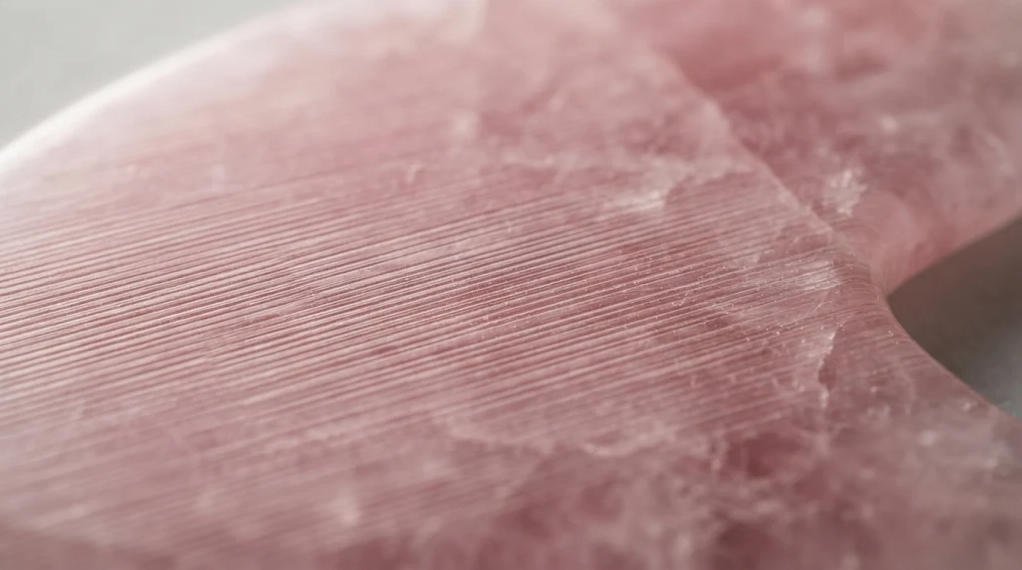
What Gua Sha Production Grinding Wheel Marks Really Cost
Gua sha production runs into the same six root causes of grinding wheel marks again and again: the wrong grit step, a worn wheel, too much pressure, the wrong wheel speed, weak hand-offs between stages, and thin cooling water. Quartz measures 7 on the Mohs scale, according to GIA’s rose quartz fact sheet, so a wheel that cuts it can also leave a groove that polish will not erase. This article shows you what a gua sha factory can control, what it cannot, and what you should ask before you order. A sound gua sha process uses a four-stage grit sequence, one inspection before polishing, and a 7-step rework routine. It also comes with limits, because natural stone varies and no gua sha manufacturer can honestly promise a zero-defect batch. If you buy through guasha wholesale channels, those limits become your risk too. What Grinding Marks Reveal About Gua Sha Production Risk Start here: a grinding mark is not only a scratch you can see. It is a record of what happened on the grinding line. Read it correctly and you learn which wheel, which pressure or which water supply caused it. Read it wrongly and you pay for the same defect again in the next batch. The Short Answer: Three Controls That Stop Most Marks Three controls stop most grinding marks in gua sha production. The first is a grit sequence where each stage erases the last stage’s scratches. The second is a dedicated inspection before polishing. The third is graded rework that respects thickness tolerance. Everything below explains how to run them and how to tell when someone only claims to. The grit sequence matters most. Polish improves gloss, but it does not promise to remove deep grinding scratches. A coarse wheel used on a nearly finished board therefore leaves a groove that survives every later step, and the polish only makes that groove easier to see. This means you can judge a supplier by asking which stage is expected to erase which scratch, instead of asking how shiny the sample looks. The inspection is the cheapest control and the easiest to skip. Marks show up more clearly before polishing, because gloss scatters light and hides the pattern until a customer spots it under a bathroom lamp. One fixed light and a few tilted angles catch most of them. This means you can move defects out of the packing room and into a stage where fixing them is cheaper. Why a Surface Defect Is Also a Disclosure Issue Here is the uncomfortable part. A mark that survives to packing is a quality problem, but a mark that was found, covered with polish and shipped anyway is a disclosure problem. If you resell through guasha wholesale channels or marketplaces, you carry that risk downstream, because the end customer never meets the person who ground the stone. This article therefore follows a risk-disclosure format: for each control, it describes what works, what can still go wrong, and who pays when it does. Natural stone adds a second layer. Veins, inclusions and fissures belong to the material, not to the wheel, so a fair gua sha manufacturer separates the two on the inspection sheet and tells you which defects are grounds for rejection. If your supplier files everything under “natural characteristics,” ask for close-up photos and a written definition. This means you can protect your return rate by agreeing on defect categories before the first order ships. One more note before you read on. Nothing here promises that your next shipment will be defect-free. Wheels wear, stones hide internal flaws, and people get tired at hour seven of a shift. A supplier who admits this and shows you the control points is a safer bet than one who says it never happens. This means you can treat honest limits as a buying signal. How Grit Progression Works in Gua Sha Production Grit progression is the backbone of the whole gua sha process. Rough grinding removes cutting traces and shapes the outline. Medium grinding erases the grooves that rough grinding left behind. Fine grinding refines the surface, and final grinding plus polishing deliver flatness and gloss. Each wheel has one job, and the rule is strict: the next stage must be able to remove what the previous stage left. Speed tempts people to skip steps, since a coarse wheel removes material fastest. This means you can ask for a stage checklist and see exactly where a supplier lets scratches slip through. How to Set a Four-Stage Grit Sequence You can set this up without borrowing anyone else’s numbers. First, pick a test batch of the exact stone you plan to run, whether that is rose quartz, amethyst or nephrite. Second, grind three sample boards through the rough and medium stages, then inspect each one under a single fixed light. If rough-stage marks are still visible, the grit jump is too large and the sequence needs an intermediate wheel. Third, repeat the same check from medium to fine and from fine to polish. Fourth, record wheel type, grit, pressure range and time for each stage on one card, and freeze that card for the material. Keep one caveat in mind. Grit values and stage counts depend on stone type, wheel material and machine condition, so a card that works on quartz may behave differently on nephrite, which GIA lists at 6 to 6.5 on the Mohs scale, against 7 for quartz. This means you can replace guesswork with one documented trial, and you can compare two suppliers by the quality of their stage cards. Why Polishing Cannot Hide Deep Scratches in Gua Sha Production Polish is a finishing step, not a repair step. GIA’s durability guide treats hardness, toughness and stability as three separate factors, which is a useful reminder that a stone can resist scratching in general and still carry a deep groove from one wrong wheel. A groove cut at the rough stage usually sits well below the thin layer […]
What Gua Sha Production Grinding Wheel Marks Really Cost Read More »
Gua sha production runs into the same six root causes of grinding wheel marks again and again: the wrong grit step, a worn wheel, too much pressure, the wrong wheel speed, weak hand-offs between stages, and thin cooling water. Quartz measures 7 on the Mohs scale, according to GIA’s rose quartz fact sheet, so a wheel that cuts it can also leave a groove that polish will not erase. This article shows you what a gua sha factory can control, what it cannot, and what you should ask before you order. A sound gua sha process uses a four-stage grit sequence, one inspection before polishing, and a 7-step rework routine. It also comes with limits, because natural stone varies and no gua sha manufacturer can honestly promise a zero-defect batch. If you buy through guasha wholesale channels, those limits become your risk too. What Grinding Marks Reveal About Gua Sha Production Risk Start here: a grinding mark is not only a scratch you can see. It is a record of what happened on the grinding line. Read it correctly and you learn which wheel, which pressure or which water supply caused it. Read it wrongly and you pay for the same defect again in the next batch. The Short Answer: Three Controls That Stop Most Marks Three controls stop most grinding marks in gua sha production. The first is a grit sequence where each stage erases the last stage’s scratches. The second is a dedicated inspection before polishing. The third is graded rework that respects thickness tolerance. Everything below explains how to run them and how to tell when someone only claims to. The grit sequence matters most. Polish improves gloss, but it does not promise to remove deep grinding scratches. A coarse wheel used on a nearly finished board therefore leaves a groove that survives every later step, and the polish only makes that groove easier to see. This means you can judge a supplier by asking which stage is expected to erase which scratch, instead of asking how shiny the sample looks. The inspection is the cheapest control and the easiest to skip. Marks show up more clearly before polishing, because gloss scatters light and hides the pattern until a customer spots it under a bathroom lamp. One fixed light and a few tilted angles catch most of them. This means you can move defects out of the packing room and into a stage where fixing them is cheaper. Why a Surface Defect Is Also a Disclosure Issue Here is the uncomfortable part. A mark that survives to packing is a quality problem, but a mark that was found, covered with polish and shipped anyway is a disclosure problem. If you resell through guasha wholesale channels or marketplaces, you carry that risk downstream, because the end customer never meets the person who ground the stone. This article therefore follows a risk-disclosure format: for each control, it describes what works, what can still go wrong, and who pays when it does. Natural stone adds a second layer. Veins, inclusions and fissures belong to the material, not to the wheel, so a fair gua sha manufacturer separates the two on the inspection sheet and tells you which defects are grounds for rejection. If your supplier files everything under “natural characteristics,” ask for close-up photos and a written definition. This means you can protect your return rate by agreeing on defect categories before the first order ships. One more note before you read on. Nothing here promises that your next shipment will be defect-free. Wheels wear, stones hide internal flaws, and people get tired at hour seven of a shift. A supplier who admits this and shows you the control points is a safer bet than one who says it never happens. This means you can treat honest limits as a buying signal. How Grit Progression Works in Gua Sha Production Grit progression is the backbone of the whole gua sha process. Rough grinding removes cutting traces and shapes the outline. Medium grinding erases the grooves that rough grinding left behind. Fine grinding refines the surface, and final grinding plus polishing deliver flatness and gloss. Each wheel has one job, and the rule is strict: the next stage must be able to remove what the previous stage left. Speed tempts people to skip steps, since a coarse wheel removes material fastest. This means you can ask for a stage checklist and see exactly where a supplier lets scratches slip through. How to Set a Four-Stage Grit Sequence You can set this up without borrowing anyone else’s numbers. First, pick a test batch of the exact stone you plan to run, whether that is rose quartz, amethyst or nephrite. Second, grind three sample boards through the rough and medium stages, then inspect each one under a single fixed light. If rough-stage marks are still visible, the grit jump is too large and the sequence needs an intermediate wheel. Third, repeat the same check from medium to fine and from fine to polish. Fourth, record wheel type, grit, pressure range and time for each stage on one card, and freeze that card for the material. Keep one caveat in mind. Grit values and stage counts depend on stone type, wheel material and machine condition, so a card that works on quartz may behave differently on nephrite, which GIA lists at 6 to 6.5 on the Mohs scale, against 7 for quartz. This means you can replace guesswork with one documented trial, and you can compare two suppliers by the quality of their stage cards. Why Polishing Cannot Hide Deep Scratches in Gua Sha Production Polish is a finishing step, not a repair step. GIA’s durability guide treats hardness, toughness and stability as three separate factors, which is a useful reminder that a stone can resist scratching in general and still carry a deep groove from one wrong wheel. A groove cut at the rough stage usually sits well below the thin layer […]