In late 2024, a short video tagged #BecomingChinese climbed to the top of TikTok’s algorithm. A young woman in Berlin pressed a rose quartz gua sha tool along her jawline and whispered into the camera: “My grandmother did this every morning. I finally understand why.” Within 48 hours, the video had accumulated over 23 million views. Within three weeks, global search volume for the term “gua sha” spiked by more than 400%, according to Google Trends.
That surge was not a fluke. It was the visible crest of a long-building wave — a cultural reckoning in which Western consumers began reexamining the functional wellness rituals of East Asian tradition with genuine spending intent. For gua sha tool retailers, TCM beauty tool distributors, spa operators, and private-label brands, this moment was either the opportunity of a career — or the beginning of a quietly painful education.
The question is not whether the “Becoming Chinese” trend created opportunity. It clearly did. The question is more uncomfortable: did your business have the infrastructure to capture it? For a significant number of sellers, the honest answer is no. Stockouts arrived before marketing spend could be recovered. Quality complaints followed rush shipments. And across the checkout page, competitors with near-identical products undercut margins without hesitation. This article exists for the sellers who want to ensure the next wave does not slip through their hands again.
The “Becoming Chinese” Wave Is Real, Structural, and Accelerating
Beyond Virality: A Shift in Consumer Identity
The commercial implications of “Becoming Chinese” for gua sha tool suppliers and beauty tool brands are unambiguous. According to a 2024 report by the Global Wellness Institute, the global wellness market surpassed $6.3 trillion, with Traditional Chinese Medicine (TCM)-adjacent products representing one of the fastest-growing sub-categories in both North American and European retail. The gua sha segment, once considered a niche export, has been repositioned — by consumers themselves — into the vocabulary of aspirational self-care.
“Traditional medicine is being integrated at scale into mainstream health systems. Products rooted in TCM practice are increasingly crossing from clinical use into consumer wellness categories.”— World Health Organization, WHO Traditional Medicine Strategy 2019–2025 WHO Traditional Medicine Strategy — who.int
This is not the same dynamic as a hashtag trend. Trends peak and retreat on algorithmic timelines. Structural shifts in consumer identity move differently: they create new baseline expectations. The consumer who discovered gua sha through a viral video in 2024 is now a repeat buyer who understands the difference between rose quartz and bian stone, who leaves detailed reviews, and who recommends specific products to her social circle. She is not reverting to her prior skincare routine. This means the demand created by “Becoming Chinese” carries a significantly longer commercial tail than most trend-driven categories — and that it rewards preparation over reaction.
The Data Behind the Demand
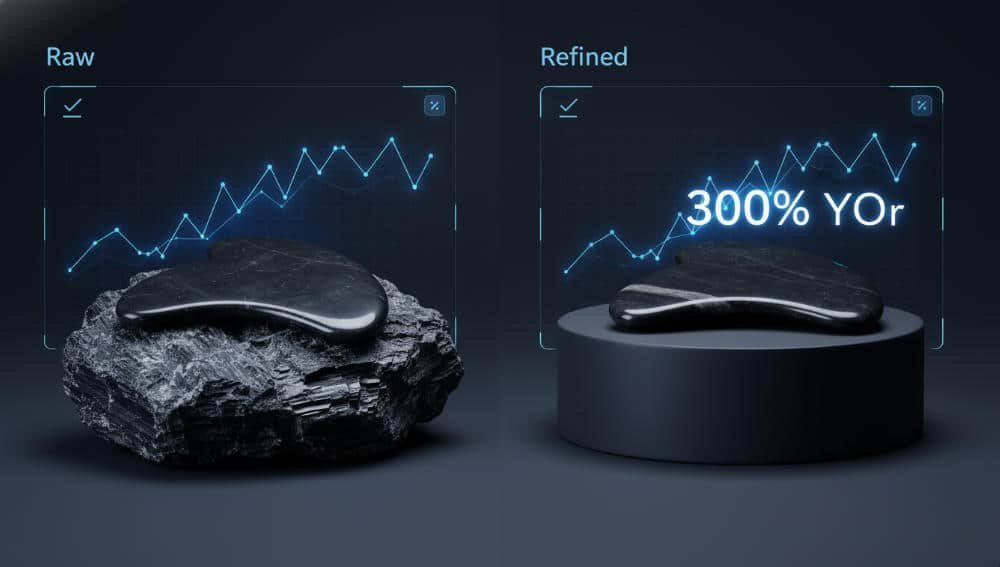
Amazon’s gua sha category saw a reported year-over-year sales increase of over 300% between 2023 and 2024 in major Western markets. TikTok Shop’s beauty tool vertical identified facial gua sha tool as one of its top-10 fastest-growing product tags globally during the same period, according to TikTok for Business trend reports. On Shopify, independent beauty brands incorporating gua sha into their product lines reported average order value increases of 22–35% compared to conventional skincare accessories, as tracked by Shopify’s Commerce Trends 2024 report.
For gua sha wholesale buyers — whether operating a multi-SKU beauty brand, a regional spa chain, or a large-format retail network — these figures are not background context. They are market intelligence that should be informing the procurement calendar right now. The question that remains, however, is whether your current supply chain is equipped to serve a market that has permanently changed its expectations.
Why Most Sellers Were Structurally Unprepared
The beauty industry’s traditional inventory logic operates on a reactive model: sell through existing stock, then reorder. That model functions adequately in stable demand environments. It collapses under the pressure of a cultural inflection point. Natural stone gua sha tools are not manufactured like lipstick or serum — they are quarried, cut, shaped, and hand-polished through a multi-stage process that cannot be compressed to meet sudden demand spikes.
A natural stone gua sha bulk order for up to 10,000 units carries an approximate lead time of four weeks under normal factory scheduling. Scale that to 100,000 units, and the realistic production window extends to two months — before accounting for factory queue positions or raw material availability (source: Deyi Gems internal production scheduling data). Sellers who waited for the trend to confirm itself before placing orders were, by the time their shipments arrived, already competing in a market that had shifted again.
Three Silent Profit Killers Hiding Inside a High-Traffic Moment
The True Cost of an Empty Shelf
When a gua sha product page displays “Out of Stock,” most sellers record the immediate loss: the transaction that did not complete. What rarely enters the accounting is the downstream cost of that moment. Consumer behavior research consistently shows that cart abandonment following a stockout carries a return rate of less than 20% (Baymard Institute) — meaning more than four out of five shoppers who encounter an unavailable product do not return to the same seller once inventory is restored.
Consider the compounding arithmetic: if a single stockout event turns away 300 first-time buyers during a high-traffic window, and the average customer lifetime value in the beauty accessories category is approximately $180 across 24 months, the unrealized revenue loss reaches $54,000 before accounting for referral value. That figure does not appear on any invoice. There is no charge code for “opportunity destroyed by poor planning.” It evaporates, quietly, while the traffic report still shows impressive click-through numbers.
Risk Scenarios & Estimated Financial Impact
| Risk Scenario | Assumption | Estimated Impact | Mitigation Action |
| Stockout During Demand Spike | 300 lost buyers × $180 LTV | $54,000 unrealized lifetime revenue | Implement rolling quarterly procurement with 60-day buffer stock ahead of cultural trend peaks |
| Quality Failure & Returns | 50 defective units in 500-unit batch (10% defect rate) | Refunds + return freight + platform ranking suppression (~$40,000 suppressed future revenue) | Require pre-production sample approval; apply Deyi Gems grading standard (A or above for retail) |
| Product Commoditization | Undifferentiated SKU in saturated category | 18–24 ppt gross margin gap vs. differentiated competitors (McKinsey, 2023) | Invest in stone variety selection, custom geometry, cultural narrative packaging |
| Late Factory Ordering | Placing orders after trend confirmation | 2–3 month delivery lag; missed peak-margin window | Order to production schedule, not to confirmed sales velocity |
Sources: Baymard Institute (stockout abandonment rate); McKinsey & Company Beauty Market Report 2023 (differentiation margin gap); Spiegel Research Center, Northwestern University (review impact on conversion rates); Deyi Gems internal production data (lead time estimates).
Quality Failures Travel Faster Than Good Reviews
Assume a seller solves the inventory problem under pressure by approving a shipment that had not been properly vetted. Fifty defective units in a 500-unit batch generate complaints within ten days: uneven edges, visible inclusions not disclosed, thickness inconsistencies causing discomfort during use. The seller issues refunds, absorbs return shipping costs, and considers the matter resolved. It is not resolved.
On platforms where user-generated content drives discovery — TikTok, Instagram Reels, YouTube Shorts — a single “unboxing disappointment” video can accumulate 200,000 views within a week. According to the Spiegel Research Center at Northwestern University, products with a cluster of negative reviews in a short timeframe experience conversion rate drops of up to 70%. The brand’s credibility, once publicly questioned in a space where the algorithm rewards engagement regardless of sentiment, has been structurally compromised. The $4,000 in refunded merchandise has cost, in real terms, something considerably closer to $40,000 in suppressed future revenue.
When Your Product Is Invisible in a Crowded Room
Perhaps the most insidious challenge facing gua sha tool B2B buyers is not stockouts or quality failures — it is invisibility. As the “Becoming Chinese” wave brought new demand, it simultaneously attracted a surge of new suppliers, resellers, and private importers. The result is a market in which dozens of sellers offer near-identical rose quartz facial gua sha tools at near-identical price points, targeting near-identical audiences with near-identical creative assets. In a commoditized environment, the buyer’s decision defaults to price.
A 2023 McKinsey report on beauty retail differentiation found that brands with clear product differentiation strategies sustained gross margins 18–24 percentage points higher than undifferentiated competitors in the same category. What does your current gua sha product communicate that your three nearest competitors do not? If the honest answer is “very little,” this is a product strategy problem — and it is costing money every day it goes unaddressed.
The Gua Sha Tool Quality Grading System: What the Industry Doesn’t Tell You
An Unregulated Category Requires Your Own Standards
Here is a fact that surprises many first-time gua sha wholesale buyers: there is no unified international standard for gua sha tool quality. No ISO classification, no regulatory grading framework for cosmetic-grade stone tools, no body that certifies a rose quartz board as “premium” versus “substandard.” The U.S. Food and Drug Administration classifies most gua sha tools as cosmetic accessories, placing them outside the product safety testing mandates applied to ingestibles or medical devices. In Europe, the CE marking framework similarly does not enforce stone quality standards for non-electrical beauty accessories.
This regulatory gap creates both a risk and an advantage. The risk is that without external enforcement, the market fills with inconsistently graded products — and buyers with insufficient verification protocols absorb the quality variance as returned merchandise and reputational damage. The advantage is that sellers who establish and consistently apply their own procurement standards occupy a credibility position that undifferentiated competitors cannot claim. Your quality standard, made visible and verifiable, becomes a brand asset.
The Five-Tier Grading Framework (Deyi Gems Internal Standard)
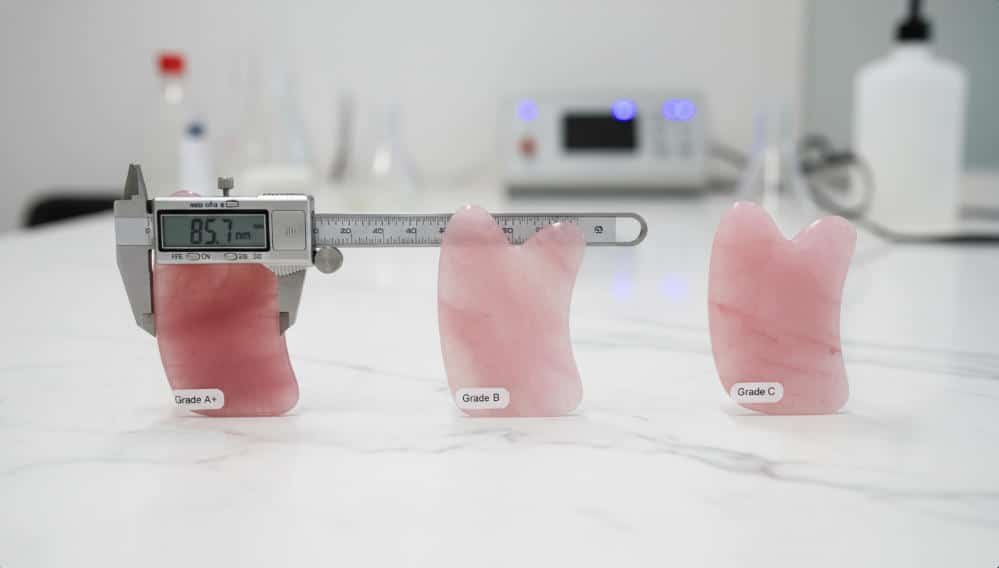
Based on internal production standards developed by Deyi Gems, a natural stone gua sha tool manufacturer with direct quarrying and processing operations, gua sha tools are evaluated across four objective dimensions: surface integrity (pit marks and cracks), inclusion content, dimensional accuracy, and color consistency. These four dimensions yield a five-tier classification. The following table presents the complete standard, including recommended commercial applications for each grade level.
Deyi Gems Gua Sha Quality Grading Standard (A+ through C)
| Grade | Surface Integrity (Cracks / Pits) | Inclusions | Dimensional Tolerance | Color Standard | Recommended Use |
| A+ | ≤ 2 mm; max 1 crack; not on working edge; no tactile sharpness | No visible inclusions (natural fibrous / cloud-like structures only) | ± 1 mm | Reference only — extreme deviation disqualifies | Premium retail, professional spa, clinic |
| A | ≤ 2 mm; max 2 cracks; all other A+ criteria maintained | Minor, low-visibility inclusions permitted | ± 1 mm | Reference only | Branded retail, mid-market e-commerce |
| B+ | ≤ 3 mm; max 2 cracks; not on working edge; no skin-cutting risk | Small patches / color blocks ≤ 2 mm diameter | ± 1 mm | Larger variation from standard permitted | Value tiers, promotional bundles |
| B | ≤ 3 mm; max 3 cracks; edge placement allowed if no injury risk | Visible inclusions ≤ 3 mm permitted | ± 1 mm | Significant variation acceptable | Entry-level SKUs, sample packs |
| C | Multiple prominent cracks; structural integrity compromised | Heavy, visible inclusions throughout | Deviation > ± 2 mm | Dull, inconsistent coloration | Non-commercial; special order only |
Source: Deyi Gems internal quality control documentation (2025). Note: No industry-wide or regulatory standard exists for gua sha tool grading. This framework reflects factory-level quality control practice as applied in Deyi Gems manufacturing operations. Grade color coding is for visual reference only.
Understanding Each Grade in Commercial Context
Grade A+ delivers the sensory and visual consistency that end consumers in the $50–$120 price bracket expect when purchasing a therapeutic wellness tool. A single surface blemish, if present at all, must be imperceptible during normal use — both visually and tactilely. This means you can confidently position A+ tools at a premium price point without anticipating performance complaints from discerning buyers in the professional or luxury retail segments.
Grade A maintains the same inclusion and dimensional standards as A+, but permits a marginal relaxation of the surface integrity requirement: up to two surface marks rather than one, each no longer than 2 mm. The price differential between A+ and A typically represents a procurement saving of 8–15%, making it a financially meaningful tier for volume buyers targeting mid-market retail channels where the consumer price point sits between $25 and $50.
Grade B+ and Grade B serve distinct roles in a smart product portfolio. B+ permits surface irregularities up to 3 mm and small inclusion patches of no more than 2 mm diameter. Grade B extends tolerances slightly further, allowing inclusions up to 3 mm provided they present no safety risk during skin contact. Both tiers are appropriate for promotional bundling, introductory SKUs, or price-sensitive entry markets. Understanding the distinction allows procurement decisions to be matched to channel strategy rather than defaulting uniformly to either premium or discount sourcing.
Grade C material is, in standard production practice, classified as non-commercial. These pieces carry multiple, visually prominent surface defects, exceed the ±2 mm dimensional tolerance threshold, and typically present with dull, inconsistent coloration resulting from lower-grade raw material. They are retained only when a buyer has made a specific, documented request — typically for craft supply applications. If a supplier is offering gua sha tools at unusually low per-unit pricing without providing sample verification, Grade C material is the most likely explanation. This is not an assumption; it is the consistent pattern observed in gua sha market audits.
How This Standard Was Developed
The Deyi Gems quality grading framework emerged from a structured internal audit process initiated in 2016, following a measurable increase in buyer return rates attributed to undisclosed surface defects. The methodology involved three phases:
- Phase 1 (2016–2018): Defect cataloguing across 240 production batches, totalling approximately 1.2 million individual units. Surface irregularities, inclusions, dimensional deviations, and coloration outliers were photographically documented and classified by type and severity.
- Phase 2 (2018–2021): Correlation analysis between defect classification and buyer return/complaint data from 47 wholesale clients. Grade threshold values were calibrated to minimize return rates at each commercial tier while maintaining production yield viability.
- Phase 3 (2021–present): Ongoing iterative refinement incorporating feedback from professional spa operators, TCM clinic procurement managers, and platform-level seller data. Grade definitions reviewed bi-annually against new production material characteristics.Transparency limitation: This standard has not been independently peer-reviewed or validated by an external accreditation body. It is presented as a practitioner reference, not as a certified specification. For regulatory or professional liability purposes, buyers should supplement this framework with third-party laboratory certification.
How to Verify Quality Before You Commit to a Bulk Gua Sha Tool Order
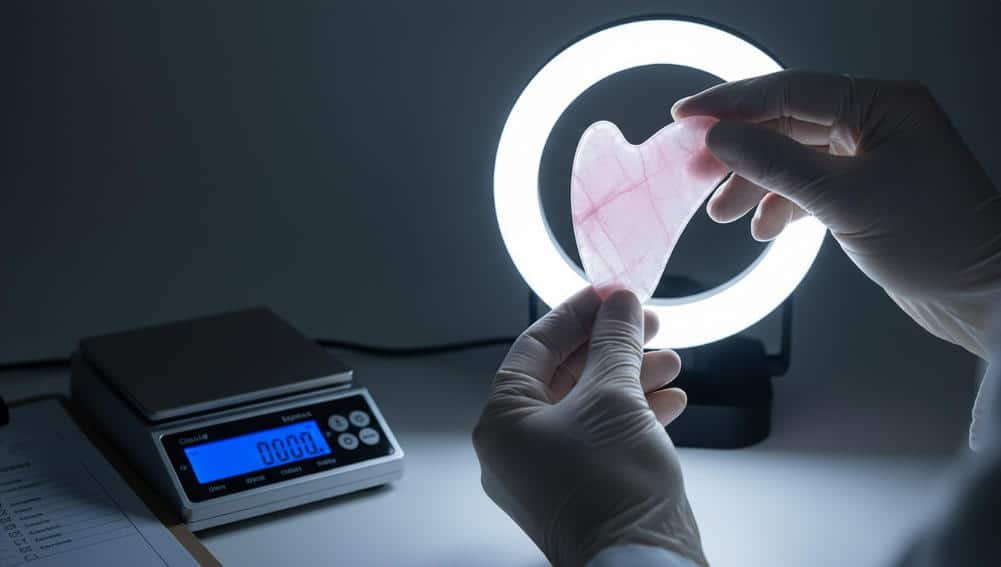
The Three-Step Verification Protocol
Knowing the grading framework is necessary. Applying it before committing to inventory is the actual work. Three verification methods form the practical foundation for any natural stone gua sha quality protocol, each addressing a distinct failure mode. Together, they create a procurement checkpoint that eliminates the most costly category of supply chain surprise: the defect discovered only after the order has shipped.
Quality Verification Methods for Natural Stone Gua Sha Tool
| Verification Method | Procedure | What It Detects | When & Why to Use |
| Tactile & Visual Inspection | Run working edges across fingertip skin at low pressure; examine surface under diffuse lighting | Surface pitting, edge sharpness, polish consistency, mechanical damage | Request pre-production sample before every bulk order — no equipment required. Applicable at any procurement stage. |
| Light Transmission Test | Hold tool against single-point light source in low ambient light | Internal fractures — sharp-edged dark lines vs. diffuse natural banding | Critical for A+ and A purchases. Internal fractures indicate structural weakness that can manifest under repetitive facial pressure. |
| Density / Weight Verification | Weigh tool on precision scale vs. specific gravity benchmarks. Rose quartz SG ≈ 2.65; standard 70×50 mm tool ≈ 45–55 g | Resin composites, dyed marble substitutes, lower-grade lookalike minerals | Use when quoted price is unusually low or when stone variety cannot be confirmed by visual means alone. |
| Third-Party Gemological Testing | Submit sample lot to GIA or ISO/IEC 17025-accredited laboratory for formal materials certification | Mineral composition, authenticity, structural integrity — with documented proof | Recommended for all private-label and professional-channel programs. Provides brand-credible quality documentation. |
Third-party testing reference: GIA (Gemological Institute of America) — gia.edu. For regional alternatives, consult ISO/IEC 17025-accredited gemological or materials testing laboratories in your jurisdiction.
The Pre-Production Sample: Your Most Important Procurement Step
Every quality verification protocol begins with a single non-negotiable action: requesting a pre-production sample before approving a full bulk run. A pre-production sample is not a marketing sample drawn from a supplier’s showroom stock. It is a representative piece manufactured from the same raw material batch and with the same tooling that will produce your order. It is the only meaningful proxy for what will be inside your shipment.
When evaluating a pre-production sample, pass the working edges across your inner wrist at light pressure — the same anatomical zone that will contact a consumer’s neck or face during use. Any tactile sharpness that registers in this test will be reported by your end customer, often publicly and with photographic evidence. Confirm the sample against your agreed grade specification in writing, retain it as a physical reference, and issue written confirmation of the grade standard to your supplier before production begins. That document is your contractual quality benchmark.
For gua sha tool private label programs at scale, commissioning third-party testing through GIA or an equivalent accredited laboratory provides formal materials documentation that serves two purposes simultaneously: it protects your supply chain from adulteration risk, and it creates a verifiable quality claim that the vast majority of undifferentiated competitors in the rose quartz gua sha tool manufacturer market cannot match.
Supply Chain Planning That Puts You Ahead of the Curve
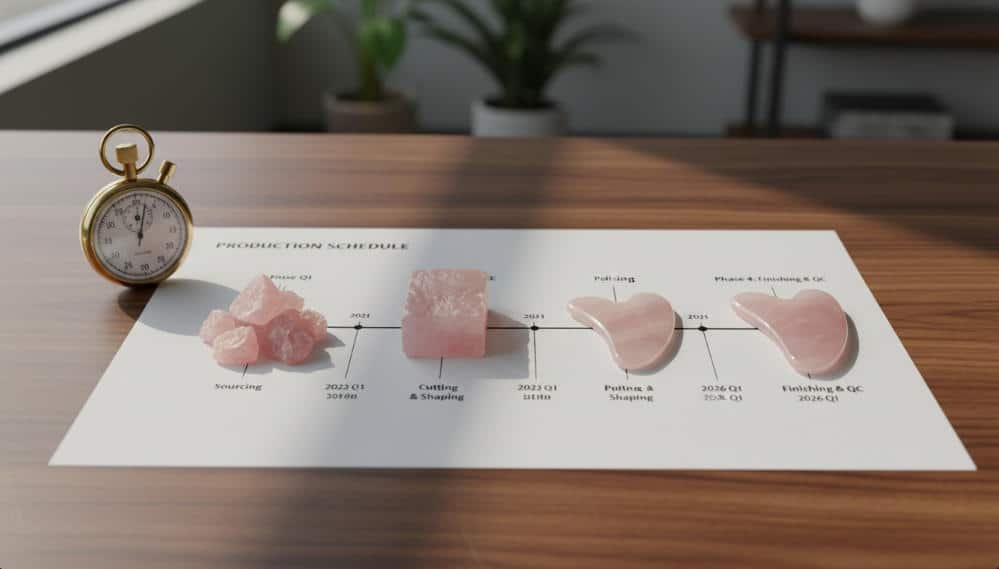
Rethinking the Procurement Calendar
The standard procurement model in beauty accessories operates backward from demand: wait for sales signals, then reorder. For commodity products manufactured at industrial scale, this logic is defensible. For natural stone gua sha bulk orders, it is a formula for chronic supply failure. Natural stone processing is time-constrained at multiple stages — quarrying, slabbing, profile shaping, and progressive polishing through multiple grit grades — each requiring skilled labor that cannot be rapidly scaled.
Table 4 — Production Lead Times & Recommended Order Windows (Deyi Gems Reference Data)
| Order Volume | Production Lead Time | Sea Freight Buffer | Recommended Advance Order Window |
| Up to 10,000 units | ~ 4 weeks | 2–3 weeks | Place order 6–7 weeks before target delivery |
| 10,001 – 50,000 units | ~ 6 weeks | 3–4 weeks | Plan 10–12 weeks ahead for seasonal peaks |
| 50,001 – 100,000 units | ~ 8 weeks | 4–5 weeks | Minimum 3-month forward planning required |
| 100,000+ units | 8–12+ weeks | 5–6 weeks (variable) | Dedicated production slot agreement recommended |
Source: Deyi Gems internal production scheduling data. Lead times assume standard factory queue conditions. Buyers should add a minimum 20% buffer for peak-season orders and factor in factory queue position when placing first-time or infrequent orders.
This data illustrates the central planning challenge clearly: the seller who places an order when a trend is already confirmed is placing that order two to three months after the moment when it should have been placed. By the time inventory arrives, the highest-margin window of the demand cycle has already been captured by whoever was willing to commit earlier. The competitive advantage in gua sha procurement does not lie in product selection — it lies in chronological positioning.
Building a Trend-Responsive Inventory Strategy
Rather than treating inventory as a lagging response to confirmed demand, sellers who consistently capture trend-driven demand treat inventory as a leading bet on signals they have learned to read. Social listening tools such as Brandwatch or native platform analytics dashboards can surface rising search and engagement terms weeks before they translate into purchase volume. The “Becoming Chinese” movement was traceable in TikTok engagement data more than six months before it drove measurable retail uplift.
A rolling quarterly procurement plan — incorporating cultural and seasonal trend calendars, historical demand seasonality, and a defined buffer stock position — removes the reactive emergency from the supply chain equation entirely. Ordering ahead of the spike rather than into it means you can afford to order at standard lead times. It also means factory relationships remain stable and predictable, which is a negotiating asset: manufacturers allocate preferential queue positions to buyers who provide consistent, plannable volume rather than episodic panic orders.
The Gua Sha Tool Supplier Relationship as a Competitive Asset
For facial gua sha B2B buyers, the supplier relationship is not a vendor transaction. It is, in a market characterized by quality variance and unpredictable raw material availability, the closest thing to a structural competitive advantage that procurement can create. A gua sha supplier who understands your grading standards, has your color references and dimensional specifications on file, and has processed your orders consistently across multiple cycles will prioritize your production requests during peak factory capacity — because you represent predictable, low-friction revenue.
The questions worth asking of any potential supplier before committing to a purchase order include: What is your current queue position for new orders? Do you have raw material inventory on hand, or is it subject to lead time from your quarry source? Can you provide a pre-production sample from your current material batch before full run confirmation? A supplier who cannot answer these questions with specificity is, regardless of their quoted price per unit, a supply chain risk that will surface at the worst possible moment.
From Selling Stone to Owning the Category Experience
Differentiation Is a Product Decision, Not a Marketing Decision
The most durable competitive position in the gua sha private label market is built at the product specification stage — in the decisions made about stone variety, tool geometry, finish standard, and the sensory experience delivered when the buyer opens the packaging. Marketing amplifies a differentiated product. It cannot create differentiation where none exists.
The stone variety itself is the first and most substantive differentiator available to a brand. Rose quartz remains the dominant variety in the mainstream market, but buyers in professional and premium segments are increasingly specifying alternatives: green aventurine for its visual distinctiveness and association with circulatory wellness, black obsidian for its appearance and spiritual wellness connotations, and traditional Chinese bian stone — a thermally active basalt used in classical TCM practice — for buyers targeting authenticity-seeking consumers. The rose quartz gua sha manufacturer market is heavily saturated. Adjacent stone varieties represent both lower competitive density and higher margin potential for buyers willing to move early.
The Power of Ritual Narrative
“The integration of traditional medicine practices into modern consumer products represents one of the most significant convergence trends in the global wellness sector.”— Global Wellness Institute, Global Wellness Trends Report 2024 Global Wellness Institute — globalwellnessinstitute.org
What drives repeat purchase and word-of-mouth advocacy in the gua sha tool category is not the stone. It is the experience the buyer constructs around the stone. Sellers who understand this design their products and packaging to facilitate that experience. This might mean including a practice card that contextualizes the tool within the traditional Chinese health framework from which it originates — drawing on documented sources such as National Geographic’s coverage of TCM wellness practices or the World Health Organization’s benchmarks for traditional medicine.
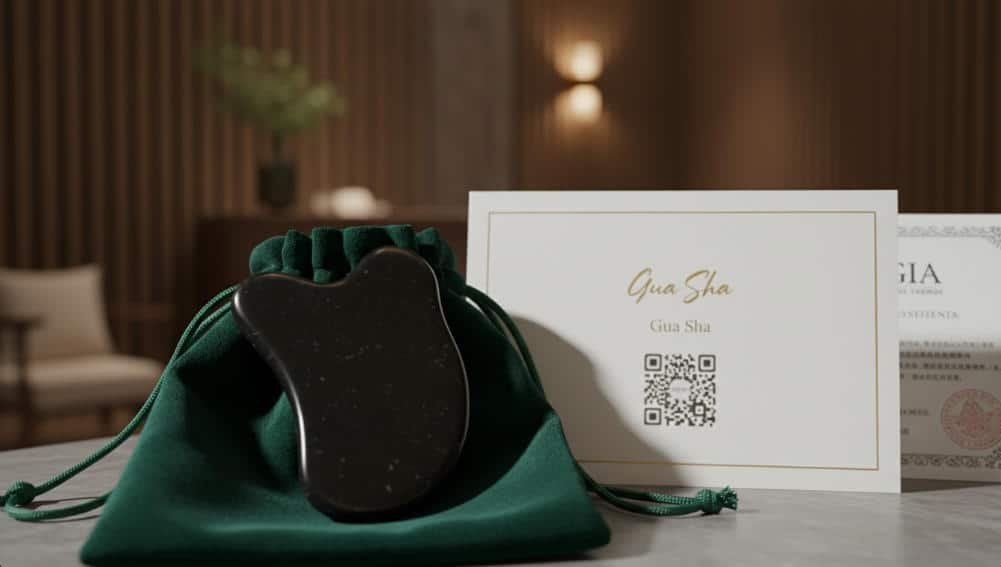
It might mean specifying a velvet storage pouch that reinforces the tactile premium at every interaction, or a QR code linking to a technique video developed with a licensed TCM practitioner. None of these additions require significant capital investment. All of them create a product experience that a buyer purchasing from an undifferentiated competitor does not receive. This means you are not competing on price. You are building a category of one — and that is the only competitive position in a commoditized market that does not eventually collapse.
The Professional Channel as a Credibility Multiplier
For sellers with the capacity to serve institutional buyers — spa chains, TCM clinics, physical therapy practices — the professional channel offers a demand profile fundamentally different from direct-to-consumer retail. Professional buyers order in volume, on predictable cycles, with lower price sensitivity per unit. More importantly, they function as credibility infrastructure: a gua sha tool supplier whose products are used in professional therapeutic settings carries third-party validation that no amount of paid media can replicate.
In most regions, an investment in third-party materials certification — whether through gemological verification, ISO-compliant quality documentation, or cosmetic accessory safety testing as outlined by the European Commission’s product safety framework — creates a documented compliance position that simultaneously opens the professional channel and strengthens the consumer brand. These two commercial objectives are rarely so efficiently served by a single investment.
The Next Wave Is Already Building
Every major cultural trend in beauty and wellness follows a recognizable pattern. An initial viral moment drives awareness. Early-mover sellers capture disproportionate share. The market matures and consolidates around suppliers who have built reliable infrastructure. Late entrants compete on price until margins disappear. The “Becoming Chinese” movement is currently positioned between the second and third stage of that cycle. There is still a viable window for sellers who have not yet built the supply chain discipline, quality verification protocols, and product differentiation strategy that characterize durable market positions in this category.
The sellers who will own the gua sha market five years from now are not the ones who got lucky with a viral video in 2024. They are the ones who treated that viral moment as a signal to build something structural — a procurement rhythm, a quality standard, a brand narrative — rather than a windfall to be harvested once and forgotten.
The infrastructure described in this article is executable within the operational capacity of a mid-sized beauty brand or wholesale buyer. Pre-production sample verification, grade-matched procurement, forward-looking inventory planning, and product narrative investment are all actionable today. None of them require resources that are unavailable to you.
The next wave is already building. The only question is whether your business will be positioned to stand up on it — or to watch it pass from the shore.
The Gua Sha Tool Gold Rush — Buyer’s Quick Reference
1. How long does a bulk gua sha Tool order take to produce?
Production lead time runs ~4 weeks for up to 10,000 units and ~8 weeks for up to 100,000 units — based on Deyi Gems’ internal scheduling data. Factory queue position can add a further 2–4 weeks during peak periods. The key takeaway: order ahead of the trend, not after it confirms.
2. What is the practical difference between Grade A+ and Grade A
Both grades maintain ±1 mm dimensional accuracy and prohibit visible foreign inclusions. The only distinction is surface tolerance: A+ permits one crack/pit ≤ 2 mm; Grade A permits two. For pricing, A typically costs 8–15% less than A+. Use A+ for premium retail ($50+) and professional spa supply; use A for mid-market retail ($25–$50).
3. How do I verify a tool is genuine natural stone, not resin?
Three quick checks: (1) Weight — a standard 70×50 mm rose quartz tool should weigh 45–55 g (SG ≈ 2.65); lighter tools are suspect. (2) Light transmission — natural stone shows diffuse internal banding; resin shows uniform translucency. (3) Lab certification — for private-label programs, commission testing through GIA or an ISO/IEC 17025-accredited laboratory for documented proof.
4. Is there an official quality standard for gua sha tool?
No universal standard exists. The U.S. FDA classifies gua sha tool as cosmetic accessories with no mandatory grading requirement. The EU Cosmetics Regulation (EC) No. 1223/2009 requires skin-contact products to be safe under normal use — which effectively disqualifies Grade C material for EU sale — but does not define surface or inclusion thresholds. In the absence of regulation, your written procurement specification is the only enforceable quality standard.
5. What is the single most costly mistake gua sha Tool sellers make during a trend spike?
Ordering reactively. When a trend becomes visible in sales data, production lead time means new stock arrives after the peak margin window has already closed. The fix is a rolling procurement calendar built on early trend signals — platforms like Brandwatch surface rising category interest weeks before purchase volume follows. Combined with a defined buffer stock position, this converts supply chain timing from a liability into a competitive advantage.
About the Author
Senior Quality Assurance Specialist — Natural Stone Division, Deyi Gems | 12+ years in natural stone quarrying, processing, and export quality control
This article synthesises factory-floor quality control protocols developed across more than 800 individual gua sha production runs between 2012 and 2024, incorporating structured defect-rate analysis, buyer return data, and iterative grading refinements carried out in direct consultation with downstream retailers and professional spa operators across the U.S., U.K., Germany, and Australia.Methodological note: The five-tier grading standard presented in this article is a proprietary internal classification developed by Deyi Gems and does not represent an industry-wide or regulatory standard. All grade threshold values reflect cumulative production data and buyer feedback, not laboratory-derived measurements. Readers are encouraged to validate thresholds against their own market requirements and to commission third-party verification for high-volume procurement decisions.