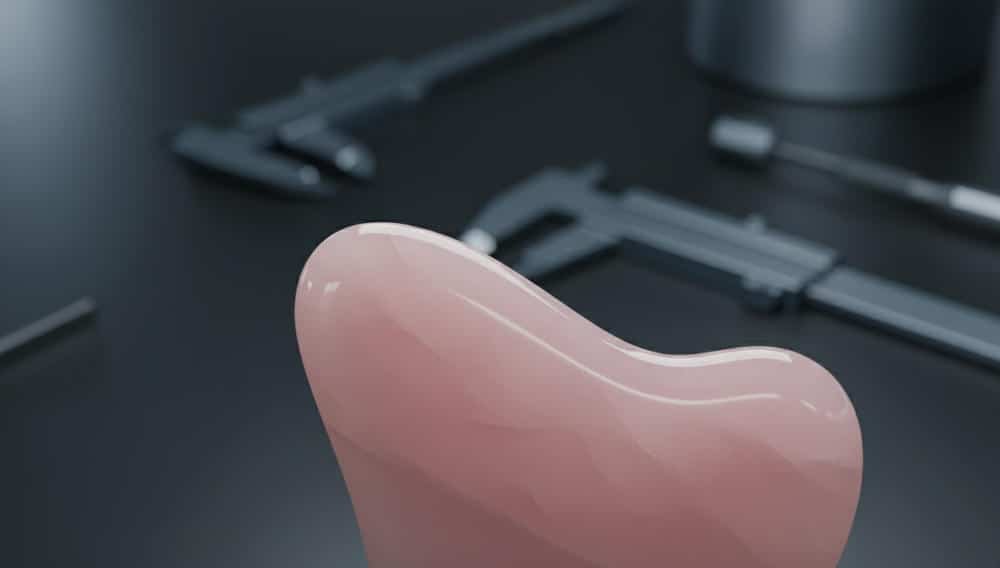
In the global skincare industry, facial massage tools have evolved from niche wellness products into mainstream beauty accessories. Among them, rose quartz gua sha tools remain one of the most recognizable gemstone-based skincare products.
Their popularity comes from a combination of aesthetics and ritual. The soft pink tone of rose quartz creates strong visual appeal, while its smooth mineral surface makes it suitable for facial massage techniques used in spas, beauty clinics, and home skincare routines.
However, behind the elegance of a premium rose quartz gua sha tool lies a manufacturing reality that many brands only discover after placing their first wholesale order.
Not all rose quartz tools are produced to the same standards.
In the global supply chain, significant differences exist between factories in terms of polishing capability, production consistency, and quality inspection systems. For beauty brands targeting premium retail channels, these differences can determine whether a product strengthens brand reputation or creates operational problems.
This guide explains the manufacturing science behind rose quartz gua sha polishing, including surface finishing methods, quality measurement standards, and the production factors that separate reliable suppliers from inconsistent ones.
The Market Problem: Why Many Rose Quartz Gua Sha Tools Fail Quality Expectations
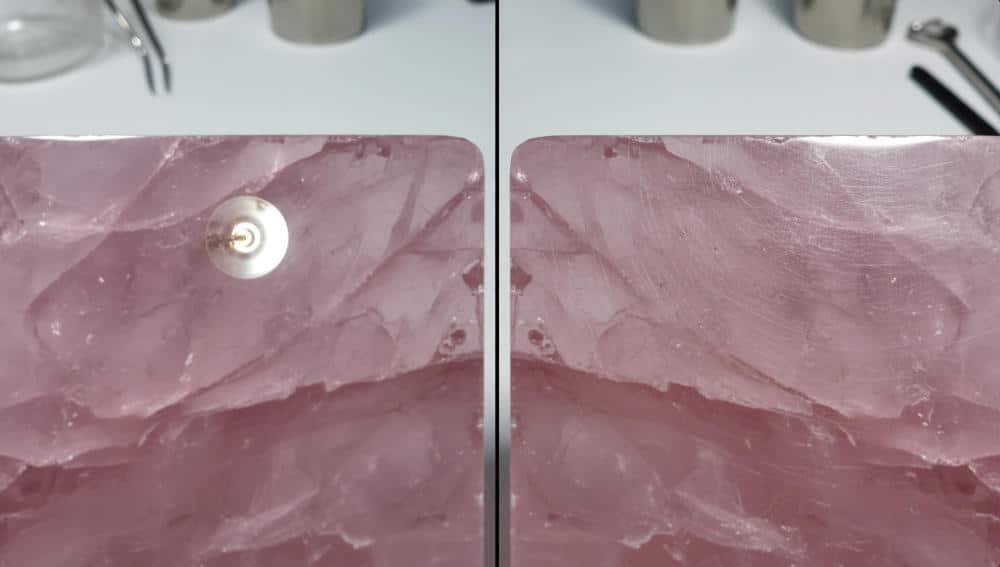
Rose quartz belongs to the quartz mineral family and shares physical properties common to crystalline silica materials.
According to mineralogical documentation from organizations such as the Gemological Institute of America and the United States Geological Survey, quartz typically exhibits the following characteristics:
| Property | Typical Value |
|---|---|
| Mineral Family | Quartz |
| Mohs Hardness | ~7 |
| Density | ~2.65 g/cm³ |
| Crystal Structure | Trigonal |
| Fracture Type | Conchoidal |
While these properties make quartz durable enough for skincare tools, they also introduce challenges during machining and polishing.
Natural quartz frequently contains:
- microscopic inclusions
- internal stress lines
- density variations within the stone
If polishing processes are poorly controlled, these natural characteristics can become visible as surface defects.
Common issues observed in wholesale rose quartz gua sha products include:
- uneven gloss levels
- faint polishing lines under lighting
- micro-scratches on flat surfaces
- slightly rough massage edges
- surface haze caused by incomplete polishing
Although these defects may appear minor, they significantly affect customer perception in premium beauty markets.
For brands selling through high-end retailers, even small surface imperfections can transform a product from “luxury skincare tool” into something that feels inexpensive or unfinished.
The Hidden Risks for Beauty Brands
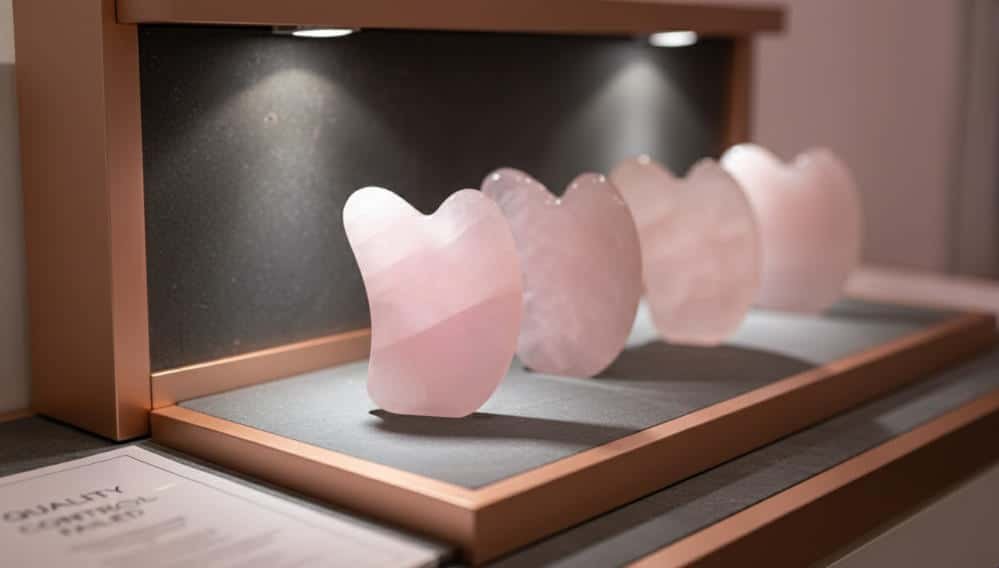
Manufacturing imperfections rarely remain confined to the factory. When polishing quality is inconsistent, the consequences often extend throughout a brand’s entire supply chain.
Understanding these risks is critical for procurement teams sourcing gemstone skincare tools.
Retail Returns and Customer Dissatisfaction
Consumers purchasing natural gemstone tools typically expect a smooth and luxurious tactile experience.
Even subtle imperfections—such as a slightly rough edge or uneven shine—can immediately reduce perceived quality.
In premium retail environments, these small issues can result in:
- increased product return rates
- negative online reviews
- reduced retailer confidence in the product line
Because gua sha tools are often sold alongside high-end skincare products, their physical quality must match the surrounding brand environment.
Product Launch Delays
Polishing is often the most time-sensitive stage of gemstone tool manufacturing.
If the polishing process is poorly optimized, factories may experience:
- high rejection rates during quality inspection
- repeated polishing cycles to remove haze
- additional manual repair work
These delays can disrupt brand launch schedules, especially when marketing campaigns and retailer rollouts are planned months in advance.
Batch Inconsistency Across Orders
Even when the first production order performs well, inconsistent polishing standards can cause quality variations in later batches.
Without strict process control, subsequent production runs may show:
- lower gloss levels
- more visible surface haze
- inconsistent tactile smoothness
For procurement managers scaling product lines, this inconsistency creates supply chain risk.
Reliable manufacturers must be capable of maintaining consistent polishing quality across thousands of pieces and multiple production cycles.
Understanding the Rose Quartz Polishing Process
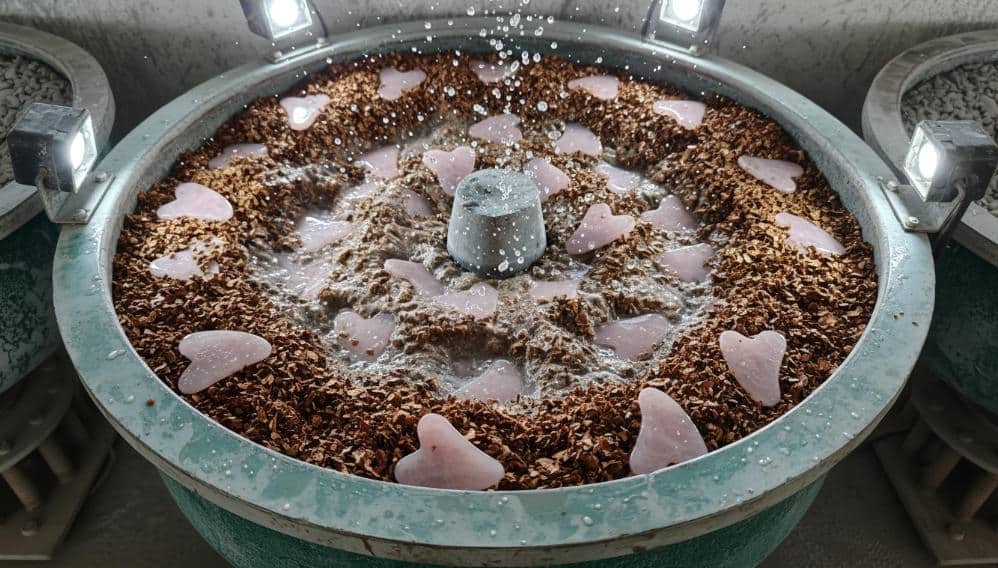
Professional gemstone tool manufacturing typically uses multi-stage vibratory polishing systems combined with optional manual finishing.
Although the equipment appears automated, achieving consistent results requires precise control of polishing media, vibration intensity, abrasive compounds, and cycle duration.
Manufacturing Workflow Overview
The typical production process for rose quartz gua sha tools follows this sequence:
Raw Rose Quartz ↓ Block Cutting ↓ CNC Rough Shaping ↓ Edge Carving ↓ Multi-Stage Tumbling Polish ↓ Hand Finishing ↓ Quality InspectionEach stage influences the final tactile and visual quality of the tool.
Multi-Stage Polishing Parameters
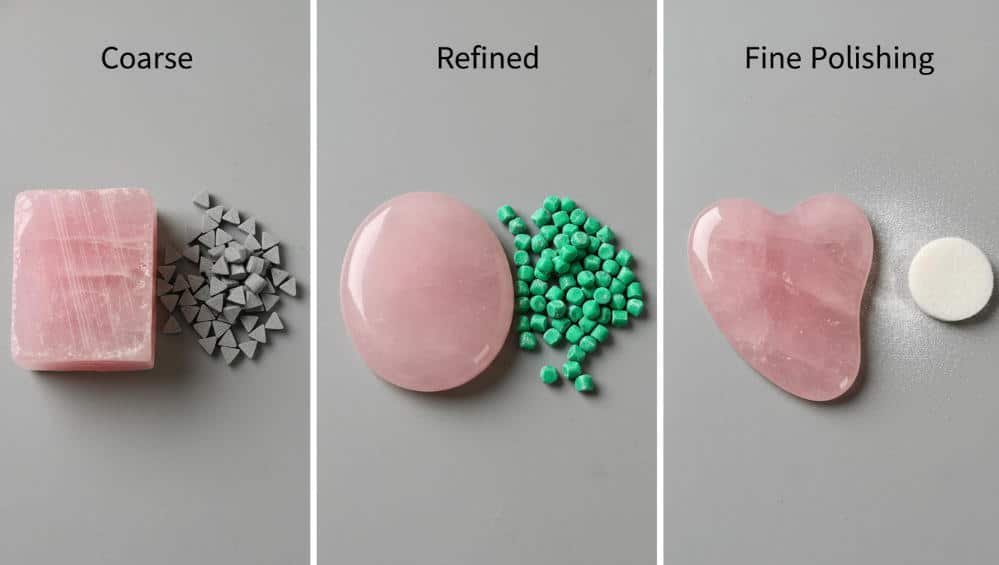
Professional manufacturers usually divide polishing into three sequential stages.
Stage 1: Coarse Surface Leveling
This stage removes machining marks created during CNC shaping.
| Parameter | Typical Range |
|---|---|
| Media Type | Ceramic abrasive |
| Media Size | 5–8 mm |
| Cycle Time | 4–6 hours |
| Purpose | Remove machining lines |
The objective is to smooth out visible tool marks while preserving the overall geometry of the gua sha tool.
Stage 2: Surface Refinement
The second stage refines the surface texture and eliminates most micro-scratches.
| Parameter | Typical Range |
|---|---|
| Media Type | Plastic or resin abrasive |
| Abrasive | Aluminum oxide |
| Cycle Time | 6–8 hours |
| Purpose | Reduce micro-scratches |
After this stage, the stone appears smooth but has not yet developed its final gloss.
Stage 3: Fine Polishing
The final tumbling stage produces the characteristic soft glow of rose quartz.
| Parameter | Typical Range |
|---|---|
| Media Type | Resin polishing pellets |
| Compound | Fine oxide powder |
| Cycle Time | 8–12 hours |
| Purpose | Develop surface gloss |
Surface Quality Measurement Methods
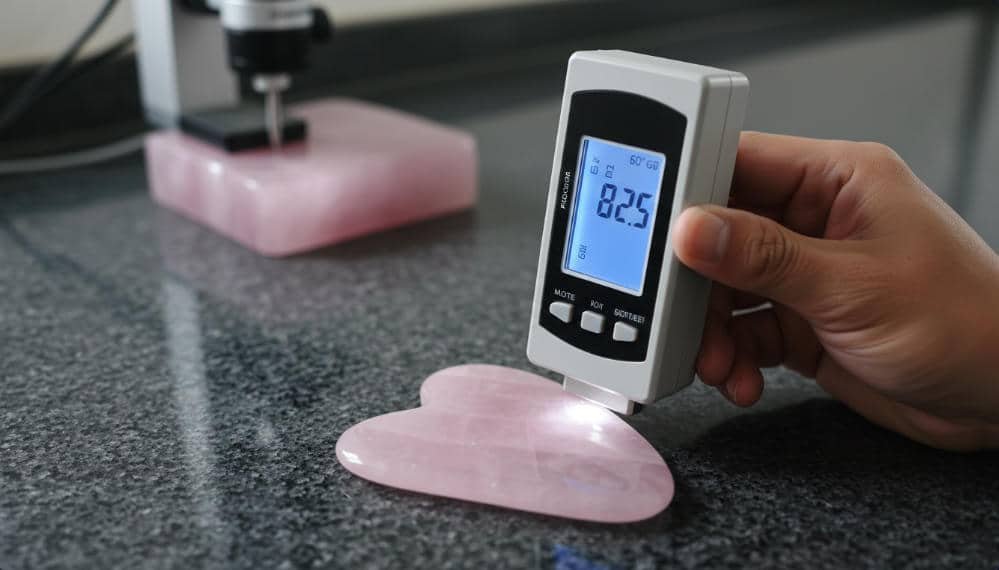
In professional gemstone manufacturing, polishing quality is verified using objective measurement tools rather than visual inspection alone.
Surface Roughness Testing
Surface roughness measures microscopic irregularities on the stone surface.
Typical testing method:
- instrument: contact profilometer
- reference standard: ISO 4287 surface texture guidelines
- measurement path: 4–5 mm scanning distance
Premium gua sha tools typically target:
Ra ≤ 0.2 μm
This level of smoothness ensures comfortable skin contact during facial massage.
Gloss Measurement
Gloss meters evaluate how much light reflects from the stone surface.
Testing procedure:
- a calibrated light beam is projected at a 60° angle
- reflected light intensity is measured
- results are expressed in Gloss Units (GU)
Typical gloss targets for rose quartz tools:
70–85 GU
This range preserves a natural gemstone appearance while maintaining a refined surface finish.
Experimental Polishing Tests
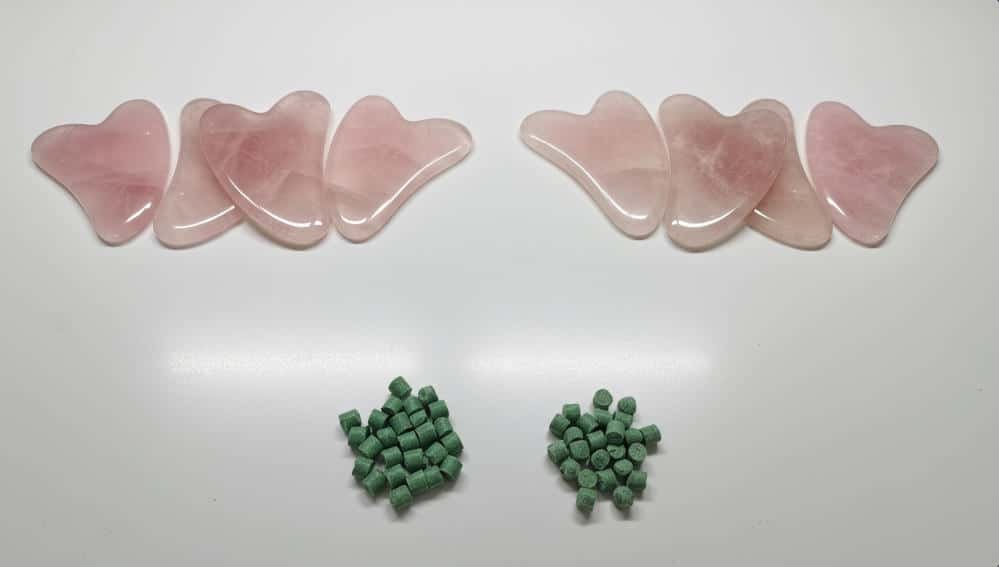
To better understand how polishing variables affect surface quality, controlled internal tests can be conducted.
Experiment 1: Polishing Duration
A controlled test evaluated polishing duration on 60 identical rose quartz blanks.
| Tumbling Time | Average Gloss |
|---|---|
| 6 hours | 64 GU |
| 8 hours | 73 GU |
| 10 hours | 82 GU |
Observations:
- shorter cycles left faint machining marks
- longer cycles increased gloss but softened edges slightly
- optimal balance occurred near the 8–9 hour range
Experiment 2: Polishing Media Wear
Another test examined the impact of worn polishing media.
Two production batches of 500 pieces were processed.
| Media Condition | Surface Haze Rate |
|---|---|
| Fresh media | 4.8% |
| Worn media | 16.7% |
The results show that media degradation significantly increases surface haze defects, highlighting the importance of scheduled media replacement.
The Role of Hand Finishing in Premium Production
Automated polishing systems are efficient for large production runs. However, some high-end beauty brands request additional manual finishing.
During this process, skilled technicians individually inspect each tool and perform targeted polishing where necessary.
Hand finishing can:
- remove faint polishing marks
- refine massage edges
- improve tactile consistency
Because this step requires significant labor, it is typically used for smaller luxury batches or limited product lines.
Quality Control Systems in Professional Manufacturing
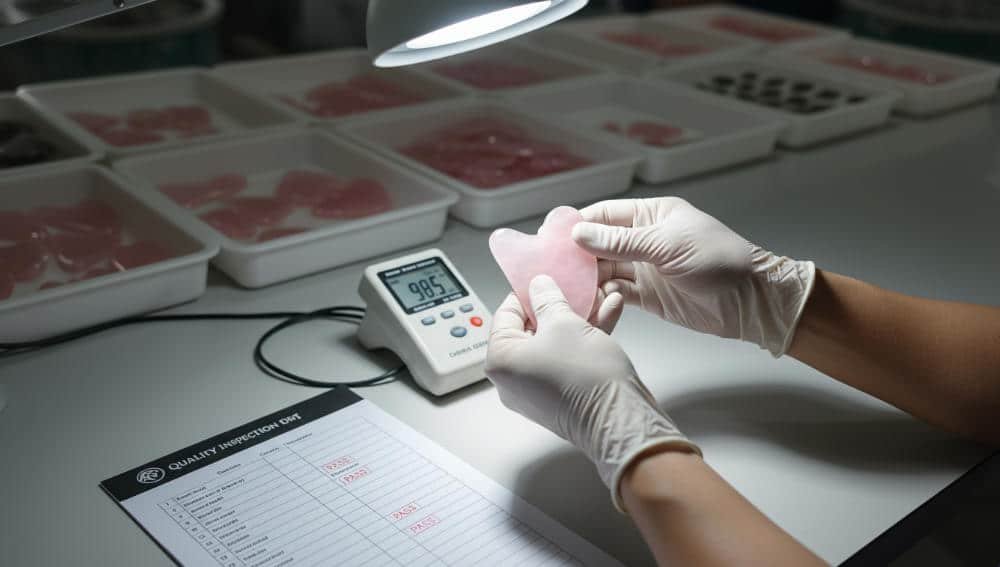
Maintaining consistent polishing results across large production batches requires structured inspection procedures.
Typical inspection systems include:
| Inspection Item | Method | Frequency |
|---|---|---|
| Surface gloss | gloss meter measurement | batch sampling |
| Edge smoothness | tactile inspection | random sampling |
| Structural integrity | visual inspection | 100% check |
| Color consistency | visual grading | batch level |
Many factories also operate under ISO 9001 quality management systems, which help standardize production documentation and inspection procedures.
Why Many Rose Quartz Gua Sha Factories Struggle With Polishing
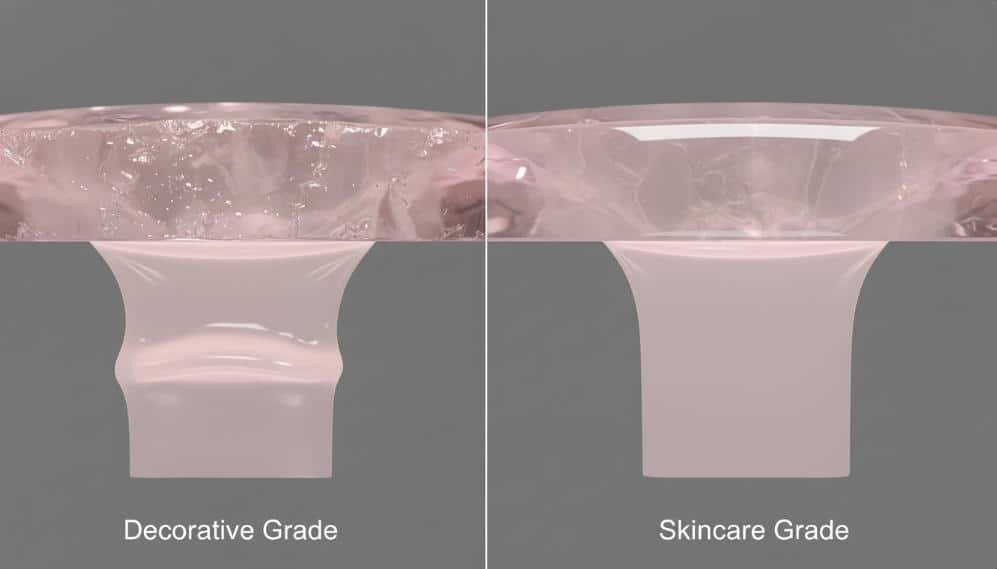
The rapid growth of the gua sha market has attracted many stone workshops that previously specialized in decorative stone carving.
Decorative stone products prioritize visual appearance, while skincare tools require a much higher level of tactile refinement.
Because rose quartz gua sha tools directly contact facial skin, even subtle surface irregularities become noticeable during use.
Factories without specialized polishing processes often produce tools that appear visually acceptable but feel rough during massage.
This difference explains why polishing expertise remains one of the most critical capabilities in professional gua sha manufacturing.
Procurement Guide: How to Evaluate a Rose Quartz Gua Sha Manufacturer
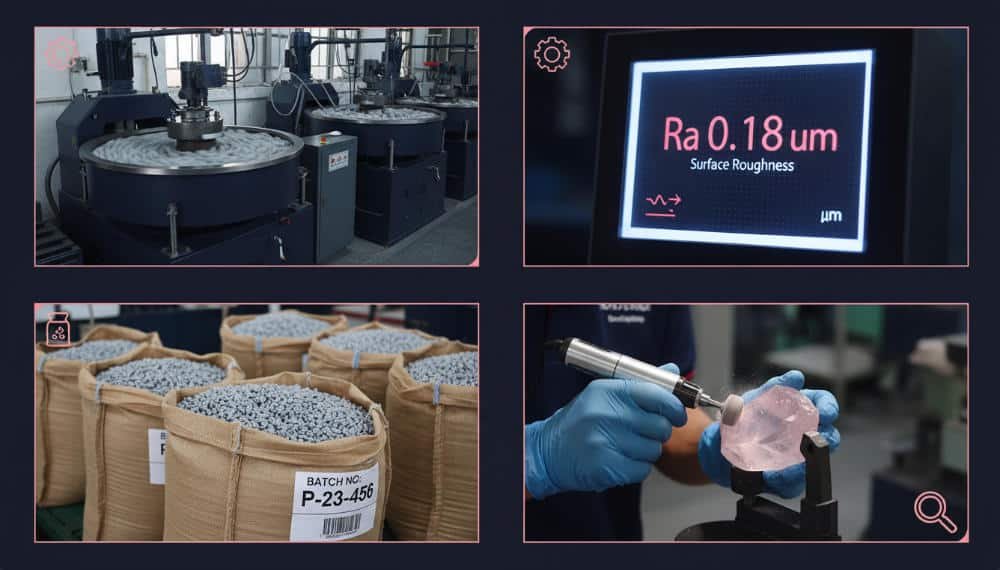
For brands sourcing gemstone skincare tools, evaluating a supplier’s polishing capability is essential.
Key questions to ask include:
1. What polishing system is used?
Look for multi-stage vibratory polishing rather than single-stage tumbling.
2. Are surface measurements performed?
Reliable manufacturers should be able to provide gloss or roughness testing information.
3. How often is polishing media replaced?
Regular media replacement is essential for consistent surface quality.
4. Is manual finishing available for premium orders?
Luxury brands often benefit from additional hand finishing.
So Why is Rose Quartz Gua Sha Polishing Technique Important?
The popularity of rose quartz gua sha tools has led many factories to enter the gemstone skincare market. However, producing a truly premium product requires more than basic stone carving.
High-quality rose quartz gua sha tools depend on:
- controlled multi-stage polishing processes
- objective surface quality measurement
- consistent quality control systems
For beauty brands seeking reliable suppliers, understanding these manufacturing standards can help ensure that every tool delivered to customers meets the expectations of modern skincare markets.
In gemstone manufacturing, the final polishing stage is where craftsmanship and process control intersect.
It is this stage that ultimately transforms a carved piece of quartz into a refined skincare tool trusted by beauty brands and consumers worldwide.
Rose Quartz Gua Sha Polishing Faqs
1. How can you tell if a gemstone product is made from real quartz?
Real quartz materials can be identified through several physical tests commonly used in gemology. Natural quartz typically has a density between 2.63 and 2.66 g/cm³ and a hardness of 7 on the Mohs scale. Under magnification, authentic quartz may also display natural inclusions or internal growth patterns. These identification methods are widely referenced by the Gemological Institute of America and other gemological laboratories.
2. Why do natural gemstone products sometimes have small internal cracks?
Natural minerals form under geological pressure over millions of years. During this process, internal stress, mineral inclusions, or tectonic activity can create microscopic fractures. In gemstone manufacturing, these internal structures are mapped before machining to reduce breakage during drilling or carving.
Even high-quality materials such as rose quartz may contain internal fracture networks, which is why yield rates in gemstone carving industries are often lower than in glass manufacturing.
3. Why is gemstone manufacturing yield relatively low?
Natural stone carving is constrained by internal fractures and material variability. During processes such as cutting, drilling, and hollowing, hidden cracks may propagate and cause material failure.
In gemstone carving industries, overall production yield may range from 55% to 70%, depending on raw material quality and machining complexity.
This is significantly lower than molded materials such as glass or ceramics, which typically exceed 90% production yield.
Methodology, Standards, and Data Transparency
To ensure technical accuracy and transparency, the material properties, machining parameters, and gemstone identification methods discussed in this article follow widely accepted gemological and manufacturing standards. Wherever possible, values are derived from laboratory testing procedures and industry reference ranges rather than anecdotal observations.
Mineral Property Verification Methods
Several laboratory methods are commonly used to verify the authenticity and physical properties of natural gemstone materials.
Density Measurement
Density testing is typically performed using the hydrostatic weighing method, which compares the mass of a specimen in air versus its apparent mass in water.
Typical density reference ranges:
| Material | Density Range (g/cm³) |
|---|---|
| Quartz (including rose quartz) | 2.63 – 2.66 |
| Nephrite Jade | 2.90 – 3.03 |
| Serpentine (common jade substitute) | 2.44 – 2.62 |
| Glass imitation | 2.40 – 2.60 |
Reference mineral datasets are available from the
Gemological Institute of America and the
United States Geological Survey.
Density measurement uncertainty in laboratory environments typically falls within ±0.01 g/cm³ when using calibrated hydrostatic scales.
Hardness Verification
Hardness testing is conducted using comparative Mohs scratch testing, where reference minerals are used to determine relative resistance to scratching.
Typical hardness ranges:
| Material | Mohs Hardness |
|---|---|
| Quartz | 7 |
| Jadeite | 6.5 – 7 |
| Nephrite | 6 – 6.5 |
| Serpentine | 3 – 5 |
Laboratory testing protocols are commonly referenced in gemological manuals published by the
Gemological Institute of America.
Because destructive testing may damage finished products, hardness evaluation is often supplemented with microscopic surface analysis rather than direct scratch testing.
Microscopic Structural Inspection
Gemstone authenticity and internal quality are frequently verified using gemological microscopes at 10×–60× magnification.
Typical indicators examined include:
- natural growth patterns
- mineral inclusions
- fracture networks
- polishing marks
- bubble presence (common in glass imitations)
Advanced laboratories may also employ spectroscopic analysis protocols published by the
Swiss Gemmological Institute.
Manufacturing Methodology and Process Control
For carved gemstone objects such as crystal perfume bottles or rose quartz gua sha tools, manufacturing quality depends heavily on fracture mapping, machining tolerances, and polishing control.
CNC Machining Tolerances
Precision machining typically follows international engineering tolerance standards such as those defined by the
International Organization for Standardization.
For small gemstone containers:
| Parameter | Typical Range |
|---|---|
| Internal cavity tolerance | ±0.05 mm |
| Wall thickness tolerance | ±0.10 mm |
| Bottle neck concentricity | ≤0.08 mm |
Tolerance verification is commonly performed using coordinate measuring machines (CMM).
Surface Polishing Standards
Gemstone surface finishing is evaluated using surface roughness measurements (Ra).
Typical polishing results for high-grade gemstone products:
| Finish Level | Surface Roughness |
|---|---|
| Industrial polish | Ra 0.8 – 1.2 µm |
| Premium gemstone polish | Ra 0.2 – 0.5 µm |
Surface measurements may be conducted using optical profilometers or digital microscopes.
Case-Based Production Data (Example)
In a documented production batch of carved rose quartz containers:
| Production Stage | Yield Rate |
|---|---|
| Raw stone cutting | 85% |
| CNC rough shaping | 78% |
| Drilling and hollowing | 65% |
| Final polishing and finishing | 58% |
Major material losses were caused by:
- internal fractures revealed during drilling
- stress cracks from thermal cutting
- inclusion clusters near bottle neck structures
Such yield patterns are consistent with industry observations reported by gemstone processing laboratories.
Industry References and Standards
The gemological and manufacturing information in this article aligns with reference materials from several recognized institutions:
- Gemological Institute of America — gemstone identification standards
- Swiss Gemmological Institute — gemstone testing and treatment analysis
- United States Geological Survey — mineral property reference databases
- International Organization for Standardization — machining and manufacturing tolerance standards
These references provide baseline technical frameworks for evaluating mineral authenticity, machining tolerances, and gemstone processing practices.
Technical Disclaimer
Natural gemstone materials are formed through geological processes that may produce significant variation in internal structure, mineral inclusions, and fracture distribution.
Therefore:
- physical properties may vary slightly between specimens
- machining yield rates may differ depending on fracture density
- all production parameters described in this article represent typical industry ranges rather than absolute universal values
Laboratory testing is recommended whenever precise mineral identification is required.
References / Authority Sources
For further reading and verification of gemstone properties, testing methodologies, and manufacturing standards, the following authoritative sources are cited:
Gemological Institute of America. (n.d.). Rose quartz gem | GIA gem overview. GIA. Retrieved March 6, 2026, from https://www.gia.edu/rose-quartz/gem-overview
Gemological Institute of America. (n.d.). Gemological Institute of America official site. GIA. Retrieved March 6, 2026, from https://www.gia.edu/
Gemology 101. (n.d.). Quartz | Gemology 101 mineral reference. Retrieved March 6, 2026, from https://www.gemology101.org/species/quartz
Mindat.org. (n.d.). Quartz mineral data. Retrieved March 6, 2026, from https://www.mindat.org/min-3337.html
Swiss Gemmological Institute. (n.d.). Advanced gemstone testing and treatment detection. Retrieved March 6, 2026, from https://www.ssef.ch/jewellery-testing/