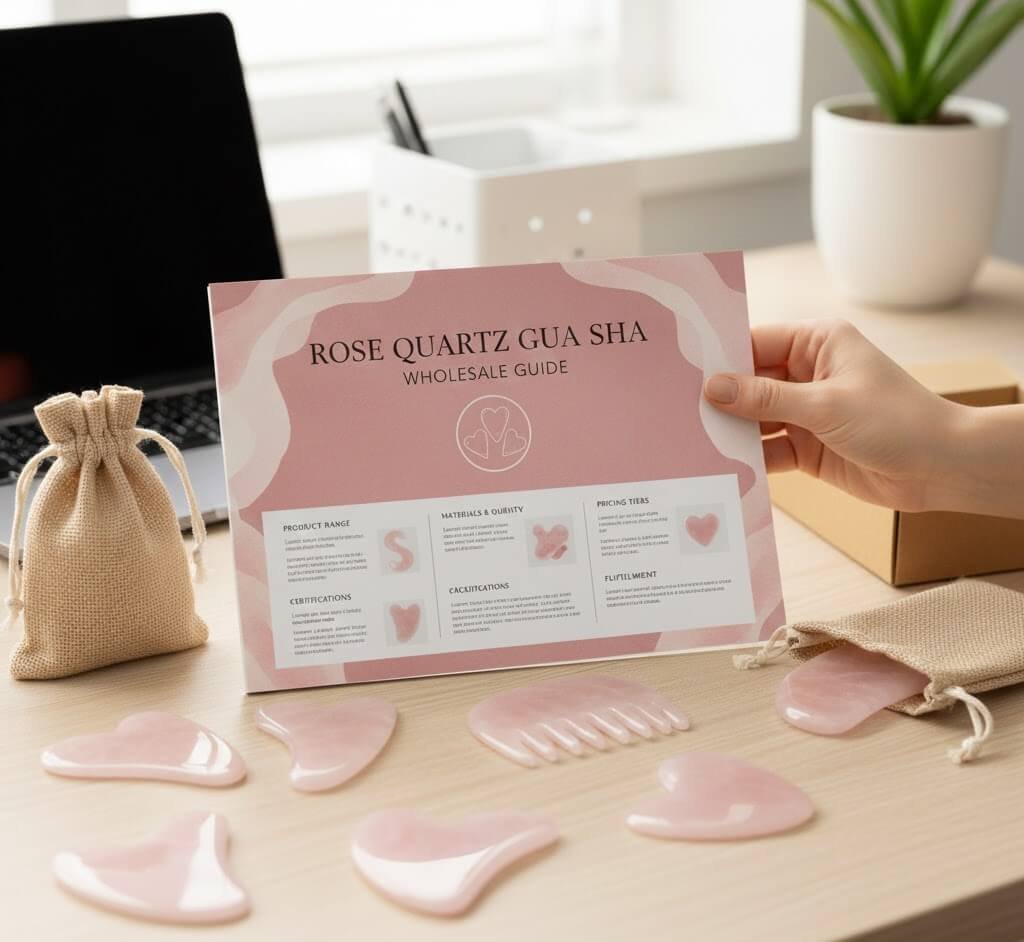
Upon its introduction, rose quartz gua sha quickly gained popularity among users thanks to its elegant pink color and the symbolism of “love and healing,” becoming one of the most sought-after gua sha materials and continuing to rise in popularity.
This enthusiastic market demand has led more and more businesses and brands to focus on rose quartz gua sha, planning to add it to their product lines as a future development strategy. If you are one of them, this guide will provide you with comprehensive professional advice, from raw materials to suppliers. We will start with a material analysis, progress to evaluating the quality of the product itself, then explain the precautions in the procurement process, and finally tell you how to choose a suitable rose quartz gua sha supplier.
- 1. Analysis of Rose Quartz Material
- 2. Principles for Evaluating the Quality of Rose Quartz Gua Sha Tools
- 3. Important Considerations for Rose Quartz Gua Sha Wholesale
- 4. Rose Quartz Gua Sha Supplier Selection Guide
- Frequently Asked Questions About Wholesale Rose Quartz Gua Sha Tools
- 1. The Rose Quartz has White, Cloudy Inclusions Inside. Is this Considered A Defective Product?
- 2. How Long Does the Production Cycle for Rose Quartz Gua Sha Tools Take?
- 3. Why do Rose Quartz Gua Sha Tools of Different Shapes Have Different Prices?
- 4. Does A Higher Price Mean A Better Rose Quartz Gua Sha Tool?
1. Analysis of Rose Quartz Material
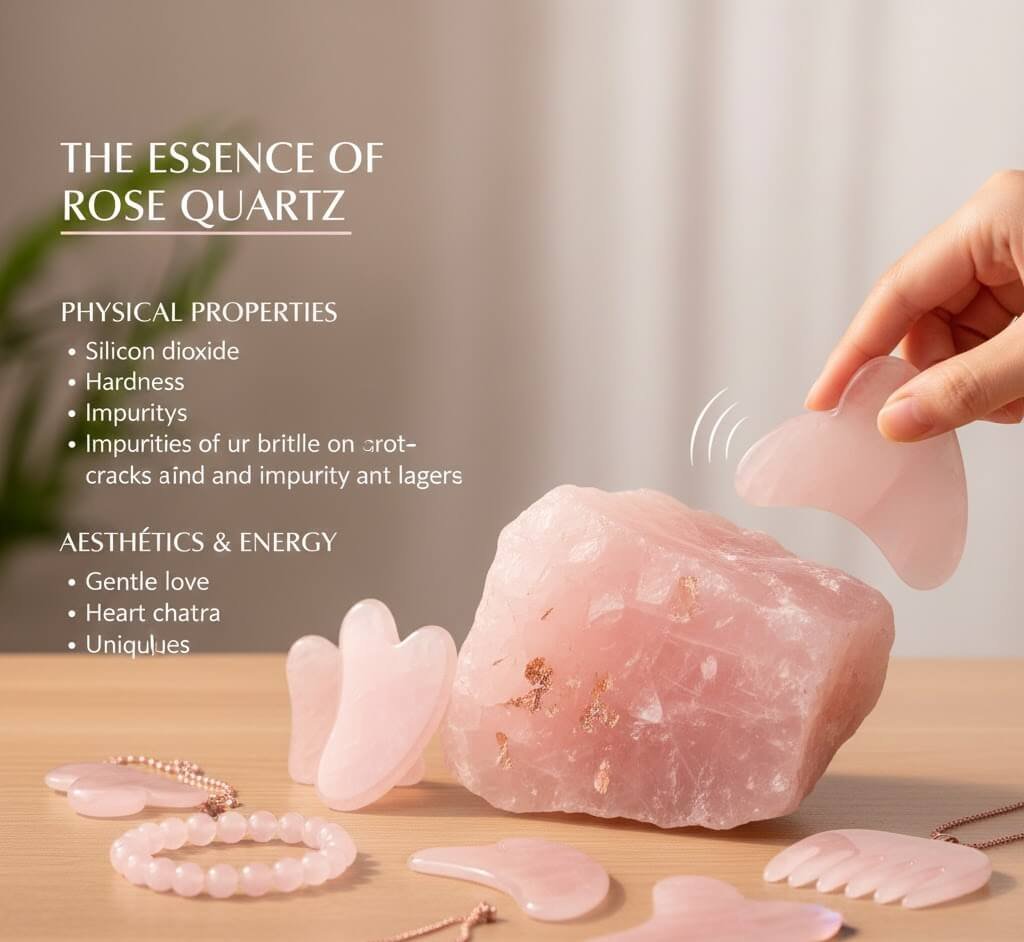
We will analyze the characteristics of rose quartz from two perspectives: 1. Physical and mineral properties. 2. Aesthetics and energy theories. The former is a factual description, while the latter is a metaphysical cultural belief.
1. Physical and Mineralogical Properties of Rose Quartz
- Rose quartz is primarily composed of silicon dioxide, and its color ranges from light pink to deep pink. Rose quartz is generally translucent to transparent. In addition to silicon dioxide, rose quartz also contains other mineral elements, which means that the raw rose quartz is not purely colored, but contains white striped structures or copper-colored flaky impurities.
- Rose quartz has a Mohs hardness of approximately 7. While it is hard, it is also brittle. This characteristic gives it considerable wear resistance, but it has poor resistance to deformation and is easily broken upon impact.
2. The Aesthetics and Energy of Rose Quartz
The pink color of rose quartz is not an intense pink, but rather a gentle and elegant shade. Therefore, rose quartz is often considered a symbol of gentle “love.”
- The pink color of rose quartz originates from the intrusion of other elements into the crystal during its formation, usually trace amounts of titanium, iron, and manganese. Truly high-quality rose quartz is not necessarily the pinkest, but rather has a uniform, gentle, and translucent pink color. The fewer impurities and internal cracks, the higher the quality.
- Uniqueness: Every piece of rose quartz is unique, due to variations in trace element content and the inevitable internal cracks and impurities. This is one of the key factors used to determine whether rose quartz is natural.
- Due to its soft pink color, rose quartz is often considered a gemstone representing “love” in Western culture; this is its aesthetic attribute. This love is not limited to romantic love, but encompasses all expressions of “love,” including familial and platonic love.
It is this aesthetic factor of love that makes all rose quartz products highly sought after; not only rose quartz gua sha tools, but also rose quartz bracelets and necklaces are widely popular in the market.
- Rose quartz is believed to possess magical energy. In ancient civilizations and modern crystal therapy, rose quartz is often used to balance emotions and promote heart chakra health.
2. Principles for Evaluating the Quality of Rose Quartz Gua Sha Tools
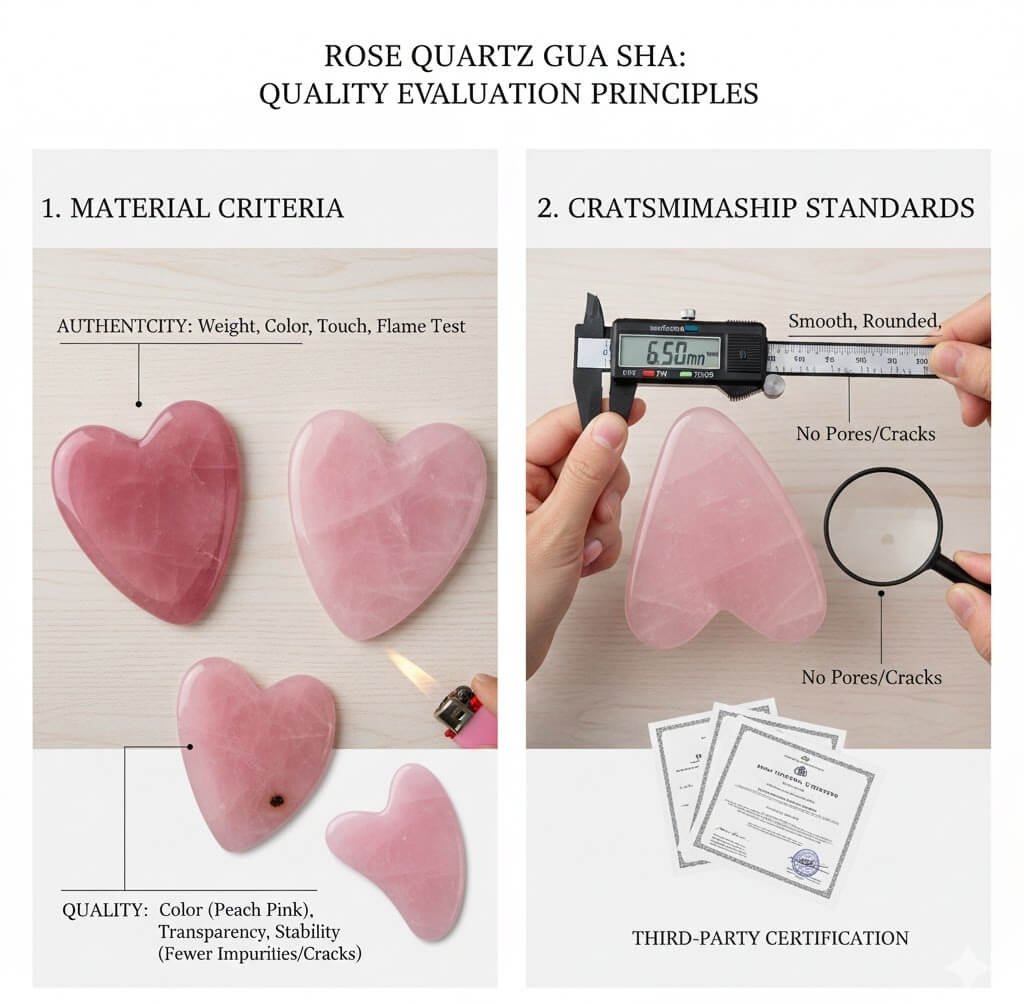
Judging the quality of a rose quartz gua sha tool should be approached from two main perspectives: 1. The quality of the rose quartz material itself and the craftsmanship involved in making it into a gua sha tool. Both aspects must be in harmony to create a high-quality rose quartz gua sha tool.
1. Standard Criteria for Evaluating Rose Quartz Material.
When evaluating raw materials, one should first determine their authenticity before assessing their quality.
- Authenticity identification of rose quartz raw materials:
Currently, there are not many counterfeit rose quartz gua sha tools on the market. The main reason is that the price of genuine products is not high, and there is not enough profit margin to justify counterfeiting. The possible counterfeits mainly consist of resin or plastic with added pink dye. The main identification methods are as follows:
- Weight: Due to density differences, rose quartz is heavier than resin and plastic of the same size.
- Color: The color of rose quartz is not uniform.
- Touch: Rose quartz feels cooler to the touch than plastic and resin.
- If necessary, a flame test can be performed. Briefly expose the gua sha tool to an open flame. Natural rose quartz gua sha tools will not be damaged, while resin and plastic will melt and turn black.
- Identifying the quality of raw rose quartz materials:
The quality of rose quartz should be assessed from multiple dimensions. These mainly include:
- Color. The color of rose quartz should be a soft pink; overly intense or too pale colors are generally considered to be of lower quality. Standard rose quartz should be a “peach” pink.
- Transparency. While preferences for transparency may vary among individuals, generally, the more transparent the rose quartz, the higher the quality. If it achieves a glass-like transparency, it meets gemstone standards.
- Stability of internal structure. The fewer impurities and cracks within the rose quartz material, the higher the quality, although these are difficult to completely avoid.。
2. Evaluation Standards for the Quality of Rose Quartz Gua Sha Tools.
The quality of the material only plays a supplementary role in a gua sha tool; the true determinant of a good gua sha tool lies in its craftsmanship. The quality of a rose quartz gua sha tool is primarily judged by three aspects:
- Surface Treatment of Gua Sha Tools: A good gua sha tool should have a smooth and even surface. Especially for crystalline materials like rose quartz, the surface smoothness should reach a near-glassy luster. According to industry standards, acceptable gua sha tools may be allowed to have a few small pores, but there are requirements regarding the size of the pores, and the fewer and smaller the pores, the higher the rating.
- The edges should be smooth and rounded. Edge control is a more demanding technique than surface treatment, involving cutting, grinding, and polishing. Furthermore, the requirements for cracks and pores are higher than those for the surface of the gua sha tool, as this is the area that directly contacts the skin. A qualified rose quartz gua sha tool should not have any noticeable or sharp cracks or pores on its edges.
- Thickness and Uniformity: A qualified gua sha tool should have uniform thickness. The thickness of the gua sha tool is often the most overlooked detail. However, gua sha tools of different thicknesses may produce different effects during use and also affect the feel of the operation. An excellent rose quartz gua sha tool should have a thickness of 5-7 millimeters. Too thin, and the feel is poor; too thick, and the gua sha effect may be affected.
In addition to evaluating the product itself, third-party testing and certification can also demonstrate the quality of the gua sha tools. Therefore, you can request third-party testing certificates from your gua sha supplier, including but not limited to: heavy metal testing, raw material certificates, and third-party factory quality management system certifications. These certificates directly demonstrate the factory’s capabilities and indirectly reflect the quality of the products.
3. Important Considerations for Rose Quartz Gua Sha Wholesale
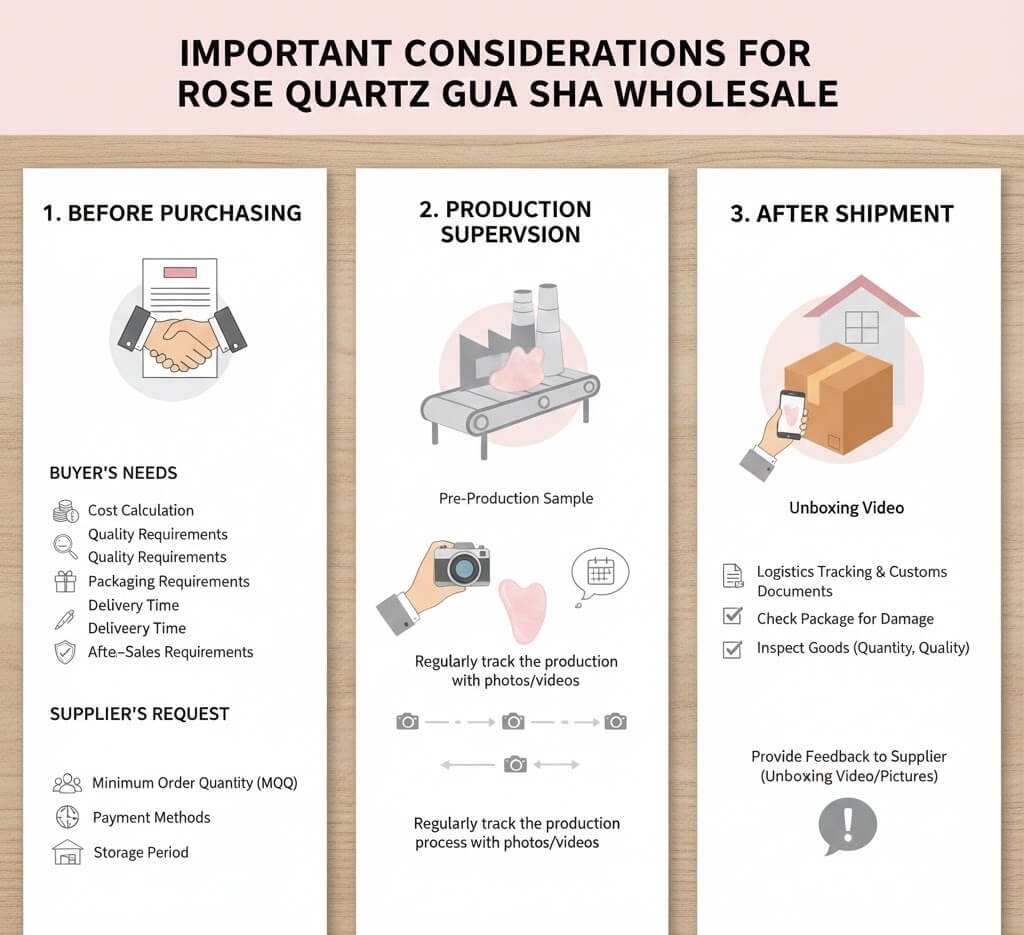
When purchasing rose quartz gua sha tools, you should prepare for three stages. Therefore, we will explain the considerations for each of these three different stages:
1. Before Purchasing Rose Quartz Gua Sha (Before Order Confirmation)
Before confirming the order, you need to clarify two factors: your needs and the supplier’s needs. This is crucial not only for the smooth execution of the contract but also for protecting the legal rights and interests of both parties.
- Clearly define your (the buyer’s) needs.
Clearly define your actual needs and communicate them to the supplier, and include them in the contract. This is how you can protect your own interests. For specific requirements, you can refer to the following points:
- Cost Calculation: This includes product cost, packaging cost, and transportation cost. Negotiate with suppliers and adjust the costs based on your expected cost calculations to reach an acceptable range. This is crucial for your profit margin.
- Quality Requirements: Clearly define the acceptable range of quality for the rose quartz gua sha tools. The most important aspect is the minimum acceptable quality level.
- Packaging Requirements: For some buyers, special packaging may be required, such as the material, style, and environmental friendliness of the packaging.
- Customization Requirements: Specify whether customization is needed and the specific customization requirements. For example, the color, size, and location of the logo, or whether the product’s shape needs to be adjusted.
- Delivery Time: Clearly state your latest acceptable delivery date, especially during specific promotional events.
- Transportation Requirements: Air freight, sea freight, or land transport? This affects logistics efficiency and transportation costs.
- After-Sales Requirements: What remedial measures or penalties should the supplier provide if there are problems with the goods or production? The purpose of this requirement is primarily to protect your legal rights and to hold the supplier accountable.
In addition to clearly stating your needs, you also need to be open to accepting the requirements proposed by the supplier.
- Accept the supplier’s request:
- Minimum Order Quantity (MOQ): Suppliers often set a minimum order quantity. This standard fluctuates based on various factors, such as price and customization requirements. Of course, you can negotiate the minimum order quantity with the supplier.
- Payment Methods: For new buyers, suppliers may require full payment upfront (before production). For existing customers, suppliers may require a deposit of a certain percentage before production, with the remaining balance due before shipment.
- Storage Period: For some buyers, products may need to be stored in the supplier’s warehouse due to various factors. The supplier will specify the storage period and impose penalties (storage fees) for exceeding that period.
2. Production Supervision (After Order Confirmation)
Once the needs of both the buyer and seller are clearly defined and a formal contract is signed, your focus should shift to monitoring the supplier’s actual production process. You can refer to the following practices:
- Request a pre-production sample of the rose quartz gua sha tool. A pre-production sample is essential; although it doesn’t guarantee that subsequent orders will perfectly match the sample, it provides a reference standard for comparison with future products, protecting your interests.
- Regularly track the production progress. The production timelines provided by many gua sha suppliers are often inaccurate. The supplier may not intentionally misrepresent the time to increase the chances of a sale, but various uncertainties in the production process can affect the production cycle. Request that the supplier regularly provide pictures and videos of the production process.
3. Important Notes After Shipment
Once all the goods have been manufactured, the supplier will arrange logistics and delivery according to the contract requirements. Considering the international shipping involved, you will need to prepare for the following:
- Request logistics tracking information from the rose quartz gua sha supplier. This is used to track the actual logistics status, including potential customs clearance issues. Tracking information for shipping methods such as sea freight is often delayed, so patience is required.
- Prepare the necessary customs clearance documents and provide them when required. These documents mainly include product information (including price, quantity, and customs code), supplier company information, and tax identification number. Some logistics channels may not require separate customs clearance, but it’s still necessary to be prepared just in case.
After the goods have cleared customs, you will need to take the following steps to protect your legal rights:
- Check the package for any external damage.
- Record an unboxing video. The video should cover the entire process from receiving the package to opening it and inspecting the contents.
- Inspect the goods. This includes checking the quantity, quality, and any damage to the goods.
- If there are any problems with the goods, please provide feedback to the supplier and negotiate after-sales service based on the actual situation. Please provide your unboxing video and pictures to facilitate the after-sales process.
4. Rose Quartz Gua Sha Supplier Selection Guide
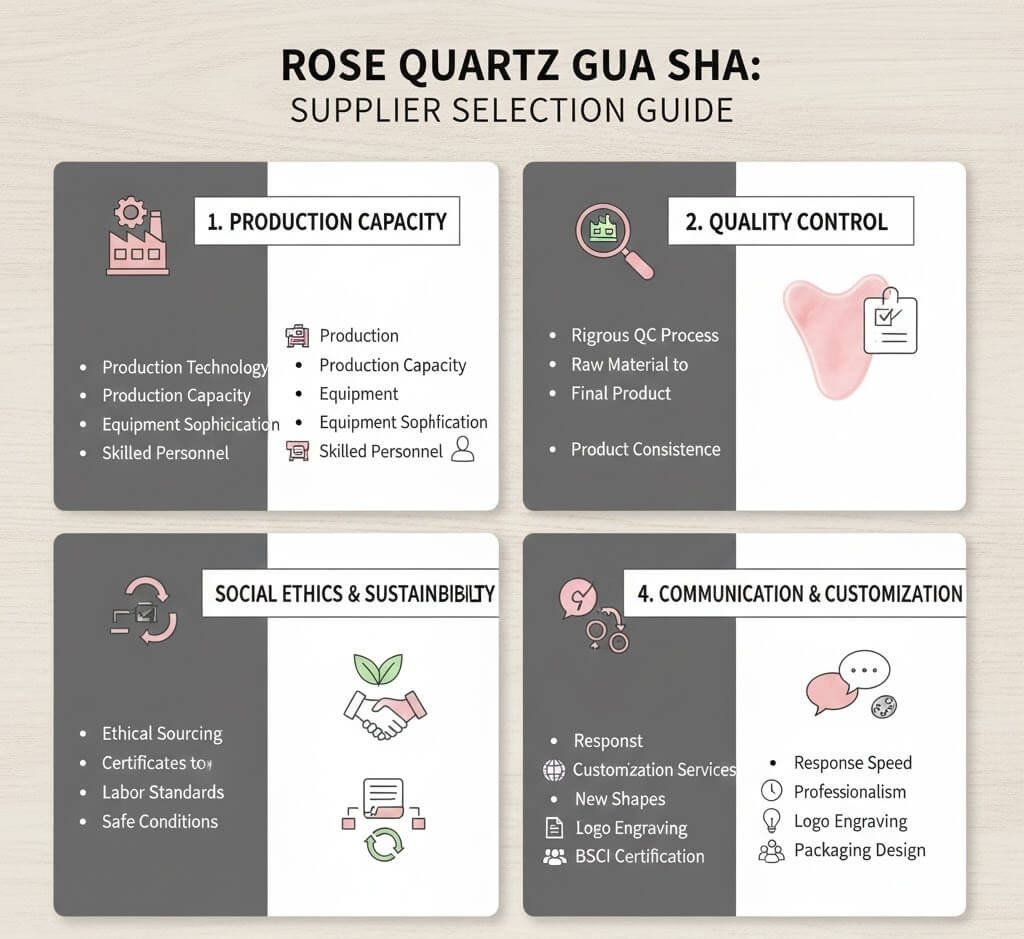
With the booming development of the gua sha industry, numerous gua sha suppliers have sprung up like mushrooms after rain. Therefore, choosing the right gua sha supplier is a crucial step. Below, we will tell you the key factors to consider when evaluating a rose quartz gua sha supplier:
1. Production Capacity
Production capacity mainly includes two aspects: 1. Production technology. 2. Production capacity. The former represents the company’s ability to control product quality, while the latter represents the stability of its supply.
- Production technology: This mainly focuses on the sophistication of the equipment and the skill level of the technical personnel.
- Production capacity: This mainly revolves around the number of machines and the number of processing personnel.
It is difficult to assess production capacity through online means, so the best approach is to conduct an on-site inspection. If an on-site inspection is not possible, you can request the supplier to conduct a video call or provide relevant videos for evaluation.
2. Quality Control
- Does the supplier have a comprehensive and rigorous quality control process? Many factories lack corresponding quality control procedures, resulting in inconsistent product quality. A complete quality control process should cover all stages, from raw material selection and production processes to finished product inspection.
- In addition to a robust quality control process, product consistency is also a crucial factor. An excellent gua sha supplier should minimize variations between batches of goods.
Similarly, on-site factory inspection is the most direct and accurate method. If this is not possible, request that the supplier provide corresponding videos.
3. Social Morality and Sustainability
This has little to do with product quality, but rather reflects a sense of corporate responsibility. An excellent company, in addition to producing high-quality products, should also contribute to society and even to all of humanity.
- Raw Material Sourcing: We emphasize ethical sourcing and require suppliers to provide clear and legitimate certificates of origin and mining licenses for raw materials. This not only helps maintain our brand image but also demonstrates our commitment to environmental and social responsibility.
- Labor Standards: We ensure that our partner factories comply with local labor laws, prohibit child labor, guarantee safe working conditions and benefits for employees, and avoid any potential supply chain scandals.
You can request that the supplier provide relevant third-party factory certifications, such as BSCI certification.
4. Communication Efficiency and Customization Capabilities
- Response Speed: Evaluate the supplier’s business representatives’ communication response speed, professionalism, and understanding of your needs. Efficient communication can prevent delays and misunderstandings.
- Customization Services: Confirm whether the supplier offers flexible customization services, including new gua sha shape designs, laser engraving or screen printing of private brand logos, and special packaging design services. Strong customization capabilities are crucial for brand differentiation.
By considering the four factors mentioned above, you can gain a general understanding of the actual capabilities of a gua sha factory or supplier. If you find this process too complicated, you can contact us directly for gua sha wholesale purchases. As a leading gua sha factory in China, Deyi Gems not only provides high-quality products and efficient communication but also understands the importance of corporate social responsibility. Therefore, we are committed to carbon neutrality and improving employee welfare. We may not be the top factory, but we will strive to provide you with the best service.
Frequently Asked Questions About Wholesale Rose Quartz Gua Sha Tools
1. The Rose Quartz has White, Cloudy Inclusions Inside. Is this Considered A Defective Product?
No, the white, cloudy inclusions inside rose quartz are natural crystal inclusions and are completely natural, not a defect. On the contrary, these white inclusions are an important factor in determining whether the rose quartz is natural or not. Although manufacturers of gua sha tools try to avoid these inclusions during production, a small amount of residue is unavoidable.
2. How Long Does the Production Cycle for Rose Quartz Gua Sha Tools Take?
The production cycle is often determined by the factory’s size and product characteristics. Larger factories generally have shorter production cycles, while products with higher processing difficulty require longer production cycles. For DeYi Gemstone Company, our monthly production capacity is 300,000 pieces. By dividing the order quantity by the monthly capacity, we can obtain a basic production cycle. However, this production cycle covers all orders for gua sha products, so for a single order, it needs to be multiplied by 5-10. This means that an order of 50,000 to 100,000 gua sha pieces will have a production cycle of approximately one month.
3. Why do Rose Quartz Gua Sha Tools of Different Shapes Have Different Prices?
The main factors determining the price include: 1. Raw material costs. 2. Labor costs. 3. Additional costs (electricity, water, etc.). For rose quartz gua sha tools of different shapes, the volume of raw material used varies for each piece, resulting in cost differences. Furthermore, the processing difficulty changes depending on the shape; the more complex the shape, the higher the labor and additional costs.
Therefore, the price differences among different rose quartz gua sha tools, excluding quality factors, are due to differences in production costs.
4. Does A Higher Price Mean A Better Rose Quartz Gua Sha Tool?
Generally, for products with the same appearance, the price reflects the quality. This is a common phenomenon, but not an absolute rule. There are price differences among different gua sha suppliers, stemming from factors such as the type of supplier (factory or trading company), the level of processing technology (different production costs), and even regional differences (different overhead costs).
Therefore, while price often indicates the quality of gua sha tools, it’s not always the case. When making a purchase, it’s advisable to compare several suppliers before making a final decision.