gua sha factory

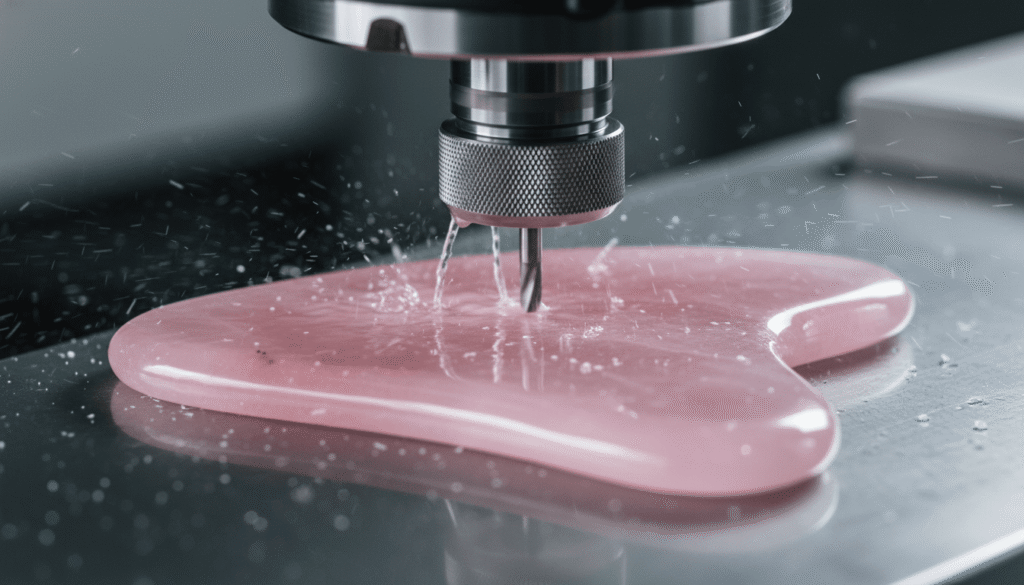
Gua Sha Factory Using CNC

Gua Sha Factory Using CNC Fully Automated Production: Advantages and Disadvantages

In the global beauty and wellness tools market, gua sha tools have gained significant popularity for their therapeutic benefits and aesthetic appeal. At Deyi Gems, our gua sha factory specializes in producing high-quality gua sha stones, rollers, and crystal tools for wholesalers and custom brands. Over years of production experience, we have observed a major shift in manufacturing methods — particularly the increasing adoption of CNC fully automated production. CNC, or Computer Numerical Control, allows machines to shape materials with minimal human intervention. CNC machines work continuously, produce consistent shapes, and handle high-volume production demands. However, natural stones such as jade, rose quartz, or obsidian have internal variations that machines cannot detect, which poses challenges in automated production. This guide explores the technical advantages and limitations of CNC automation in gua sha manufacturing, with real data from Deyi Gems’ internal statistics. What Is a Gua Sha Factory and the Role of CNC Automation Gua Sha Factory Overview A gua sha factory produces tools used for facial massage, lymphatic drainage, and skin wellness. These tools are typically made from natural stones that require precise shaping, smoothing, and polishing. Traditionally, artisans handcraft each piece, adjusting for stone texture and internal fissures, which ensures tactile precision but limits scalability. CNC Automation Integration At Deyi Gems, CNC machines are integrated into production lines for rough shaping. Multi-axis routers and milling machines are programmed with precise digital tool paths, achieving consistent forms efficiently. After CNC shaping, skilled artisans perform final edge refinement and surface polishing to maintain premium quality. Technical Advantages of CNC Production Production Efficiency and Speed Consistent Uniformity Scalability and Continuous Running Flexible Design and Rapid Prototyping Reduced Labor Requirements Technical Details of CNC Processes CNC Parameters for Gua Sha Production Parameter Typical Range / Notes Machine Type 3–5 axis CNC router or milling machine Spindle Speed 12,000–18,000 RPM (stone-dependent) Feed Rate 800–1,200 mm/min for standard gua sha Cutting Depth 0.3–0.5 mm per pass for delicate edges Tool Type Diamond-coated or tungsten carbide end mills Cooling Water or oil mist to reduce heat and prevent microcracks Stone-Specific Considerations Hybrid Production Workflow Disadvantages of CNC Production Internal Stone Flaws Tactile Quality Capital and Maintenance Costs Skilled Operators Required Technology Dependence Quality Control and Inspection Standards QC Step Measurement Tool Standard / Target Dimensional Accuracy Digital calipers / CMM ±0.5 mm Surface Roughness Ra tester ≤0.8 µm Edge Smoothness Visual and tactile No sharp edges Structural Integrity Optical scan / X-ray (optional) No cracks/fissures Polishing Finish Visual & tactile High gloss, uniform texture Production Method Selection Based on Market Needs Conclusion: Smart CNC Use in Gua Sha Factories CNC automation enhances speed, uniformity, and scalability in gua sha manufacturing: Limitations: higher scrap rate, slightly reduced tactile feel, capital investment, and need for skilled operators. Recommendation: Adopt a hybrid workflow—CNC for rough shaping, artisans for fine finishing—to balance efficiency, quality, and premium tactile experience. This ensures both wholesale and boutique customers receive gua sha tools that meet functional, aesthetic, and tactile standards. Deyi Gems’ internal production data confirms that this approach is both practical and sustainable for long-term growth.
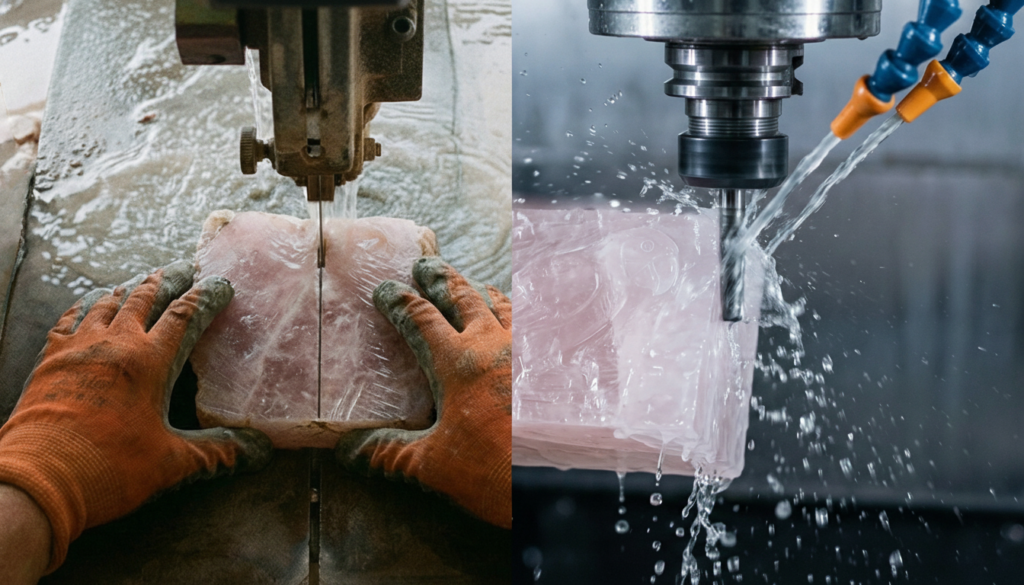
Gua Sha Factory Using CNC Fully Automated Production: Advantages and Disadvantages Read More »

In the global beauty and wellness tools market, gua sha tools have gained significant popularity for their therapeutic benefits and aesthetic appeal. At Deyi Gems, our gua sha factory specializes in producing high-quality gua sha stones, rollers, and crystal tools for wholesalers and custom brands. Over years of production experience, we have observed a major shift in manufacturing methods — particularly the increasing adoption of CNC fully automated production. CNC, or Computer Numerical Control, allows machines to shape materials with minimal human intervention. CNC machines work continuously, produce consistent shapes, and handle high-volume production demands. However, natural stones such as jade, rose quartz, or obsidian have internal variations that machines cannot detect, which poses challenges in automated production. This guide explores the technical advantages and limitations of CNC automation in gua sha manufacturing, with real data from Deyi Gems’ internal statistics. What Is a Gua Sha Factory and the Role of CNC Automation Gua Sha Factory Overview A gua sha factory produces tools used for facial massage, lymphatic drainage, and skin wellness. These tools are typically made from natural stones that require precise shaping, smoothing, and polishing. Traditionally, artisans handcraft each piece, adjusting for stone texture and internal fissures, which ensures tactile precision but limits scalability. CNC Automation Integration At Deyi Gems, CNC machines are integrated into production lines for rough shaping. Multi-axis routers and milling machines are programmed with precise digital tool paths, achieving consistent forms efficiently. After CNC shaping, skilled artisans perform final edge refinement and surface polishing to maintain premium quality. Technical Advantages of CNC Production Production Efficiency and Speed Consistent Uniformity Scalability and Continuous Running Flexible Design and Rapid Prototyping Reduced Labor Requirements Technical Details of CNC Processes CNC Parameters for Gua Sha Production Parameter Typical Range / Notes Machine Type 3–5 axis CNC router or milling machine Spindle Speed 12,000–18,000 RPM (stone-dependent) Feed Rate 800–1,200 mm/min for standard gua sha Cutting Depth 0.3–0.5 mm per pass for delicate edges Tool Type Diamond-coated or tungsten carbide end mills Cooling Water or oil mist to reduce heat and prevent microcracks Stone-Specific Considerations Hybrid Production Workflow Disadvantages of CNC Production Internal Stone Flaws Tactile Quality Capital and Maintenance Costs Skilled Operators Required Technology Dependence Quality Control and Inspection Standards QC Step Measurement Tool Standard / Target Dimensional Accuracy Digital calipers / CMM ±0.5 mm Surface Roughness Ra tester ≤0.8 µm Edge Smoothness Visual and tactile No sharp edges Structural Integrity Optical scan / X-ray (optional) No cracks/fissures Polishing Finish Visual & tactile High gloss, uniform texture Production Method Selection Based on Market Needs Conclusion: Smart CNC Use in Gua Sha Factories CNC automation enhances speed, uniformity, and scalability in gua sha manufacturing: Limitations: higher scrap rate, slightly reduced tactile feel, capital investment, and need for skilled operators. Recommendation: Adopt a hybrid workflow—CNC for rough shaping, artisans for fine finishing—to balance efficiency, quality, and premium tactile experience. This ensures both wholesale and boutique customers receive gua sha tools that meet functional, aesthetic, and tactile standards. Deyi Gems’ internal production data confirms that this approach is both practical and sustainable for long-term growth.

gua sha quality

Gua Sha Quality Grading and Evaluation Standards – From the Source Gua Sha Factory

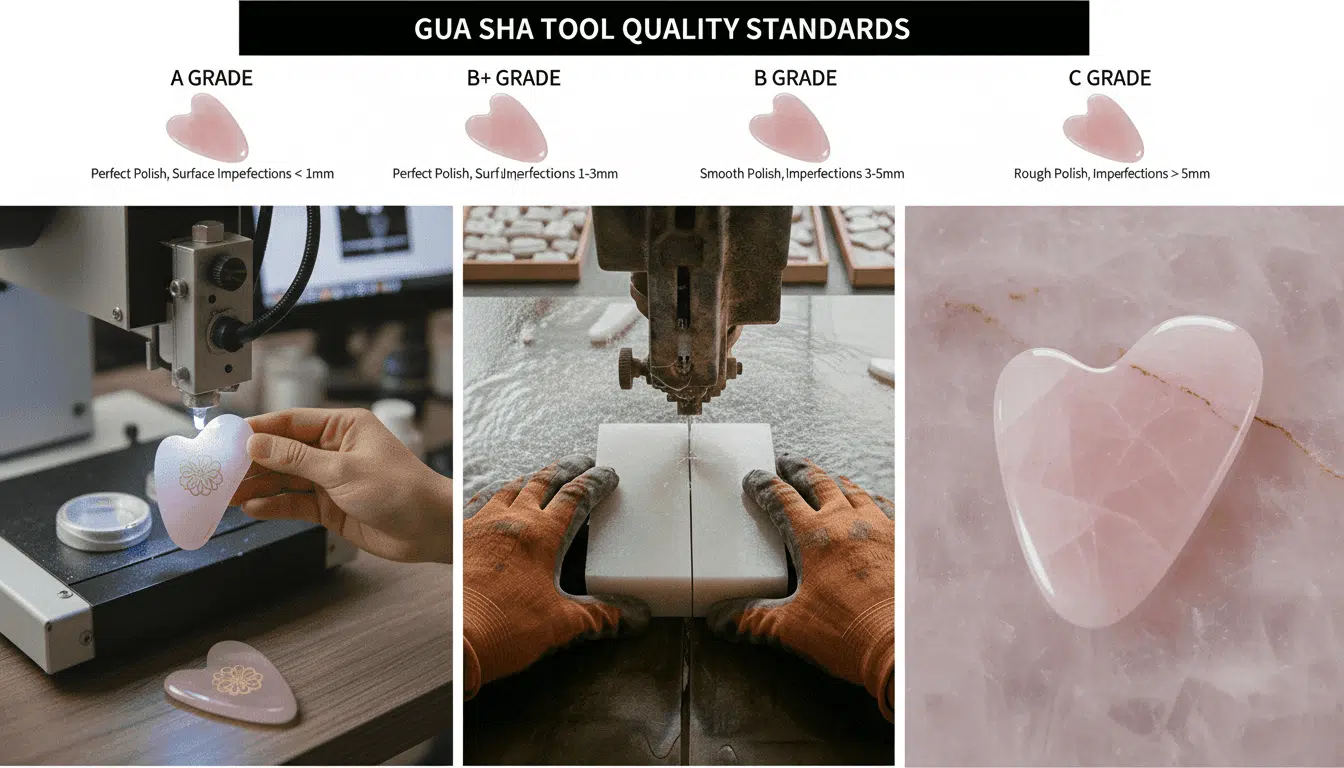
“Gua sha quality” has quickly become a key purchasing standard for brands, wholesalers, and consumers in the global beauty and wellness industry. As facial gua sha, body scraping tools, and crystal rollers continue to gain global popularity, the market is also experiencing massive differences in quality levels. On one end, there are high-end, properly polished, mineral-verified tools made from real stone or premium stainless steel. On the other end, there are low-cost, mass-produced pieces with inconsistent color, cracks, dull edges, and poor finishing. Because the gua sha sector has no unified global grading system, the responsibility of defining what “high-quality” means falls directly on the factory. This is why factories with real craftsmanship — like Deyi Gems, a direct manufacturer with a decade of production experience — must be transparent about how grading works, what standards are used, and how every piece is evaluated before shipping. This guide provides a complete breakdown of gua sha quality grading and evaluation standards, based fully on real manufacturing practice. It explains the differences between stone/crystal and metal gua sha tools, the exact criteria used to define A, B+, B, and C grades, the typical defects found in production, and why these details impact performance, safety, and durability. To strengthen the article’s credibility, this guide also includes authoritative external references from mineral research institutions, material-science organizations, and cosmetic-tool safety regulators, including the Gemological Institute of America (GIA), ASM International, and the European Chemicals Agency (ECHA). Chapter 1 – The Core Concept of Gua Sha Quality Why “Gua Sha Quality” Has No Industry-Wide Standard Unlike medical devices, gemstones, or metals, gua sha tools are not regulated under any internationally unified grading system. Bodies like ISO, ASTM International, or EN Standards do not publish gua sha-specific quality guidelines. Most material-specific data only covers things like mineral hardness, chemical composition, or stainless-steel corrosion resistance — not the finished gua sha product. For instance: Because there is no official grading system, factories define their own standards. Factory-Established Quality Systems At Deyi Gems, we rely on a three-pillar grading system for stone and crystal gua sha tools: For stainless steel gua sha tools, grading is mainly based on: This factory-defined system allows objective differentiation between A, B+, B, and C grades (for stone) and A vs B grades (for stainless steel). Chapter 2 – Material Differences and Why They Matter Why Material Determines Quality Criteria Every gua sha tool starts from a raw material. Different materials carry different natural properties and therefore require different expectations. For example: Because of these differences, grading cannot be universal across materials. How Factories Source Crystal Materials Stone gua sha tools typically come from bulk mineral blocks sourced from Brazil, Madagascar, India, or China. During production: These natural variations heavily influence the final grade. Chapter 3 – The Three Core Quality Dimensions for Crystal Gua Sha Tools 1. Color Quality – The First Visual Benchmark Purity and Color Correctness Color is the most noticeable indicator of quality. For example: According to GIA’s mineral identification guidelines, color consistency and mineral purity are key components in gemstone quality evaluation. Color Uniformity A-grade tools come from blocks with: Lower grades show uneven colors or multiple distracting tones. 2. Cracks, Pits, and Internal Defects Measuring Cracks Clearly Our factory uses measurable criteria: These are natural features but influence the tool’s structural reliability and visual appeal. Impact on Safety Small cracks (<1 mm) are typically cosmetic. However, cracks exceeding 3–5 mm compromise durability or smoothness. The European Chemicals Agency (ECHA) reminds consumers that surface safety is relevant to skin-contact items, making smoothness an important indicator. 3. Polishing Quality – The Most Critical Functional Factor Importance of Polishing Smoothness Polishing is crucial because: What Perfect Polishing Looks Like An A-grade polish: Rough or dull surfaces indicate lower grades. Chapter 4 – Quality Grading for Stone and Crystal Gua Sha Tools A-Grade Quality (Top-Tier) A-grade tools match the highest factory standards: Suitable for premium brands, gift boxes, and retail packaging. B+ Grade Quality Still high quality but with minor cosmetic variation: Best for mid-tone retail brands or affordable wellness lines. B Grade Quality Moderate-grade with more noticeable flaws: Often used in spa bulk orders or budget-friendly portfolios. C Grade Quality Entry-level with clear visible imperfections: Suitable for low-price wholesale markets, not recommended for premium branding. Chapter 5 – Stainless Steel Gua Sha Quality Standards Unlike stone tools, stainless steel gua sha tools rely almost entirely on surface finishing. A Grade Stainless Steel Perfect Mirror Polish A-grade stainless steel tools feature: This matches standards referenced by ASM International, which discusses how 304 and 316 stainless steels can achieve high-reflectivity finishes through controlled polishing processes. No Surface Imperfections A-grade tools must be: B Grade Stainless Steel Minor Surface Marks B-grade pieces may include: Still Safe, but Not Perfect B-grade does not affect functionality. The steel remains durable, hygienic, and corrosion-resistant. However, it lacks the flawless beauty expected by premium brands. Chapter 6 – How Factories Conduct Quality Inspection Step 1 – Raw Material Pre-Inspection Factories inspect mineral blocks for: Workers cut the block into slabs and categorize them before shaping begins. Step 2 – Semi-Finished Body Inspection After shaping, every piece is checked for: Pieces with major defects are eliminated early. Step 3 – Polishing Quality Check Polishing lines typically involve 3–7 rounds of grinding and finishing. After each round, workers check whether: Step 4 – Final Grading Each piece is graded into A, B+, B, or C categories (stone) or A/B categories (steel). This grading is 100% manual, based on experience — which is why factories vary widely in quality consistency. Chapter 7 – Why Polishing Quality Is the Most Important Indicator Polishing determines: Even expensive raw material becomes “low-quality” if polishing is poorly done. In our factory, polishing accounts for 40–50% of total labor time and cost because it requires skilled sanding, finishing, and quality verification. Chapter 8 – How Brands Should Evaluate Their Supplier’s Quality Claims 1. Request Real Grading Samples A reliable factory should provide: This helps brands

Gua Sha Quality Grading and Evaluation Standards – From the Source Gua Sha Factory Read More »

“Gua sha quality” has quickly become a key purchasing standard for brands, wholesalers, and consumers in the global beauty and wellness industry. As facial gua sha, body scraping tools, and crystal rollers continue to gain global popularity, the market is also experiencing massive differences in quality levels. On one end, there are high-end, properly polished, mineral-verified tools made from real stone or premium stainless steel. On the other end, there are low-cost, mass-produced pieces with inconsistent color, cracks, dull edges, and poor finishing. Because the gua sha sector has no unified global grading system, the responsibility of defining what “high-quality” means falls directly on the factory. This is why factories with real craftsmanship — like Deyi Gems, a direct manufacturer with a decade of production experience — must be transparent about how grading works, what standards are used, and how every piece is evaluated before shipping. This guide provides a complete breakdown of gua sha quality grading and evaluation standards, based fully on real manufacturing practice. It explains the differences between stone/crystal and metal gua sha tools, the exact criteria used to define A, B+, B, and C grades, the typical defects found in production, and why these details impact performance, safety, and durability. To strengthen the article’s credibility, this guide also includes authoritative external references from mineral research institutions, material-science organizations, and cosmetic-tool safety regulators, including the Gemological Institute of America (GIA), ASM International, and the European Chemicals Agency (ECHA). Chapter 1 – The Core Concept of Gua Sha Quality Why “Gua Sha Quality” Has No Industry-Wide Standard Unlike medical devices, gemstones, or metals, gua sha tools are not regulated under any internationally unified grading system. Bodies like ISO, ASTM International, or EN Standards do not publish gua sha-specific quality guidelines. Most material-specific data only covers things like mineral hardness, chemical composition, or stainless-steel corrosion resistance — not the finished gua sha product. For instance: Because there is no official grading system, factories define their own standards. Factory-Established Quality Systems At Deyi Gems, we rely on a three-pillar grading system for stone and crystal gua sha tools: For stainless steel gua sha tools, grading is mainly based on: This factory-defined system allows objective differentiation between A, B+, B, and C grades (for stone) and A vs B grades (for stainless steel). Chapter 2 – Material Differences and Why They Matter Why Material Determines Quality Criteria Every gua sha tool starts from a raw material. Different materials carry different natural properties and therefore require different expectations. For example: Because of these differences, grading cannot be universal across materials. How Factories Source Crystal Materials Stone gua sha tools typically come from bulk mineral blocks sourced from Brazil, Madagascar, India, or China. During production: These natural variations heavily influence the final grade. Chapter 3 – The Three Core Quality Dimensions for Crystal Gua Sha Tools 1. Color Quality – The First Visual Benchmark Purity and Color Correctness Color is the most noticeable indicator of quality. For example: According to GIA’s mineral identification guidelines, color consistency and mineral purity are key components in gemstone quality evaluation. Color Uniformity A-grade tools come from blocks with: Lower grades show uneven colors or multiple distracting tones. 2. Cracks, Pits, and Internal Defects Measuring Cracks Clearly Our factory uses measurable criteria: These are natural features but influence the tool’s structural reliability and visual appeal. Impact on Safety Small cracks (<1 mm) are typically cosmetic. However, cracks exceeding 3–5 mm compromise durability or smoothness. The European Chemicals Agency (ECHA) reminds consumers that surface safety is relevant to skin-contact items, making smoothness an important indicator. 3. Polishing Quality – The Most Critical Functional Factor Importance of Polishing Smoothness Polishing is crucial because: What Perfect Polishing Looks Like An A-grade polish: Rough or dull surfaces indicate lower grades. Chapter 4 – Quality Grading for Stone and Crystal Gua Sha Tools A-Grade Quality (Top-Tier) A-grade tools match the highest factory standards: Suitable for premium brands, gift boxes, and retail packaging. B+ Grade Quality Still high quality but with minor cosmetic variation: Best for mid-tone retail brands or affordable wellness lines. B Grade Quality Moderate-grade with more noticeable flaws: Often used in spa bulk orders or budget-friendly portfolios. C Grade Quality Entry-level with clear visible imperfections: Suitable for low-price wholesale markets, not recommended for premium branding. Chapter 5 – Stainless Steel Gua Sha Quality Standards Unlike stone tools, stainless steel gua sha tools rely almost entirely on surface finishing. A Grade Stainless Steel Perfect Mirror Polish A-grade stainless steel tools feature: This matches standards referenced by ASM International, which discusses how 304 and 316 stainless steels can achieve high-reflectivity finishes through controlled polishing processes. No Surface Imperfections A-grade tools must be: B Grade Stainless Steel Minor Surface Marks B-grade pieces may include: Still Safe, but Not Perfect B-grade does not affect functionality. The steel remains durable, hygienic, and corrosion-resistant. However, it lacks the flawless beauty expected by premium brands. Chapter 6 – How Factories Conduct Quality Inspection Step 1 – Raw Material Pre-Inspection Factories inspect mineral blocks for: Workers cut the block into slabs and categorize them before shaping begins. Step 2 – Semi-Finished Body Inspection After shaping, every piece is checked for: Pieces with major defects are eliminated early. Step 3 – Polishing Quality Check Polishing lines typically involve 3–7 rounds of grinding and finishing. After each round, workers check whether: Step 4 – Final Grading Each piece is graded into A, B+, B, or C categories (stone) or A/B categories (steel). This grading is 100% manual, based on experience — which is why factories vary widely in quality consistency. Chapter 7 – Why Polishing Quality Is the Most Important Indicator Polishing determines: Even expensive raw material becomes “low-quality” if polishing is poorly done. In our factory, polishing accounts for 40–50% of total labor time and cost because it requires skilled sanding, finishing, and quality verification. Chapter 8 – How Brands Should Evaluate Their Supplier’s Quality Claims 1. Request Real Grading Samples A reliable factory should provide: This helps brands

gua sha factory Machine and Manual Cutting

Gua Sha Factory Detail – The Difference Between Machine and Manual Cutting

A gua sha factory is the starting point of every high-quality gua sha tool we see in the beauty and wellness market today. From selecting raw stone materials to shaping, polishing, and final inspection, the manufacturing process determines the actual value and performance of the tool far more than branding alone. As someone who has worked for years across gua sha production, wholesale customization, and raw material sourcing, I’ve seen how dramatically production methods—especially machine cutting versus manual cutting—change the cost, durability, safety, and overall user experience of the final product. This article provides a clear, detailed look inside how a gua sha factory operates, why production quality varies so widely, and what the real differences are between machine-cut and hand-cut gua sha tools. To support accuracy and trust, I also reference data from authoritative industry sources such as ASTM, ISO, GIA, China’s GB standards, and ECHA material safety guidelines. These external references demonstrate how material performance, hardness, and machining methods influence final product quality. Understanding the Role of a Gua Sha Factory A gua sha factory is far more than a workshop where stones are shaped. It is a highly specialized supply chain system that includes material sourcing, mechanical processing, manual craftsmanship, polishing, finishing, and quality control. Each step affects the next, and minor differences in technique can lead to very noticeable differences in price and performance. Material Selection Defines the Foundation Different stones carry different hardness and brittleness levels. For example: A gua sha factory must purchase stone blocks or slabs that meet both structural and cosmetic requirements. Poor material selection dramatically increases breakage during cutting and polishing. Why Material Origin Matters Different locations produce stones with different textures and internal density. For example: Manufacturers often reference GB/T 16552–2017 (Chinese National Gemstone Standard) to classify natural stones used in gua sha production.Official source: http://openstd.samr.gov.cn/ Factories committed to quality will ensure materials comply with national gemstone definitions and avoid dyed or polymer-filled stones. Machine Cutting in a Gua Sha Factory Machine cutting is the most common method in large-scale gua sha production. It uses tools such as waterjet machines, CNC milling, and high-precision grinding equipment. What Machine Cutting Actually Means Machine cutting uses mechanical force—typically diamond-coated blades or waterjet pressure—to shape the raw stone into consistent pieces. Waterjet cutting, for example, can reach 60,000 psi, according to the Waterjet Manufacturers Association: https://www.wjta.org/ This extremely high pressure allows the stone slab to be cut accurately without excessive heating, reducing breakage. Production Speed and Cost Advantages Machine cutting is significantly faster than manual cutting. Faster output reduces cost. This is why most low- and mid-range gua sha factories rely heavily on mechanical cutting. Consistency and Shape Accuracy Machine cutting offers higher dimensional accuracy. CNC machines frequently maintain tolerances within ±0.2 mm, enough to guarantee that mass-produced gua sha tools have identical sizes. This consistency benefits large retailers needing uniform appearance and packaging. When Machine Cutting Has Limitations Machines struggle with highly irregular stone veins or brittle mineral structures. Stones like obsidian or fluorite, which fracture easily, may break under machine vibration.ECHA’s material safety documentation notes that crystalline structures with cleavage planes fracture more easily under pressure: https://echa.europa.eu/ In these cases, manual cutting becomes necessary to reduce waste and preserve the material. Manual Cutting in a Gua Sha Factory Manual cutting refers to shaping stone using handheld tools such as small diamond saws, handheld grinders, and manual edge-forming blades. Why Manual Cutting Still Matters Manual cutting remains essential for premium gua sha tools because certain stone categories require a human touch. A skilled craftsman can “read” the stone—evaluating internal cracks, layers, and texture to avoid breaking valuable material. Machines cannot make these decisions. Higher Artisan Skill Level A craftsman in a gua sha factory typically undergoes at least 6–12 months of training before being allowed to shape valuable stones. The training focuses on: Manual workers learn to avoid micro-fracturing, which machines often fail to detect. Ideal for Premium or Irregular Designs Manual cutting allows better customization and creativity. Factories often use it for: This type of work is commonly required by high-end retailers and spas who want a unique product. Why Manual Cutting Costs More Manual cutting is slower and requires skilled labor, which increases costs: This explains why handmade gua sha tools usually sell at higher prices. Polishing and Finishing: A Critical Stage in Every Gua Sha Factory Both machine-cut and manual-cut pieces must go through polishing to achieve a smooth surface that is safe for the skin. Multi-Stage Polishing Process A professional gua sha factory uses at least 4–7 polishing stages, including: The purpose is to avoid sharp edges that may cause micro-tears on the skin. Why Polishing Quality Affects Safety Dermatological studies show that rough surfaces above 0.3 μm Ra can increase the likelihood of skin irritation. ISO’s surface roughness guidelines provide important benchmarks: https://www.iso.org/standard/84995.html High-quality gua sha tools are polished until their surface roughness is extremely fine, often between 0.05–0.1 μm, which feels silky on the skin. Machine vs. Manual Polishing Machine polishing is faster but may create flat, uniform curves that lack the refined touch of manual polishing. Skilled artisans can create smoother transitions, deeper curves, and more ergonomic designs. This is why premium handmade tools feel more comfortable during scraping. Quality Control Differences in Gua Sha Factories A gua sha factory that focuses on premium output uses stricter quality control systems. Dimensional Inspection High-precision calipers help measure thickness, length, and curvature.Factories aiming for export quality must meet tolerances set by client specifications or internal standards. Surface Safety Checks Inspectors examine: Some factories use magnification tools or light boards to detect internal fractures. Material Safety and Regulatory Compliance High-end gua sha factories follow regulatory guidelines such as: These systems ensure material authenticity and prevent the use of dyed or chemically modified stones. Price Differences Explained by Cutting Method The way a gua sha tool is cut plays a major role in pricing. Machine-Cut Prices Machine cutting results in: Typical wholesale price range:$0.80–$3.00 per piece, depending on

Gua Sha Factory Detail – The Difference Between Machine and Manual Cutting Read More »

A gua sha factory is the starting point of every high-quality gua sha tool we see in the beauty and wellness market today. From selecting raw stone materials to shaping, polishing, and final inspection, the manufacturing process determines the actual value and performance of the tool far more than branding alone. As someone who has worked for years across gua sha production, wholesale customization, and raw material sourcing, I’ve seen how dramatically production methods—especially machine cutting versus manual cutting—change the cost, durability, safety, and overall user experience of the final product. This article provides a clear, detailed look inside how a gua sha factory operates, why production quality varies so widely, and what the real differences are between machine-cut and hand-cut gua sha tools. To support accuracy and trust, I also reference data from authoritative industry sources such as ASTM, ISO, GIA, China’s GB standards, and ECHA material safety guidelines. These external references demonstrate how material performance, hardness, and machining methods influence final product quality. Understanding the Role of a Gua Sha Factory A gua sha factory is far more than a workshop where stones are shaped. It is a highly specialized supply chain system that includes material sourcing, mechanical processing, manual craftsmanship, polishing, finishing, and quality control. Each step affects the next, and minor differences in technique can lead to very noticeable differences in price and performance. Material Selection Defines the Foundation Different stones carry different hardness and brittleness levels. For example: A gua sha factory must purchase stone blocks or slabs that meet both structural and cosmetic requirements. Poor material selection dramatically increases breakage during cutting and polishing. Why Material Origin Matters Different locations produce stones with different textures and internal density. For example: Manufacturers often reference GB/T 16552–2017 (Chinese National Gemstone Standard) to classify natural stones used in gua sha production.Official source: http://openstd.samr.gov.cn/ Factories committed to quality will ensure materials comply with national gemstone definitions and avoid dyed or polymer-filled stones. Machine Cutting in a Gua Sha Factory Machine cutting is the most common method in large-scale gua sha production. It uses tools such as waterjet machines, CNC milling, and high-precision grinding equipment. What Machine Cutting Actually Means Machine cutting uses mechanical force—typically diamond-coated blades or waterjet pressure—to shape the raw stone into consistent pieces. Waterjet cutting, for example, can reach 60,000 psi, according to the Waterjet Manufacturers Association: https://www.wjta.org/ This extremely high pressure allows the stone slab to be cut accurately without excessive heating, reducing breakage. Production Speed and Cost Advantages Machine cutting is significantly faster than manual cutting. Faster output reduces cost. This is why most low- and mid-range gua sha factories rely heavily on mechanical cutting. Consistency and Shape Accuracy Machine cutting offers higher dimensional accuracy. CNC machines frequently maintain tolerances within ±0.2 mm, enough to guarantee that mass-produced gua sha tools have identical sizes. This consistency benefits large retailers needing uniform appearance and packaging. When Machine Cutting Has Limitations Machines struggle with highly irregular stone veins or brittle mineral structures. Stones like obsidian or fluorite, which fracture easily, may break under machine vibration.ECHA’s material safety documentation notes that crystalline structures with cleavage planes fracture more easily under pressure: https://echa.europa.eu/ In these cases, manual cutting becomes necessary to reduce waste and preserve the material. Manual Cutting in a Gua Sha Factory Manual cutting refers to shaping stone using handheld tools such as small diamond saws, handheld grinders, and manual edge-forming blades. Why Manual Cutting Still Matters Manual cutting remains essential for premium gua sha tools because certain stone categories require a human touch. A skilled craftsman can “read” the stone—evaluating internal cracks, layers, and texture to avoid breaking valuable material. Machines cannot make these decisions. Higher Artisan Skill Level A craftsman in a gua sha factory typically undergoes at least 6–12 months of training before being allowed to shape valuable stones. The training focuses on: Manual workers learn to avoid micro-fracturing, which machines often fail to detect. Ideal for Premium or Irregular Designs Manual cutting allows better customization and creativity. Factories often use it for: This type of work is commonly required by high-end retailers and spas who want a unique product. Why Manual Cutting Costs More Manual cutting is slower and requires skilled labor, which increases costs: This explains why handmade gua sha tools usually sell at higher prices. Polishing and Finishing: A Critical Stage in Every Gua Sha Factory Both machine-cut and manual-cut pieces must go through polishing to achieve a smooth surface that is safe for the skin. Multi-Stage Polishing Process A professional gua sha factory uses at least 4–7 polishing stages, including: The purpose is to avoid sharp edges that may cause micro-tears on the skin. Why Polishing Quality Affects Safety Dermatological studies show that rough surfaces above 0.3 μm Ra can increase the likelihood of skin irritation. ISO’s surface roughness guidelines provide important benchmarks: https://www.iso.org/standard/84995.html High-quality gua sha tools are polished until their surface roughness is extremely fine, often between 0.05–0.1 μm, which feels silky on the skin. Machine vs. Manual Polishing Machine polishing is faster but may create flat, uniform curves that lack the refined touch of manual polishing. Skilled artisans can create smoother transitions, deeper curves, and more ergonomic designs. This is why premium handmade tools feel more comfortable during scraping. Quality Control Differences in Gua Sha Factories A gua sha factory that focuses on premium output uses stricter quality control systems. Dimensional Inspection High-precision calipers help measure thickness, length, and curvature.Factories aiming for export quality must meet tolerances set by client specifications or internal standards. Surface Safety Checks Inspectors examine: Some factories use magnification tools or light boards to detect internal fractures. Material Safety and Regulatory Compliance High-end gua sha factories follow regulatory guidelines such as: These systems ensure material authenticity and prevent the use of dyed or chemically modified stones. Price Differences Explained by Cutting Method The way a gua sha tool is cut plays a major role in pricing. Machine-Cut Prices Machine cutting results in: Typical wholesale price range:$0.80–$3.00 per piece, depending on

gua sha manufacturer vs buyer

A Gua Sha Manufacturer & Factory Perspective – Differences from Buyers

In the global wellness and beauty market, gua sha tools are often discussed from a consumer or brand perspective. Online conversations typically focus on shapes, materials, facial techniques, or short-term trends. However, these discussions rarely explain how gua sha tools are actually produced, evaluated, and stabilized at scale. From the viewpoint of a gua sha manufacturer, the industry looks fundamentally different. Manufacturing is not only about producing attractive tools, but about managing raw material variability, machining tolerances, surface safety, regulatory reference frameworks, defect control, and long-term supply consistency. These factors determine whether a product can be reliably produced and supplied—not just whether it looks appealing in a sample. As a long-established manufacturer and wholesale supplier under the Deyi Gems brand, our experience spans raw material sourcing, OEM and ODM development, quality control, and international B2B distribution. This article explains how manufacturers evaluate gua sha products, and why this perspective often differs from that of buyers. Understanding the Role of a Gua Sha Manufacturer Manufacturing Is a System, Not a Single Step A professional gua sha manufacturer operates across multiple interconnected stages. These include upstream raw material selection, midstream shaping and finishing, and downstream inspection, packaging, and logistics preparation. Each stage influences product safety, durability, and cost. Unlike traders or resellers, factories must absorb losses caused by material defects, processing errors, and transit damage. These operational realities strongly influence how manufacturers assess designs, materials, and order structures. Manufacturer Responsibility vs Buyer Flexibility Buyers often evaluate products by price, appearance, and branding potential. Manufacturers, by contrast, are responsible for consistency across hundreds or thousands of units. When quality fluctuates, factories cannot simply replace inventory without cost. This difference explains why manufacturers tend to be conservative about certain design requests. A visually appealing concept may carry hidden risks that only become visible during mass production or international shipping. Raw Materials: How Manufacturers Evaluate Them Differently Natural Stone Beyond Visual Appearance For many buyers, the primary indicators of stone quality are color, translucency, or surface polish. From a manufacturer’s standpoint, internal structure and mechanical stability are more critical. Natural stones such as nephrite jade, rose quartz, obsidian, and amethyst vary in hardness, grain structure, and internal inclusions. For reference, nephrite jade typically measures around Mohs 6.0–6.5, while rose quartz averages Mohs 7.0, a difference that directly affects cutting speed, tool wear, and edge stability during mass production. According to the Gemological Institute of America (GIA), inclusions and microfractures influence how gemstones behave during cutting and polishing, directly affecting durability and yield rates. Source: Gemological Institute of America (GIA) – Gem Materials & Durabilityhttps://www.gia.edu Manufacturers routinely reject a portion of raw stone before processing begins. This pre-production loss is rarely visible to buyers, yet it is a real cost factor embedded in pricing. Metal and Alternative Materials Require Framework Alignment With the growing popularity of stainless steel, copper, and alloy gua sha tools, manufacturers must evaluate materials against recognized safety and material performance frameworks. For example, stainless steel commonly used for wellness tools is selected for corrosion resistance and cleanability. In the United States, material characteristics relevant to skin-contact applications are referenced in guidance published by the U.S. Food and Drug Administration (FDA). It is important to clarify that such references apply to material properties rather than certifying gua sha tools as medical devices. Source: U.S. FDA – Medical Device Materials Overviewhttps://www.fda.gov/medical-devices From a factory perspective, surface finishing processes must also be controlled to avoid burrs, sharp edges, or residues that could affect skin comfort. Design and Shape: Production Reality vs Market Expectations Shape Complexity and Manufacturing Consistency Unique shapes are often requested to support brand differentiation. Manufacturers evaluate these requests by assessing machining feasibility and repeatability. Complex curves, concave edges, or asymmetrical designs require precise tooling and skilled labor. In stone tool production, dimensional tolerances are commonly controlled within ±0.5–1.0 mm for functional edges, as deviations beyond this range can be perceptible during skin contact. Even small deviations in curvature or thickness can affect user comfort. Maintaining these tolerances across large batches increases production time and inspection requirements. Manufacturers therefore assess not only whether a design is attractive, but whether it can be produced consistently without excessive defect risk. Thickness as a Structural Consideration Thickness is often discussed by buyers in terms of weight or elegance. In manufacturing, thickness is a structural variable linked to breakage risk. Based on long-term production observations, reducing stone thickness beyond certain thresholds tends to increase the likelihood of cracking during polishing and transportation. For many common gua sha stones, manufacturers often set a practical minimum thickness of approximately 4–6 mm for facial tools to balance ergonomics and structural safety, although exact limits vary by material and design. Exact percentages vary depending on material type and process conditions, but the relationship between reduced thickness and higher defect risk is a well-recognized consideration in stone-based manufacturing. This is why factories often recommend minimum thickness standards even when thinner designs appear visually appealing. Quality Control: What Happens Before Final Inspection Multi-Stage Quality Control Processes Buyers typically associate quality control with final visual inspection. In manufacturing, quality control begins much earlier. Raw materials are sorted, semi-finished pieces are checked for stress lines, and polished tools are evaluated for edge smoothness and dimensional stability. Batch sampling is used to monitor weight consistency and shape tolerances. Factories that follow structured quality management systems aim to reduce variability rather than correct defects after they occur. In practice, batch sampling ratios of 3–5% are commonly used during mid-process inspection to monitor weight, thickness, and surface consistency. This approach aligns with principles outlined in ISO 9001 quality management frameworks. Source: International Organization for Standardization (ISO) – ISO 9001 Overviewhttps://www.iso.org/iso-9001-quality-management.html Packaging as a Quality Factor From a manufacturer’s perspective, packaging is part of product safety. Stone tools require cushioning, spacing control, and protection against vibration. Factories evaluate packaging performance by monitoring shipping damage patterns. Repeated damage feedback often leads to packaging or design adjustments in future batches. Pricing Logic: Factory Cost Structure vs Buyer Expectations Beyond Material

A Gua Sha Manufacturer & Factory Perspective – Differences from Buyers Read More »

In the global wellness and beauty market, gua sha tools are often discussed from a consumer or brand perspective. Online conversations typically focus on shapes, materials, facial techniques, or short-term trends. However, these discussions rarely explain how gua sha tools are actually produced, evaluated, and stabilized at scale. From the viewpoint of a gua sha manufacturer, the industry looks fundamentally different. Manufacturing is not only about producing attractive tools, but about managing raw material variability, machining tolerances, surface safety, regulatory reference frameworks, defect control, and long-term supply consistency. These factors determine whether a product can be reliably produced and supplied—not just whether it looks appealing in a sample. As a long-established manufacturer and wholesale supplier under the Deyi Gems brand, our experience spans raw material sourcing, OEM and ODM development, quality control, and international B2B distribution. This article explains how manufacturers evaluate gua sha products, and why this perspective often differs from that of buyers. Understanding the Role of a Gua Sha Manufacturer Manufacturing Is a System, Not a Single Step A professional gua sha manufacturer operates across multiple interconnected stages. These include upstream raw material selection, midstream shaping and finishing, and downstream inspection, packaging, and logistics preparation. Each stage influences product safety, durability, and cost. Unlike traders or resellers, factories must absorb losses caused by material defects, processing errors, and transit damage. These operational realities strongly influence how manufacturers assess designs, materials, and order structures. Manufacturer Responsibility vs Buyer Flexibility Buyers often evaluate products by price, appearance, and branding potential. Manufacturers, by contrast, are responsible for consistency across hundreds or thousands of units. When quality fluctuates, factories cannot simply replace inventory without cost. This difference explains why manufacturers tend to be conservative about certain design requests. A visually appealing concept may carry hidden risks that only become visible during mass production or international shipping. Raw Materials: How Manufacturers Evaluate Them Differently Natural Stone Beyond Visual Appearance For many buyers, the primary indicators of stone quality are color, translucency, or surface polish. From a manufacturer’s standpoint, internal structure and mechanical stability are more critical. Natural stones such as nephrite jade, rose quartz, obsidian, and amethyst vary in hardness, grain structure, and internal inclusions. For reference, nephrite jade typically measures around Mohs 6.0–6.5, while rose quartz averages Mohs 7.0, a difference that directly affects cutting speed, tool wear, and edge stability during mass production. According to the Gemological Institute of America (GIA), inclusions and microfractures influence how gemstones behave during cutting and polishing, directly affecting durability and yield rates. Source: Gemological Institute of America (GIA) – Gem Materials & Durabilityhttps://www.gia.edu Manufacturers routinely reject a portion of raw stone before processing begins. This pre-production loss is rarely visible to buyers, yet it is a real cost factor embedded in pricing. Metal and Alternative Materials Require Framework Alignment With the growing popularity of stainless steel, copper, and alloy gua sha tools, manufacturers must evaluate materials against recognized safety and material performance frameworks. For example, stainless steel commonly used for wellness tools is selected for corrosion resistance and cleanability. In the United States, material characteristics relevant to skin-contact applications are referenced in guidance published by the U.S. Food and Drug Administration (FDA). It is important to clarify that such references apply to material properties rather than certifying gua sha tools as medical devices. Source: U.S. FDA – Medical Device Materials Overviewhttps://www.fda.gov/medical-devices From a factory perspective, surface finishing processes must also be controlled to avoid burrs, sharp edges, or residues that could affect skin comfort. Design and Shape: Production Reality vs Market Expectations Shape Complexity and Manufacturing Consistency Unique shapes are often requested to support brand differentiation. Manufacturers evaluate these requests by assessing machining feasibility and repeatability. Complex curves, concave edges, or asymmetrical designs require precise tooling and skilled labor. In stone tool production, dimensional tolerances are commonly controlled within ±0.5–1.0 mm for functional edges, as deviations beyond this range can be perceptible during skin contact. Even small deviations in curvature or thickness can affect user comfort. Maintaining these tolerances across large batches increases production time and inspection requirements. Manufacturers therefore assess not only whether a design is attractive, but whether it can be produced consistently without excessive defect risk. Thickness as a Structural Consideration Thickness is often discussed by buyers in terms of weight or elegance. In manufacturing, thickness is a structural variable linked to breakage risk. Based on long-term production observations, reducing stone thickness beyond certain thresholds tends to increase the likelihood of cracking during polishing and transportation. For many common gua sha stones, manufacturers often set a practical minimum thickness of approximately 4–6 mm for facial tools to balance ergonomics and structural safety, although exact limits vary by material and design. Exact percentages vary depending on material type and process conditions, but the relationship between reduced thickness and higher defect risk is a well-recognized consideration in stone-based manufacturing. This is why factories often recommend minimum thickness standards even when thinner designs appear visually appealing. Quality Control: What Happens Before Final Inspection Multi-Stage Quality Control Processes Buyers typically associate quality control with final visual inspection. In manufacturing, quality control begins much earlier. Raw materials are sorted, semi-finished pieces are checked for stress lines, and polished tools are evaluated for edge smoothness and dimensional stability. Batch sampling is used to monitor weight consistency and shape tolerances. Factories that follow structured quality management systems aim to reduce variability rather than correct defects after they occur. In practice, batch sampling ratios of 3–5% are commonly used during mid-process inspection to monitor weight, thickness, and surface consistency. This approach aligns with principles outlined in ISO 9001 quality management frameworks. Source: International Organization for Standardization (ISO) – ISO 9001 Overviewhttps://www.iso.org/iso-9001-quality-management.html Packaging as a Quality Factor From a manufacturer’s perspective, packaging is part of product safety. Stone tools require cushioning, spacing control, and protection against vibration. Factories evaluate packaging performance by monitoring shipping damage patterns. Repeated damage feedback often leads to packaging or design adjustments in future batches. Pricing Logic: Factory Cost Structure vs Buyer Expectations Beyond Material

Gua Sha Wholesale in France – Somethings You Should Pay Attention

The gua sha wholesale business is rapidly growing. As one of the world-renowned fashion trendsetter countries, France naturally wouldn’t overlook the increasingly popular beauty trend of guasha. Are you also interested in purchasing a batch of gua sha tools for your beauty store in France to boost your income? If so, congratulations! This article will provide you with substantial help. We will cover various aspects of wholesale gua sha, including: 1. Where to Source Gua Sha tools? By now, you’re likely aware of the origins of gua sha and can find a lot of information online about it. Yes, gua sha originated in Asia, specifically China. Apart from China, other major producers of gua sha tools include countries like India and Vietnam in Southeast Asia. We recommend considering China first. Compared to other countries, China has more extensive gua sha production experience, advanced processing techniques, better quality, and a wider variety of gua sha tools. So, China should be your primary choice when searching for excellent gua sha suppliers. In China, the primary production areas for gua sha tools are divided into the northern and southern regions. Generally, guasha tools from the north are cheaper compared to those from the south. However, the quality of tools from the south, especially the Guangdong Province centered around Dongguan, is higher. If you’re looking for the most cost-effective option, the city of Donghai in northern China would be your best choice. If you have certain quality requirements, then Dongguan city, especially gua sha tools produced by the Deyi Gems Company in Dongguan, is the top recommendation. Other countries, like India, also produce gua sha tools, but the variety is relatively limited. They mainly produce guasha tools made of brass, which are considered to have mystical energy in India. If you’re not only interested in this specific type of gua sha tool, India might not be the best choice. 2. How to Choose A Suitable Gua Sha Wholesale Supplier? We have discussed this issue in detail in the previous article, you can check this article – How to find an excellent Gua Sha supplier. You can generally distinguish from the following aspects. The credibility of the Gua Sha suppliers you find from regular channels is much higher than that from unknown channels. For example, the suppliers you search for from Google and the Alibaba wholesale website are often better than those companies that send messages to your spam mailbox all day long. Of course, if there are people around you who have purchased gua sha tools, you can consult them. Please keep in mind that no matter which channel it is, as long as there is a ranking mechanism, the one at the top is often a better choice (not absolutely). After finding the suppliers you think are suitable, the first task is to examine their qualifications. For example: whether it is a formal company, whether there is corresponding certification, whether there are patents or authorizations for certain products, etc. These qualifications often determine the strength of a company. The sample before the formal order can confirm the final quality of the product to the greatest extent. Because compared with pictures or videos, it is impossible to make real objects. Although the supplier may send samples of good quality to promote the transaction of the order, and then give you a formal order product with slightly lower quality. But it is still possible to pursue accountability with samples. Make sure that the supplier is using a regular payment channel and that the account is normal. In this way, you can better protect your own interests in future contract disputes that may arise. Excellent companies often put the purpose of service first, including but not limited to: replying on time, solving questions, being gentle and sincere, etc. If one supplier responds to you curtly and not on time, you should choose someone else. 3. How to Distinguish the Quality of Gua Sha Tools? As said before, you should confirm the sample before the formal order. After receiving the sample, you need to distinguish its quality from several aspects: The color is pure and free of impurities is the best. For example, the rose quartz material should have pink and transparent or white stripes all over the body, and its transparency may be different for some reason. But it should not have large areas of black spots or variegated colors. Once this phenomenon occurs, the quality is not good. Cracks usually exist in two forms: surface and interior. If there are cracks with a diameter of more than 2 mm on the surface, it is a defective product, and it may hurt our skin when using it. And if there is an internal crack that runs through the whole body of the gua sha tool, it is also a defective product. May break in use. Different gua sha tools have different standard size requirements. Generally speaking, the error range of this size is within ±1.5mm. Products exceeding this error range can be regarded as unqualified products. But usually, it does not affect the actual use effect. The surface of high-quality gua sha tools is often smooth to ensure smooth use. If the surface of the gua sha tool has unevenness, frosted texture and other factors, it will be regarded as a defective product. However, it should be noted that the polishing effect achieved by different materials is not the same. Generally, the higher the hardness, the better the polishing effect, and vice versa. In addition to confirming the quality through actual samples, finding a high-quality Gua Sha supplier mentioned in the second point is also an important factor to ensure product quality. Excellent Gua Sha suppliers often have high-quality products. For example, the guasha tools produced by Deyi Gem Company are of the highest quality in the industry, and they are also a leading guasha manufacturer in China. 4. Gua Sha Wholesale In France – What to Consider These are the key points to consider when importing and wholesaling

Gua Sha Wholesale in France – Somethings You Should Pay Attention Read More »

The gua sha wholesale business is rapidly growing. As one of the world-renowned fashion trendsetter countries, France naturally wouldn’t overlook the increasingly popular beauty trend of guasha. Are you also interested in purchasing a batch of gua sha tools for your beauty store in France to boost your income? If so, congratulations! This article will provide you with substantial help. We will cover various aspects of wholesale gua sha, including: 1. Where to Source Gua Sha tools? By now, you’re likely aware of the origins of gua sha and can find a lot of information online about it. Yes, gua sha originated in Asia, specifically China. Apart from China, other major producers of gua sha tools include countries like India and Vietnam in Southeast Asia. We recommend considering China first. Compared to other countries, China has more extensive gua sha production experience, advanced processing techniques, better quality, and a wider variety of gua sha tools. So, China should be your primary choice when searching for excellent gua sha suppliers. In China, the primary production areas for gua sha tools are divided into the northern and southern regions. Generally, guasha tools from the north are cheaper compared to those from the south. However, the quality of tools from the south, especially the Guangdong Province centered around Dongguan, is higher. If you’re looking for the most cost-effective option, the city of Donghai in northern China would be your best choice. If you have certain quality requirements, then Dongguan city, especially gua sha tools produced by the Deyi Gems Company in Dongguan, is the top recommendation. Other countries, like India, also produce gua sha tools, but the variety is relatively limited. They mainly produce guasha tools made of brass, which are considered to have mystical energy in India. If you’re not only interested in this specific type of gua sha tool, India might not be the best choice. 2. How to Choose A Suitable Gua Sha Wholesale Supplier? We have discussed this issue in detail in the previous article, you can check this article – How to find an excellent Gua Sha supplier. You can generally distinguish from the following aspects. The credibility of the Gua Sha suppliers you find from regular channels is much higher than that from unknown channels. For example, the suppliers you search for from Google and the Alibaba wholesale website are often better than those companies that send messages to your spam mailbox all day long. Of course, if there are people around you who have purchased gua sha tools, you can consult them. Please keep in mind that no matter which channel it is, as long as there is a ranking mechanism, the one at the top is often a better choice (not absolutely). After finding the suppliers you think are suitable, the first task is to examine their qualifications. For example: whether it is a formal company, whether there is corresponding certification, whether there are patents or authorizations for certain products, etc. These qualifications often determine the strength of a company. The sample before the formal order can confirm the final quality of the product to the greatest extent. Because compared with pictures or videos, it is impossible to make real objects. Although the supplier may send samples of good quality to promote the transaction of the order, and then give you a formal order product with slightly lower quality. But it is still possible to pursue accountability with samples. Make sure that the supplier is using a regular payment channel and that the account is normal. In this way, you can better protect your own interests in future contract disputes that may arise. Excellent companies often put the purpose of service first, including but not limited to: replying on time, solving questions, being gentle and sincere, etc. If one supplier responds to you curtly and not on time, you should choose someone else. 3. How to Distinguish the Quality of Gua Sha Tools? As said before, you should confirm the sample before the formal order. After receiving the sample, you need to distinguish its quality from several aspects: The color is pure and free of impurities is the best. For example, the rose quartz material should have pink and transparent or white stripes all over the body, and its transparency may be different for some reason. But it should not have large areas of black spots or variegated colors. Once this phenomenon occurs, the quality is not good. Cracks usually exist in two forms: surface and interior. If there are cracks with a diameter of more than 2 mm on the surface, it is a defective product, and it may hurt our skin when using it. And if there is an internal crack that runs through the whole body of the gua sha tool, it is also a defective product. May break in use. Different gua sha tools have different standard size requirements. Generally speaking, the error range of this size is within ±1.5mm. Products exceeding this error range can be regarded as unqualified products. But usually, it does not affect the actual use effect. The surface of high-quality gua sha tools is often smooth to ensure smooth use. If the surface of the gua sha tool has unevenness, frosted texture and other factors, it will be regarded as a defective product. However, it should be noted that the polishing effect achieved by different materials is not the same. Generally, the higher the hardness, the better the polishing effect, and vice versa. In addition to confirming the quality through actual samples, finding a high-quality Gua Sha supplier mentioned in the second point is also an important factor to ensure product quality. Excellent Gua Sha suppliers often have high-quality products. For example, the guasha tools produced by Deyi Gem Company are of the highest quality in the industry, and they are also a leading guasha manufacturer in China. 4. Gua Sha Wholesale In France – What to Consider These are the key points to consider when importing and wholesaling

Top 5 Gua Sha Wholesale Supplier in USA

If you are looking for the top Gua Sha wholesale suppliers in the United States to manufacture your products and grow your business, this article will be of great help. We will list the top five Gua Sha wholesale suppliers in the USA, based on nine key aspects: product quality, supply chain stability, production capacity, innovation capability, customer service, price competitiveness, social responsibility, brand reputation, and cooperation relationships. Let’s dive into the details. Gua Sha Wholesale Supplier Top 1 – Deyi Gems As one of the pioneers in the crystal and jade Gua Sha industry, Deyi Gems has been engaged in the production and sales of Gua Sha products for many years, setting industry standards. Their commitment to excellence in product quality and service has earned them the trust and collaboration of numerous brands. Product Quality: Deyi Gems boasts the highest product quality control capability in the industry. They use top-grade raw materials, state-of-the-art production equipment, skilled processing personnel, and rigorous quality testing, resulting in products that surpass industry standards. Supply Chain Stability: With substantial reserves of raw materials and stable partnerships with various logistics companies, Deyi Gems ensures a highly stable supply chain, placing them at the forefront of the industry. Production Capacity: Leveraging advanced production equipment and skilled workers, Deyi Gems produces over 300,000 Gua Sha pieces per month, catering to large-volume orders and customization requirements. Innovation Capability: Recognizing the importance of innovation, Deyi Gems continuously conducts research and development to meet the evolving market demands. They hold multiple product patents, demonstrating their commitment to innovation. Customer Service: Emphasizing a people-first approach and the vision of bringing health to everyone, Deyi Gems prioritizes customer satisfaction by providing professional pre-sales consultation and responsive after-sales support. Price Competitiveness: While Deyi Gems may not offer the lowest prices in the industry, they prioritize product quality over supplying cheaper, inferior products. Social Responsibility: Certified by BSCI, Deyi Gems prioritizes the health and safety of its employees and provides job opportunities for local residents. They are committed to sustainable practices and comply with industry standards and regulations. Brand Reputation: Thanks to their reliability and professionalism, Deyi Gems enjoys a strong reputation and is regarded as an industry benchmark. Cooperation Relationships: Deyi Gems fosters long-term partnerships with clients, establishing mutual trust and cooperation, including stable collaborations with internationally renowned brands such as Sephora and Ulta. Gua Sha Wholesale Supplier Top 2 – Hanhe Gems Hanhe Gems has experienced rapid growth and has become the second-leading Gua Sha manufacturer in the industry, although relatively new and lacking the extensive track record of Deyi Gems. Product Quality: While slightly lower than Deyi Gems, Hanhe Gems’ product quality still exceeds the industry average, meeting the needs of most customers. Supply Chain Stability: Proactively integrating their supply chain system, Hanhe Gems is currently ranked higher than most Gua Sha suppliers in terms of supply chain stability, though still not on par with Deyi Gems. Production Capacity: By investing significantly in production equipment, Hanhe Gems boasts production capabilities at the top level within the industry, matching Deyi Gems with a monthly Gua Sha production of 300,000 pieces. Innovation Capability: Due to a lack of experience and dedicated professionals, Hanhe Gems’ innovation capability is moderate and falls within the industry’s average range. Customer Service: Hanhe Gems provides customer service above the industry average. Price Competitiveness: Similar to Deyi Gems, Hanhe Gems’ product prices are not notably lower than their peers. Social Responsibility: As a newer company, Hanhe Gems’ social responsibility is slightly less established but still meets industry standards. Brand Reputation: Being a new company, Hanhe Gems has taken measures to catch up with other brands, which may have affected its reputation among its peers. Cooperation Relationships: Through offering excellent product quality and services, Hanhe Gems has established cooperation with several brands. Gua Sha Wholesale Supplier Top 3 – Easter Easter does not exclusively focus on Gua Sha production and wholesale; instead, their main business revolves around crystal ornaments, such as crystal trees and clusters. Consequently, they do not have their own manufacturing facility and source products from other factories. Product Quality: Easter’s product quality varies as they source products from various factories, some of which may not meet high-quality standards to reduce costs and increase profits. Supply Chain Stability: Although not sourcing directly from factories, Easter has a well-established supply chain that can generally meet customer demands. Production Capacity: As mentioned earlier, Easter lacks its own manufacturing facility, and their production capacity depends on the factories they collaborate with. Innovation Capability: Easter’s innovation capability is limited. Customer Service: Easter provides above-average customer service. Price Competitiveness: Easter’s product prices are usually lower than Deyi Gems and Hanhe Gems, making them more competitive in terms of price (without considering quality). Social Responsibility: Easter demonstrates a decent level of social responsibility and adheres to industry standards and regulations. Brand Reputation: As Easter is not primarily focused on Gua Sha, their reputation in this field may not be outstanding compared to specialized competitors. Cooperation Relationships: Due to their lack of emphasis on Gua Sha, Easter does not have extensive collaborations with major brands in the industry. Gua Sha Wholesale Supplier Top 4 – Dexin Having its own factory and relatively well-equipped production facilities and personnel, Dexin does not possess any distinct advantages compared to the top three companies. Nevertheless, they are a suitable choice for ordinary customers. If you prefer not to select from the top three, Dexin is still a viable option. Gua Sha Wholesale Supplier Top 5 – Deshi Gems Deshi Gems, as a sister company to Deyi Gems (with the same company owner as Deyi Gems), can be considered a slightly scaled-down version of Deyi Gems. They fall slightly behind Deyi Gems in all aspects but remain a solid choice overall. These are the top 5 Gua Sha wholesale suppliers in the USA. Overall, we recommend considering Deyi Gems and Hanhe Gems before making your choice. If you have any further questions, feel free to contact us, and we

Top 5 Gua Sha Wholesale Supplier in USA Read More »

If you are looking for the top Gua Sha wholesale suppliers in the United States to manufacture your products and grow your business, this article will be of great help. We will list the top five Gua Sha wholesale suppliers in the USA, based on nine key aspects: product quality, supply chain stability, production capacity, innovation capability, customer service, price competitiveness, social responsibility, brand reputation, and cooperation relationships. Let’s dive into the details. Gua Sha Wholesale Supplier Top 1 – Deyi Gems As one of the pioneers in the crystal and jade Gua Sha industry, Deyi Gems has been engaged in the production and sales of Gua Sha products for many years, setting industry standards. Their commitment to excellence in product quality and service has earned them the trust and collaboration of numerous brands. Product Quality: Deyi Gems boasts the highest product quality control capability in the industry. They use top-grade raw materials, state-of-the-art production equipment, skilled processing personnel, and rigorous quality testing, resulting in products that surpass industry standards. Supply Chain Stability: With substantial reserves of raw materials and stable partnerships with various logistics companies, Deyi Gems ensures a highly stable supply chain, placing them at the forefront of the industry. Production Capacity: Leveraging advanced production equipment and skilled workers, Deyi Gems produces over 300,000 Gua Sha pieces per month, catering to large-volume orders and customization requirements. Innovation Capability: Recognizing the importance of innovation, Deyi Gems continuously conducts research and development to meet the evolving market demands. They hold multiple product patents, demonstrating their commitment to innovation. Customer Service: Emphasizing a people-first approach and the vision of bringing health to everyone, Deyi Gems prioritizes customer satisfaction by providing professional pre-sales consultation and responsive after-sales support. Price Competitiveness: While Deyi Gems may not offer the lowest prices in the industry, they prioritize product quality over supplying cheaper, inferior products. Social Responsibility: Certified by BSCI, Deyi Gems prioritizes the health and safety of its employees and provides job opportunities for local residents. They are committed to sustainable practices and comply with industry standards and regulations. Brand Reputation: Thanks to their reliability and professionalism, Deyi Gems enjoys a strong reputation and is regarded as an industry benchmark. Cooperation Relationships: Deyi Gems fosters long-term partnerships with clients, establishing mutual trust and cooperation, including stable collaborations with internationally renowned brands such as Sephora and Ulta. Gua Sha Wholesale Supplier Top 2 – Hanhe Gems Hanhe Gems has experienced rapid growth and has become the second-leading Gua Sha manufacturer in the industry, although relatively new and lacking the extensive track record of Deyi Gems. Product Quality: While slightly lower than Deyi Gems, Hanhe Gems’ product quality still exceeds the industry average, meeting the needs of most customers. Supply Chain Stability: Proactively integrating their supply chain system, Hanhe Gems is currently ranked higher than most Gua Sha suppliers in terms of supply chain stability, though still not on par with Deyi Gems. Production Capacity: By investing significantly in production equipment, Hanhe Gems boasts production capabilities at the top level within the industry, matching Deyi Gems with a monthly Gua Sha production of 300,000 pieces. Innovation Capability: Due to a lack of experience and dedicated professionals, Hanhe Gems’ innovation capability is moderate and falls within the industry’s average range. Customer Service: Hanhe Gems provides customer service above the industry average. Price Competitiveness: Similar to Deyi Gems, Hanhe Gems’ product prices are not notably lower than their peers. Social Responsibility: As a newer company, Hanhe Gems’ social responsibility is slightly less established but still meets industry standards. Brand Reputation: Being a new company, Hanhe Gems has taken measures to catch up with other brands, which may have affected its reputation among its peers. Cooperation Relationships: Through offering excellent product quality and services, Hanhe Gems has established cooperation with several brands. Gua Sha Wholesale Supplier Top 3 – Easter Easter does not exclusively focus on Gua Sha production and wholesale; instead, their main business revolves around crystal ornaments, such as crystal trees and clusters. Consequently, they do not have their own manufacturing facility and source products from other factories. Product Quality: Easter’s product quality varies as they source products from various factories, some of which may not meet high-quality standards to reduce costs and increase profits. Supply Chain Stability: Although not sourcing directly from factories, Easter has a well-established supply chain that can generally meet customer demands. Production Capacity: As mentioned earlier, Easter lacks its own manufacturing facility, and their production capacity depends on the factories they collaborate with. Innovation Capability: Easter’s innovation capability is limited. Customer Service: Easter provides above-average customer service. Price Competitiveness: Easter’s product prices are usually lower than Deyi Gems and Hanhe Gems, making them more competitive in terms of price (without considering quality). Social Responsibility: Easter demonstrates a decent level of social responsibility and adheres to industry standards and regulations. Brand Reputation: As Easter is not primarily focused on Gua Sha, their reputation in this field may not be outstanding compared to specialized competitors. Cooperation Relationships: Due to their lack of emphasis on Gua Sha, Easter does not have extensive collaborations with major brands in the industry. Gua Sha Wholesale Supplier Top 4 – Dexin Having its own factory and relatively well-equipped production facilities and personnel, Dexin does not possess any distinct advantages compared to the top three companies. Nevertheless, they are a suitable choice for ordinary customers. If you prefer not to select from the top three, Dexin is still a viable option. Gua Sha Wholesale Supplier Top 5 – Deshi Gems Deshi Gems, as a sister company to Deyi Gems (with the same company owner as Deyi Gems), can be considered a slightly scaled-down version of Deyi Gems. They fall slightly behind Deyi Gems in all aspects but remain a solid choice overall. These are the top 5 Gua Sha wholesale suppliers in the USA. Overall, we recommend considering Deyi Gems and Hanhe Gems before making your choice. If you have any further questions, feel free to contact us, and we

How Does the Top Gua Sha Factory Produce Perfect Gua Sha Tools?

Gua Sha is still a popular product in the natural beauty market. But do you know how a gua sha board is made? What are the differences between top gua sha factory and ordinary gua sha factories? Today, this article will give you an answer. Step 1: Choose The Selection of Raw Materials To make perfect gua sha tools, high-quality raw materials are essential, which is also one of the differences between top gua sha factories and ordinary gua sha factories. The top gua sha factories will choose high-quality raw materials. For example, Deyi Gemstones will select materials from high-quality origins and conduct strict screening according to standards before processing. Ordinary factories may not pay too much attention to the quality of raw materials, but more to the quantity of production. Judging high-quality raw materials is mainly based on the color and texture of raw materials. Step 2: Processing After choosing the right material, the next step is to process the raw material. The processing process generally goes through the following steps: Cut a large piece of rough stone into a flake stone with a thickness of about 1.5-2 cm. The purpose is for the next step of drawing and shaping. Select the corresponding mold, and draw the corresponding shape on the stone slice according to the mold. Use a professional machine to cut along the pattern that has been drawn on the stone to get the prototype of the gua sha board. Because the cutting is difficult to reach the standard of the finished gua sha, it is necessary to use a grinder to polish the details of the guasha tool. Such as radians, grooves, etc. After grinding, we will get a gua sha board that is close to the finished product. Its appearance is no different from that of standard products, but we will notice that its surface is not smooth, but has a matte texture. In order to achieve maximum results when using gua sha, we need to use a special machine to polish the gua sha. This machine is called a “shock bucket”, which is shaped like a bucket and contains polishing substances, such as walnuts. wood or emery. Polishing by high-frequency vibration. After polishing, we will get a final Gua Sha product. The pros and cons of processing technology are usually the biggest factor that determines the gap between top gua sha processing factories and ordinary factories. The top gua sha factory has more advanced processing technology, more reasonable processing process and more responsible processing attitude. Step 3: Quality Inspection Although the gua sha tools produced by the top gua sha factories have higher quality, they cannot guarantee a 100% yield rate. After all, they are made of natural materials and will have many natural defects, such as variegated colors and internal defects. Cracks etc. Therefore, it is necessary to use quality inspection to screen out unqualified products, which is also the difference between top guasha factories and ordinary guasha factories. Although most ordinary factories also have quality inspection departments, they do not have high quality requirements. For top factories, defective products can also be regarded as good products in their eyes. As the leader of China’s Gua Sha factory, Deyi Gems has the highest quality inspection standards in almost the entire industry. Their products are often enthusiastically sought after, and thus have been recognized and selected by many international well-known brands. To sum up, the top gua sha factories obtain perfect gua sha tools mainly because they choose the best gua sha raw materials, rely on their own excellent processing technology to obtain high-quality gua sha products, and use strict product quality inspection to check the quality of the products. Quality is strictly controlled. If you want to open your own beauty brand and use Gua Sha as one of the product lines, it is very important to choose an excellent gua sha factory. In addition to excellent product quality, they usually have better service attitude, more stable supply chain, more timely response, etc. And if you have this plan, Deyi gem is your perfect choice.

How Does the Top Gua Sha Factory Produce Perfect Gua Sha Tools? Read More »

Gua Sha is still a popular product in the natural beauty market. But do you know how a gua sha board is made? What are the differences between top gua sha factory and ordinary gua sha factories? Today, this article will give you an answer. Step 1: Choose The Selection of Raw Materials To make perfect gua sha tools, high-quality raw materials are essential, which is also one of the differences between top gua sha factories and ordinary gua sha factories. The top gua sha factories will choose high-quality raw materials. For example, Deyi Gemstones will select materials from high-quality origins and conduct strict screening according to standards before processing. Ordinary factories may not pay too much attention to the quality of raw materials, but more to the quantity of production. Judging high-quality raw materials is mainly based on the color and texture of raw materials. Step 2: Processing After choosing the right material, the next step is to process the raw material. The processing process generally goes through the following steps: Cut a large piece of rough stone into a flake stone with a thickness of about 1.5-2 cm. The purpose is for the next step of drawing and shaping. Select the corresponding mold, and draw the corresponding shape on the stone slice according to the mold. Use a professional machine to cut along the pattern that has been drawn on the stone to get the prototype of the gua sha board. Because the cutting is difficult to reach the standard of the finished gua sha, it is necessary to use a grinder to polish the details of the guasha tool. Such as radians, grooves, etc. After grinding, we will get a gua sha board that is close to the finished product. Its appearance is no different from that of standard products, but we will notice that its surface is not smooth, but has a matte texture. In order to achieve maximum results when using gua sha, we need to use a special machine to polish the gua sha. This machine is called a “shock bucket”, which is shaped like a bucket and contains polishing substances, such as walnuts. wood or emery. Polishing by high-frequency vibration. After polishing, we will get a final Gua Sha product. The pros and cons of processing technology are usually the biggest factor that determines the gap between top gua sha processing factories and ordinary factories. The top gua sha factory has more advanced processing technology, more reasonable processing process and more responsible processing attitude. Step 3: Quality Inspection Although the gua sha tools produced by the top gua sha factories have higher quality, they cannot guarantee a 100% yield rate. After all, they are made of natural materials and will have many natural defects, such as variegated colors and internal defects. Cracks etc. Therefore, it is necessary to use quality inspection to screen out unqualified products, which is also the difference between top guasha factories and ordinary guasha factories. Although most ordinary factories also have quality inspection departments, they do not have high quality requirements. For top factories, defective products can also be regarded as good products in their eyes. As the leader of China’s Gua Sha factory, Deyi Gems has the highest quality inspection standards in almost the entire industry. Their products are often enthusiastically sought after, and thus have been recognized and selected by many international well-known brands. To sum up, the top gua sha factories obtain perfect gua sha tools mainly because they choose the best gua sha raw materials, rely on their own excellent processing technology to obtain high-quality gua sha products, and use strict product quality inspection to check the quality of the products. Quality is strictly controlled. If you want to open your own beauty brand and use Gua Sha as one of the product lines, it is very important to choose an excellent gua sha factory. In addition to excellent product quality, they usually have better service attitude, more stable supply chain, more timely response, etc. And if you have this plan, Deyi gem is your perfect choice.

What Conditions Should An Excellent Gua Sha Factory Have?

As a beauty tool that has re-emerged in recent years, scraping has become a very common beauty equipment in the market. If you want to purchase Gua Sha tools now to enrich your store’s product line, or plan to open a store that sells Gua Sha, rollers and other beauty equipment. It is important to find a good Gua Sha factory as your supplier. So what are the conditions for an excellent Gua Sha factory? Why can Deyi Gems become the leader of Gua Sha tools? Next we will elaborate one by one. Excellent Gua Sha Product An excellent product not only refers to the high quality of the product, but also has many other aspects. How can you tell that a company has a good product line? These conditions should be met. 1. Excellent product quality. There is no doubt that product quality is the most important point to evaluate whether a company’s products are excellent. Because this often means that the company has better raw materials, better technology, and more reasonable and strict processes. Good product quality ensures that buyers and sellers can have a good interactive experience. At the same time, it also deepened the trust between the two parties. For those buyers who are reselling, good product quality is the key to ensuring the competitiveness of their stores and maintaining customer loyalty. 2. Stable supply When you’re shopping, perhaps the most annoying thing about a product isn’t its quality, but its delay in shipping. I believe that many people will encounter these problems. The supplier said the goods would be delivered within seven days, but it turned out to be 14 days or even a month. As a result, the expected peak sales season was missed, causing serious losses. Therefore, it is very important for the supplier to be able to supply the goods required by the customer in a stable and timely manner, even surpassing the quality of the product itself. 3. Customizable If you are a buyer with your own store, do you want to buy products with the logo of the factory or no logo at all, or do you want to buy products with your own unique design? I think most prefer the latter. Unique product design and logo can maximize the customer’s first impression of your product and brand. The above three points are the product requirements for an excellent Gua Sha factory. These conditions must be met at the same time in order to be said to have an excellent Gua Sha product line. In addition to the product itself, an excellent scraping factory should have these other aspects: Logistics Except for large buyers or a few small buyers who have their own forwarding partners, most buyers of Gua Sha need sellers to provide logistics. Therefore, an excellent scraping factory needs to provide logistics options that can meet customer needs. There are a variety of transportation channels to choose from, and a variety of transportation time limits to choose from, and try to provide them at the most favorable price. After Sales Excellent scraping factories can be responsible for the products they leave the factory. If the goods are damaged or fail to meet expectations due to their own reasons, then they should provide after-sales service to consumers. In addition to the product itself and services, the factory’s own system and personnel management are also key factors to evaluate whether a factory is excellent or not. Safety: Safety should be the top priority of any plant. The facility should comply with all relevant safety regulations and have robust safety protocols in place to protect workers, visitors and the environment. This includes proper training, safety equipment, regular inspections and emergency response plans. Organization and layout: A factory should have a well-designed layout that optimizes the flow of materials, equipment and people. This includes the proper layout of machinery, assembly lines, storage areas and workstations to minimize waste, reduce bottlenecks and increase productivity. Efficient Workflow: Factories should have streamlined and efficient workflows to maximize productivity. This includes clear processes and standard operating procedures (SOPs) for each task, minimizing unnecessary steps and leveraging automation and technology where appropriate. Skilled Workforce: A capable and well-trained workforce is critical to a plant’s success. Management should invest in hiring and retaining skilled employees, provide ongoing training and development opportunities, and foster a positive work culture that encourages collaboration, innovation, and accountability. Care and maintenance: Regular maintenance and upkeep of machinery, equipment and facilities is essential to prevent breakdowns and ensure peak performance. Factories should have a preventive maintenance program that includes regular inspections, repairs, and replacement of worn parts. sustainable development: A good factory should strive to be sustainable by minimizing its impact on the environment. This includes adopting energy-efficient practices, implementing waste management systems, promoting recycling and reuse, and exploring environmentally friendly technologies and materials. Technology Integration: The adoption of technology and automation can significantly increase the productivity and efficiency of factories. Implementing advanced manufacturing technologies such as robotics, the Internet of Things (IoT), data analytics, and artificial intelligence (AI) can streamline processes, reduce errors, and improve overall performance. supply chain management: The success of a factory depends on an effective supply chain management system. This includes building strong relationships with suppliers, ensuring timely delivery of raw materials and components, optimizing inventory levels, and minimizing supply chain disruptions. keep improve: An excellent factory should have a culture of continuous improvement. This includes encouraging employee feedback, monitoring key performance indicators (KPIs), analyzing data, and implementing strategies to enhance processes, resolve bottlenecks, and adapt to changing market demands. If you are looking for a premium Gua Sha factory to supply you with high quality Gua Sha Tools, Deyi Gems is your perfect choice. Deyi Gems has the most complete production system in the entire industry, the most stringent testing process, the best processing workers, and finally brings you the most satisfactory Gua Sha products.

What Conditions Should An Excellent Gua Sha Factory Have? Read More »

As a beauty tool that has re-emerged in recent years, scraping has become a very common beauty equipment in the market. If you want to purchase Gua Sha tools now to enrich your store’s product line, or plan to open a store that sells Gua Sha, rollers and other beauty equipment. It is important to find a good Gua Sha factory as your supplier. So what are the conditions for an excellent Gua Sha factory? Why can Deyi Gems become the leader of Gua Sha tools? Next we will elaborate one by one. Excellent Gua Sha Product An excellent product not only refers to the high quality of the product, but also has many other aspects. How can you tell that a company has a good product line? These conditions should be met. 1. Excellent product quality. There is no doubt that product quality is the most important point to evaluate whether a company’s products are excellent. Because this often means that the company has better raw materials, better technology, and more reasonable and strict processes. Good product quality ensures that buyers and sellers can have a good interactive experience. At the same time, it also deepened the trust between the two parties. For those buyers who are reselling, good product quality is the key to ensuring the competitiveness of their stores and maintaining customer loyalty. 2. Stable supply When you’re shopping, perhaps the most annoying thing about a product isn’t its quality, but its delay in shipping. I believe that many people will encounter these problems. The supplier said the goods would be delivered within seven days, but it turned out to be 14 days or even a month. As a result, the expected peak sales season was missed, causing serious losses. Therefore, it is very important for the supplier to be able to supply the goods required by the customer in a stable and timely manner, even surpassing the quality of the product itself. 3. Customizable If you are a buyer with your own store, do you want to buy products with the logo of the factory or no logo at all, or do you want to buy products with your own unique design? I think most prefer the latter. Unique product design and logo can maximize the customer’s first impression of your product and brand. The above three points are the product requirements for an excellent Gua Sha factory. These conditions must be met at the same time in order to be said to have an excellent Gua Sha product line. In addition to the product itself, an excellent scraping factory should have these other aspects: Logistics Except for large buyers or a few small buyers who have their own forwarding partners, most buyers of Gua Sha need sellers to provide logistics. Therefore, an excellent scraping factory needs to provide logistics options that can meet customer needs. There are a variety of transportation channels to choose from, and a variety of transportation time limits to choose from, and try to provide them at the most favorable price. After Sales Excellent scraping factories can be responsible for the products they leave the factory. If the goods are damaged or fail to meet expectations due to their own reasons, then they should provide after-sales service to consumers. In addition to the product itself and services, the factory’s own system and personnel management are also key factors to evaluate whether a factory is excellent or not. Safety: Safety should be the top priority of any plant. The facility should comply with all relevant safety regulations and have robust safety protocols in place to protect workers, visitors and the environment. This includes proper training, safety equipment, regular inspections and emergency response plans. Organization and layout: A factory should have a well-designed layout that optimizes the flow of materials, equipment and people. This includes the proper layout of machinery, assembly lines, storage areas and workstations to minimize waste, reduce bottlenecks and increase productivity. Efficient Workflow: Factories should have streamlined and efficient workflows to maximize productivity. This includes clear processes and standard operating procedures (SOPs) for each task, minimizing unnecessary steps and leveraging automation and technology where appropriate. Skilled Workforce: A capable and well-trained workforce is critical to a plant’s success. Management should invest in hiring and retaining skilled employees, provide ongoing training and development opportunities, and foster a positive work culture that encourages collaboration, innovation, and accountability. Care and maintenance: Regular maintenance and upkeep of machinery, equipment and facilities is essential to prevent breakdowns and ensure peak performance. Factories should have a preventive maintenance program that includes regular inspections, repairs, and replacement of worn parts. sustainable development: A good factory should strive to be sustainable by minimizing its impact on the environment. This includes adopting energy-efficient practices, implementing waste management systems, promoting recycling and reuse, and exploring environmentally friendly technologies and materials. Technology Integration: The adoption of technology and automation can significantly increase the productivity and efficiency of factories. Implementing advanced manufacturing technologies such as robotics, the Internet of Things (IoT), data analytics, and artificial intelligence (AI) can streamline processes, reduce errors, and improve overall performance. supply chain management: The success of a factory depends on an effective supply chain management system. This includes building strong relationships with suppliers, ensuring timely delivery of raw materials and components, optimizing inventory levels, and minimizing supply chain disruptions. keep improve: An excellent factory should have a culture of continuous improvement. This includes encouraging employee feedback, monitoring key performance indicators (KPIs), analyzing data, and implementing strategies to enhance processes, resolve bottlenecks, and adapt to changing market demands. If you are looking for a premium Gua Sha factory to supply you with high quality Gua Sha Tools, Deyi Gems is your perfect choice. Deyi Gems has the most complete production system in the entire industry, the most stringent testing process, the best processing workers, and finally brings you the most satisfactory Gua Sha products.

Gua Sha Wholesale FAQs and Answers, How to Better Guasha Wholesale?

As a gua sha wholesale supplier and factory, we will receive many questions from customers in our daily communication with customers. So we started to think about whether we can collect the questions of customers and answer them one by one, hoping to give some help to customers who have doubts in the wholesale process. Hence this article. In this article, we will focus on analyzing some of the most frequently asked questions from customers during the inquiry process, and explain the answers. Of course, this article is not only applicable to gua sha products, some of the content here can also give you some help when you wholesale other products. Now let’s officially enter the main text. 1. How to Gua Sha Wholesale? How Does the Wholesale Process Unfold? This is one of the more frequently asked questions by customers in their first emails. The specific wholesale process may be different for each company. But generally follow the following order: The above is the basic process of wholesale jade gua sha. Each supplier may be slightly different before each process. In addition, some customers asked whether it is possible to open a wholesale account? This is not a problem. In fact, we archive every customer, which is actually equivalent to opening a wholesale account. 2. Is the Gua Sha Board Pure Natural? If you are referring specifically to the jade gua sha, it is natural in our factory. However, many people will collectively call facial guasha “jade gua sha”. In this case, we cannot guarantee that it is all natural. Because with the development of the facial guasha industry, more and more materials are used in facial gua sha. In addition to natural crystal, jade materials. Our common facial guasha materials include stainless steel, glass, resin and plastic (obviously, these are not natural materials). You can indicate to the supplier what kind of gua sha it is when you ask, and the supplier should tell you what materials they use. Also, our company will specifically point you to non-natural materials for facial guasha when you inquire. 3. Can You Provide A More Favorable Price of About Gua Sha Wholesale?   Discounting is an issue that is mentioned by almost all customers, regardless of the number of products ordered. Regarding the issue of discount, the biggest key point is the profit margin of the supplier. When the supplier’s profit margin is sufficient, they will be willing to make appropriate price reductions for you. Generally speaking, the supplier will be willing to reduce the price for you when the following two situations occur: Ps: When the price reduction offered by the supplier is very small, it often means that it has reached the limit of the profit margin that the supplier can accept. If you want to apply for a price reduction again, it is very difficult. 4. Can the Logo of Jade Gua Sha be Customized? can! We provide jade gua sha logo customization service. We only charge for basic logo engraving. But not all logos we can provide engraving. Generally, we have the following requirements for the logo: 5. I Want to Receive the Goods At the End of This Month, Is It Possible? The issue of delivery time is also a frequently raised issue by many customers. Especially when the holidays are approaching. But there are many factors involved in delivery: When the conditions are met, it is perfectly feasible to deliver within one month. 6. I Want All Gua Sha to be the Same Color and Texture, Is That Possible? The answer is yes and no. The color of the guasha board mainly considers the material problem. If you need man-made materials such as stainless steel, plastic, etc., the same color and texture are completely feasible. But if you buy a gua sha made of natural crystal or jade, you need them to maintain the same color and texture, which is impossible. Due to its natural formation, natural crystal or jade has uneven distribution of its substances, so various patterns and colors will be formed. Especially for lapis lazuli, blue point stone and other stones with many different color blocks, it is a fantasy to want two stones to keep the same color and texture. Even black flash stones with relatively uniform colors cannot do it. So if you want all the guasha pads you buy to keep the same color and texture, the only solution is to buy face gua sha pads made of artificial materials. 7. Can I Pay Part of the Amount in Advance And Pay the Rest After Receiving the Goods? The payment method of advance payment + balance payment is usually acceptable to us. However, we generally only accept the pre-payment deposit before production, and then the production is completed, and the final payment is settled before delivery. We generally do not accept the balance payment after the delivery of the goods (unless it is a very long-term cooperation, and we will accept this payment method when we have full trust.) Under normal circumstances, the payment ratio of deposit + balance payment has the following three types: 1.30% deposit + 70% balance 2.50% deposit + 50% balance 3.70% deposit + 30% balance If we are cooperating for the first time, we may be more willing to accept the cooperation method of 70% deposit + 30% balance payment, but as our cooperation deepens, we may also accept 30% deposit or a lower deposit ratio. 8. Can I Get the Sample Before the Formal Order? Is It Free? No problem, it is perfectly feasible to provide samples before the formal order. We are so confident in the quality of our products that we are happy to provide you with samples. As for the price of the samples, usually we can provide it to you for free, you just need to pay the freight. But for those high-cost products, or customized products, we will charge a certain fee (but not more than its production cost). 9. After Receiving the Product, Can I Make A

Gua Sha Wholesale FAQs and Answers, How to Better Guasha Wholesale? Read More »

As a gua sha wholesale supplier and factory, we will receive many questions from customers in our daily communication with customers. So we started to think about whether we can collect the questions of customers and answer them one by one, hoping to give some help to customers who have doubts in the wholesale process. Hence this article. In this article, we will focus on analyzing some of the most frequently asked questions from customers during the inquiry process, and explain the answers. Of course, this article is not only applicable to gua sha products, some of the content here can also give you some help when you wholesale other products. Now let’s officially enter the main text. 1. How to Gua Sha Wholesale? How Does the Wholesale Process Unfold? This is one of the more frequently asked questions by customers in their first emails. The specific wholesale process may be different for each company. But generally follow the following order: The above is the basic process of wholesale jade gua sha. Each supplier may be slightly different before each process. In addition, some customers asked whether it is possible to open a wholesale account? This is not a problem. In fact, we archive every customer, which is actually equivalent to opening a wholesale account. 2. Is the Gua Sha Board Pure Natural? If you are referring specifically to the jade gua sha, it is natural in our factory. However, many people will collectively call facial guasha “jade gua sha”. In this case, we cannot guarantee that it is all natural. Because with the development of the facial guasha industry, more and more materials are used in facial gua sha. In addition to natural crystal, jade materials. Our common facial guasha materials include stainless steel, glass, resin and plastic (obviously, these are not natural materials). You can indicate to the supplier what kind of gua sha it is when you ask, and the supplier should tell you what materials they use. Also, our company will specifically point you to non-natural materials for facial guasha when you inquire. 3. Can You Provide A More Favorable Price of About Gua Sha Wholesale?   Discounting is an issue that is mentioned by almost all customers, regardless of the number of products ordered. Regarding the issue of discount, the biggest key point is the profit margin of the supplier. When the supplier’s profit margin is sufficient, they will be willing to make appropriate price reductions for you. Generally speaking, the supplier will be willing to reduce the price for you when the following two situations occur: Ps: When the price reduction offered by the supplier is very small, it often means that it has reached the limit of the profit margin that the supplier can accept. If you want to apply for a price reduction again, it is very difficult. 4. Can the Logo of Jade Gua Sha be Customized? can! We provide jade gua sha logo customization service. We only charge for basic logo engraving. But not all logos we can provide engraving. Generally, we have the following requirements for the logo: 5. I Want to Receive the Goods At the End of This Month, Is It Possible? The issue of delivery time is also a frequently raised issue by many customers. Especially when the holidays are approaching. But there are many factors involved in delivery: When the conditions are met, it is perfectly feasible to deliver within one month. 6. I Want All Gua Sha to be the Same Color and Texture, Is That Possible? The answer is yes and no. The color of the guasha board mainly considers the material problem. If you need man-made materials such as stainless steel, plastic, etc., the same color and texture are completely feasible. But if you buy a gua sha made of natural crystal or jade, you need them to maintain the same color and texture, which is impossible. Due to its natural formation, natural crystal or jade has uneven distribution of its substances, so various patterns and colors will be formed. Especially for lapis lazuli, blue point stone and other stones with many different color blocks, it is a fantasy to want two stones to keep the same color and texture. Even black flash stones with relatively uniform colors cannot do it. So if you want all the guasha pads you buy to keep the same color and texture, the only solution is to buy face gua sha pads made of artificial materials. 7. Can I Pay Part of the Amount in Advance And Pay the Rest After Receiving the Goods? The payment method of advance payment + balance payment is usually acceptable to us. However, we generally only accept the pre-payment deposit before production, and then the production is completed, and the final payment is settled before delivery. We generally do not accept the balance payment after the delivery of the goods (unless it is a very long-term cooperation, and we will accept this payment method when we have full trust.) Under normal circumstances, the payment ratio of deposit + balance payment has the following three types: 1.30% deposit + 70% balance 2.50% deposit + 50% balance 3.70% deposit + 30% balance If we are cooperating for the first time, we may be more willing to accept the cooperation method of 70% deposit + 30% balance payment, but as our cooperation deepens, we may also accept 30% deposit or a lower deposit ratio. 8. Can I Get the Sample Before the Formal Order? Is It Free? No problem, it is perfectly feasible to provide samples before the formal order. We are so confident in the quality of our products that we are happy to provide you with samples. As for the price of the samples, usually we can provide it to you for free, you just need to pay the freight. But for those high-cost products, or customized products, we will charge a certain fee (but not more than its production cost). 9. After Receiving the Product, Can I Make A

When Should You Use Gua Sha? Recommend Gua Sha Tools and Sellers

With the vigorous development of the gua sha industry, everyone has more and more opportunities to come into contact with guasha. But do you know when to use Gua Sha? Or what symptoms should you use Gua Sha when you have symptoms? Today, we will analyze all the secrets of Gua Sha in all directions and angles! The History and Effects of Gua Sha The History of Gua Sha Gua Sha originated in China. Gua Sha has a long history. Gua Sha is a kind of Bianstone therapy or pricking therapy. It has been spread among Chinese people for a long time, and it has been passed down from generation to generation. According to legend, in ancient times, when human beings invented fire, they felt very comfortable when they found that the fire was roasting certain parts of the body when using fire for heating. Later, humans discovered that when the stone was heated to stimulate the body, it could cure the disease. Later, humans discovered that the abscess was punctured by heating with a Bianstone stone. Gradually, people at that time felt that using hot stones could cure some diseases. This is the prototype of “gua sha” treatment. In the Bronze Age, people invented metallurgical technology. With the development of metallurgical technology, iron can be smelted. Iron is finer than Bianstone. Humans at that time made iron like needles used by modern people. With the development of the theory of acupuncture and meridians, the folks began to use blunt-edged copper coins, spoons, porcelain cup lids, coins, jades, buttons and other instruments to repeatedly scrape the relevant meridians on the skin surface until red or purple blood stasis appeared under the skin spot, to achieve the method of conditioning. In continuous practice, it has been interpreted as a natural therapy – gua sha health therapy. The earliest written record of gua sha was written by Wei Yilin, a physician in the Yuan Dynasty, in 1337 AD. The earliest “sand” refers to a disease syndrome. Because of the red, purple or dark blue-like “sand”-like spots on the surface of the skin that have been scraped for many diseases, people gradually call this therapy “gua sha therapy”. Moreover, with the research of later generations, there are no less than dozens of medical books related to gua sha. Now, with the gua sha frenzy rolled up through various social media, gua sha has spread from China to the world and is known to more and more people. The Effects of Gua Sha Although guasha has a very long history, so far, there is not enough scientific research to prove many of the effects of gua sha. Most of the efficacy is the experience summed up in the clinical treatment of traditional Chinese medicine. In summary, gua sha has the following effects: As we said, the main power of Gua Sha is to improve our “Qi and blood condition”. Therefore, it has a certain effect in the face of some problems involving qi and blood. Such as muscle soreness, headache and other symptoms as well as beauty. The main reason why Gua Sha can set off a craze all over the world is also because of the miraculous effects it brings in beauty! Gua Sha includes but is not limited to the following cosmetic benefits: Gua Sha is indeed embraced by many people in terms of beauty. What’s more, it can not only improve the condition of your skin through its own effect, it can also enhance the effect of your other beauty products, and more importantly, it belongs to natural beauty! But gua sha is not a panacea, nor is it a tool that can bring you miracles. It can only improve your base, not directly give you a drastic change. If you want to make you different in the short term, Gua Sha can’t do it, maybe make-up and cosmetic surgery can. (But we do not recommend plastic surgery, the risk is too high, and it has serious sequelae. If it is not because of birth defects, please stay away from plastic surgery.) How do You Use Gua Sha Correctly? How to use Gua Sha depends on what purpose you want to achieve. It is generally analyzed from two perspectives: cosmetic and therapeutic. Cosmetic Generally divided into home beauty and professional beauty shop care. We only briefly describe the use of home beauty care here. If you want to experience a deeper level of gua sha beauty, please find a local beauty place that can provide guasha, and they will give you professional services. First, you must clean your gua sha tool before using it. Then, apply your favorite serum or cream to your face. Now, officially enter the Gua Sha tutorial: The above four methods can basically meet your daily gua sha and beauty needs. Treat Gua sha for treatment. We recommend not to try it at home, please go to a regular gua sha place for treatment. Because guasha for the purpose of treatment, the force used is much heavier than that of beauty. Only in this way can the force penetrate deep into the muscles and achieve the effect of treatment. This requires personnel with professional skills and experience. If you try it yourself at home, there is a chance of more serious injury. Not worth the loss. If you must do it yourself at home, please consult enough information and fully understand the technique of gua sha before you try it. Precautions for Gua Sha Before Use: During Gua Sha: Try to scrape according to the instructions, do not change the guasha method at will. If you feel discomfort during the gua sha process, you should stop it immediately, and if it is serious, please go to the hospital for treatment. After Use: Recommended Gua Sha Tools There are many gua sha tools on the market today. Different styles, different materials, varied. If we say which guasha tools are worth recommending, we will consider from two aspects: material and style. Material: At present, there

When Should You Use Gua Sha? Recommend Gua Sha Tools and Sellers Read More »

With the vigorous development of the gua sha industry, everyone has more and more opportunities to come into contact with guasha. But do you know when to use Gua Sha? Or what symptoms should you use Gua Sha when you have symptoms? Today, we will analyze all the secrets of Gua Sha in all directions and angles! The History and Effects of Gua Sha The History of Gua Sha Gua Sha originated in China. Gua Sha has a long history. Gua Sha is a kind of Bianstone therapy or pricking therapy. It has been spread among Chinese people for a long time, and it has been passed down from generation to generation. According to legend, in ancient times, when human beings invented fire, they felt very comfortable when they found that the fire was roasting certain parts of the body when using fire for heating. Later, humans discovered that when the stone was heated to stimulate the body, it could cure the disease. Later, humans discovered that the abscess was punctured by heating with a Bianstone stone. Gradually, people at that time felt that using hot stones could cure some diseases. This is the prototype of “gua sha” treatment. In the Bronze Age, people invented metallurgical technology. With the development of metallurgical technology, iron can be smelted. Iron is finer than Bianstone. Humans at that time made iron like needles used by modern people. With the development of the theory of acupuncture and meridians, the folks began to use blunt-edged copper coins, spoons, porcelain cup lids, coins, jades, buttons and other instruments to repeatedly scrape the relevant meridians on the skin surface until red or purple blood stasis appeared under the skin spot, to achieve the method of conditioning. In continuous practice, it has been interpreted as a natural therapy – gua sha health therapy. The earliest written record of gua sha was written by Wei Yilin, a physician in the Yuan Dynasty, in 1337 AD. The earliest “sand” refers to a disease syndrome. Because of the red, purple or dark blue-like “sand”-like spots on the surface of the skin that have been scraped for many diseases, people gradually call this therapy “gua sha therapy”. Moreover, with the research of later generations, there are no less than dozens of medical books related to gua sha. Now, with the gua sha frenzy rolled up through various social media, gua sha has spread from China to the world and is known to more and more people. The Effects of Gua Sha Although guasha has a very long history, so far, there is not enough scientific research to prove many of the effects of gua sha. Most of the efficacy is the experience summed up in the clinical treatment of traditional Chinese medicine. In summary, gua sha has the following effects: As we said, the main power of Gua Sha is to improve our “Qi and blood condition”. Therefore, it has a certain effect in the face of some problems involving qi and blood. Such as muscle soreness, headache and other symptoms as well as beauty. The main reason why Gua Sha can set off a craze all over the world is also because of the miraculous effects it brings in beauty! Gua Sha includes but is not limited to the following cosmetic benefits: Gua Sha is indeed embraced by many people in terms of beauty. What’s more, it can not only improve the condition of your skin through its own effect, it can also enhance the effect of your other beauty products, and more importantly, it belongs to natural beauty! But gua sha is not a panacea, nor is it a tool that can bring you miracles. It can only improve your base, not directly give you a drastic change. If you want to make you different in the short term, Gua Sha can’t do it, maybe make-up and cosmetic surgery can. (But we do not recommend plastic surgery, the risk is too high, and it has serious sequelae. If it is not because of birth defects, please stay away from plastic surgery.) How do You Use Gua Sha Correctly? How to use Gua Sha depends on what purpose you want to achieve. It is generally analyzed from two perspectives: cosmetic and therapeutic. Cosmetic Generally divided into home beauty and professional beauty shop care. We only briefly describe the use of home beauty care here. If you want to experience a deeper level of gua sha beauty, please find a local beauty place that can provide guasha, and they will give you professional services. First, you must clean your gua sha tool before using it. Then, apply your favorite serum or cream to your face. Now, officially enter the Gua Sha tutorial: The above four methods can basically meet your daily gua sha and beauty needs. Treat Gua sha for treatment. We recommend not to try it at home, please go to a regular gua sha place for treatment. Because guasha for the purpose of treatment, the force used is much heavier than that of beauty. Only in this way can the force penetrate deep into the muscles and achieve the effect of treatment. This requires personnel with professional skills and experience. If you try it yourself at home, there is a chance of more serious injury. Not worth the loss. If you must do it yourself at home, please consult enough information and fully understand the technique of gua sha before you try it. Precautions for Gua Sha Before Use: During Gua Sha: Try to scrape according to the instructions, do not change the guasha method at will. If you feel discomfort during the gua sha process, you should stop it immediately, and if it is serious, please go to the hospital for treatment. After Use: Recommended Gua Sha Tools There are many gua sha tools on the market today. Different styles, different materials, varied. If we say which guasha tools are worth recommending, we will consider from two aspects: material and style. Material: At present, there

How to Market Assessment for Your Product in 2023

“Hey, I think there’s a market for this product and I’m going to open a store to sell this product”. Half a year later, due to poor sales, the product was unsalable, and the store had no choice but to close. Brutal but true. Sometimes we find something that might have market potential, and we’re so excited that we’re ready to act. Starting a business can be exciting, but it can also be a lot of work — if you do it right. Market analysis is one of the first hurdles you need to overcome when you’re taking a business or product idea out of your head and onto paper. An accurate market assessment is your first step towards a successful business. What is A Market Assessment? A market assessment (or analysis) is an assessment or study of the market available in a particular niche or industry. The term “market” broadly refers to the state of who and how many people buy and sell a particular product or service. The idea is to study the dynamics of the field in which you intend to do business. It contains many aspects. You need to understand who your customers are, their spending habits and specific needs, the size of the market and other businesses you will be competing with. Whether you are starting a brand new business or an existing business is looking to enter a new market, market assessment is one of the essential steps. It will provide real data support for your business, not empty “I think”. These are the questions you need to focus on: Benefits of Conducting A Market Assessment: There’s a good reason that most, if not all, business loan providers need a business plan that includes market analysis — and it brings a lot of benefits. Let’s take a look at some of the key benefits below: These are some of the many benefits you will gain from conducting a market assessment or appraisal. Disadvantages of Conducting A Market Assessment The benefits of conducting a market assessment cannot be overemphasized. But it’s not all glitter and rainbows – there are some downsides to running a market assessment, especially with your first business. Here are some common drawbacks: This isn’t an exhaustive list of potential headwinds for market assessments, but you shouldn’t take it lightly — each one could prove to be a challenging hurdle. However, in most cases, the benefits outweigh the disadvantages. How to Conduct A Market Assessment 1. Determine Market Conditions. The first part of your market analysis should contain an overview or description of the industry you wish to operate in. Take a look at where the industry is headed. These are the questions your market overview should answer. However, while this section is always at the front of the document, it can be done more easily after you’ve done other research. You have multiple channels to investigate market conditions, such as Google Trends and the Keyword Planner within Google Ads. They can easily show you the search growth and search index of your product over a certain period of time. You can use this to understand basic market or industry trends. 2. Research Your Target Customers. Who your product is for, or what type of product your target customers need. This is what we will focus on next. No matter how great you think your product is, you can’t serve everyone in the world. Trying to do this will waste a lot of time. Therefore, your best bet is to focus on the customer base most likely to be interested in your product – this will be your niche. You need to define your segmentation strategy to help you identify individuals within your target audience. Targeted segments help you narrow down your audience based on shared sets of characteristics, such as: Accurate analysis of your target audience can maximize your conversion efficiency, especially when you promote your products through paid advertising. 3. Conduct Competitor Analysis Another important market segment is your competitors – it’s hard to identify a market need that no business has already met. In this section, you need to research which businesses you will be competing with for customers. Some of the main areas you need to cover are: After you’ve researched each competitor, it’s helpful to rank them according to their threat level: the most serious to the least threat to your business. At the same time, you can also optimize your product promotion through competitor analysis. For example, if you are planning to open an online store, you can gain a lot of useful information by analyzing your competitors. With this information, you can optimize your product promotion. You can directly use your competitor’s keywords for promotion, you can learn from your competitor’s promotion channels, and you can learn from your competitor’s audience to divide an audience. With this content, you can save a considerable amount of trial and error costs. For example. As the leading gua sha factory, our force keywords is about “gua sha wholesale”. So we googled to find out the competitors that existed. Then on https://www.semrush.com/: fill in the competitor’s URL, and finally we can see the main keywords of this website. It can be found that some are what we need and some are not suitable for us. For example, the keyword “gua sha wholesale”, as a gua sha factory, this B-end long-tail keyword is undoubtedly very suitable for our business model. However, the gua sha retail price is not suitable for our business model. Therefore, we can create corresponding content and advertising promotion for Gua Sha wholesale, and at the same time exclude the content and keywords of Gua Sha retail, so as to make our audience more accurate and improve our conversion rate. 4. Create Financial Forecasts You will try to find out the profit potential of your business in this area. The numbers you want to include are: If you’re doing market analysis for a new business, your forecasts will

How to Market Assessment for Your Product in 2023 Read More »

“Hey, I think there’s a market for this product and I’m going to open a store to sell this product”. Half a year later, due to poor sales, the product was unsalable, and the store had no choice but to close. Brutal but true. Sometimes we find something that might have market potential, and we’re so excited that we’re ready to act. Starting a business can be exciting, but it can also be a lot of work — if you do it right. Market analysis is one of the first hurdles you need to overcome when you’re taking a business or product idea out of your head and onto paper. An accurate market assessment is your first step towards a successful business. What is A Market Assessment? A market assessment (or analysis) is an assessment or study of the market available in a particular niche or industry. The term “market” broadly refers to the state of who and how many people buy and sell a particular product or service. The idea is to study the dynamics of the field in which you intend to do business. It contains many aspects. You need to understand who your customers are, their spending habits and specific needs, the size of the market and other businesses you will be competing with. Whether you are starting a brand new business or an existing business is looking to enter a new market, market assessment is one of the essential steps. It will provide real data support for your business, not empty “I think”. These are the questions you need to focus on: Benefits of Conducting A Market Assessment: There’s a good reason that most, if not all, business loan providers need a business plan that includes market analysis — and it brings a lot of benefits. Let’s take a look at some of the key benefits below: These are some of the many benefits you will gain from conducting a market assessment or appraisal. Disadvantages of Conducting A Market Assessment The benefits of conducting a market assessment cannot be overemphasized. But it’s not all glitter and rainbows – there are some downsides to running a market assessment, especially with your first business. Here are some common drawbacks: This isn’t an exhaustive list of potential headwinds for market assessments, but you shouldn’t take it lightly — each one could prove to be a challenging hurdle. However, in most cases, the benefits outweigh the disadvantages. How to Conduct A Market Assessment 1. Determine Market Conditions. The first part of your market analysis should contain an overview or description of the industry you wish to operate in. Take a look at where the industry is headed. These are the questions your market overview should answer. However, while this section is always at the front of the document, it can be done more easily after you’ve done other research. You have multiple channels to investigate market conditions, such as Google Trends and the Keyword Planner within Google Ads. They can easily show you the search growth and search index of your product over a certain period of time. You can use this to understand basic market or industry trends. 2. Research Your Target Customers. Who your product is for, or what type of product your target customers need. This is what we will focus on next. No matter how great you think your product is, you can’t serve everyone in the world. Trying to do this will waste a lot of time. Therefore, your best bet is to focus on the customer base most likely to be interested in your product – this will be your niche. You need to define your segmentation strategy to help you identify individuals within your target audience. Targeted segments help you narrow down your audience based on shared sets of characteristics, such as: Accurate analysis of your target audience can maximize your conversion efficiency, especially when you promote your products through paid advertising. 3. Conduct Competitor Analysis Another important market segment is your competitors – it’s hard to identify a market need that no business has already met. In this section, you need to research which businesses you will be competing with for customers. Some of the main areas you need to cover are: After you’ve researched each competitor, it’s helpful to rank them according to their threat level: the most serious to the least threat to your business. At the same time, you can also optimize your product promotion through competitor analysis. For example, if you are planning to open an online store, you can gain a lot of useful information by analyzing your competitors. With this information, you can optimize your product promotion. You can directly use your competitor’s keywords for promotion, you can learn from your competitor’s promotion channels, and you can learn from your competitor’s audience to divide an audience. With this content, you can save a considerable amount of trial and error costs. For example. As the leading gua sha factory, our force keywords is about “gua sha wholesale”. So we googled to find out the competitors that existed. Then on https://www.semrush.com/: fill in the competitor’s URL, and finally we can see the main keywords of this website. It can be found that some are what we need and some are not suitable for us. For example, the keyword “gua sha wholesale”, as a gua sha factory, this B-end long-tail keyword is undoubtedly very suitable for our business model. However, the gua sha retail price is not suitable for our business model. Therefore, we can create corresponding content and advertising promotion for Gua Sha wholesale, and at the same time exclude the content and keywords of Gua Sha retail, so as to make our audience more accurate and improve our conversion rate. 4. Create Financial Forecasts You will try to find out the profit potential of your business in this area. The numbers you want to include are: If you’re doing market analysis for a new business, your forecasts will

Gua Sha Wholesale? Here is Our Advice to You.

Are you at a loss as to how to gua sha wholesale? Not sure how to proceed? Not sure which scraping product to choose? Not sure which scraping service to choose? Or maybe you know what kind of scraping wholesale you want, but you can’t find a suitable supplier? Now, let us answer you one by one. How does Gua Sha Wholesale Work? Each supplier may have different requirements and procedures for scraping wholesale, but generally they will not deviate from the following: 1. MOQ The MOQ requirements are changeable, different merchants will have different MOQ requirements, and different products and different needs will make the MOQ change. We can’t give you a specific number, but you can refer to the general rule: spot products < customized products < new products. 2. Payment method After determining the product, quantity and service, the next step is to pay for it. Of course, the payment methods accepted by each merchant may vary. Some may not accept credit card payments, and some merchants will not accept payments other than US dollars. In our case, we generally accept PayPal and bank card payment, generally do not accept credit card payment, and in currency, we usually accept payment in US dollars (but in special cases also accept payment in other national currencies.) Specific The payment matters and requirements need to be negotiated with the supplier. 3. Delivery Method There are no more than 3 delivery methods: land, air and sea. Our suggestions on how to choose the right shipping method are as follows: Ground Freight: The prerequisite is a country that can be delivered by ground transportation. Ground shipping is a good option if you have a large quantity of goods, have a low shipping cost budget and do not need to obtain the shipment in a short time. Sea Freight: The prerequisite is a country that can be delivered by sea. For buyers with large order volume, no urgency requirements and need to save costs, sea freight is the best choice. Air Freight: Any country can be delivered. The advantages are fast speed, fast transportation timeliness, and high cargo safety. The disadvantage is that it is expensive. Buyers with large orders are not recommended to choose air freight. (Of course, if you need the shipment urgently, that’s another story.) Which Gua Sha Services to Choose? Each scraping supplier will basically provide various guasha customization services, but there are three types of scraping: logo customization (product, outer packaging), product customization (including logo, shape and material, etc.) and packaging customization (outer packaging logo, styles, etc.). How to choose the custom service that is right for you? Scraping logo customization: low MOQ, low production cost and fast speed. Basically, logo customization service is an option that all customers who choose customization service will choose. It suits every customer who needs customization. Gua Sha product customization: the MOQ is large and the cost is high. If you are just starting out, this customization is not recommended for you to choose. Packaging customization: logo and packaging style customization. The MOQ is large and the cost is high, which is similar to the customization of scraping products. If you have limited funds, we do not recommend you to choose this customized service. Of course, if you have a sufficient budget, then choose all three customized services to customize the most distinctive and highly competitive products! Looking for a Suitable Gua Sha Wholesale Manufacturer? We – Deyi Gem is one of your best choices! We are a leading Gua Sha factory and supplier, supplying quality products to many of the world’s well-known companies, such as Sephora and Ulta. We have always been renowned in the industry for our high-quality products and services. Choose us now, we will give you the most perfect gusha wholesale experience!

Gua Sha Wholesale? Here is Our Advice to You. Read More »

Are you at a loss as to how to gua sha wholesale? Not sure how to proceed? Not sure which scraping product to choose? Not sure which scraping service to choose? Or maybe you know what kind of scraping wholesale you want, but you can’t find a suitable supplier? Now, let us answer you one by one. How does Gua Sha Wholesale Work? Each supplier may have different requirements and procedures for scraping wholesale, but generally they will not deviate from the following: 1. MOQ The MOQ requirements are changeable, different merchants will have different MOQ requirements, and different products and different needs will make the MOQ change. We can’t give you a specific number, but you can refer to the general rule: spot products < customized products < new products. 2. Payment method After determining the product, quantity and service, the next step is to pay for it. Of course, the payment methods accepted by each merchant may vary. Some may not accept credit card payments, and some merchants will not accept payments other than US dollars. In our case, we generally accept PayPal and bank card payment, generally do not accept credit card payment, and in currency, we usually accept payment in US dollars (but in special cases also accept payment in other national currencies.) Specific The payment matters and requirements need to be negotiated with the supplier. 3. Delivery Method There are no more than 3 delivery methods: land, air and sea. Our suggestions on how to choose the right shipping method are as follows: Ground Freight: The prerequisite is a country that can be delivered by ground transportation. Ground shipping is a good option if you have a large quantity of goods, have a low shipping cost budget and do not need to obtain the shipment in a short time. Sea Freight: The prerequisite is a country that can be delivered by sea. For buyers with large order volume, no urgency requirements and need to save costs, sea freight is the best choice. Air Freight: Any country can be delivered. The advantages are fast speed, fast transportation timeliness, and high cargo safety. The disadvantage is that it is expensive. Buyers with large orders are not recommended to choose air freight. (Of course, if you need the shipment urgently, that’s another story.) Which Gua Sha Services to Choose? Each scraping supplier will basically provide various guasha customization services, but there are three types of scraping: logo customization (product, outer packaging), product customization (including logo, shape and material, etc.) and packaging customization (outer packaging logo, styles, etc.). How to choose the custom service that is right for you? Scraping logo customization: low MOQ, low production cost and fast speed. Basically, logo customization service is an option that all customers who choose customization service will choose. It suits every customer who needs customization. Gua Sha product customization: the MOQ is large and the cost is high. If you are just starting out, this customization is not recommended for you to choose. Packaging customization: logo and packaging style customization. The MOQ is large and the cost is high, which is similar to the customization of scraping products. If you have limited funds, we do not recommend you to choose this customized service. Of course, if you have a sufficient budget, then choose all three customized services to customize the most distinctive and highly competitive products! Looking for a Suitable Gua Sha Wholesale Manufacturer? We – Deyi Gem is one of your best choices! We are a leading Gua Sha factory and supplier, supplying quality products to many of the world’s well-known companies, such as Sephora and Ulta. We have always been renowned in the industry for our high-quality products and services. Choose us now, we will give you the most perfect gusha wholesale experience!

Scroll to Top

Getting Fast Reply

gua sha wholesale