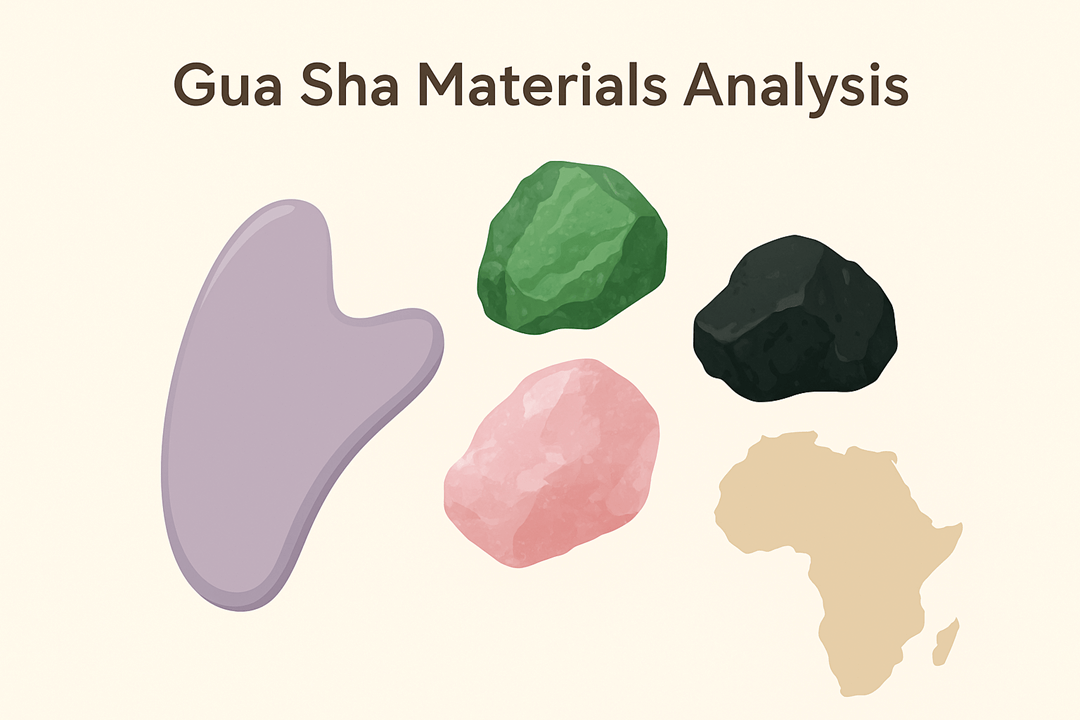
gua sha material

gua sha manufactuer material analysis

Gua Sha Manufacturers: Gua Sha Material Market Analysis

In recent years, with the continuous expansion of the Gua Sha market and a surge in demand, the market trends and price fluctuations of Gua Sha materials have become a key focus for many Gua Sha manufacturer. Low prices mean a sharp reduction in production costs, while securing large quantities of raw materials ensures a stable supply. Both are directly related to the manufacturer’s specific interests. However, for raw materials such as crystal and jade, their market supply is directly affected by mining volume, resulting in drastic price fluctuations. For example, the current amethyst raw material, affected by mining volume, has led to a sharp increase in cost and a shortage of supply. Today, we will analyze the market trends of amethyst raw materials, starting with amethyst raw materials and branching out to other crystal and jade materials. 1. Why is Amethyst Gua Sha so Hard to Come By? Amethyst in China is primarily divided into two types: “dog-tooth amethyst” (the raw material contains white banding), and “flower amethyst” (which lacks the white banding). Originally, the price of “dog-tooth amethyst” was slightly lower than that of “flower amethyst,” but with increasing material scarcity, the prices of both have risen sharply, and are now roughly on par. Most of the world’s amethyst is mined in regions such as South Africa, Brazil, and Uruguay. Amethyst is inherently scarcer than crystals like rose quartz. In addition to recent years of heavy mining, several major mines have been depleted, and new mines have yet to be discovered. This has led to an extreme shortage of amethyst in the raw material market. Not only is the quantity scarce, but the quality is also subpar. This situation has persisted for nearly a year and shows no signs of improvement. Besides the scarcity of raw material, another major factor is the structure of amethyst’s crystals. Amethyst cannot be produced in the form of large crystals like rose quartz, which can weigh several tons. Instead, it typically weighs around one or two kilograms. This size makes it difficult to create gua sha tools. Most raw amethyst is not large enough for this purpose, and can only be made into small carvings. Future Trend: Alternative materials (dyed crystal/synthetic amethyst) may emerge, but genuine amethyst will remain the mainstream in the high-end market. 2. Analysis of Other Crystal/Jade Gua Sha Materials 1. Mining situation: 2. Analysis of the Market Sales Situation of Gua Sha materials: 3. Challenges Faced By Supply Chain and Gua Sha Manufacturer In recent years, with the booming Gua Sha market, a large amount of raw stones have been mined. However, raw stone resources are limited, and some precious raw stones are at risk of depletion, while new resources are unlikely to be discovered in a short period of time. This has led to a large shortage of raw materials, with amethyst being a typical example. This situation has forced Gua Sha manufacturer to lock in resources in advance, resulting in increased financial pressure. The international market is increasingly demanding sustainable mining and environmental certification, and some supply chains are facing compliance challenges. Controls on the export of rough diamonds will also become increasingly stringent. The high-end market has higher requirements for the polishing, design, and branding of Gua Sha blades. While this will drive the upgrading of manufacturing processes in the industry to a certain extent, it also brings more challenges to Gua Sha manufacturer. The material market for Gua Sha tools is no longer simply a matter of raw material selection; it is a comprehensive reflection of supply chains, environmental policies, and global consumer trends. Given the scarcity of amethyst resources, Gua Sha manufacturer must not only seize opportunities in the high-end market but also actively explore alternative materials and innovative products to maintain their advantages in the fierce competition of the future.

Gua Sha Manufacturers: Gua Sha Material Market Analysis Read More »

In recent years, with the continuous expansion of the Gua Sha market and a surge in demand, the market trends and price fluctuations of Gua Sha materials have become a key focus for many Gua Sha manufacturer. Low prices mean a sharp reduction in production costs, while securing large quantities of raw materials ensures a stable supply. Both are directly related to the manufacturer’s specific interests. However, for raw materials such as crystal and jade, their market supply is directly affected by mining volume, resulting in drastic price fluctuations. For example, the current amethyst raw material, affected by mining volume, has led to a sharp increase in cost and a shortage of supply. Today, we will analyze the market trends of amethyst raw materials, starting with amethyst raw materials and branching out to other crystal and jade materials. 1. Why is Amethyst Gua Sha so Hard to Come By? Amethyst in China is primarily divided into two types: “dog-tooth amethyst” (the raw material contains white banding), and “flower amethyst” (which lacks the white banding). Originally, the price of “dog-tooth amethyst” was slightly lower than that of “flower amethyst,” but with increasing material scarcity, the prices of both have risen sharply, and are now roughly on par. Most of the world’s amethyst is mined in regions such as South Africa, Brazil, and Uruguay. Amethyst is inherently scarcer than crystals like rose quartz. In addition to recent years of heavy mining, several major mines have been depleted, and new mines have yet to be discovered. This has led to an extreme shortage of amethyst in the raw material market. Not only is the quantity scarce, but the quality is also subpar. This situation has persisted for nearly a year and shows no signs of improvement. Besides the scarcity of raw material, another major factor is the structure of amethyst’s crystals. Amethyst cannot be produced in the form of large crystals like rose quartz, which can weigh several tons. Instead, it typically weighs around one or two kilograms. This size makes it difficult to create gua sha tools. Most raw amethyst is not large enough for this purpose, and can only be made into small carvings. Future Trend: Alternative materials (dyed crystal/synthetic amethyst) may emerge, but genuine amethyst will remain the mainstream in the high-end market. 2. Analysis of Other Crystal/Jade Gua Sha Materials 1. Mining situation: 2. Analysis of the Market Sales Situation of Gua Sha materials: 3. Challenges Faced By Supply Chain and Gua Sha Manufacturer In recent years, with the booming Gua Sha market, a large amount of raw stones have been mined. However, raw stone resources are limited, and some precious raw stones are at risk of depletion, while new resources are unlikely to be discovered in a short period of time. This has led to a large shortage of raw materials, with amethyst being a typical example. This situation has forced Gua Sha manufacturer to lock in resources in advance, resulting in increased financial pressure. The international market is increasingly demanding sustainable mining and environmental certification, and some supply chains are facing compliance challenges. Controls on the export of rough diamonds will also become increasingly stringent. The high-end market has higher requirements for the polishing, design, and branding of Gua Sha blades. While this will drive the upgrading of manufacturing processes in the industry to a certain extent, it also brings more challenges to Gua Sha manufacturer. The material market for Gua Sha tools is no longer simply a matter of raw material selection; it is a comprehensive reflection of supply chains, environmental policies, and global consumer trends. Given the scarcity of amethyst resources, Gua Sha manufacturer must not only seize opportunities in the high-end market but also actively explore alternative materials and innovative products to maintain their advantages in the fierce competition of the future.

Top 10 the Best Popular Gua Sha Materials Introduction. Differnt Advantages and Disadvantages

With the introduction of our many articles about gua sha wholesale issues and how to wholesale, you must have a lot of understanding of the wholesale process of gua sha tools and the places to pay attention. Today, we are going to top 10 of the most popular gua sha materials that will give you some help with your gua sha wholesale purchases. We will introduce from the material itself, and at the same time we will introduce the advantages and disadvantages of various materials. Here we go! Top 1 Rose Quartz Gua Sha Board Without a doubt, the most popular gua sha material. The guasha tool made of this material has been occupying the top spot of the best-selling gua sha tool since its birth. Rose quartz is a member of the quartz family and is a hexagonal crystal system, the main component of which is silicon dioxide. Its Mohs hardness is about 7, its specific gravity is 2.6, and its refractive index is 1.54-1.55. It is mainly produced in Brazil, South Africa, Madagascar and other places. The pink color is due to the trace amount of titanium in it. Because of its beautiful pink color, it is also called “love stone”. Rose quartz is a relatively common kind in the crystal family, so the price of ordinary quality rose quartz is not high. The price of the gua sha tool made of rose quartz is in the middle of the whole guasha series, which is also an important factor in its popularity. Advantages: Beautiful appearance, and because of its material, it can achieve a glass-like polishing effect, which is extremely smooth when guasha. The price is very attractive. Comfortable to hold. Disadvantages: Fragile, need to be carefully stored, try to avoid contact with hard objects. Color is not stable. Natural rose quartz will gradually fade in color when exposed to prolonged sunlight. Top 2 Green Jade Gua Sha Board If the rose quartz gua sha board is deeply loved by customers because of its beauty and relatively attractive price, then the green jade gua sha board takes the feature of price to the extreme. Its price is the cheapest among all natural stone materials, no one. With this advantage, it has a strong position as the second most popular guasha material. Most are composed of serpentine and contain small amounts of phlogopite, talc, calcite, tremolite, chlorite, epidote, etc. Due to the high content of impurities, the color is often different from that of Xiuyu, ranging from dark green to brownish green. At the same time, the geological conditions of the output are also different from those of Xiuyu. It is produced in the stratum composed of mica schist and banded mixed gneiss, and there is often a talc layer with a thickness of 0.2 to 5.5 meters below the jade ore body. Advantages: The price is irresistible, and because of the characteristics of jade, the feel is also satisfactory. Cons: Looks may not please everyone. It’s dark and black in color. At the same time, due to material problems, it cannot achieve a polishing effect similar to rose quartz. Top 3 Stainless Steel Gua Sha Board The appearance of stainless steel gua sha board is later than that of stone guasha board. But it’s developing very fast. Now it has become the top three most popular gua sha materials. Stainless steel does not refer to a single metal, it generally refers to various rust-resistant alloy materials. Different stainless steels have their own numbers and are used in different fields. At present, the guasha materials on the market are 304 stainless steel metal as the best. 304 stainless steel is generally used in food products or medical products. Security is impeccable. At the same time, due to the excellent properties of stainless steel, stainless steel gua sha plates can be supplied at the same quality for a long time and stably. Advantages: stable quality, not easy to break, low defective rate. Disadvantages: easy to scratch, high density so the weight is heavy. The price is relatively high compared to most gua sha boards. Top 4 Green Aventurine Gua Sha Board Many people will consider the Green aventurine gua sha board as a jade guasha board because of its conspicuous green color. And many people call it “Indian jade”. But in fact, green aventurine is not a member of jade, but a member of the quartz family. The standard chemical composition of aventurine is mainly SiO2; the mineral composition is mainly quartz, containing about 10%-18% of chromium mica, and also contains trace amounts of blue lineite, sillimanite, rutile, hematite, zircon, etc. Because the chromium mica is very small (0.2-2 mm in diameter) scale-like, and the distribution is relatively uniform, the aventurine stone is bright oily green and emerald green. Has an intense greasy and vitreous sheen, translucent to slightly translucent. The refractive index is about 1.544-1.560. Hardness 7, density 2.65-2.8 g/cm3. Sex is brittle. The texture is dense, delicate, tough and smooth. After buffing, small radiant dots (red dots for rutile, black dots for hematite, yellow dots for chrome mica, etc.) Pros: Beautiful appearance. Less brittle than rose quartz. Disadvantage: Higher possibility of containing impurities. Top 5 Obsidian Gua Sha Board In fourth place is the obsidian gua sha board. This inconspicuous-looking gua sha board is very popular. It is black throughout, and when it contains other substances, it will show other colors under the illumination of light. Obsidian is formed when acidic volcanic lava cools and condenses quickly, without enough time for the mineral crystals to grow and form glassy. Obsidian is usually found on the periphery of a lava flow because it cools the fastest. Considered by Mexico as its “national stone”. Obsidian is widely distributed in areas with or had volcanic activity, such as Hawaii, Japan and Indonesia in the United States. Dark nodules are found in Arizona and New Mexico. The origin of gem-quality obsidian is mainly in North America’s Yellowstone National Park and Colorado,

Top 10 the Best Popular Gua Sha Materials Introduction. Differnt Advantages and Disadvantages Read More »

With the introduction of our many articles about gua sha wholesale issues and how to wholesale, you must have a lot of understanding of the wholesale process of gua sha tools and the places to pay attention. Today, we are going to top 10 of the most popular gua sha materials that will give you some help with your gua sha wholesale purchases. We will introduce from the material itself, and at the same time we will introduce the advantages and disadvantages of various materials. Here we go! Top 1 Rose Quartz Gua Sha Board Without a doubt, the most popular gua sha material. The guasha tool made of this material has been occupying the top spot of the best-selling gua sha tool since its birth. Rose quartz is a member of the quartz family and is a hexagonal crystal system, the main component of which is silicon dioxide. Its Mohs hardness is about 7, its specific gravity is 2.6, and its refractive index is 1.54-1.55. It is mainly produced in Brazil, South Africa, Madagascar and other places. The pink color is due to the trace amount of titanium in it. Because of its beautiful pink color, it is also called “love stone”. Rose quartz is a relatively common kind in the crystal family, so the price of ordinary quality rose quartz is not high. The price of the gua sha tool made of rose quartz is in the middle of the whole guasha series, which is also an important factor in its popularity. Advantages: Beautiful appearance, and because of its material, it can achieve a glass-like polishing effect, which is extremely smooth when guasha. The price is very attractive. Comfortable to hold. Disadvantages: Fragile, need to be carefully stored, try to avoid contact with hard objects. Color is not stable. Natural rose quartz will gradually fade in color when exposed to prolonged sunlight. Top 2 Green Jade Gua Sha Board If the rose quartz gua sha board is deeply loved by customers because of its beauty and relatively attractive price, then the green jade gua sha board takes the feature of price to the extreme. Its price is the cheapest among all natural stone materials, no one. With this advantage, it has a strong position as the second most popular guasha material. Most are composed of serpentine and contain small amounts of phlogopite, talc, calcite, tremolite, chlorite, epidote, etc. Due to the high content of impurities, the color is often different from that of Xiuyu, ranging from dark green to brownish green. At the same time, the geological conditions of the output are also different from those of Xiuyu. It is produced in the stratum composed of mica schist and banded mixed gneiss, and there is often a talc layer with a thickness of 0.2 to 5.5 meters below the jade ore body. Advantages: The price is irresistible, and because of the characteristics of jade, the feel is also satisfactory. Cons: Looks may not please everyone. It’s dark and black in color. At the same time, due to material problems, it cannot achieve a polishing effect similar to rose quartz. Top 3 Stainless Steel Gua Sha Board The appearance of stainless steel gua sha board is later than that of stone guasha board. But it’s developing very fast. Now it has become the top three most popular gua sha materials. Stainless steel does not refer to a single metal, it generally refers to various rust-resistant alloy materials. Different stainless steels have their own numbers and are used in different fields. At present, the guasha materials on the market are 304 stainless steel metal as the best. 304 stainless steel is generally used in food products or medical products. Security is impeccable. At the same time, due to the excellent properties of stainless steel, stainless steel gua sha plates can be supplied at the same quality for a long time and stably. Advantages: stable quality, not easy to break, low defective rate. Disadvantages: easy to scratch, high density so the weight is heavy. The price is relatively high compared to most gua sha boards. Top 4 Green Aventurine Gua Sha Board Many people will consider the Green aventurine gua sha board as a jade guasha board because of its conspicuous green color. And many people call it “Indian jade”. But in fact, green aventurine is not a member of jade, but a member of the quartz family. The standard chemical composition of aventurine is mainly SiO2; the mineral composition is mainly quartz, containing about 10%-18% of chromium mica, and also contains trace amounts of blue lineite, sillimanite, rutile, hematite, zircon, etc. Because the chromium mica is very small (0.2-2 mm in diameter) scale-like, and the distribution is relatively uniform, the aventurine stone is bright oily green and emerald green. Has an intense greasy and vitreous sheen, translucent to slightly translucent. The refractive index is about 1.544-1.560. Hardness 7, density 2.65-2.8 g/cm3. Sex is brittle. The texture is dense, delicate, tough and smooth. After buffing, small radiant dots (red dots for rutile, black dots for hematite, yellow dots for chrome mica, etc.) Pros: Beautiful appearance. Less brittle than rose quartz. Disadvantage: Higher possibility of containing impurities. Top 5 Obsidian Gua Sha Board In fourth place is the obsidian gua sha board. This inconspicuous-looking gua sha board is very popular. It is black throughout, and when it contains other substances, it will show other colors under the illumination of light. Obsidian is formed when acidic volcanic lava cools and condenses quickly, without enough time for the mineral crystals to grow and form glassy. Obsidian is usually found on the periphery of a lava flow because it cools the fastest. Considered by Mexico as its “national stone”. Obsidian is widely distributed in areas with or had volcanic activity, such as Hawaii, Japan and Indonesia in the United States. Dark nodules are found in Arizona and New Mexico. The origin of gem-quality obsidian is mainly in North America’s Yellowstone National Park and Colorado,

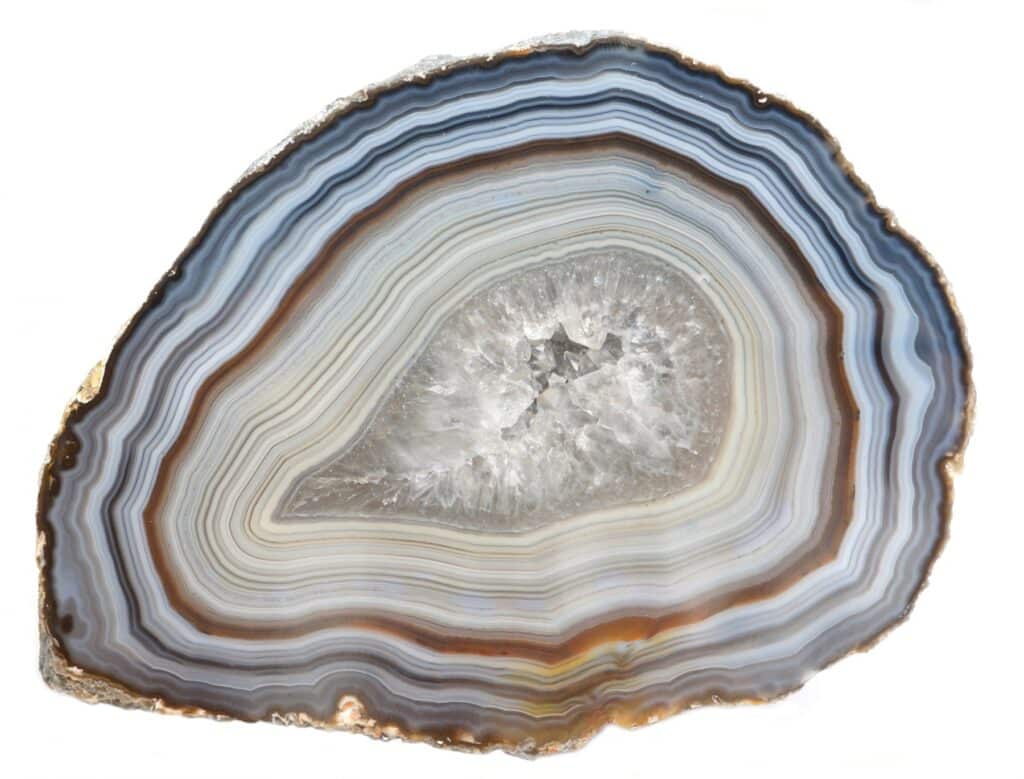
agate

Agate-Beauty and High Quality Gua Sha Material

Gua sha board materials are varied, natural stone, artificial plastic and metal materials are numerous. Today, we introduce to you one of the materials for scraping – agate. Today’s article mainly contains two contents: the material introduction of agate and why we choose it as one of our gua sha raw materials. What is Agate? Agate is a kind of chalcedony minerals that are often mixed with opal and cryptocrystalline quartz. The hardness is 6.5-7 degrees, the specific gravity is 2.65, and the color is quite layered. Available in translucent or opaque. The original form of the trigonal crystal system. It is often dense and massive and forms various structures, such as breast, grape, tuberculosis, etc. The common concentric structure. Chalcedony has different colors, usually green, red, yellow, brown, white and other colors. According to the pattern and impurities, it can be divided into onyx, silk agate, moss agate, castle agate, etc. Irregular block, nearly oblate, cylindrical (for the excess part of processing handicrafts). Red, orange-red to dark red and milky white, off-white. Streaks white. translucent. The surface is flat and smooth, with vitreous luster; some are more uneven and waxy luster. The body is light, hard and brittle, easy to break, and concentric circular ripples with the force point as the center can be seen on the cross section, like a shell. With sharp edges and corners, it can score glass and leave scratches. Odorless, tasteless. Quick friction is not easy to heat. The quality is firm, the color is red, and the transparent one is better. The main component of agate is silica, which is often repeated in layers due to alternating with hydrated silica (silicic acid). Due to the inclusion of oxidized metals, the color can vary from very pale to dark. Using iron, cobalt, nickel and other salts, allowing them to naturally penetrate into the silicic acid gel, can be artificially made into “agate”, and natural agate may also be generated under similar circumstances. Why do We Choose Agate As One Of the Raw Materials for the Gua Sha Board? Our development of gua sha board raw materials mainly follows the following factors: Customer and market demand: Agate is a very popular semi-precious stone. There is a very large audience in jewelry, home decoration and other industries, so from the perspective of customers and market demand, this is a guasha raw material with good market prospects. Raw material price and cost: The price of agate is one of the highest among all gua sha board raw materials. It is generally more expensive than the mainstream pink crystal material in the market, but it is also much lower than amethyst, so it is an acceptable cost in terms of cost. scope. Processing difficulty: The hardness of agate is roughly the same as that of crystal, but due to the characteristics of agate structure, its structure is tighter and the processing difficulty will be higher. If it is made manually, it will take more labor. But the tight texture also has a benefit. That is, it is not easy to be damaged during reprocessing, which reduces material loss in production. Material fit: Not all materials are suitable for guasha. If the hardness is not enough, it is difficult for the gua sha board to reach the polished state that meets the standard, which will reduce the comfort of use. And if there are a lot of gaps in the material, such as a scraping board made of volcanic rock, because there are abundant holes with large diameters on the surface, it is difficult to say that its use experience is comfortable, or even bad. However, the agate material is hard and has few internal gaps, so it is very suitable for the requirements of the gua sha board. To sum up, agate material meets the requirements of a qualified gua sha product in terms of customer and market demand, cost, processing difficulty and fit, which is why we choose agate as one of the raw materials for gua sha. Want to wholesale high quality agate gua sha stones at factory direct price? Contact us right now! We have more than 100 different gua sha to choose from, and customized services offer! You will meet all your needs here. Dropshipping available!

Agate-Beauty and High Quality Gua Sha Material Read More »

Gua sha board materials are varied, natural stone, artificial plastic and metal materials are numerous. Today, we introduce to you one of the materials for scraping – agate. Today’s article mainly contains two contents: the material introduction of agate and why we choose it as one of our gua sha raw materials. What is Agate? Agate is a kind of chalcedony minerals that are often mixed with opal and cryptocrystalline quartz. The hardness is 6.5-7 degrees, the specific gravity is 2.65, and the color is quite layered. Available in translucent or opaque. The original form of the trigonal crystal system. It is often dense and massive and forms various structures, such as breast, grape, tuberculosis, etc. The common concentric structure. Chalcedony has different colors, usually green, red, yellow, brown, white and other colors. According to the pattern and impurities, it can be divided into onyx, silk agate, moss agate, castle agate, etc. Irregular block, nearly oblate, cylindrical (for the excess part of processing handicrafts). Red, orange-red to dark red and milky white, off-white. Streaks white. translucent. The surface is flat and smooth, with vitreous luster; some are more uneven and waxy luster. The body is light, hard and brittle, easy to break, and concentric circular ripples with the force point as the center can be seen on the cross section, like a shell. With sharp edges and corners, it can score glass and leave scratches. Odorless, tasteless. Quick friction is not easy to heat. The quality is firm, the color is red, and the transparent one is better. The main component of agate is silica, which is often repeated in layers due to alternating with hydrated silica (silicic acid). Due to the inclusion of oxidized metals, the color can vary from very pale to dark. Using iron, cobalt, nickel and other salts, allowing them to naturally penetrate into the silicic acid gel, can be artificially made into “agate”, and natural agate may also be generated under similar circumstances. Why do We Choose Agate As One Of the Raw Materials for the Gua Sha Board? Our development of gua sha board raw materials mainly follows the following factors: Customer and market demand: Agate is a very popular semi-precious stone. There is a very large audience in jewelry, home decoration and other industries, so from the perspective of customers and market demand, this is a guasha raw material with good market prospects. Raw material price and cost: The price of agate is one of the highest among all gua sha board raw materials. It is generally more expensive than the mainstream pink crystal material in the market, but it is also much lower than amethyst, so it is an acceptable cost in terms of cost. scope. Processing difficulty: The hardness of agate is roughly the same as that of crystal, but due to the characteristics of agate structure, its structure is tighter and the processing difficulty will be higher. If it is made manually, it will take more labor. But the tight texture also has a benefit. That is, it is not easy to be damaged during reprocessing, which reduces material loss in production. Material fit: Not all materials are suitable for guasha. If the hardness is not enough, it is difficult for the gua sha board to reach the polished state that meets the standard, which will reduce the comfort of use. And if there are a lot of gaps in the material, such as a scraping board made of volcanic rock, because there are abundant holes with large diameters on the surface, it is difficult to say that its use experience is comfortable, or even bad. However, the agate material is hard and has few internal gaps, so it is very suitable for the requirements of the gua sha board. To sum up, agate material meets the requirements of a qualified gua sha product in terms of customer and market demand, cost, processing difficulty and fit, which is why we choose agate as one of the raw materials for gua sha. Want to wholesale high quality agate gua sha stones at factory direct price? Contact us right now! We have more than 100 different gua sha to choose from, and customized services offer! You will meet all your needs here. Dropshipping available!

Scroll to Top

Getting Fast Reply

gua sha wholesale