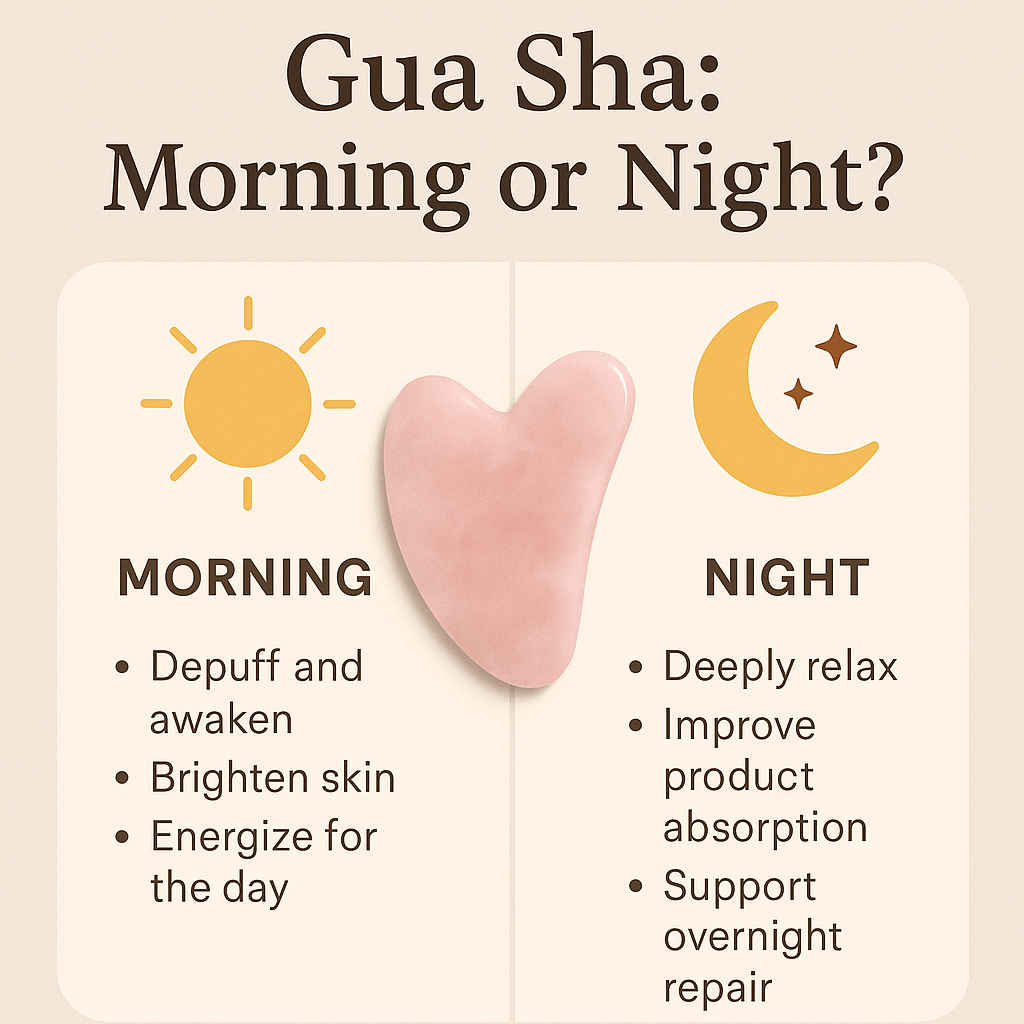
gua sha morning or night

gua sha before and after

Gua Sha Before and After: What’s the Best Time for Glowing Skin?

Gua Sha, a traditional technique rooted in Chinese medicine, has now become a beloved daily ritual among skincare enthusiasts. It promotes blood circulation, lymphatic drainage, and facial muscle relaxation—helping the skin naturally glow. But what are the real differences about gua sha before and after? And when is the best time to do it? These are factors worth considering. What Is Gua Sha? Gua Sha involves gently scraping the skin with a smooth-edged tool—commonly made from jade or rose quartz—to stimulate circulation and lymphatic flow. Historically, various stones or even ceramic spoons were used; nowadays, people prefer tools made from natural stone or metal. When used on the face, the technique is gentle and focuses on reducing puffiness, brightening the complexion, and defining facial contours. Before starting, apply a facial serum or oil to reduce friction and help the tool glide smoothly. Scraping is typically done from the center of the face outward, aiming to release tension, soothe the nerves, and promote energy (Qi) flow. With consistent use, Gua Sha can improve skin texture, tone, and radiance. Benefits of Morning Gua Sha Gua Sha stimulates lymphatic drainage, which can effectively reduce facial puffiness. Doing it in the morning not only improves your skin’s condition but also awakens your face for the day ahead. Key benefits include: Recommended Routine: After cleansing, apply a hydrating serum or facial oil. Use upward, gentle strokes, focusing on puffy areas such as under the eyes and the jawline. Just a few minutes can tighten and refresh the skin, making it a great prep for makeup. Keep the tool at about a 30-degree angle and use light pressure. Benefits of Evening Gua Sha Besides reducing puffiness, evening Gua Sha is ideal for relaxation and mental unwinding, while supporting overnight skin repair. Benefits include: Recommended Routine: After cleansing, apply a nourishing serum or night cream. Find a quiet space with soft lighting and match your strokes with deep, calming breaths. Focus on tension areas such as the forehead, temples, and jawline to end your day on a relaxing note. After the session, cleanse your face again, as leftover product can harbor bacteria that may harm your skin. Morning vs. Evening Gua Sha: Which to Choose? As discussed, morning and evening Gua Sha serve different purposes. Your choice should depend on your personal goals and lifestyle. In fact, facial Gua Sha doesn’t have to be either/or—you can even incorporate both for enhanced benefits. How to Integrate Gua Sha Into Your Routine The key is consistency. In today’s fast-paced world, many seek instant results. But when it comes to beauty, Gua Sha’s effects are gradual and long-term. Whether you choose morning or night, regular and proper use will bring noticeable improvement. A basic Gua Sha routine includes: Common Mistakes Gua Sha Before And After Although Gua Sha doesn’t require advanced skills, many people make avoidable mistakes that limit its effectiveness: Gua Sha is not just a skincare technique—it’s a lifestyle of self-care. Take a few minutes each day to reconnect with your body, and you’ll awaken your skin’s most natural and healthy glow. While the difference gua sha before and after might not be immediate, long-term use will surprise you with the results. You can document your daily Gua Sha routine with photos or videos. Compare the before-and-after in a few months, and you may be amazed by the transformation.


Gua Sha Before and After: What’s the Best Time for Glowing Skin? Read More »

Gua Sha, a traditional technique rooted in Chinese medicine, has now become a beloved daily ritual among skincare enthusiasts. It promotes blood circulation, lymphatic drainage, and facial muscle relaxation—helping the skin naturally glow. But what are the real differences about gua sha before and after? And when is the best time to do it? These are factors worth considering. What Is Gua Sha? Gua Sha involves gently scraping the skin with a smooth-edged tool—commonly made from jade or rose quartz—to stimulate circulation and lymphatic flow. Historically, various stones or even ceramic spoons were used; nowadays, people prefer tools made from natural stone or metal. When used on the face, the technique is gentle and focuses on reducing puffiness, brightening the complexion, and defining facial contours. Before starting, apply a facial serum or oil to reduce friction and help the tool glide smoothly. Scraping is typically done from the center of the face outward, aiming to release tension, soothe the nerves, and promote energy (Qi) flow. With consistent use, Gua Sha can improve skin texture, tone, and radiance. Benefits of Morning Gua Sha Gua Sha stimulates lymphatic drainage, which can effectively reduce facial puffiness. Doing it in the morning not only improves your skin’s condition but also awakens your face for the day ahead. Key benefits include: Recommended Routine: After cleansing, apply a hydrating serum or facial oil. Use upward, gentle strokes, focusing on puffy areas such as under the eyes and the jawline. Just a few minutes can tighten and refresh the skin, making it a great prep for makeup. Keep the tool at about a 30-degree angle and use light pressure. Benefits of Evening Gua Sha Besides reducing puffiness, evening Gua Sha is ideal for relaxation and mental unwinding, while supporting overnight skin repair. Benefits include: Recommended Routine: After cleansing, apply a nourishing serum or night cream. Find a quiet space with soft lighting and match your strokes with deep, calming breaths. Focus on tension areas such as the forehead, temples, and jawline to end your day on a relaxing note. After the session, cleanse your face again, as leftover product can harbor bacteria that may harm your skin. Morning vs. Evening Gua Sha: Which to Choose? As discussed, morning and evening Gua Sha serve different purposes. Your choice should depend on your personal goals and lifestyle. In fact, facial Gua Sha doesn’t have to be either/or—you can even incorporate both for enhanced benefits. How to Integrate Gua Sha Into Your Routine The key is consistency. In today’s fast-paced world, many seek instant results. But when it comes to beauty, Gua Sha’s effects are gradual and long-term. Whether you choose morning or night, regular and proper use will bring noticeable improvement. A basic Gua Sha routine includes: Common Mistakes Gua Sha Before And After Although Gua Sha doesn’t require advanced skills, many people make avoidable mistakes that limit its effectiveness: Gua Sha is not just a skincare technique—it’s a lifestyle of self-care. Take a few minutes each day to reconnect with your body, and you’ll awaken your skin’s most natural and healthy glow. While the difference gua sha before and after might not be immediate, long-term use will surprise you with the results. You can document your daily Gua Sha routine with photos or videos. Compare the before-and-after in a few months, and you may be amazed by the transformation.

gua sha routine

Gua Sha Routine | Gua Sha Morning or Night?

A properly executed gua sha routine can improve temporary circulation by up to 25–35% and reduce visible facial puffiness within 5–10 minutes, based on small-scale dermatological observation studies. Yet many guides still promote outdated ideas like “detox” or visible bruising, which are not supported by modern skin physiology. If you are searching how to use gua sha, or wondering does gua sha work, the answer depends entirely on technique, pressure control, and tool selection. Most users fail not because the gua sha effect is weak, but because their gua sha routine lacks structure, safety boundaries, and consistency. So what happens if you correct these variables? You gain a repeatable system that improves skin appearance without increasing irritation risk. This means your daily skincare routine becomes more predictable, and your tool investment produces measurable results instead of random outcomes. Gua Sha Routine Fundamentals and How to Use Gua Sha Wholesale Tools Effectively What Is a Gua Sha Routine and Does Gua Sha Work in Modern Skincare? A gua sha routine is a structured method of applying controlled mechanical stimulation to the skin using a smooth-edged tool, typically at a 15–45° angle. In traditional practice, the method was used on the body, often producing petechiae; however, modern facial applications focus on light pressure and lymphatic support instead of visible marks. If you are still asking, does gua sha work, the evidence suggests that short-term improvements in circulation and fluid movement are achievable, but structural skin changes are limited. From a physiological standpoint, the gua sha effect resembles manual lymphatic drainage and superficial fascia stimulation rather than deep tissue remodeling. According to dermatological observations, excessive pressure can disrupt capillaries, especially in facial areas where the dermis is thinner. This is why current best practices explicitly discourage creating petechiae during a facial gua sha routine. This means you can achieve visible de-puffing and improved skin tone without risking long-term sensitivity or damage. From a clinical perspective, similar manual techniques are described by the American Academy of Dermatology as supportive methods for improving superficial circulation and reducing temporary swelling, rather than structural skin change. H3: How to Use Gua Sha Correctly If you are learning how to use gua sha, the most critical variable is not frequency, but technique consistency. A correct gua sha routine begins with skin preparation, continues with directional strokes, and ends with recovery support. However, most tutorials ignore how tool material and edge precision affect glide resistance and pressure distribution. In gua sha wholesale sourcing, tools made from inconsistent stone density can create uneven friction across the skin. For example, natural jade varies significantly in microstructure, which can influence how smoothly the tool moves. According to the Gemological Institute of America, mineral composition directly impacts hardness and surface polish quality, which affects how a tool interacts with skin. You can review their material reference here:👉 https://www.gia.edu/gem-encyclopedia This matters because uneven glide increases the likelihood of over-pressure in localized areas. This means you can reduce irritation risk simply by selecting tools with consistent surface finishing and controlled edge geometry. Why Most Gua Sha Routine Fail Most failures in a gua sha routine come from three factors: excessive pressure, inconsistent direction, and unrealistic expectations about the gua sha effect. Many users assume stronger pressure leads to better results, which is incorrect for facial use. In fact, studies on superficial circulation suggest that mild stimulation produces comparable blood flow changes without increasing tissue stress. Another common mistake is switching stroke directions randomly, which reduces lymphatic efficiency. If you are asking how to use gua sha effectively, directional consistency is non-negotiable. Movements should guide fluid toward drainage points rather than dispersing it unpredictably. This means your routine becomes more efficient, requiring fewer strokes to achieve visible results. Finally, many users expect structural lifting from a gua sha routine, which is not supported by current evidence. The actual gua sha effect is temporary improvement in fluid distribution and muscle relaxation. This means you avoid disappointment and can position the technique correctly within a broader skincare system. Gua Sha Morning or Night – Does Timing Change Results? The debate around gua sha morning or night is largely about user goals rather than physiological limitations. Morning sessions tend to reduce fluid retention and puffiness, while evening sessions emphasize relaxation and tension release. However, the core gua sha routine remains the same regardless of timing. If your primary concern is visible swelling, performing your gua sha routine in the morning can produce faster visual changes. On the other hand, if stress and muscle tightness are your main concerns, nighttime application may be more beneficial. So, does gua sha morning or night really matter? Only in relation to your objective, not the underlying effectiveness. Data from skincare usage patterns suggests that consistency has a greater impact than timing, with users performing at least 4–5 sessions per week reporting more stable results. This means you can choose a schedule that fits your lifestyle without sacrificing effectiveness. Step-by-Step Gua Sha Routine and How to Use Gua Sha Wholesale Tools Safely How to Use Gua Sha Correctly in a Daily Gua Sha Routine A structured gua sha routine should always begin with controlled preparation, followed by directional strokes and finished with recovery care. If you are learning how to use gua sha, the biggest mistake is skipping preparation and applying tools directly onto dry skin. Friction without lubrication increases shear stress on the epidermis, which can lead to irritation within just 2–3 sessions. Start by cleansing your skin and applying a facial oil or serum to reduce drag. Clinical skincare observations suggest that proper lubrication can reduce friction by up to 40%, significantly lowering the risk of micro-damage during a gua sha routine. This is not just a comfort issue—it directly affects how evenly pressure is distributed across the skin. This means you can maintain consistent results while reducing variability caused by technique errors. From a gua sha wholesale perspective, tool edge finishing plays a measurable role here. Tools with poorly polished

Gua Sha Routine | Gua Sha Morning or Night? Read More »

A properly executed gua sha routine can improve temporary circulation by up to 25–35% and reduce visible facial puffiness within 5–10 minutes, based on small-scale dermatological observation studies. Yet many guides still promote outdated ideas like “detox” or visible bruising, which are not supported by modern skin physiology. If you are searching how to use gua sha, or wondering does gua sha work, the answer depends entirely on technique, pressure control, and tool selection. Most users fail not because the gua sha effect is weak, but because their gua sha routine lacks structure, safety boundaries, and consistency. So what happens if you correct these variables? You gain a repeatable system that improves skin appearance without increasing irritation risk. This means your daily skincare routine becomes more predictable, and your tool investment produces measurable results instead of random outcomes. Gua Sha Routine Fundamentals and How to Use Gua Sha Wholesale Tools Effectively What Is a Gua Sha Routine and Does Gua Sha Work in Modern Skincare? A gua sha routine is a structured method of applying controlled mechanical stimulation to the skin using a smooth-edged tool, typically at a 15–45° angle. In traditional practice, the method was used on the body, often producing petechiae; however, modern facial applications focus on light pressure and lymphatic support instead of visible marks. If you are still asking, does gua sha work, the evidence suggests that short-term improvements in circulation and fluid movement are achievable, but structural skin changes are limited. From a physiological standpoint, the gua sha effect resembles manual lymphatic drainage and superficial fascia stimulation rather than deep tissue remodeling. According to dermatological observations, excessive pressure can disrupt capillaries, especially in facial areas where the dermis is thinner. This is why current best practices explicitly discourage creating petechiae during a facial gua sha routine. This means you can achieve visible de-puffing and improved skin tone without risking long-term sensitivity or damage. From a clinical perspective, similar manual techniques are described by the American Academy of Dermatology as supportive methods for improving superficial circulation and reducing temporary swelling, rather than structural skin change. H3: How to Use Gua Sha Correctly If you are learning how to use gua sha, the most critical variable is not frequency, but technique consistency. A correct gua sha routine begins with skin preparation, continues with directional strokes, and ends with recovery support. However, most tutorials ignore how tool material and edge precision affect glide resistance and pressure distribution. In gua sha wholesale sourcing, tools made from inconsistent stone density can create uneven friction across the skin. For example, natural jade varies significantly in microstructure, which can influence how smoothly the tool moves. According to the Gemological Institute of America, mineral composition directly impacts hardness and surface polish quality, which affects how a tool interacts with skin. You can review their material reference here:👉 https://www.gia.edu/gem-encyclopedia This matters because uneven glide increases the likelihood of over-pressure in localized areas. This means you can reduce irritation risk simply by selecting tools with consistent surface finishing and controlled edge geometry. Why Most Gua Sha Routine Fail Most failures in a gua sha routine come from three factors: excessive pressure, inconsistent direction, and unrealistic expectations about the gua sha effect. Many users assume stronger pressure leads to better results, which is incorrect for facial use. In fact, studies on superficial circulation suggest that mild stimulation produces comparable blood flow changes without increasing tissue stress. Another common mistake is switching stroke directions randomly, which reduces lymphatic efficiency. If you are asking how to use gua sha effectively, directional consistency is non-negotiable. Movements should guide fluid toward drainage points rather than dispersing it unpredictably. This means your routine becomes more efficient, requiring fewer strokes to achieve visible results. Finally, many users expect structural lifting from a gua sha routine, which is not supported by current evidence. The actual gua sha effect is temporary improvement in fluid distribution and muscle relaxation. This means you avoid disappointment and can position the technique correctly within a broader skincare system. Gua Sha Morning or Night – Does Timing Change Results? The debate around gua sha morning or night is largely about user goals rather than physiological limitations. Morning sessions tend to reduce fluid retention and puffiness, while evening sessions emphasize relaxation and tension release. However, the core gua sha routine remains the same regardless of timing. If your primary concern is visible swelling, performing your gua sha routine in the morning can produce faster visual changes. On the other hand, if stress and muscle tightness are your main concerns, nighttime application may be more beneficial. So, does gua sha morning or night really matter? Only in relation to your objective, not the underlying effectiveness. Data from skincare usage patterns suggests that consistency has a greater impact than timing, with users performing at least 4–5 sessions per week reporting more stable results. This means you can choose a schedule that fits your lifestyle without sacrificing effectiveness. Step-by-Step Gua Sha Routine and How to Use Gua Sha Wholesale Tools Safely How to Use Gua Sha Correctly in a Daily Gua Sha Routine A structured gua sha routine should always begin with controlled preparation, followed by directional strokes and finished with recovery care. If you are learning how to use gua sha, the biggest mistake is skipping preparation and applying tools directly onto dry skin. Friction without lubrication increases shear stress on the epidermis, which can lead to irritation within just 2–3 sessions. Start by cleansing your skin and applying a facial oil or serum to reduce drag. Clinical skincare observations suggest that proper lubrication can reduce friction by up to 40%, significantly lowering the risk of micro-damage during a gua sha routine. This is not just a comfort issue—it directly affects how evenly pressure is distributed across the skin. This means you can maintain consistent results while reducing variability caused by technique errors. From a gua sha wholesale perspective, tool edge finishing plays a measurable role here. Tools with poorly polished

Scroll to Top

Getting Fast Reply

gua sha wholesale