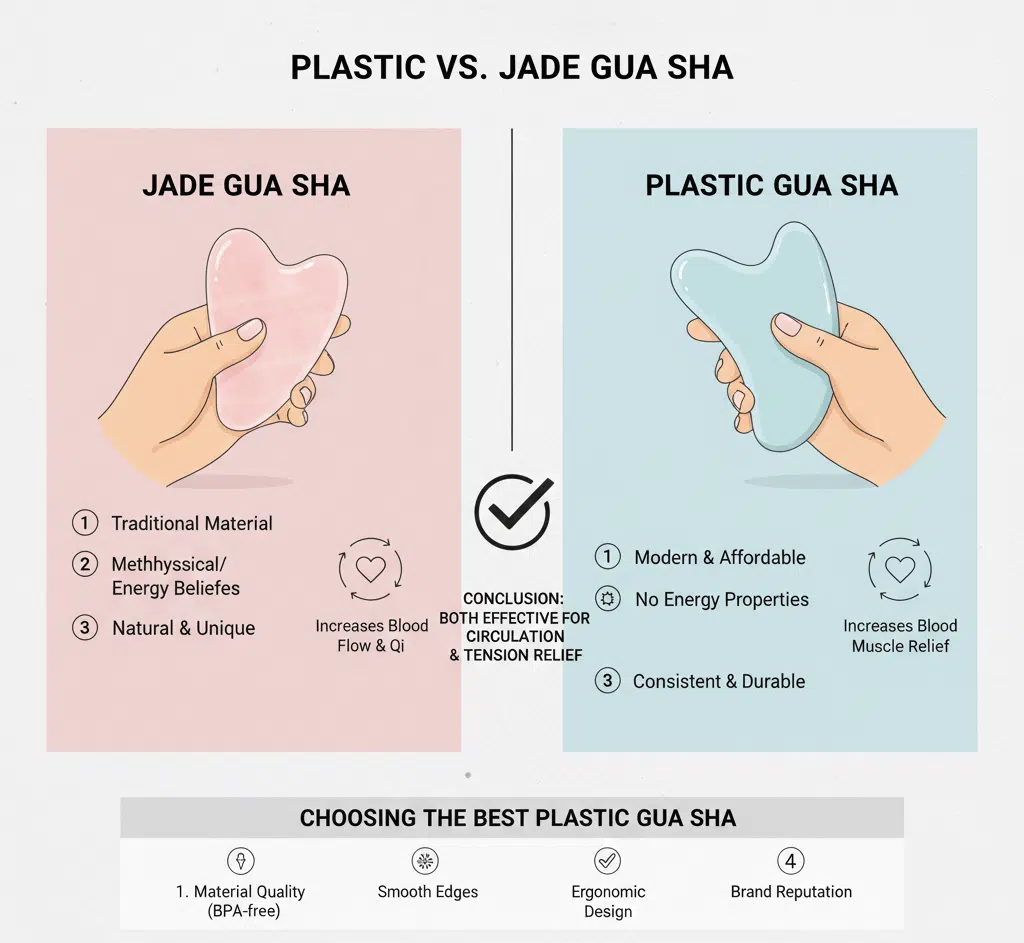
Are Plastic Gua Sha Effective? What Different with Jade Gua Sha?
If you’re evaluating whether a plastic gua sha effective tool belongs in your product line or wellness routine, here is the direct answer: yes, plastic gua sha tools work — but they operate at roughly 80% of the effectiveness of stainless steel alternatives. That 20% gap is not a minor footnote. It represents measurable differences in glide quality, thermal therapy capability, and long-term skin safety. Understanding where that gap comes from is what separates a smart sourcing decision from a costly mistake. The core mechanism behind gua sha effects has nothing to do with material. Gua sha works by applying controlled friction and pressure to the skin’s surface, stimulating microcirculation, releasing myofascial tension, and promoting lymphatic drainage. Every tool — whether plastic, jade, quartz, or stainless steel — can deliver these fundamentals. What material determines is the quality ceiling of those results, not the baseline function. This is a critical distinction that most buyers overlook entirely. So before dismissing plastic as useless, or accepting it without scrutiny, this analysis will walk you through the science, the safety data, the real-world limitations, and the specific scenarios where plastic either earns its place — or costs you more than it saves. How Plastic Gua Sha Effective Results Actually Compare: The Science Behind the Numbers The question of whether a plastic gua sha effective outcome is achievable comes down to understanding one foundational principle: gua sha’s therapeutic mechanism is technique-driven, not material-driven. According to research published by the Integrative Medicine journal, the physiological benefits of gua sha — including increased surface micro-perfusion by up to 400% in treated areas — are primarily triggered by the friction-pressure stimulus applied to skin, not by the molecular composition of the tool creating that friction. This means that a well-executed gua sha session with a food-grade plastic tool will still activate the same circulatory and lymphatic responses as one performed with a jade board. However, “activation” and “optimization” are two very different standards. The material of your tool directly influences the efficiency of energy transfer, the smoothness of glide across skin, and whether the tool can serve as a thermal medium — all of which determine how close you get to the ceiling of what gua sha effects can deliver. Think of it this way: every car engine converts fuel into motion, but a high-performance engine does so with significantly less waste. Plastic is the economy engine. It runs. It gets you somewhere. But it is not built to perform at the top of its range. The 80% Benchmark: What It Means in Practice for Plastic Gua Sha Effective Results When comparing tool performance under identical technique conditions — same practitioner, same pressure, same session duration — plastic gua sha tools consistently deliver approximately 80% of the therapeutic output produced by stainless steel tools. That figure is not arbitrary. It reflects three compounding deficits: reduced glide efficiency due to surface texture limitations, zero thermal transfer capability, and slightly lower mass that requires the user to compensate with additional hand pressure. Each of these individually represents a minor drawback. Together, they create a meaningful performance gap that accumulates across repeated sessions. For individual users exploring gua sha for the first time, an 80% effectiveness rate is entirely acceptable. The technique will produce visible results — reduced facial puffiness, improved jaw tension, and a temporary improvement in skin luminosity are all achievable. But for practitioners building a professional service, or brands positioning gua sha tools in a mid-to-premium market segment, that 20% deficit becomes a liability. Client retention, repeat booking rates, and perceived treatment value are all sensitive to the quality ceiling of the tools being used. Why Gua Sha’s Core Principle Does Not Depend on Material To understand the limits of plastic without overstating them, it helps to examine what gua sha is actually doing at a physiological level. The tool’s edge creates a controlled shear force against skin tissue, which temporarily disrupts capillary integrity and triggers a localized inflammatory healing response — a process sometimes referred to as “controlled microtrauma.” This response increases nitric oxide production, promotes collagen remodeling in facial tissue, and accelerates the clearance of metabolic byproducts in muscle fibers. None of these processes require a specific material to initiate. What they require is consistent, controlled mechanical input — and plastic can provide that. Where material begins to matter is in the precision and consistency of that input. A tool with a rough or inconsistent surface texture delivers uneven shear force, which means some strokes are doing therapeutic work while others are simply dragging across skin. A tool with insufficient weight requires the user to apply more active downward pressure, which introduces fatigue and inconsistency over a full session. These are not theoretical concerns — they translate directly into variable gua sha effects across a session and inconsistent outcomes across multiple sessions. For clinical or professional applications, this variability is a problem. For casual home use, it is a manageable tradeoff. Comparing Plastic Gua Sha Effective Rates Against Jade and Stainless Steel To give you a clear decision framework, here is how the three primary tool materials stack up across the dimensions that matter most to both practitioners and B2B buyers: Stainless Steel reaches approximately 100% of theoretical effectiveness under optimal conditions. Its high surface density produces a naturally smooth glide, its mass supports consistent pressure without user fatigue, and its thermal conductivity allows it to be pre-cooled or warmed for targeted therapy. According to sourcing data aggregated by Made-in-China and verified through SGS certification records, stainless steel gua sha tools dominate professional and clinical procurement categories precisely because of this reliability ceiling. Jade and natural quartz tools — including the tools that established gua sha’s reputation in traditional Chinese medicine practice — perform at approximately 90–95% effectiveness. Their natural density provides good weight, their stone surfaces achieve a smoothness that approaches stainless steel, and crucially, they possess genuine thermal mass. Natural jade and quartz can be cooled in ice water to reduce post-treatment
Are Plastic Gua Sha Effective? What Different with Jade Gua Sha? Read More »
If you’re evaluating whether a plastic gua sha effective tool belongs in your product line or wellness routine, here is the direct answer: yes, plastic gua sha tools work — but they operate at roughly 80% of the effectiveness of stainless steel alternatives. That 20% gap is not a minor footnote. It represents measurable differences in glide quality, thermal therapy capability, and long-term skin safety. Understanding where that gap comes from is what separates a smart sourcing decision from a costly mistake. The core mechanism behind gua sha effects has nothing to do with material. Gua sha works by applying controlled friction and pressure to the skin’s surface, stimulating microcirculation, releasing myofascial tension, and promoting lymphatic drainage. Every tool — whether plastic, jade, quartz, or stainless steel — can deliver these fundamentals. What material determines is the quality ceiling of those results, not the baseline function. This is a critical distinction that most buyers overlook entirely. So before dismissing plastic as useless, or accepting it without scrutiny, this analysis will walk you through the science, the safety data, the real-world limitations, and the specific scenarios where plastic either earns its place — or costs you more than it saves. How Plastic Gua Sha Effective Results Actually Compare: The Science Behind the Numbers The question of whether a plastic gua sha effective outcome is achievable comes down to understanding one foundational principle: gua sha’s therapeutic mechanism is technique-driven, not material-driven. According to research published by the Integrative Medicine journal, the physiological benefits of gua sha — including increased surface micro-perfusion by up to 400% in treated areas — are primarily triggered by the friction-pressure stimulus applied to skin, not by the molecular composition of the tool creating that friction. This means that a well-executed gua sha session with a food-grade plastic tool will still activate the same circulatory and lymphatic responses as one performed with a jade board. However, “activation” and “optimization” are two very different standards. The material of your tool directly influences the efficiency of energy transfer, the smoothness of glide across skin, and whether the tool can serve as a thermal medium — all of which determine how close you get to the ceiling of what gua sha effects can deliver. Think of it this way: every car engine converts fuel into motion, but a high-performance engine does so with significantly less waste. Plastic is the economy engine. It runs. It gets you somewhere. But it is not built to perform at the top of its range. The 80% Benchmark: What It Means in Practice for Plastic Gua Sha Effective Results When comparing tool performance under identical technique conditions — same practitioner, same pressure, same session duration — plastic gua sha tools consistently deliver approximately 80% of the therapeutic output produced by stainless steel tools. That figure is not arbitrary. It reflects three compounding deficits: reduced glide efficiency due to surface texture limitations, zero thermal transfer capability, and slightly lower mass that requires the user to compensate with additional hand pressure. Each of these individually represents a minor drawback. Together, they create a meaningful performance gap that accumulates across repeated sessions. For individual users exploring gua sha for the first time, an 80% effectiveness rate is entirely acceptable. The technique will produce visible results — reduced facial puffiness, improved jaw tension, and a temporary improvement in skin luminosity are all achievable. But for practitioners building a professional service, or brands positioning gua sha tools in a mid-to-premium market segment, that 20% deficit becomes a liability. Client retention, repeat booking rates, and perceived treatment value are all sensitive to the quality ceiling of the tools being used. Why Gua Sha’s Core Principle Does Not Depend on Material To understand the limits of plastic without overstating them, it helps to examine what gua sha is actually doing at a physiological level. The tool’s edge creates a controlled shear force against skin tissue, which temporarily disrupts capillary integrity and triggers a localized inflammatory healing response — a process sometimes referred to as “controlled microtrauma.” This response increases nitric oxide production, promotes collagen remodeling in facial tissue, and accelerates the clearance of metabolic byproducts in muscle fibers. None of these processes require a specific material to initiate. What they require is consistent, controlled mechanical input — and plastic can provide that. Where material begins to matter is in the precision and consistency of that input. A tool with a rough or inconsistent surface texture delivers uneven shear force, which means some strokes are doing therapeutic work while others are simply dragging across skin. A tool with insufficient weight requires the user to apply more active downward pressure, which introduces fatigue and inconsistency over a full session. These are not theoretical concerns — they translate directly into variable gua sha effects across a session and inconsistent outcomes across multiple sessions. For clinical or professional applications, this variability is a problem. For casual home use, it is a manageable tradeoff. Comparing Plastic Gua Sha Effective Rates Against Jade and Stainless Steel To give you a clear decision framework, here is how the three primary tool materials stack up across the dimensions that matter most to both practitioners and B2B buyers: Stainless Steel reaches approximately 100% of theoretical effectiveness under optimal conditions. Its high surface density produces a naturally smooth glide, its mass supports consistent pressure without user fatigue, and its thermal conductivity allows it to be pre-cooled or warmed for targeted therapy. According to sourcing data aggregated by Made-in-China and verified through SGS certification records, stainless steel gua sha tools dominate professional and clinical procurement categories precisely because of this reliability ceiling. Jade and natural quartz tools — including the tools that established gua sha’s reputation in traditional Chinese medicine practice — perform at approximately 90–95% effectiveness. Their natural density provides good weight, their stone surfaces achieve a smoothness that approaches stainless steel, and crucially, they possess genuine thermal mass. Natural jade and quartz can be cooled in ice water to reduce post-treatment