Jade Gua Sha Tool vs. Stainless Steel Gua Sha Wholesale: Why Beauty Brands and Spas Choose Differently
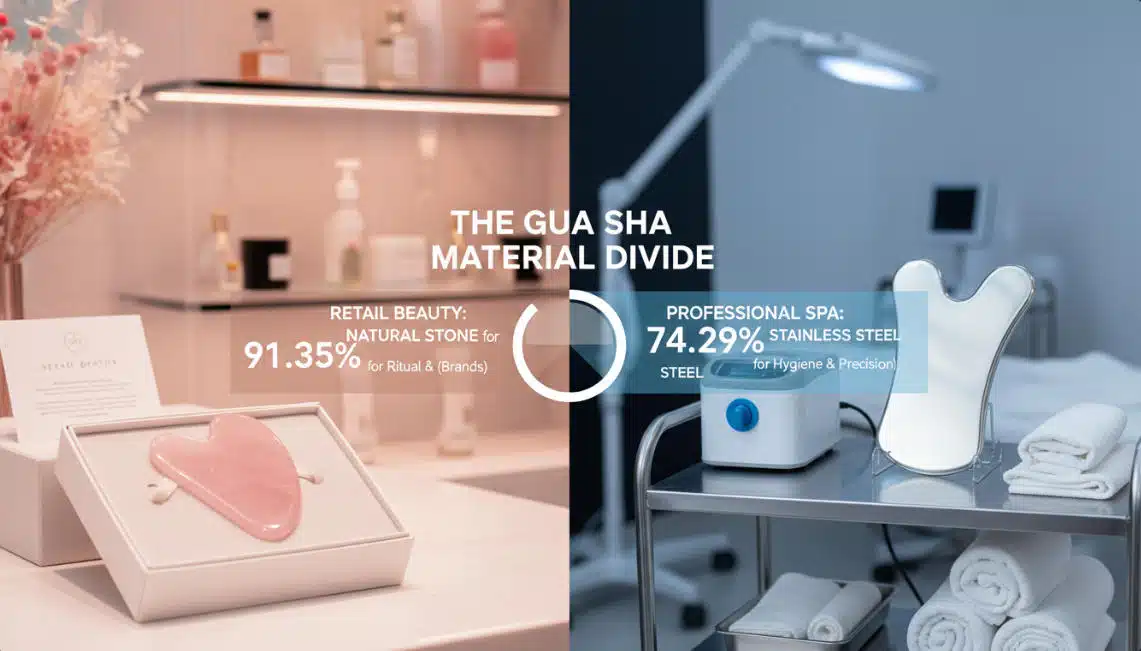
The gua sha wholesale market is splitting in two — and the data makes it impossible to ignore. In Deyi Gems’ 2025 order analysis across 290 verified B2B clients, beauty retailers directed 91.35% of their purchases toward natural jade and crystal gua sha tools, while spa and wellness institutions chose stainless steel gua sha in 74.29% of their orders. These are not random preferences. They are the output of entirely different business models, regulatory environments, and customer psychology operating in the same product category. If you are sourcing gua sha wholesale for your brand and have not yet mapped your procurement decision to your channel logic, you are likely ordering the wrong material — and paying for it in ways that won’t show up until your second reorder cycle. Understanding this divergence starts with a single clarification: this is not a question of which material is superior. Both jade gua sha tools and stainless steel gua sha instruments deliver measurable results for end users. The real question is which material is superior for your specific operating context. A retail beauty brand selling through Sephora or a DTC e-commerce channel operates under completely different constraints than a licensed spa offering 60-minute lymphatic drainage sessions to paying clients. When you align material selection with channel logic, procurement stops being a guessing game and becomes a defensible business decision. The Data Split: What 290 Real Gua Sha Wholesale Orders Reveal About Material Selection In 2025, a pattern emerged from 290 documented gua sha wholesale orders that should reshape how every serious buyer approaches material selection. Among 185 orders placed by retail beauty brands — operating in channels comparable to Sephora and luxury cosmetic retail networks — 169 specified natural jade or crystal gua sha tools, representing 91.35% of that segment. Among 105 orders from spa and wellness institutions, 78 specified stainless steel gua sha tools, accounting for 74.29%. These figures are drawn from Deyi Gems’ 2025 annual order analysis across both buyer categories. If your gua sha wholesale strategy does not account for this material split, you risk sourcing the wrong product for your channel — and paying for that misalignment in returns, compliance failures, or eroded brand positioning. Why This Split Is a Market Signal, Not a Coincidence This divergence does not reflect arbitrary preference or a passing trend. It encodes two fundamentally different commercial logics operating in parallel within the same product category. Retail beauty buyers optimize for visual impact, emotional resonance, and content marketability. Professional wellness institutions optimize for regulatory compliance, operational durability, and clinical credibility. The gua sha wholesale market serves both segments simultaneously — but treating their sourcing requirements as interchangeable leads to costly specification errors. Understanding which segment your business occupies is the first and most consequential decision that shapes every downstream specification: material, finish, edge geometry, surface treatment, and protective packaging. How to Read This Data as a Wholesale Buyer If you are a beauty brand building a product line around skincare rituals, the 91.35% jade adoption rate functions as a market benchmark — it tells you that your peers and competitors have largely converged on natural stone for documented commercial reasons. If you operate a spa network or a medical aesthetics clinic, the 74.29% stainless steel figure signals an industry norm driven by hygiene regulation and operational economics, not aesthetic preference. Neither material is categorically superior. What determines the right choice is whether your material selection aligns with your channel’s operating constraints, your customer’s experiential expectations, and your compliance obligations. This is the foundational insight that every productive gua sha wholesale sourcing conversation should begin with. The Core Argument: Material Choice Follows Business Model The central claim of this article is direct: the bifurcation between jade and stainless steel in the gua sha wholesale market is not a question of which material performs better in the abstract. It is a question of which material performs better within a specific business model. A jade gua sha tool placed in a spa’s autoclave will degrade. A stainless steel gua sha tool placed on a Sephora shelf will underperform on every content and conversion metric that retail beauty brands track. The data shows that experienced buyers in both segments have already arrived at material clarity. Your sourcing decision should be informed by that collective judgment — not made in ignorance of it. Why Retail Beauty Brands Favor Jade Gua Sha Wholesale — A Three-Layer Commercial Analysis Layer 1: Visual Dominance in a Retail and Social Commerce Environment The retail purchase journey follows a predictable sequence: the product is seen, it generates desire, and it is purchased. In this sequence, visual impact operates as the primary conversion driver — ahead of product efficacy claims and ahead of technical specification. Natural jade and crystal gua sha tools deliver visual differentiation that stainless steel cannot replicate at the same price tier: the translucency of rose quartz, the color depth of green nephrite, the surface variation that makes each stone piece visually distinct from the next. According to the Gemological Institute of America (GIA), jade exists across a spectrum from near-transparent to richly opaque, with color and structural patterning that makes each piece individually unique. This uniqueness translates directly into shelf presence and social media content value — two performance metrics that retail beauty brands track with the same rigor as sales conversion rates. This means you gain a product that generates organic content at the consumer level, reducing your paid media dependency from day one. Layer 2: Narrative Value and the Content Marketing Efficiency Gap Retail beauty brands do not sell tools — they sell experiences, rituals, and identity frameworks. The jade gua sha tool enters this narrative architecture with a pre-existing cultural vocabulary that requires no construction from your marketing team: “cooling stone,” “ancient ritual,” “holistic skincare,” “crystal energy.” These are not invented marketing constructs. They are semantically embedded associations that consumers already hold, which means your gua sha brand inherits them without the cost of building them. A
The gua sha wholesale market is splitting in two — and the data makes it impossible to ignore. In Deyi Gems’ 2025 order analysis across 290 verified B2B clients, beauty retailers directed 91.35% of their purchases toward natural jade and crystal gua sha tools, while spa and wellness institutions chose stainless steel gua sha in 74.29% of their orders. These are not random preferences. They are the output of entirely different business models, regulatory environments, and customer psychology operating in the same product category. If you are sourcing gua sha wholesale for your brand and have not yet mapped your procurement decision to your channel logic, you are likely ordering the wrong material — and paying for it in ways that won’t show up until your second reorder cycle. Understanding this divergence starts with a single clarification: this is not a question of which material is superior. Both jade gua sha tools and stainless steel gua sha instruments deliver measurable results for end users. The real question is which material is superior for your specific operating context. A retail beauty brand selling through Sephora or a DTC e-commerce channel operates under completely different constraints than a licensed spa offering 60-minute lymphatic drainage sessions to paying clients. When you align material selection with channel logic, procurement stops being a guessing game and becomes a defensible business decision. The Data Split: What 290 Real Gua Sha Wholesale Orders Reveal About Material Selection In 2025, a pattern emerged from 290 documented gua sha wholesale orders that should reshape how every serious buyer approaches material selection. Among 185 orders placed by retail beauty brands — operating in channels comparable to Sephora and luxury cosmetic retail networks — 169 specified natural jade or crystal gua sha tools, representing 91.35% of that segment. Among 105 orders from spa and wellness institutions, 78 specified stainless steel gua sha tools, accounting for 74.29%. These figures are drawn from Deyi Gems’ 2025 annual order analysis across both buyer categories. If your gua sha wholesale strategy does not account for this material split, you risk sourcing the wrong product for your channel — and paying for that misalignment in returns, compliance failures, or eroded brand positioning. Why This Split Is a Market Signal, Not a Coincidence This divergence does not reflect arbitrary preference or a passing trend. It encodes two fundamentally different commercial logics operating in parallel within the same product category. Retail beauty buyers optimize for visual impact, emotional resonance, and content marketability. Professional wellness institutions optimize for regulatory compliance, operational durability, and clinical credibility. The gua sha wholesale market serves both segments simultaneously — but treating their sourcing requirements as interchangeable leads to costly specification errors. Understanding which segment your business occupies is the first and most consequential decision that shapes every downstream specification: material, finish, edge geometry, surface treatment, and protective packaging. How to Read This Data as a Wholesale Buyer If you are a beauty brand building a product line around skincare rituals, the 91.35% jade adoption rate functions as a market benchmark — it tells you that your peers and competitors have largely converged on natural stone for documented commercial reasons. If you operate a spa network or a medical aesthetics clinic, the 74.29% stainless steel figure signals an industry norm driven by hygiene regulation and operational economics, not aesthetic preference. Neither material is categorically superior. What determines the right choice is whether your material selection aligns with your channel’s operating constraints, your customer’s experiential expectations, and your compliance obligations. This is the foundational insight that every productive gua sha wholesale sourcing conversation should begin with. The Core Argument: Material Choice Follows Business Model The central claim of this article is direct: the bifurcation between jade and stainless steel in the gua sha wholesale market is not a question of which material performs better in the abstract. It is a question of which material performs better within a specific business model. A jade gua sha tool placed in a spa’s autoclave will degrade. A stainless steel gua sha tool placed on a Sephora shelf will underperform on every content and conversion metric that retail beauty brands track. The data shows that experienced buyers in both segments have already arrived at material clarity. Your sourcing decision should be informed by that collective judgment — not made in ignorance of it. Why Retail Beauty Brands Favor Jade Gua Sha Wholesale — A Three-Layer Commercial Analysis Layer 1: Visual Dominance in a Retail and Social Commerce Environment The retail purchase journey follows a predictable sequence: the product is seen, it generates desire, and it is purchased. In this sequence, visual impact operates as the primary conversion driver — ahead of product efficacy claims and ahead of technical specification. Natural jade and crystal gua sha tools deliver visual differentiation that stainless steel cannot replicate at the same price tier: the translucency of rose quartz, the color depth of green nephrite, the surface variation that makes each stone piece visually distinct from the next. According to the Gemological Institute of America (GIA), jade exists across a spectrum from near-transparent to richly opaque, with color and structural patterning that makes each piece individually unique. This uniqueness translates directly into shelf presence and social media content value — two performance metrics that retail beauty brands track with the same rigor as sales conversion rates. This means you gain a product that generates organic content at the consumer level, reducing your paid media dependency from day one. Layer 2: Narrative Value and the Content Marketing Efficiency Gap Retail beauty brands do not sell tools — they sell experiences, rituals, and identity frameworks. The jade gua sha tool enters this narrative architecture with a pre-existing cultural vocabulary that requires no construction from your marketing team: “cooling stone,” “ancient ritual,” “holistic skincare,” “crystal energy.” These are not invented marketing constructs. They are semantically embedded associations that consumers already hold, which means your gua sha brand inherits them without the cost of building them. A