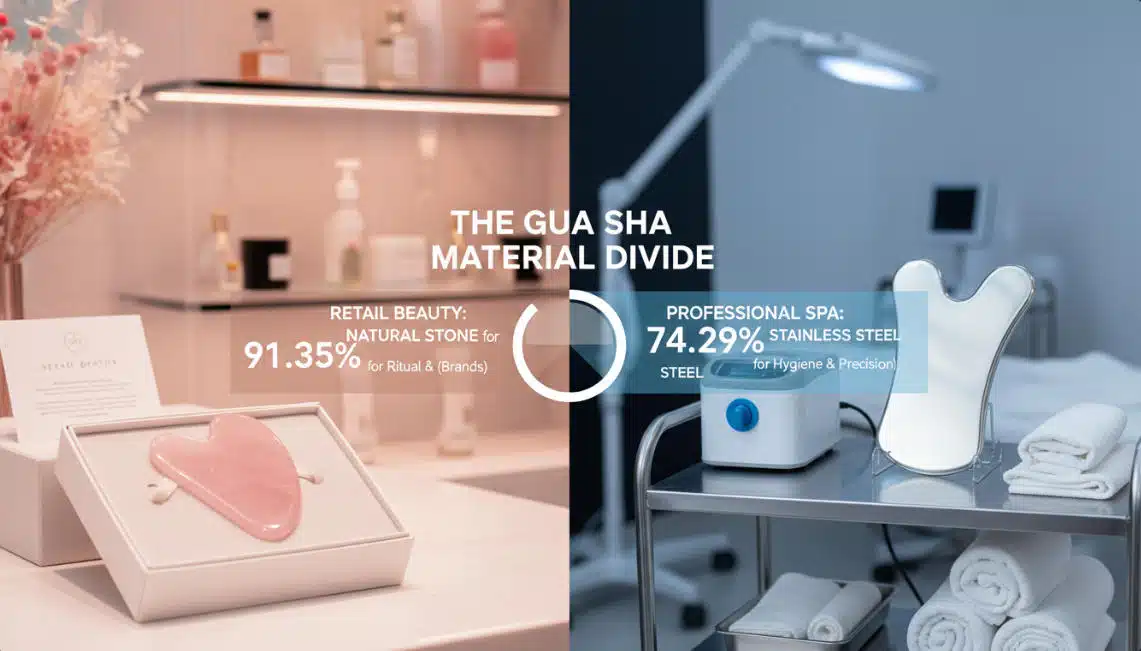
The gua sha wholesale market is splitting in two — and the data makes it impossible to ignore. In Deyi Gems’ 2025 order analysis across 290 verified B2B clients, beauty retailers directed 91.35% of their purchases toward natural jade and crystal gua sha tools, while spa and wellness institutions chose stainless steel gua sha in 74.29% of their orders. These are not random preferences. They are the output of entirely different business models, regulatory environments, and customer psychology operating in the same product category. If you are sourcing gua sha wholesale for your brand and have not yet mapped your procurement decision to your channel logic, you are likely ordering the wrong material — and paying for it in ways that won’t show up until your second reorder cycle.
Understanding this divergence starts with a single clarification: this is not a question of which material is superior. Both jade gua sha tools and stainless steel gua sha instruments deliver measurable results for end users. The real question is which material is superior for your specific operating context. A retail beauty brand selling through Sephora or a DTC e-commerce channel operates under completely different constraints than a licensed spa offering 60-minute lymphatic drainage sessions to paying clients. When you align material selection with channel logic, procurement stops being a guessing game and becomes a defensible business decision.
The Data Split: What 290 Real Gua Sha Wholesale Orders Reveal About Material Selection
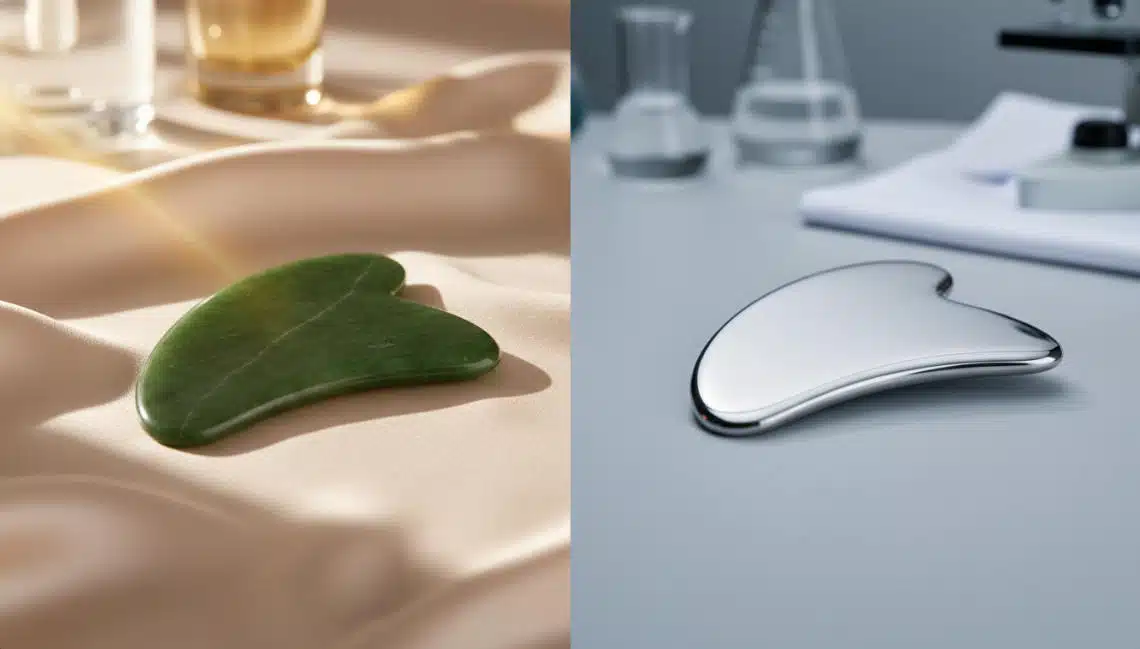
In 2025, a pattern emerged from 290 documented gua sha wholesale orders that should reshape how every serious buyer approaches material selection. Among 185 orders placed by retail beauty brands — operating in channels comparable to Sephora and luxury cosmetic retail networks — 169 specified natural jade or crystal gua sha tools, representing 91.35% of that segment. Among 105 orders from spa and wellness institutions, 78 specified stainless steel gua sha tools, accounting for 74.29%. These figures are drawn from Deyi Gems’ 2025 annual order analysis across both buyer categories. If your gua sha wholesale strategy does not account for this material split, you risk sourcing the wrong product for your channel — and paying for that misalignment in returns, compliance failures, or eroded brand positioning.
Why This Split Is a Market Signal, Not a Coincidence
This divergence does not reflect arbitrary preference or a passing trend. It encodes two fundamentally different commercial logics operating in parallel within the same product category. Retail beauty buyers optimize for visual impact, emotional resonance, and content marketability. Professional wellness institutions optimize for regulatory compliance, operational durability, and clinical credibility. The gua sha wholesale market serves both segments simultaneously — but treating their sourcing requirements as interchangeable leads to costly specification errors. Understanding which segment your business occupies is the first and most consequential decision that shapes every downstream specification: material, finish, edge geometry, surface treatment, and protective packaging.
How to Read This Data as a Wholesale Buyer
If you are a beauty brand building a product line around skincare rituals, the 91.35% jade adoption rate functions as a market benchmark — it tells you that your peers and competitors have largely converged on natural stone for documented commercial reasons. If you operate a spa network or a medical aesthetics clinic, the 74.29% stainless steel figure signals an industry norm driven by hygiene regulation and operational economics, not aesthetic preference. Neither material is categorically superior. What determines the right choice is whether your material selection aligns with your channel’s operating constraints, your customer’s experiential expectations, and your compliance obligations. This is the foundational insight that every productive gua sha wholesale sourcing conversation should begin with.
The Core Argument: Material Choice Follows Business Model
The central claim of this article is direct: the bifurcation between jade and stainless steel in the gua sha wholesale market is not a question of which material performs better in the abstract. It is a question of which material performs better within a specific business model. A jade gua sha tool placed in a spa’s autoclave will degrade. A stainless steel gua sha tool placed on a Sephora shelf will underperform on every content and conversion metric that retail beauty brands track. The data shows that experienced buyers in both segments have already arrived at material clarity. Your sourcing decision should be informed by that collective judgment — not made in ignorance of it.
Why Retail Beauty Brands Favor Jade Gua Sha Wholesale — A Three-Layer Commercial Analysis
Layer 1: Visual Dominance in a Retail and Social Commerce Environment
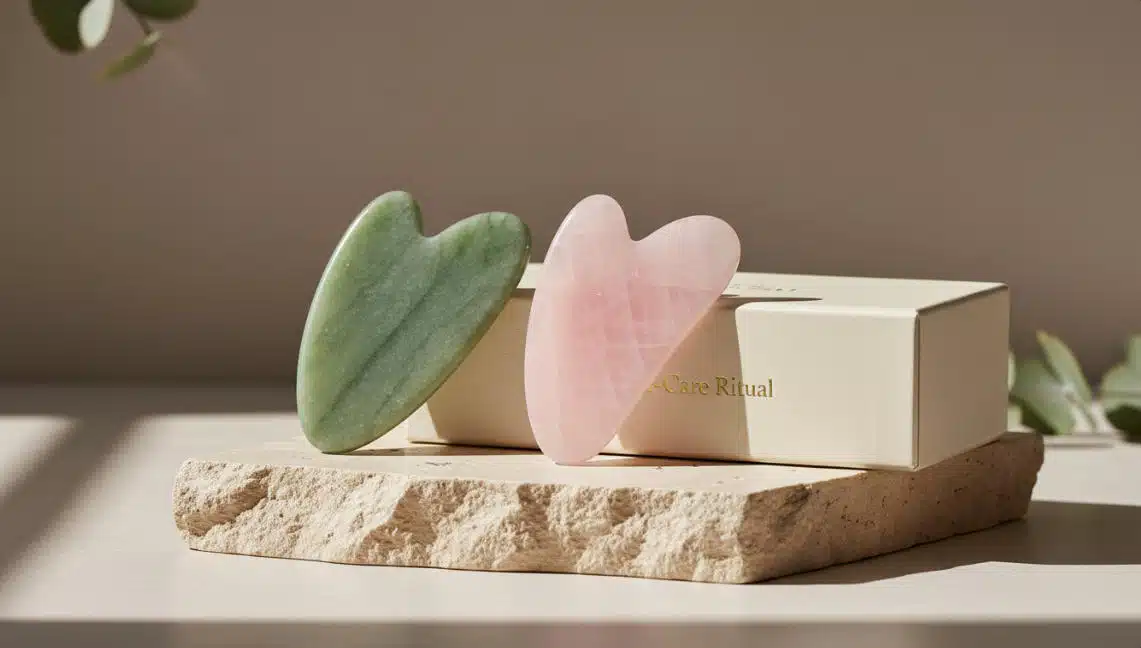
The retail purchase journey follows a predictable sequence: the product is seen, it generates desire, and it is purchased. In this sequence, visual impact operates as the primary conversion driver — ahead of product efficacy claims and ahead of technical specification. Natural jade and crystal gua sha tools deliver visual differentiation that stainless steel cannot replicate at the same price tier: the translucency of rose quartz, the color depth of green nephrite, the surface variation that makes each stone piece visually distinct from the next. According to the Gemological Institute of America (GIA), jade exists across a spectrum from near-transparent to richly opaque, with color and structural patterning that makes each piece individually unique. This uniqueness translates directly into shelf presence and social media content value — two performance metrics that retail beauty brands track with the same rigor as sales conversion rates. This means you gain a product that generates organic content at the consumer level, reducing your paid media dependency from day one.
Layer 2: Narrative Value and the Content Marketing Efficiency Gap
Retail beauty brands do not sell tools — they sell experiences, rituals, and identity frameworks. The jade gua sha tool enters this narrative architecture with a pre-existing cultural vocabulary that requires no construction from your marketing team: “cooling stone,” “ancient ritual,” “holistic skincare,” “crystal energy.” These are not invented marketing constructs. They are semantically embedded associations that consumers already hold, which means your gua sha brand inherits them without the cost of building them. A stainless steel gua sha tool — however technically superior in certain functional dimensions — carries none of this pre-loaded narrative. Generating equivalent emotional resonance with a metal tool requires substantially higher content investment: more production, more editorial framing, more influencer briefing. For any gua sha brand investing in organic social, editorial placement, or influencer seeding, the jade gua sha tool arrives with a structurally lower content-cost-per-conversion. This means your customer acquisition economics improve before your product reaches its first customer’s hands.
Layer 3: Home-Use Scenarios Define the Material Requirement Ceiling
Home skincare consumers apply gua sha tools with lighter pressure, in sessions lasting five to ten minutes, at irregular frequencies that may range from daily to weekly. This usage profile imposes a specific and relatively modest set of material requirements: adequate durability for careful home handling, comfortable ergonomic weight, and an aesthetic that reinforces the self-care context the consumer is deliberately constructing. In this scenario, jade’s brittleness — frequently cited as a sourcing liability — is effectively decoupled from actual consumer experience. The primary failure mode for jade tools in home use is impact damage from drops, not surface wear from application friction. When your retail product includes a protective storage pouch, a padded presentation box, or an instructional card that guides safe handling — all standard elements of premium beauty positioning — the practical incidence of drop damage drops substantially. This means the most commonly cited objection to jade in gua sha wholesale conversations does not accurately reflect home-use reality, and relying on it as a sourcing argument will cause you to over-specify for a risk that packaging engineering already manages.
Why “Emotional Product” Positioning Changes Your Entire Sourcing Brief
It is worth stating explicitly what the data reflects at a structural level: jade gua sha tools sold through retail beauty channels are simultaneously consumer goods and emotional goods. The material itself is not merely a functional substrate — it is a component of the brand message. Buyers who understand this do not evaluate jade against stainless steel on a shared durability axis. They evaluate jade against stainless steel on a brand alignment axis, asking whether the material choice reinforces or contradicts the product’s intended positioning. At a 91.35% adoption rate among beauty brands in the 2025 gua sha wholesale dataset, the market has delivered a clear answer to that alignment question. Your sourcing brief for a retail beauty product line should start from that answer, not work backward toward it.
Why Spa and Wellness Institutions Choose Stainless Steel Gua Sha Wholesale — Compliance First, Performance Second
Sterilization Is a Regulatory Baseline, Not a Preference
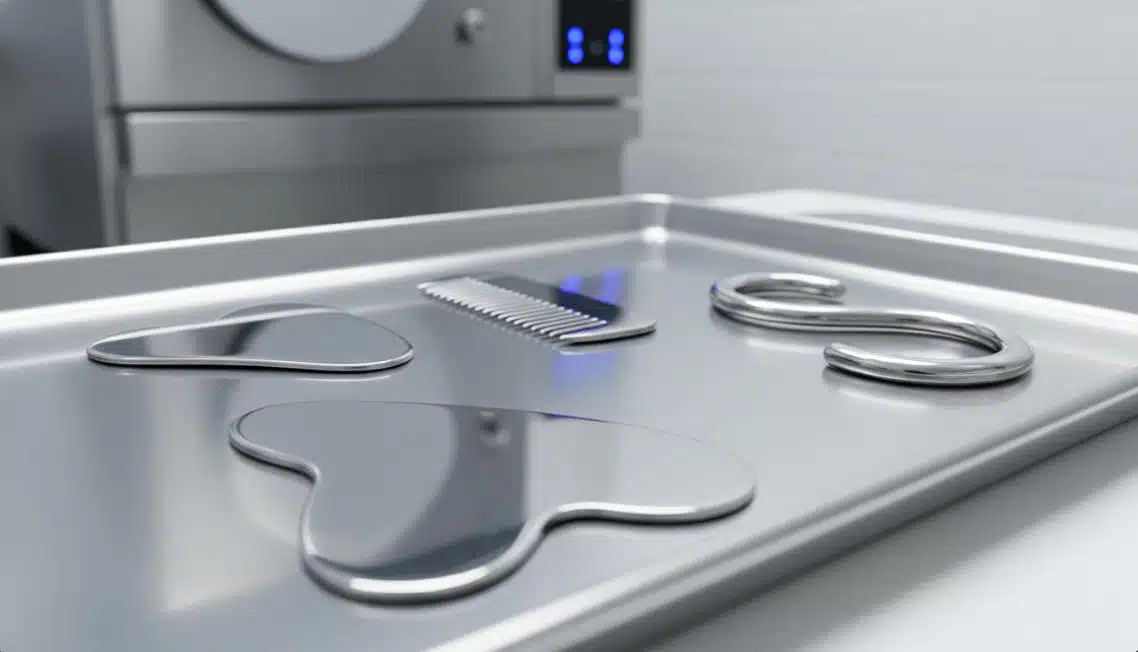
Spa and wellness institutions operating in regulated markets — across North America, Europe, and increasingly across regulated Asian markets — must meet hygiene standards that define the minimum viable condition for professional tool use. The Occupational Safety and Health Administration (OSHA) provides one widely referenced framework, and equivalent bodies in other jurisdictions impose comparable requirements: tools used on multiple clients must withstand sterilization protocols that eliminate cross-contamination risk between treatment sessions. Stainless steel gua sha tools meet this requirement directly. They support autoclave sterilization at high-pressure steam temperatures, alcohol-based and quaternary ammonium compound disinfection, and repeated chemical cleaning cycles without surface degradation. Natural jade and crystal present a structural compliance problem: jade’s microporous surface can trap oils, bacteria, and residual product even after visible surface cleaning. Prolonged sterilization exposure causes jade tools to lose surface luster and, over extended cycles, develop micro-fractures that compromise both hygiene integrity and structural stability. For your spa operation, choosing stainless steel gua sha wholesale eliminates a compliance liability that natural stone cannot resolve through any product design modification.
High-Frequency Commercial Use Demands a Different Durability Calculus
A retail consumer uses a gua sha tool intermittently, under low mechanical load, with natural care for a personal possession. A spa professional applies the same product category on multiple clients per day, under varying pressure levels, across face and full-body treatment protocols. The cumulative mechanical load on a commercially-used gua sha tool over a single month exceeds what a home-use consumer would accumulate in a year. Stainless steel gua sha tools, properly maintained, sustain this load with a service life typically measured between one and three years under commercial conditions. Jade tools subjected to the same frequency and handling intensity generate a meaningfully higher breakage rate from between-session handling impacts — being set down on treatment trolleys, stored in drawers without individual protection, and passed between practitioners. This means your per-unit procurement cost cannot function as your primary evaluation metric. Total cost of ownership — purchase price plus replacement frequency plus operational disruption from mid-session tool failure — must enter your stainless steel gua sha wholesale evaluation before you finalize specifications.
Precision Engineering Enables Professional Technique Execution
Professional facial and body gua sha protocols — including lymphatic drainage mobilization, myofascial release, and deep tissue decompression strokes — require consistent edge geometry across every tool in a facility’s inventory. Stainless steel fabrication tolerances allow edge profiles to be machined to sub-millimeter specifications, ensuring that every gua sha supplier delivery performs identically to the last. This consistency matters at the practitioner level: when a therapist switches between tools mid-session, inconsistent edge geometry changes the pressure distribution on the client’s skin, introducing variability into outcomes that clients notice and associate with treatment quality fluctuation. Additionally, stainless steel’s thermal conductivity enables cold and heat therapy integration: a refrigerated stainless steel gua sha tool delivers a physiologically meaningful cooling response within seconds of application, accelerating lymphatic fluid movement and supporting anti-inflammatory treatment objectives. Natural stone conducts temperature more slowly and less predictably across individual pieces, making temperature-dependent protocols difficult to standardize. For professional practitioners integrating temperature modulation into their service menus, stainless steel gua sha wholesale is not a preference — it is a technical specification requirement.
The Professional Perception Effect and Its Impact on Treatment Pricing
Client trust in a spa or wellness setting is built through sensory cues as much as through certification display. The visual and tactile language of stainless steel — its weight, its surface finish, its cool initial contact sensation — activates what consumer psychology research identifies as the “medical instrument heuristic”: clients in professional treatment contexts perceive metal tools as more clinically efficacious than non-metal alternatives. This perception effect has measurable commercial implications. When clients associate your treatment tools with clinical precision rather than cosmetic ritual, the service commands a higher perceived value — which directly supports premium session pricing and reduces resistance to treatment package upselling. A spa that positions its stainless steel gua sha treatments as precision wellness protocols, rather than relaxation rituals, can price those sessions at a meaningfully higher rate than a comparable service using natural stone tools. This means stainless steel gua sha wholesale sourcing is not merely a compliance decision — it is a revenue positioning decision.
Durability Under Real Conditions — A Two-Month Field Test Comparing Jade and Stainless Steel Gua Sha
Test Design: Third-Party Participants, Paired Tools, Authentic Use
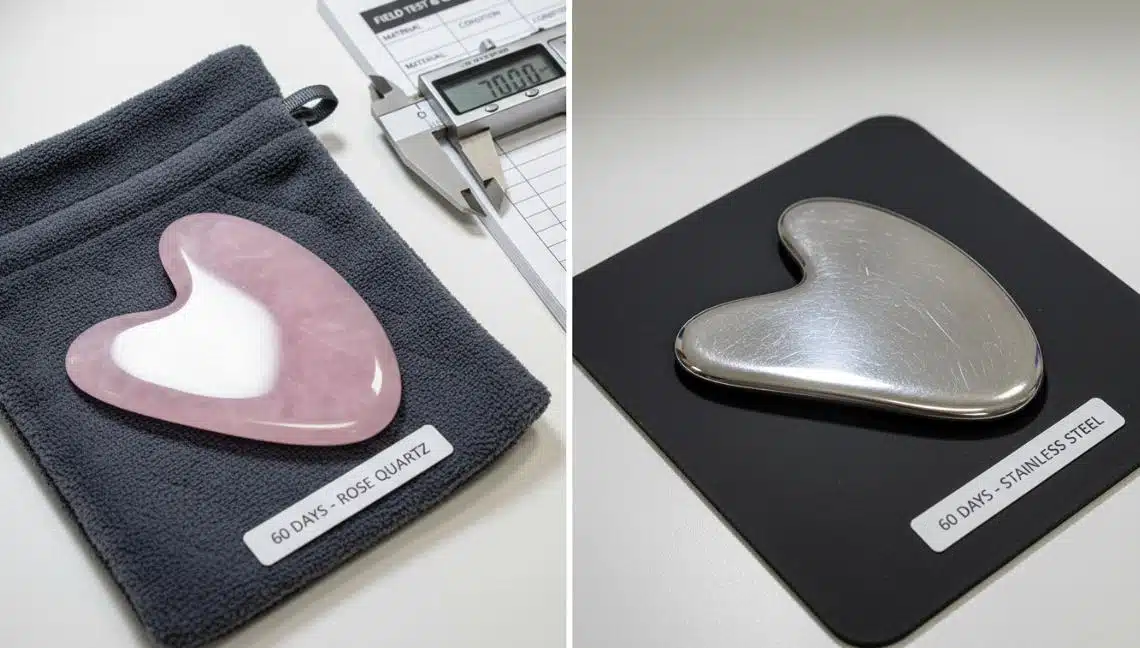
To replace assumptions about material durability with observation-based data, Deyi Gems conducted a structured two-month field test with 30 participants — residents of the surrounding community, with no affiliation to the company and no compensation beyond the tools themselves. Each participant received one rose quartz gua sha tool and one stainless steel gua sha tool of identical model specifications, and alternated use between the two over the test period. The test environment was intentionally designed to reflect authentic home-use conditions rather than controlled laboratory protocols, making the results directly applicable to retail consumer channel scenarios. Before interpreting the findings, this limitation must be stated clearly: 30 participants over two months generates indicative data. It does not produce statistically generalizable conclusions, it carries no institutional certification, and no claim of universal applicability is made. What the test does provide is a structured, third-party-use observation of how each material actually behaves under real handling conditions — which is precisely the information most absent from standard gua sha supplier product descriptions.
Results: What Actually Failed, and Why
At the conclusion of the two-month test period, two rose quartz tools showed structural damage. Both failures were attributed to high-impact drops — the tools were knocked from surfaces or dropped during handling outside of use sessions. Critically, no rose quartz tool showed surface scratching from normal gua sha application. The stone’s hardness, which the International Gem Society (IGS) identifies as 7 on the Mohs scale, proved resistant to the friction forces generated during typical skin application. Among the stainless steel tools, zero breakage occurred across all 30 units. However, 11 out of 30 stainless steel tools developed visible surface scratches — all attributed to storage conditions, specifically contact with other metal objects or rough surfaces during non-use periods. In every case, the scratches were cosmetic and did not affect functional performance within the test window.
The Correct Interpretation: Failure Mode Clarity, Not Material Verdict
These results define the failure mode of each material with a specificity that generic durability claims cannot provide. Rose quartz’s durability limitation is impact-specific: it fractures from conchoidal impact — a drop onto a hard surface — not from the compressive or frictional forces of normal skin application. This is consistent with the physical characterization of quartz varieties described by GIA gemological resources, which identify cleavage and conchoidal fracture as the primary structural vulnerabilities of crystalline quartz minerals. Stainless steel’s limitation is cosmetic and progressive: scratch accumulation from improper storage affects surface appearance before it affects functional performance. This distinction has direct sourcing implications. If your retail product specification includes a padded storage pouch, a protective travel case, or a display box that keeps the stone tool separated from hard surfaces during storage — all standard elements of premium beauty packaging — the practical incidence of impact damage drops substantially. This means jade’s field-test failure rate reflects a packaging engineering gap, not an inherent material disqualification. With proper protective packaging in your gua sha wholesale order specifications, rose quartz tool durability in home-use conditions is functionally comparable to stainless steel.
What the Test Does Not Tell You — And Why That Matters
Responsible interpretation of this test data requires acknowledging its limits explicitly. The test does not simulate commercial spa use: it does not include autoclave cycles, chemical disinfection exposure, multi-client daily handling loads, or the impact risk of professional treatment room environments. It also does not account for stone quality variation between individual rose quartz pieces — a factor that GIA’s quality grading frameworks identify as a meaningful variable in how individual specimens perform under mechanical stress. The test speaks to home-use behavior. For professional-use scenarios, the compliance and durability arguments for stainless steel gua sha wholesale remain structurally intact, and this test does not challenge them. What it does do is give retail-channel buyers a data point that counters the oversimplified narrative that jade is categorically fragile. Fragility, the test shows, is context-dependent — and context is precisely what your sourcing decision should be built around.
A Practical Decision Framework for Your Next Gua Sha Wholesale Order
When Jade Gua Sha Wholesale Is the Right Specification
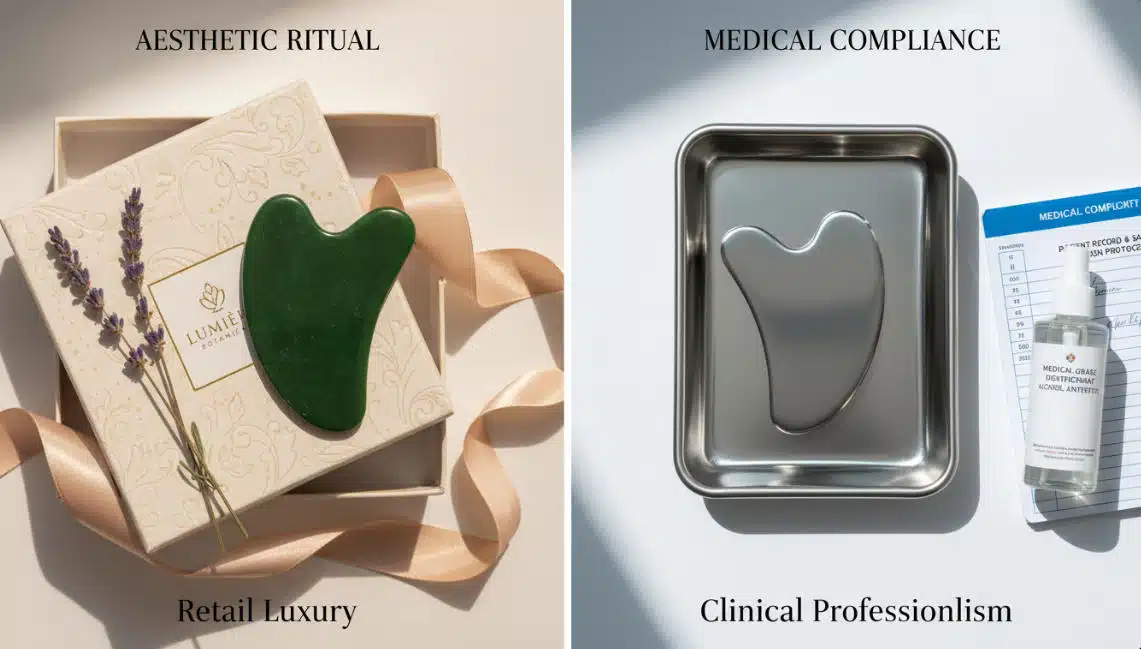
Your material selection should follow your channel’s operating logic, applied systematically to each variable in your sourcing brief. If your distribution model centers on retail — physical shelves, e-commerce product pages, social commerce driven by influencer and consumer content — and your end customer is an individual consumer seeking a self-care product, then jade and crystal gua sha wholesale is your material category. The visual differentiation of natural stone drives organic consumer content creation, which reduces your paid media burden across the product lifecycle. The narrative pre-loading of jade — its cultural associations with ancient practice, natural healing, and ritual self-care — gives your content team a vocabulary that generates engagement without requiring the construction of new brand stories from scratch. The per-unit cost of natural jade gua sha tools, while higher than commodity stainless steel at entry-level pricing, is supported by retail price points that consumers accept based on the material’s perceived value. This means your margin structure benefits from a material that your end customers are already priced to accept at premium positioning.
Beyond economics, jade gua sha wholesale sourcing gives you access to a product category that the IGS identifies as holding significant cultural and commercial resonance in both Eastern and Western markets — a dual-market relevance that matters if your brand operates across geographies. For any gua sha brand building toward international distribution, jade’s cross-cultural familiarity removes a consumer education barrier that would otherwise require marketing investment to clear.
When Stainless Steel Gua Sha Wholesale Is the Right Specification
If your operation involves professional service delivery — spa treatments, clinical facial protocols, medical aesthetics, or physiotherapy-adjacent wellness services — stainless steel gua sha wholesale is the specification your compliance obligations require. The hygiene argument is determinative: tools used on multiple clients must withstand sterilization protocols that jade cannot sustain without progressive degradation. The durability argument follows directly: high-frequency commercial handling generates the impact exposure that the field test identified as jade’s primary failure mode, and in a commercial setting where tools are not individually protected between sessions, that impact exposure is unavoidable. The precision argument completes the case: edge geometry standardization and thermal conductivity give your practitioners tools that perform consistently across every treatment session and every unit in your inventory.
For multi-location spa operators, standardizing on stainless steel gua sha wholesale also simplifies supply chain management: one material specification, one supplier relationship, predictable reorder cadence based on a known service-life range, and a single QC standard to apply across your full procurement process. This is not a small operational advantage — the administrative cost of managing multiple material categories across multiple locations compounds quickly and erodes the margin benefit of lower per-unit prices on individual orders.
Hybrid Sourcing: Why Some Gua Sha Brands Order Both Materials
An expanding segment of operators in the gua sha market sources both jade and stainless steel simultaneously, serving differentiated sub-channels with purpose-specified product lines. A beauty brand with a professional services arm — a retail product line sold through wholesale beauty channels and a treatment service delivered in branded spa environments — requires both jade tools for its retail SKUs and stainless steel gua sha tools for its treatment rooms. If this model describes your business trajectory, the critical discipline is maintaining strict specification separation between the two product lines rather than allowing one generic specification to serve both contexts inadequately. Your jade wholesale order should specify individual padded pouches, display-optimized dimensions, and surface polish grades optimized for visual retail impact. Your stainless steel gua sha wholesale order should specify sterilization-compatible surface finishes — typically brushed or electropolished — and edge profiles calibrated to professional technique requirements, not retail aesthetic preferences. Working with a single gua sha supplier capable of manufacturing both materials under one QC framework eliminates the coordination friction of managing two vendor relationships and ensures that your quality standard is applied consistently across your full product range.
How to Evaluate a Gua Sha Supplier Before Committing to Volume
Before placing any volume gua sha wholesale order, your qualification process for a gua sha supplier should cover four areas. First, request material origin documentation for jade and crystal tools — stone sourcing traceability directly affects both quality consistency and your ability to make accurate material claims in your product marketing. For jade specifically, sourcing origin matters: the distinction between nephrite and jadeite, both commercially sold as jade, involves significant quality and price variation that GIA’s gemological frameworks document in detail, and the difference will be visible to informed end customers. Second, request alloy grade specification for stainless steel tools — food-grade 316L stainless steel is the standard for tools requiring repeated sterilization, and accepting lower-grade alloys introduces long-term surface degradation that affects both hygiene safety and client-facing tool appearance. Third, request production sample units before committing to minimum order quantities, and test those samples under conditions representative of your actual use environment. Fourth, ask your gua sha supplier for a written production schedule rather than a quoted lead time: the schedule reveals where your order sits in the production queue and whether the supplier’s stated capacity is genuinely available during your required window.
What to Look for in a Gua Sha Wholesale Manufacturer — Beyond Price Per Unit
Manufacturing Depth Across Both Material Categories
The manufacturing capability profile of your gua sha wholesale partner carries more long-term impact on your business than any single order’s unit economics. A manufacturer who produces only natural stone tools optimizes every process variable — grinding geometry, polishing protocol, QC inspection criteria — for stone-specific properties and failure modes. A manufacturer who produces only metal tools does the same for steel fabrication. Neither specialization is wrong, but both create a constraint for brands whose product roadmap may require both material categories at different stages of growth. A beauty brand that launches with a jade retail line may add a professional treatment service within two to three years; a spa brand that standardizes on stainless steel gua sha may launch a retail take-home line as an ancillary revenue stream. A gua sha supplier with documented, concurrent manufacturing experience in both material categories can serve your full product roadmap without forcing a vendor transition at a moment when your operational bandwidth is already stretched by growth. This means your supply chain remains stable precisely when stability matters most.
Quality Control Processes That Protect Your End Customer’s Experience
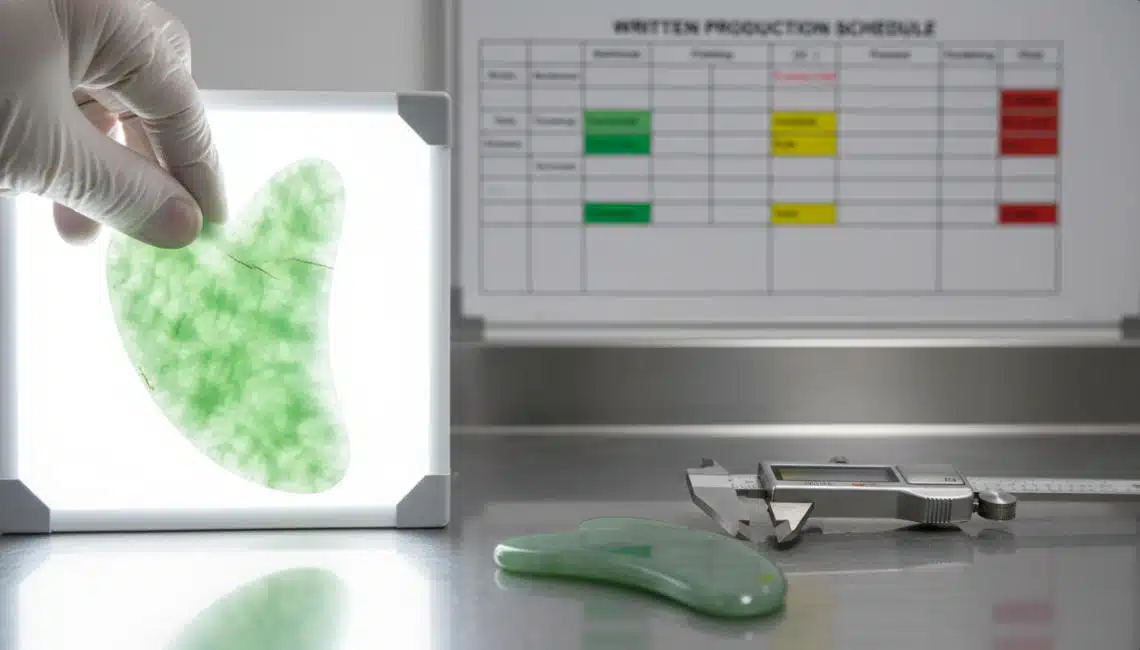
For jade and crystal gua sha tools, manufacturing-level quality control centers on three inspection points: internal fissure identification, surface polish consistency, and edge geometry uniformity across production batches. Internal fissures in jade — structural weaknesses that may not be visible without backlighting — are the primary cause of in-use breakage that generates consumer returns and warranty claims at the brand level. A gua sha supplier with rigorous QC protocols uses light-transmission inspection — holding each stone blank against a backlighted surface — to identify and reject flawed blanks before shaping begins. For stainless steel gua sha tools, QC focuses on burr elimination and surface finish consistency across the working edge. A burr or surface roughness at the edge creates unequal pressure distribution during skin application, reducing treatment effectiveness and generating the kind of client discomfort that drives negative reviews in professional settings. The quality control discipline your supplier applies at the manufacturing level determines the defect rate your end customers encounter — and that connection should be a primary topic in every supplier qualification conversation you have.
Lead Times, MOQ, and the Gua Sha Wholesale Terms That Protect Your Cash Flow
Minimum order quantities, production lead times, and payment terms are not peripheral logistics details — they constitute the financial architecture of your wholesale sourcing relationship and determine whether your product launches on schedule and within budget. For natural stone gua sha wholesale orders, MOQs tend to be set higher because stone sourcing, rough-cutting, shaping, and polishing involve longer and less compressible production cycles than metal fabrication. Custom jade specifications — proprietary shapes, branded edge profiles, specific stone variety requirements — typically require six to ten weeks from order confirmation to shipment-ready inventory. Standard stainless steel gua sha wholesale production runs shorter: four to six weeks for standard specifications is typical, because metal fabrication scheduling is more predictable and less dependent on raw material variability. Understanding these lead time realities before entering commercial negotiations prevents the cash flow mismatches and inventory gaps that derail product launches and damage retail partner relationships. Request a written production schedule from any prospective gua sha supplier — not just a verbal lead time commitment — and verify that your order volume fits within the supplier’s confirmed production capacity for your required delivery window.
Building a Sourcing Relationship That Scales With Your Brand
The gua sha wholesale relationships that generate the most long-term value are not those that deliver the lowest per-unit price on a first order — they are those that deliver consistent quality, responsive communication, and the manufacturing flexibility to accommodate specification changes as your brand evolves. As your gua sha brand grows, your order volumes will increase, your specifications will become more precise, and your lead time requirements will become more demanding as retail and distribution partners hold you to tighter inventory schedules. A manufacturing partner whose QC, capacity, and communication infrastructure can scale in parallel with your business is worth a premium over a lower-cost option whose systems break down under the operational demands of a growing brand. Before placing your first volume order, evaluate your prospective gua sha supplier not just on the sample you receive, but on the responsiveness, documentation quality, and production transparency they demonstrate during the qualification process — because those behaviors predict how they will perform when your business depends on them.
The Material Decision Is a Business Strategy Decision

The choice between jade and stainless steel in the gua sha wholesale market is not an aesthetic preference question or a technical performance debate — it is a business strategy question. The 2025 order data is unambiguous: retail beauty brands adopt jade at a 91.35% rate; spa and wellness institutions adopt stainless steel at a 74.29% rate. These figures encode the accumulated sourcing judgment of buyers who have already navigated this decision across real commercial contexts. Treating that data as market intelligence — rather than as someone else’s choice to observe from a distance — is what separates reactive sourcing from strategic procurement.
The field test data adds operational precision to this picture. Jade’s risk is impact damage, a variable that packaging engineering manages effectively in retail contexts. Stainless steel’s risk is cosmetic scratch accumulation, a variable that storage protocol manages in professional settings. Neither material requires you to accept a binary trade-off between durability and visual or functional performance — both can be specified correctly for their intended environment, and both can perform reliably when the specification is built around the actual use conditions your product will encounter.
Whether you are building your first gua sha brand or scaling an established wholesale operation, the framework remains consistent: identify your channel’s operating logic, match your material specification to its compliance and aesthetic requirements, verify your supplier’s manufacturing capability across both material categories, and protect your sourcing investment with documented specifications and a qualified supplier relationship. A gua sha wholesale strategy built on this foundation does not just deliver product inventory — it builds a supply chain capable of scaling with the commercial ambitions of your brand.
Faqs for Jade vs Stainless Steel Gua Sha Wholesale
1. Why do beauty brands prefer jade while spas choose stainless steel?
Retail beauty brands prioritize visual impact and emotional storytelling, leading 91.35% to choose natural stone. Conversely, 74.29% of spas choose stainless steel because it meets strict medical-grade sterilization requirements and operational durability needs
2. Is jade too fragile for commercial retail?
Field tests show that jade’s primary failure mode is impact damage from drops, not wear from actual skin application. For retail, this risk is effectively managed through protective packaging engineering, such as padded pouches or display boxes
3.What are the technical advantages of stainless steel tools?
Stainless steel offers precise edge geometry for consistent professional results and superior thermal conductivity, allowing for immediate integration of heat or cold therapies. It also leverages the “medical instrument heuristic,” increasing the perceived clinical value of a treatment.
4. How does material choice affect marketing and customer acquisition?
Natural stones like rose quartz or jade come with pre-loaded cultural narratives (e.g., “ancient ritual,” “cooling stone”), which reduces the need for high-cost content creation. Metal tools require significantly more editorial framing to generate the same emotional resonance with consumers.
5. What should I ask a supplier before placing a wholesale order?
You should request material origin documentation for stones and alloy grade specifications (ideally 316L) for steel. Additionally, ask for a written production schedule rather than a verbal lead time to ensure your order fits their actual capacity.
Data Disclosure Notice: The order statistics cited throughout this article are drawn from Deyi Gems’ internal transaction records covering 290 verified B2B clients between January and December 2025. Deyi Gems is a manufacturer and gua sha supplier, which means this data reflects the purchasing decisions of its own client base — not a neutral industry-wide sample. The 30-person durability trial described in Section 4 was conducted with independent community participants and was not peer-reviewed or validated by an external laboratory. Both datasets are directionally informative but not statistically generalizable. Where third-party data exists to corroborate or contextualize these internal findings, it has been cited and linked directly.