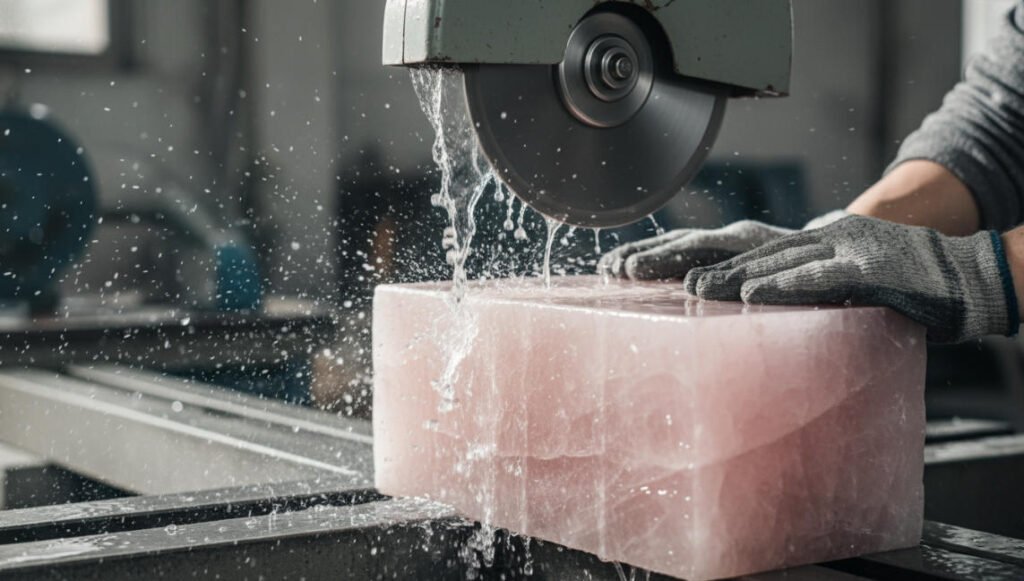
How a Gua Sha Factory Controls Internal Impurities: The 3-Stage System That Reduces Defects by 95%+
Internal impurities are the single most common reason natural crystal gua sha tools fail quality inspection — not at the end of the production line, but long before that, in decisions made during raw material handling and early-stage processing. Data from a 500-piece internal production study conducted by Deyi Gems in 2021 shows that a structured three-stage process — shape mapping, rough cutting, and final grading — reduces the occurrence of internal impurities and micro-fractures in natural crystal gua sha production by over 95%. That result is not achieved by better inspection at the end of the line. It is achieved by intercepting defects at the earliest viable point in the process, before manufacturing cost accumulates around material that will ultimately be rejected. This article examines exactly how that process works — step by step, material by material — covering both natural crystal and synthetic fused crystal. It also addresses two supplementary techniques that experienced gua sha manufacturers use in specific circumstances, and their documented limitations. Whether you are evaluating a gua sha factory as a potential supplier or building internal QC benchmarks for an existing relationship, the process logic described here gives you a concrete, technically grounded framework for those assessments. Why Internal Impurity Control Starts With Understanding the Material, Not the Machine The most common mistake in gua sha factory quality control is applying the same defect management logic to fundamentally different materials. Natural stone and synthetic fused crystal share a product category — both are used to make gua sha tools — but they require entirely different process frameworks, because the origin and nature of their internal defects are entirely different. A factory that treats all materials identically will underperform on at least one category, usually without recognizing the specific mechanism of failure. Understanding why requires a clear-eyed look at what “internal impurity” actually means in each material type, before any discussion of how to address it. Natural Crystal vs. Fused Crystal: Two Materials, Two Defect Origins, Two Control Strategies In natural gemstone materials — rose quartz, clear quartz, jade, green aventurine — internal inclusions, mineral formations, and hairline fractures are geological features. They formed over thousands to millions of years under temperature and pressure conditions that cannot be reversed or modified by anything that happens inside a manufacturing facility. The GIA (Gemological Institute of America) explicitly documents these formations as inherent characteristics of natural quartz, not quality failures. What this means operationally is that no tool, chemical process, or technique available in a standard gua sha production environment can remove these features from natural stone without risking structural damage to the material. The correct strategic response is not elimination — it is intelligent avoidance during the layout and cutting stages, combined with grading-based separation at the end. Fused crystal — including synthetic quartz, fused silica, and resin-based composites — is manufactured rather than mined. Its internal defects are not geological events; they are manufacturing artifacts: gas bubbles from trapped atmospheric air or moisture vapor, undissolved raw material particles, and thermally induced micro-fractures from improperly managed cooling. Because these defects are caused by specific, identifiable process variables, they can be directly reduced — often dramatically — by controlling those variables with greater precision. A gua sha manufacturer working with synthetic materials has, in principle, direct quantitative control over the defect rate from the very beginning of the production run. The question is whether that control is actually exercised. For anyone evaluating a gua sha factory supplier, this material distinction is the first and most important diagnostic frame. Impurity rates in natural crystal are primarily a function of how early in the process defects are identified and avoided. Impurity rates in fused crystal are primarily a function of how rigorously manufacturing parameters are controlled upstream. Confusing these two frames produces incorrect conclusions when assessing supplier quality data. Controlling Internal Impurities in Natural Crystal Gua Sha Production: The 3-Stage Pipeline Natural crystal gua sha production cannot be quality-controlled by inspection alone. By the time a finished gua sha tool reaches the final examination stage, every unit of manufacturing investment — raw material cost, machine time, labor, surface finishing — has already been committed to that piece. A defect found at final inspection does not recover any of that cost. It only confirms the loss. The professional approach is structured around a different logic: intercept defects at the moment in the process where they cost the least to address, and use each successive stage to catch what the previous stage did not. The three-stage pipeline described below is the operational implementation of that logic. Each stage has a measurable, documented contribution to cumulative defect reduction. Each stage targets defects that the previous stage could not reliably catch. Together they produce a cumulative result — over 95% defect reduction — that no single-stage inspection process can match. 1 — Shape Mapping in the Gua Sha Factory: The Step That Eliminates 80% of Defects Before Any Cut Is Made Shape mapping is performed on pre-cut natural crystal or jade slabs, before any shaping work begins. A worker holds each slab against a high-intensity directional light source, allowing light to pass through the material and reveal internal structures that are completely invisible under ambient lighting. Inclusions, mineral deposits, cloud formations, and hairline fractures become visible as the transmitted light interacts with their internal boundaries. The worker traces these flagged zones directly onto the slab surface using a high-contrast marker, creating a visual map of the material’s internal defect distribution. When the intended gua sha outline is then drawn onto the slab, it is routed to avoid all flagged zones — meaning that identified defects are physically excluded from the cut shape before a single blade contacts the stone. According to the 2021 internal production study by Deyi Gems (500-piece sample), this single step reduces the probability of internal impurities appearing in the finished gua sha tool by more than 80%. The mechanism is straightforward: decisions made at the layout stage are far
Internal impurities are the single most common reason natural crystal gua sha tools fail quality inspection — not at the end of the production line, but long before that, in decisions made during raw material handling and early-stage processing. Data from a 500-piece internal production study conducted by Deyi Gems in 2021 shows that a structured three-stage process — shape mapping, rough cutting, and final grading — reduces the occurrence of internal impurities and micro-fractures in natural crystal gua sha production by over 95%. That result is not achieved by better inspection at the end of the line. It is achieved by intercepting defects at the earliest viable point in the process, before manufacturing cost accumulates around material that will ultimately be rejected. This article examines exactly how that process works — step by step, material by material — covering both natural crystal and synthetic fused crystal. It also addresses two supplementary techniques that experienced gua sha manufacturers use in specific circumstances, and their documented limitations. Whether you are evaluating a gua sha factory as a potential supplier or building internal QC benchmarks for an existing relationship, the process logic described here gives you a concrete, technically grounded framework for those assessments. Why Internal Impurity Control Starts With Understanding the Material, Not the Machine The most common mistake in gua sha factory quality control is applying the same defect management logic to fundamentally different materials. Natural stone and synthetic fused crystal share a product category — both are used to make gua sha tools — but they require entirely different process frameworks, because the origin and nature of their internal defects are entirely different. A factory that treats all materials identically will underperform on at least one category, usually without recognizing the specific mechanism of failure. Understanding why requires a clear-eyed look at what “internal impurity” actually means in each material type, before any discussion of how to address it. Natural Crystal vs. Fused Crystal: Two Materials, Two Defect Origins, Two Control Strategies In natural gemstone materials — rose quartz, clear quartz, jade, green aventurine — internal inclusions, mineral formations, and hairline fractures are geological features. They formed over thousands to millions of years under temperature and pressure conditions that cannot be reversed or modified by anything that happens inside a manufacturing facility. The GIA (Gemological Institute of America) explicitly documents these formations as inherent characteristics of natural quartz, not quality failures. What this means operationally is that no tool, chemical process, or technique available in a standard gua sha production environment can remove these features from natural stone without risking structural damage to the material. The correct strategic response is not elimination — it is intelligent avoidance during the layout and cutting stages, combined with grading-based separation at the end. Fused crystal — including synthetic quartz, fused silica, and resin-based composites — is manufactured rather than mined. Its internal defects are not geological events; they are manufacturing artifacts: gas bubbles from trapped atmospheric air or moisture vapor, undissolved raw material particles, and thermally induced micro-fractures from improperly managed cooling. Because these defects are caused by specific, identifiable process variables, they can be directly reduced — often dramatically — by controlling those variables with greater precision. A gua sha manufacturer working with synthetic materials has, in principle, direct quantitative control over the defect rate from the very beginning of the production run. The question is whether that control is actually exercised. For anyone evaluating a gua sha factory supplier, this material distinction is the first and most important diagnostic frame. Impurity rates in natural crystal are primarily a function of how early in the process defects are identified and avoided. Impurity rates in fused crystal are primarily a function of how rigorously manufacturing parameters are controlled upstream. Confusing these two frames produces incorrect conclusions when assessing supplier quality data. Controlling Internal Impurities in Natural Crystal Gua Sha Production: The 3-Stage Pipeline Natural crystal gua sha production cannot be quality-controlled by inspection alone. By the time a finished gua sha tool reaches the final examination stage, every unit of manufacturing investment — raw material cost, machine time, labor, surface finishing — has already been committed to that piece. A defect found at final inspection does not recover any of that cost. It only confirms the loss. The professional approach is structured around a different logic: intercept defects at the moment in the process where they cost the least to address, and use each successive stage to catch what the previous stage did not. The three-stage pipeline described below is the operational implementation of that logic. Each stage has a measurable, documented contribution to cumulative defect reduction. Each stage targets defects that the previous stage could not reliably catch. Together they produce a cumulative result — over 95% defect reduction — that no single-stage inspection process can match. 1 — Shape Mapping in the Gua Sha Factory: The Step That Eliminates 80% of Defects Before Any Cut Is Made Shape mapping is performed on pre-cut natural crystal or jade slabs, before any shaping work begins. A worker holds each slab against a high-intensity directional light source, allowing light to pass through the material and reveal internal structures that are completely invisible under ambient lighting. Inclusions, mineral deposits, cloud formations, and hairline fractures become visible as the transmitted light interacts with their internal boundaries. The worker traces these flagged zones directly onto the slab surface using a high-contrast marker, creating a visual map of the material’s internal defect distribution. When the intended gua sha outline is then drawn onto the slab, it is routed to avoid all flagged zones — meaning that identified defects are physically excluded from the cut shape before a single blade contacts the stone. According to the 2021 internal production study by Deyi Gems (500-piece sample), this single step reduces the probability of internal impurities appearing in the finished gua sha tool by more than 80%. The mechanism is straightforward: decisions made at the layout stage are far