Rose Quartz Gua Sha Custom Orders: A Manufacturer’s Risk Disclosure & Buyer’s Guide
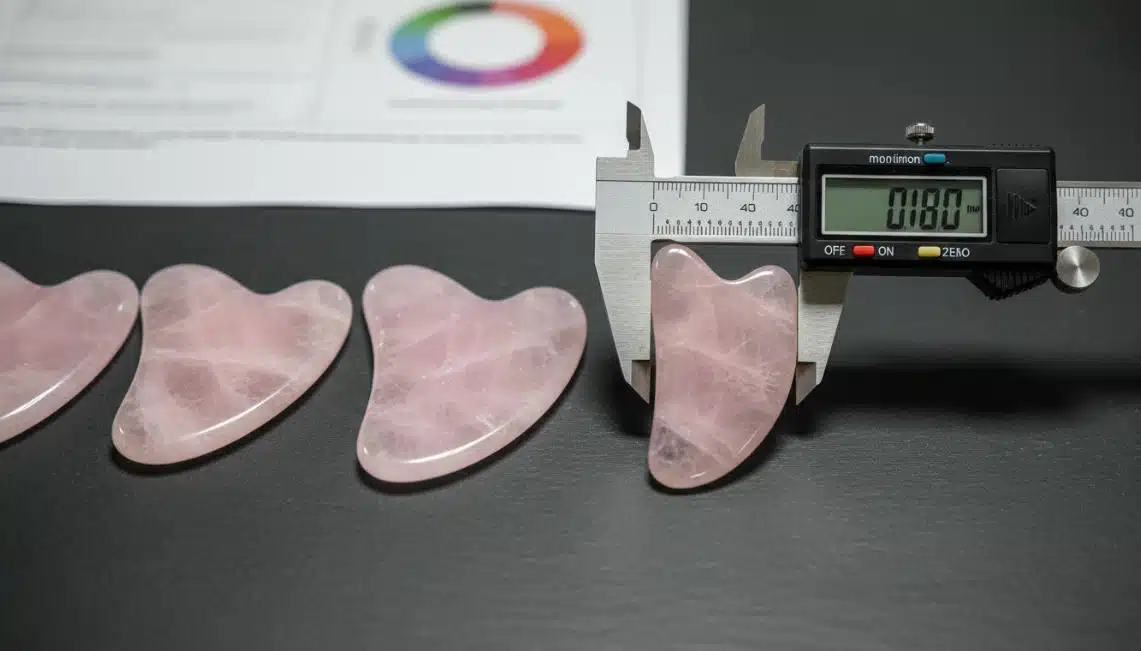
If you’re sourcing rose quartz gua sha custom tools for your brand, the biggest risk isn’t price — it’s what happens before production even starts. Industry data shows that approximately 23% of natural stone wholesale orders encounter quality disputes rooted in raw material issues: color inconsistency, undisclosed inclusions, or outright material substitution. This guide is written from the manufacturing floor, not a sales desk. You’ll get an honest breakdown of every stage where rose quartz gua sha wholesale orders can go wrong — and exactly what to do about it. Whether you’re working with a gua sha supplier for the first time or scaling an existing product line, understanding the risk landscape upfront will save you rework costs, customs delays, and the kind of customer complaints that quietly kill brand reputation. Let’s get into it. Why Raw Material Selection Is the Highest-Risk Phase in Rose Quartz Gua Sha Custom Production Most buyers assume manufacturing is where quality problems happen. In reality, the decision you make about sourcing — who you buy stone from, what verification you require, and how you document material standards — determines whether your finished product is something you’re proud to sell, or something you’re stuck negotiating returns on. This is the stage where rose quartz gua sha custom production either gets set up for success or quietly sabotaged. Natural Color Variation: What a Gua Sha Factory Should Tell You Before You Commit to Bulk Rose quartz is a naturally occurring mineral, and its color exists on a spectrum — from near-transparent pale blush to a deeper, more saturated pink. No two batches from the same quarry are identical. This isn’t a manufacturing flaw; it’s geology. However, a gua sha factory that doesn’t proactively communicate this to buyers before bulk production is setting the stage for disputes. The practical implication is straightforward: if you place a rose quartz gua sha wholesale order for 500 pieces without establishing a color reference standard upfront, you will receive pieces that vary — and your customers will notice. The industry-accepted practice is to agree on a physical color swatch or a calibrated photo reference before production begins. According to the Gemological Institute of America (GIA), rose quartz color is influenced by microscopic inclusions of aligned mineral fibers, which means even stones from the same source batch can display different saturation levels under different lighting conditions. This means you should request your gua sha supplier to provide 3–5 representative sample pieces from the actual raw material batch before signing off on production. How to Identify Dyed or Synthetic Rose Quartz Before Your Wholesale Order Ships This is the issue that makes experienced buyers nervous — and rightly so. The market for low-cost crystal wellness tools has created economic pressure that pushes some suppliers toward using dyed quartzite, heat-treated materials, or fully synthetic glass composites sold as “rose quartz.” The price difference between genuine rose quartz and its substitutes can exceed 40–60% on raw material cost, which tells you exactly why the temptation exists. There are several verification steps you can take before committing to a rose quartz gua sha wholesale order. First, request a gemological material certificate from an independent testing lab — the International Gem Society (IGS) provides a useful reference on standard identification methods for quartz varieties. Second, ask your gua sha manufacturer to provide a batch hardness test result: genuine rose quartz registers 7 on the Mohs scale, while common glass substitutes typically fall between 5.5 and 6. Third, examine samples under UV light — many dyed stones will show uneven fluorescence patterns that natural material doesn’t produce. These steps aren’t bureaucratic hurdles; they are the difference between a product that clears customs cleanly and one that gets flagged at inspection. Internal Cracks and Inclusions — The Defect That Hides Until After Cutting Natural rose quartz frequently contains internal inclusions: rutile needles, fractures, and micro-fissures that are invisible to the naked eye in raw block form but become visible — sometimes dramatically so — after the stone is cut and polished. A responsible gua sha factory will factor this into raw material yield projections, but not all suppliers communicate the implication to buyers: that your effective usable yield from a given raw material purchase may be 15–30% lower than the total stone weight purchased. This matters because it affects both cost and delivery timelines. If a gua sha supplier quotes you based on gross raw material weight without accounting for inclusion-related breakage and rejection rates, your final per-unit cost will be higher than the original quote implied. Ask for a clear breakdown of estimated yield rate before production begins, and specify in your purchase agreement that final pricing is based on delivered, inspection-passed units — not raw input weight. This one clause alone can prevent some of the most common cost disputes in rose quartz gua sha custom manufacturing relationships. Manufacturing Process Risks — Where a Gua Sha Manufacturer Either Earns or Loses Your Trust Raw material quality sets the ceiling. Manufacturing process determines whether you actually reach it. In rose quartz gua sha custom production, the gap between a competent gua sha manufacturer and a low-cost operation that cuts corners is measurable — in edge sharpness tolerances, surface finish consistency, and rejection rates per batch. Understanding what happens on the production floor helps you ask better questions, set enforceable specifications, and ultimately receive a product that performs the way your customers expect. Edge Grinding Standards — Why This Is a Product Safety Issue, Not Just Aesthetics A gua sha tool that leaves microscopic burrs or sharp transition points on its edges is not just a quality issue — it is a liability issue. The entire functional premise of a gua sha tool is sustained skin contact under light to moderate pressure. Any edge irregularity that wouldn’t matter on a decorative stone becomes a potential source of micro-abrasion injury in this application. A gua sha factory operating to professional standards should be able to specify its edge radius
Rose Quartz Gua Sha Custom Orders: A Manufacturer’s Risk Disclosure & Buyer’s Guide Read More »
If you’re sourcing rose quartz gua sha custom tools for your brand, the biggest risk isn’t price — it’s what happens before production even starts. Industry data shows that approximately 23% of natural stone wholesale orders encounter quality disputes rooted in raw material issues: color inconsistency, undisclosed inclusions, or outright material substitution. This guide is written from the manufacturing floor, not a sales desk. You’ll get an honest breakdown of every stage where rose quartz gua sha wholesale orders can go wrong — and exactly what to do about it. Whether you’re working with a gua sha supplier for the first time or scaling an existing product line, understanding the risk landscape upfront will save you rework costs, customs delays, and the kind of customer complaints that quietly kill brand reputation. Let’s get into it. Why Raw Material Selection Is the Highest-Risk Phase in Rose Quartz Gua Sha Custom Production Most buyers assume manufacturing is where quality problems happen. In reality, the decision you make about sourcing — who you buy stone from, what verification you require, and how you document material standards — determines whether your finished product is something you’re proud to sell, or something you’re stuck negotiating returns on. This is the stage where rose quartz gua sha custom production either gets set up for success or quietly sabotaged. Natural Color Variation: What a Gua Sha Factory Should Tell You Before You Commit to Bulk Rose quartz is a naturally occurring mineral, and its color exists on a spectrum — from near-transparent pale blush to a deeper, more saturated pink. No two batches from the same quarry are identical. This isn’t a manufacturing flaw; it’s geology. However, a gua sha factory that doesn’t proactively communicate this to buyers before bulk production is setting the stage for disputes. The practical implication is straightforward: if you place a rose quartz gua sha wholesale order for 500 pieces without establishing a color reference standard upfront, you will receive pieces that vary — and your customers will notice. The industry-accepted practice is to agree on a physical color swatch or a calibrated photo reference before production begins. According to the Gemological Institute of America (GIA), rose quartz color is influenced by microscopic inclusions of aligned mineral fibers, which means even stones from the same source batch can display different saturation levels under different lighting conditions. This means you should request your gua sha supplier to provide 3–5 representative sample pieces from the actual raw material batch before signing off on production. How to Identify Dyed or Synthetic Rose Quartz Before Your Wholesale Order Ships This is the issue that makes experienced buyers nervous — and rightly so. The market for low-cost crystal wellness tools has created economic pressure that pushes some suppliers toward using dyed quartzite, heat-treated materials, or fully synthetic glass composites sold as “rose quartz.” The price difference between genuine rose quartz and its substitutes can exceed 40–60% on raw material cost, which tells you exactly why the temptation exists. There are several verification steps you can take before committing to a rose quartz gua sha wholesale order. First, request a gemological material certificate from an independent testing lab — the International Gem Society (IGS) provides a useful reference on standard identification methods for quartz varieties. Second, ask your gua sha manufacturer to provide a batch hardness test result: genuine rose quartz registers 7 on the Mohs scale, while common glass substitutes typically fall between 5.5 and 6. Third, examine samples under UV light — many dyed stones will show uneven fluorescence patterns that natural material doesn’t produce. These steps aren’t bureaucratic hurdles; they are the difference between a product that clears customs cleanly and one that gets flagged at inspection. Internal Cracks and Inclusions — The Defect That Hides Until After Cutting Natural rose quartz frequently contains internal inclusions: rutile needles, fractures, and micro-fissures that are invisible to the naked eye in raw block form but become visible — sometimes dramatically so — after the stone is cut and polished. A responsible gua sha factory will factor this into raw material yield projections, but not all suppliers communicate the implication to buyers: that your effective usable yield from a given raw material purchase may be 15–30% lower than the total stone weight purchased. This matters because it affects both cost and delivery timelines. If a gua sha supplier quotes you based on gross raw material weight without accounting for inclusion-related breakage and rejection rates, your final per-unit cost will be higher than the original quote implied. Ask for a clear breakdown of estimated yield rate before production begins, and specify in your purchase agreement that final pricing is based on delivered, inspection-passed units — not raw input weight. This one clause alone can prevent some of the most common cost disputes in rose quartz gua sha custom manufacturing relationships. Manufacturing Process Risks — Where a Gua Sha Manufacturer Either Earns or Loses Your Trust Raw material quality sets the ceiling. Manufacturing process determines whether you actually reach it. In rose quartz gua sha custom production, the gap between a competent gua sha manufacturer and a low-cost operation that cuts corners is measurable — in edge sharpness tolerances, surface finish consistency, and rejection rates per batch. Understanding what happens on the production floor helps you ask better questions, set enforceable specifications, and ultimately receive a product that performs the way your customers expect. Edge Grinding Standards — Why This Is a Product Safety Issue, Not Just Aesthetics A gua sha tool that leaves microscopic burrs or sharp transition points on its edges is not just a quality issue — it is a liability issue. The entire functional premise of a gua sha tool is sustained skin contact under light to moderate pressure. Any edge irregularity that wouldn’t matter on a decorative stone becomes a potential source of micro-abrasion injury in this application. A gua sha factory operating to professional standards should be able to specify its edge radius