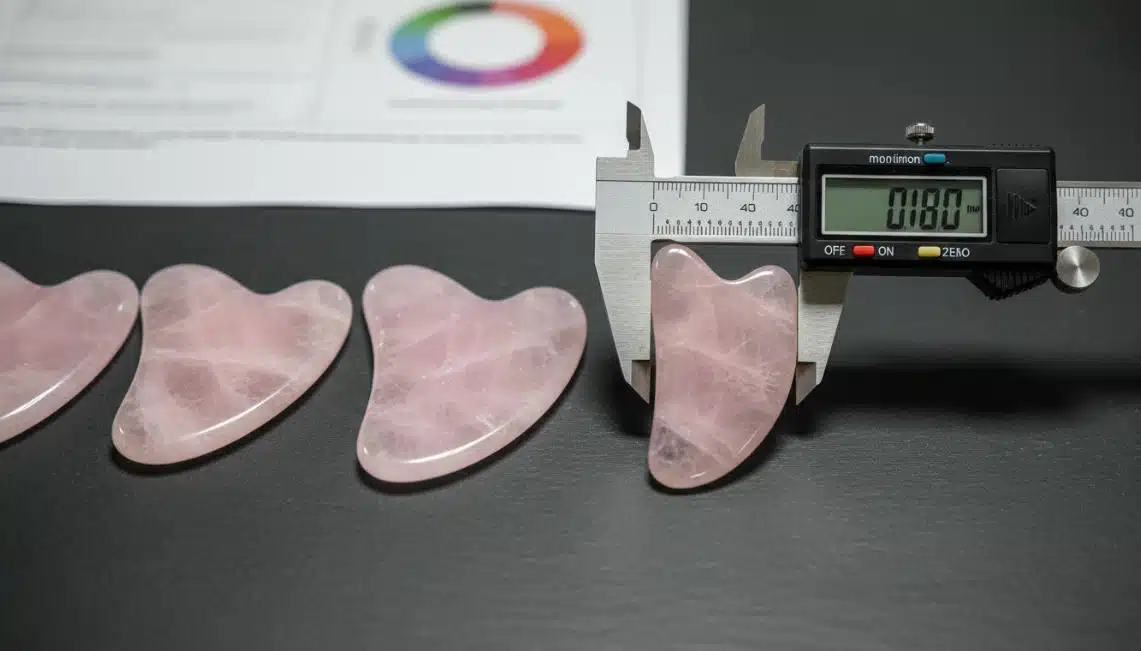
If you’re sourcing rose quartz gua sha custom tools for your brand, the biggest risk isn’t price — it’s what happens before production even starts. Industry data shows that approximately 23% of natural stone wholesale orders encounter quality disputes rooted in raw material issues: color inconsistency, undisclosed inclusions, or outright material substitution. This guide is written from the manufacturing floor, not a sales desk. You’ll get an honest breakdown of every stage where rose quartz gua sha wholesale orders can go wrong — and exactly what to do about it.
Whether you’re working with a gua sha supplier for the first time or scaling an existing product line, understanding the risk landscape upfront will save you rework costs, customs delays, and the kind of customer complaints that quietly kill brand reputation. Let’s get into it.
- Why Raw Material Selection Is the Highest-Risk Phase in Rose Quartz Gua Sha Custom Production
- Manufacturing Process Risks — Where a Gua Sha Manufacturer Either Earns or Loses Your Trust
- The Rose Quartz Gua Sha Custom Order Workflow — A Step-by-Step SOP That Protects Your Investment
- Packaging, Shipping, and Customs Risk — The Final Mile Where Rose Quartz Gua Sha Custom Orders Get Damaged or Delayed
- Supplier Contract Terms That Protect Your Rose Quartz Gua Sha Wholesale Investment
- Managing Color Variation and End-User Expectations — The Communication Layer That Prevents Returns
- Faqs About Rose Quartz Gua Sha Custom
Why Raw Material Selection Is the Highest-Risk Phase in Rose Quartz Gua Sha Custom Production
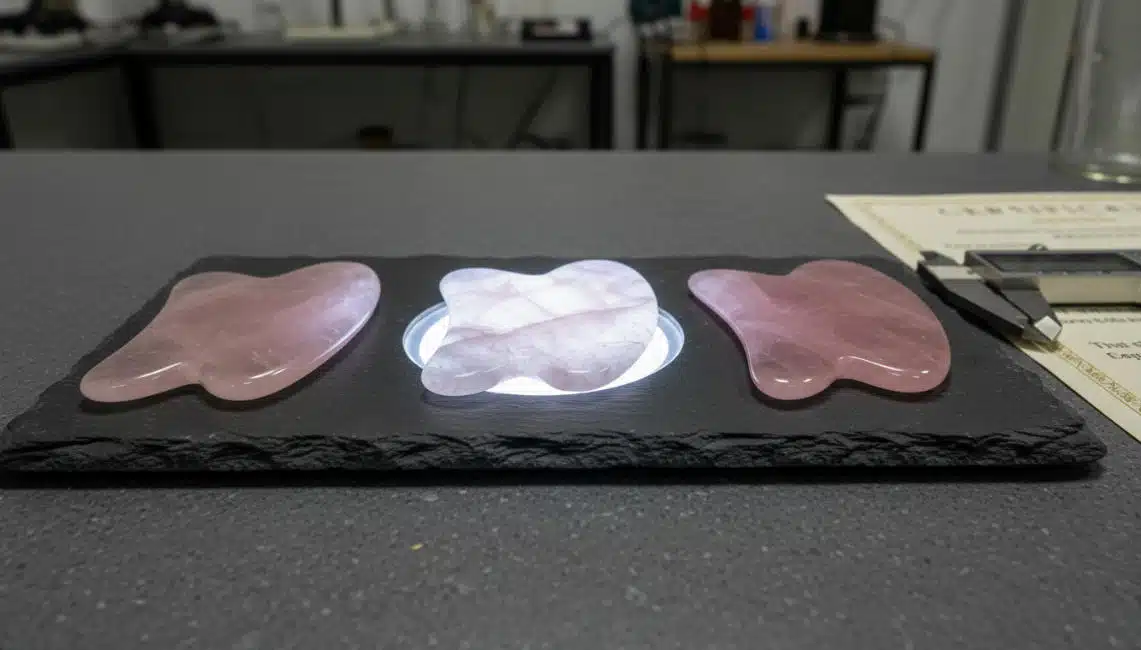
Most buyers assume manufacturing is where quality problems happen. In reality, the decision you make about sourcing — who you buy stone from, what verification you require, and how you document material standards — determines whether your finished product is something you’re proud to sell, or something you’re stuck negotiating returns on. This is the stage where rose quartz gua sha custom production either gets set up for success or quietly sabotaged.
Natural Color Variation: What a Gua Sha Factory Should Tell You Before You Commit to Bulk
Rose quartz is a naturally occurring mineral, and its color exists on a spectrum — from near-transparent pale blush to a deeper, more saturated pink. No two batches from the same quarry are identical. This isn’t a manufacturing flaw; it’s geology. However, a gua sha factory that doesn’t proactively communicate this to buyers before bulk production is setting the stage for disputes.
The practical implication is straightforward: if you place a rose quartz gua sha wholesale order for 500 pieces without establishing a color reference standard upfront, you will receive pieces that vary — and your customers will notice. The industry-accepted practice is to agree on a physical color swatch or a calibrated photo reference before production begins. According to the Gemological Institute of America (GIA), rose quartz color is influenced by microscopic inclusions of aligned mineral fibers, which means even stones from the same source batch can display different saturation levels under different lighting conditions. This means you should request your gua sha supplier to provide 3–5 representative sample pieces from the actual raw material batch before signing off on production.
How to Identify Dyed or Synthetic Rose Quartz Before Your Wholesale Order Ships
This is the issue that makes experienced buyers nervous — and rightly so. The market for low-cost crystal wellness tools has created economic pressure that pushes some suppliers toward using dyed quartzite, heat-treated materials, or fully synthetic glass composites sold as “rose quartz.” The price difference between genuine rose quartz and its substitutes can exceed 40–60% on raw material cost, which tells you exactly why the temptation exists.
There are several verification steps you can take before committing to a rose quartz gua sha wholesale order. First, request a gemological material certificate from an independent testing lab — the International Gem Society (IGS) provides a useful reference on standard identification methods for quartz varieties. Second, ask your gua sha manufacturer to provide a batch hardness test result: genuine rose quartz registers 7 on the Mohs scale, while common glass substitutes typically fall between 5.5 and 6. Third, examine samples under UV light — many dyed stones will show uneven fluorescence patterns that natural material doesn’t produce. These steps aren’t bureaucratic hurdles; they are the difference between a product that clears customs cleanly and one that gets flagged at inspection.
Internal Cracks and Inclusions — The Defect That Hides Until After Cutting
Natural rose quartz frequently contains internal inclusions: rutile needles, fractures, and micro-fissures that are invisible to the naked eye in raw block form but become visible — sometimes dramatically so — after the stone is cut and polished. A responsible gua sha factory will factor this into raw material yield projections, but not all suppliers communicate the implication to buyers: that your effective usable yield from a given raw material purchase may be 15–30% lower than the total stone weight purchased.
This matters because it affects both cost and delivery timelines. If a gua sha supplier quotes you based on gross raw material weight without accounting for inclusion-related breakage and rejection rates, your final per-unit cost will be higher than the original quote implied. Ask for a clear breakdown of estimated yield rate before production begins, and specify in your purchase agreement that final pricing is based on delivered, inspection-passed units — not raw input weight. This one clause alone can prevent some of the most common cost disputes in rose quartz gua sha custom manufacturing relationships.
Manufacturing Process Risks — Where a Gua Sha Manufacturer Either Earns or Loses Your Trust
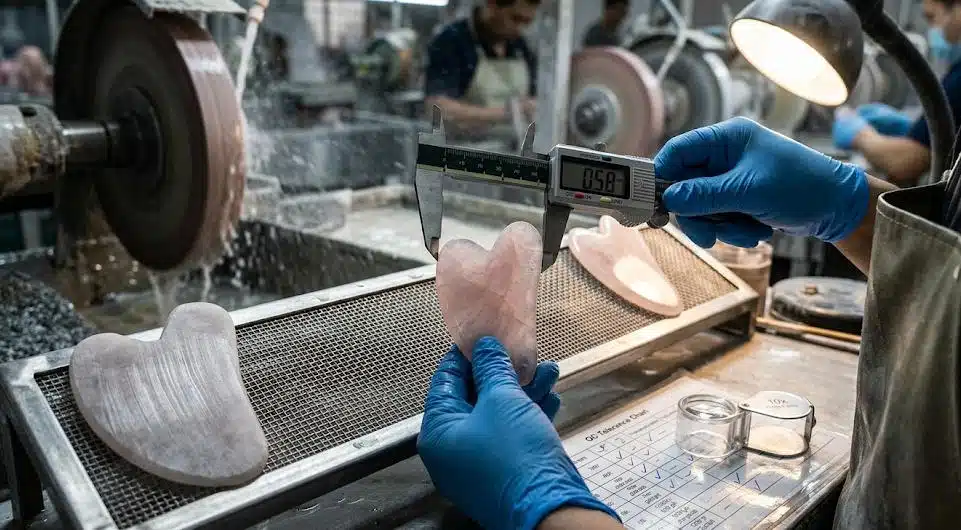
Raw material quality sets the ceiling. Manufacturing process determines whether you actually reach it. In rose quartz gua sha custom production, the gap between a competent gua sha manufacturer and a low-cost operation that cuts corners is measurable — in edge sharpness tolerances, surface finish consistency, and rejection rates per batch. Understanding what happens on the production floor helps you ask better questions, set enforceable specifications, and ultimately receive a product that performs the way your customers expect.
Edge Grinding Standards — Why This Is a Product Safety Issue, Not Just Aesthetics
A gua sha tool that leaves microscopic burrs or sharp transition points on its edges is not just a quality issue — it is a liability issue. The entire functional premise of a gua sha tool is sustained skin contact under light to moderate pressure. Any edge irregularity that wouldn’t matter on a decorative stone becomes a potential source of micro-abrasion injury in this application. A gua sha factory operating to professional standards should be able to specify its edge radius tolerance — typically a minimum 0.5mm rounded profile on all working edges — and demonstrate this through sample measurement.
The grinding and finishing sequence in quality rose quartz gua sha custom production follows a defined abrasive progression: rough shaping, intermediate grinding (typically 200–400 grit), fine grinding (800–1200 grit), and pre-polish smoothing. Each stage removes the scratch marks left by the previous one. If a gua sha manufacturer skips or compresses stages to reduce labor time, the result is a surface that looks polished under warehouse lighting but reveals fine scratches and edge inconsistencies under magnification — or worse, under the friction of actual use. You should request a 10x loupe inspection of edge samples before approving production. This means you can confidently stand behind the safety of every tool you sell.
Shape Consistency Across High-Volume Rose Quartz Gua Sha Custom Runs
The three most commercially common shapes in rose quartz gua sha wholesale — oval/comb, heart, and flat bar — each present different manufacturing challenges. Heart shapes require symmetrical curve cutting on both lobes, which is difficult to hold consistent across large batches when cutting natural stone by hand. Flat bar tools demand uniform thickness across the entire length; any taper introduced during grinding creates an uneven pressure distribution during use. Oval forms are generally the most forgiving to produce, but even here, dimensional drift across a 500-piece run is common without proper tooling fixtures.
Industry-standard dimensional tolerance for wellness tool production is ±0.5mm on primary dimensions and ±0.3mm on thickness. A gua sha factory that cannot specify and hold these tolerances — or that has never been asked to — is likely producing to visual approximation rather than measured consistency. This matters to you as a buyer because inconsistent dimensions create inconsistent customer experiences, and in the wellness product category, consistency is a direct proxy for perceived quality. Ask your gua sha supplier to include a dimensional measurement report with each production batch, sampling at minimum 10% of total units. This means every piece your customer picks up feels like it belongs to the same product line.
Polishing and Surface Finish — The Specification Most Buyers Forget to Define
Surface finish is the single most visible quality indicator in rose quartz gua sha custom production, and it is also one of the least precisely specified by most buyers. “Polished” is not a specification — it is a category. Within that category, finish quality varies enormously based on the abrasive sequence used, the polishing compound applied, and the time spent at each stage. A properly polished rose quartz surface should achieve a reflective clarity of 80–90 gloss units (measured on a standard gloss meter), with no visible directional scratch marks under diffuse lighting.
The practical test is simple: hold a sample piece under a single directional light source at a 45-degree angle and rotate it slowly. A correctly polished surface will show a clean, even reflection with no “orange peel” texture or parallel scratch lines. A surface that was rushed through polishing will show haze or fine linear marks. This test takes about 15 seconds and tells you more than most factory quality reports will. According to the Swiss Gemmological Institute SSEF, surface integrity in polished gemstone materials is a direct indicator of the abrasive process discipline applied during finishing — a principle that applies equally to therapeutic stone tools. This means the polish quality you verify on your pre-production sample is the single best predictor of what your bulk order will look like.
Rejection Rates and What They Tell You About a Gua Sha Factory’s Real Capability
Every honest gua sha manufacturer produces rejects. The question is not whether defects occur — in natural stone processing, some rate of material loss is inevitable — but what the rejection rate is, how it’s tracked, and whether it’s disclosed to buyers. A well-run gua sha factory working with rose quartz should expect a finished-goods rejection rate of 8–15% of processed units due to inclusions, edge defects, surface blemishes, and dimensional non-conformance. If a supplier quotes you rejection rates below 5% on natural stone, treat that figure with skepticism — it more likely reflects unreported defects than exceptional process control.
What you want to see is a supplier who tracks rejections by category, uses that data to adjust raw material purchasing and process parameters, and builds rejection rates into their production planning so that your contracted quantity is delivered in full. The difference between a gua sha supplier who manages this transparently and one who doesn’t will show up in your final delivery: either you receive your full order on time, or you receive a short shipment with an explanation that always sounds reasonable after the fact. Specify in your purchase agreement that the contracted quantity is the delivered, inspection-passed quantity — not the quantity that enters production.
The Rose Quartz Gua Sha Custom Order Workflow — A Step-by-Step SOP That Protects Your Investment
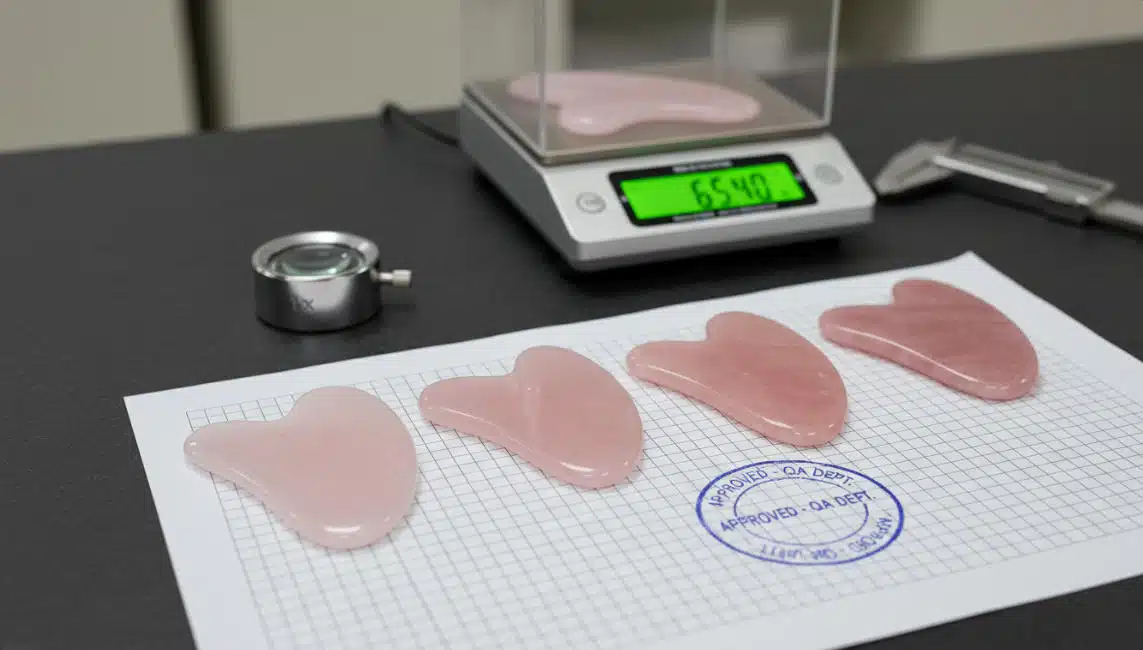
Most quality problems in rose quartz gua sha wholesale sourcing are not manufacturing failures — they are specification failures. The buyer didn’t define what they wanted precisely enough, the gua sha manufacturer filled in the gaps with their own defaults, and the result satisfied neither party. The workflow below is designed to close that gap at every stage. It’s not theoretical; it reflects the actual sequence that reduces rework rates, shortens approval cycles, and produces finished goods that match what you originally envisioned.
Step One: Writing a Specification Sheet That a Gua Sha Factory Can Actually Manufacture To
A specification sheet for rose quartz gua sha custom production needs to be more than a sketch and a color reference. It should define, at minimum: primary dimensions with tolerances, thickness range, edge radius requirement, surface finish grade, acceptable inclusion parameters, weight range per unit, and color reference standard. Each of these parameters should be expressed as a measurable range, not a subjective description. “Smooth edges” is not a specification. “Minimum 0.5mm radius on all working edges, verified by tactile inspection and 10x loupe” is a specification.
Color reference deserves particular attention. Because natural rose quartz varies between batches, your specification should define an acceptable color range rather than a single target. The most practical method is to establish a physical reference set — three to five actual stone samples representing the lightest acceptable, the target, and the darkest acceptable — and have both parties sign off on these before production begins. A gua sha factory that resists this step is signaling that it intends to make color decisions unilaterally during production. That is a risk you can eliminate before it becomes a problem. This means your specification sheet becomes a legally enforceable quality anchor for the entire order.
Your specification sheet should also address what happens when raw material conditions require deviation — for example, if the quarry batch available at production time has different average saturation than anticipated. Define in writing whether the gua sha supplier must notify you and await approval before proceeding, or whether they have discretion within defined parameters. This single clause prevents the most common “we had to make a substitution” conversation that buyers dread receiving two weeks before their expected ship date.
Step Two: The Sampling Protocol — Why a Small Trial Run Is the Most Cost-Efficient Investment You’ll Make
Before committing to full production volume, any rose quartz gua sha custom order above 200 units should go through a formal sampling phase. This typically involves producing 5–10 finished pieces from the actual raw material batch designated for your order, processed through the complete production sequence including final polish and any secondary finishing. The purpose is not simply to see what the product looks like — it is to verify that the raw material, the process, and the specification are all aligned before you’ve committed production capacity and material cost to a full run.
During sample review, evaluate each piece against your specification sheet systematically. Measure primary dimensions with calipers — not by eye. Inspect edges under a loupe at 10x magnification. Check surface finish under directional lighting as described in Section 2.3. Weigh each sample and compare against your target weight range. Record every measurement. If samples pass on some parameters and fail on others, that tells you exactly which part of the process needs adjustment before full production begins. A gua sha manufacturer who objects to this level of sample scrutiny is worth reconsidering as a partner — the sampling phase exists precisely to surface these issues when they’re still inexpensive to fix.
Research from the First Article Inspection (FAI) indicates that first-article inspection protocols — the industrial equivalent of this sampling step — reduce production defect rates by an average of 47% in custom manufacturing contexts. Applied to rose quartz gua sha wholesale production, this means that the cost of a proper sampling round, including shipping samples for review and the time spent evaluating them, is recovered many times over in avoided rework, reshipping, and inventory write-offs on non-conforming bulk goods.
Step Three: Production Monitoring — What to Track During Active Manufacturing
Once samples are approved and full production begins, your oversight role doesn’t end — it shifts. You move from specification verification to production monitoring. For rose quartz gua sha custom orders, the key monitoring touchpoints are: raw material intake inspection (confirming the actual production batch matches the approved sample batch), in-process dimensional checks at the rough-cut stage, edge inspection after grinding, and surface inspection after polishing. A gua sha factory with mature quality systems will conduct these checks internally and provide you with checkpoint reports. If your supplier doesn’t have a formal in-process inspection protocol, you can request third-party inspection at critical stages through services like SGS or Bureau Veritas.
Production monitoring also includes timeline tracking. Natural stone processing is weather-sensitive in some regions, and equipment downtime affects output rates in ways that synthetic material production doesn’t. A reliable gua sha manufacturer should provide you with a production Gantt chart at order confirmation, with defined milestone dates for material intake, rough cut completion, finishing completion, and final inspection. If milestones slip, you want to know early — not three days before your expected ship date. Build weekly production update requirements into your purchase agreement, even if the updates are brief. This means you retain visibility and decision-making control throughout the production cycle, rather than discovering problems at the point when your options are most limited.
Step Four: Pre-Shipment Inspection — Building a Checklist That Covers Every Failure Mode
A pre-shipment inspection for rose quartz gua sha wholesale orders should systematically cover every parameter defined in your original specification sheet, applied to a statistically valid sample of the finished batch. The standard sampling approach for inspection is the AQL (Acceptable Quality Limit) system — at AQL 2.5 for major defects and AQL 4.0 for minor defects, a batch of 500 units requires inspection of approximately 50 pieces to generate a statistically reliable pass/fail determination.
Your inspection checklist should cover dimensions (measured), weight (measured), edge condition (loupe inspection), surface finish (directional light inspection), color conformance against reference samples, and packaging integrity. Each parameter should have a defined acceptance criterion and a defined consequence for non-conformance — either unit-level rejection or batch-level rejection depending on severity. A gua sha supplier who is confident in their production process will welcome this inspection because it protects both parties. Resistance to third-party inspection at the pre-shipment stage is one of the clearest signals available that a supplier is not confident in what they’re about to ship. This means a well-structured pre-shipment inspection is your last line of defense — and the one that most reliably prevents quality disputes from becoming financial losses.
Packaging, Shipping, and Customs Risk — The Final Mile Where Rose Quartz Gua Sha Custom Orders Get Damaged or Delayed
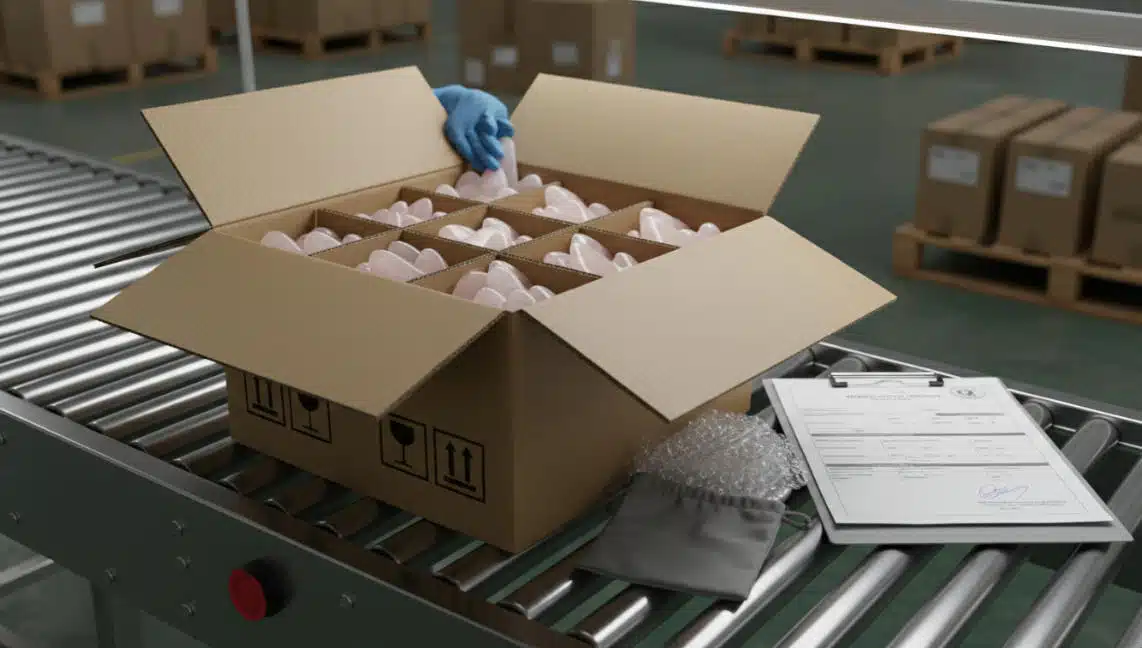
You’ve verified your raw material, approved your samples, monitored production, and passed pre-shipment inspection. At this point, most buyers mentally close the loop on quality risk. That’s a mistake. For rose quartz gua sha custom orders, the journey from factory floor to your receiving dock introduces a distinct set of risks that are entirely separate from manufacturing quality — and equally capable of turning a successful production run into a costly problem. Packaging design, carrier selection, documentation accuracy, and customs compliance each require the same deliberate attention you gave to material and process specifications.
Fragile Stone Packaging Standards — What Responsible Gua Sha Suppliers Do Differently
Rose quartz has a Mohs hardness of 7, which means it resists surface scratching reasonably well — but hardness and impact resistance are different properties. Under the dynamic shock loads generated by international freight handling — drops, vibration, compression from stacked cartons — an unprotected or under-protected gua sha tool can fracture along pre-existing internal stress planes that were invisible at inspection. Industry freight data suggests that fragile goods packed to inadequate standards experience damage rates of 11–15% on long-haul international shipments, compared to under 2% for correctly packaged equivalents.
A gua sha factory operating to professional export standards should be packaging each individual piece in a minimum of two protective layers before boxing. The standard approach is an inner soft pouch — velvet or microfiber — followed by individual bubble wrap wrapping, with each wrapped piece placed in a cell-divided inner carton that prevents piece-to-piece contact. The outer shipping carton should be double-walled corrugated, with a minimum burst strength rating appropriate for the total carton weight. Every outer carton should carry internationally recognized fragile handling labels on all four vertical faces, not just the top. A gua sha supplier who considers this level of packaging “excessive” for stone products has not shipped enough international freight to understand what actually happens to inadequately protected stone inside a container that’s been loaded and unloaded four times across three ports.
Individual vs. Retail Packaging — Aligning Protection with Your End Use Case
The packaging decisions you make for rose quartz gua sha wholesale shipments need to account for two distinct requirements: transit protection and retail presentation. These are not the same thing, and optimizing for one while ignoring the other creates problems at different points in your supply chain. If your products ship directly to consumers in their retail packaging, that packaging needs to provide transit protection — which means your retail box design and the padding inside it need to be engineered for drop testing, not just visual appeal.
If your products ship in bulk to a warehouse or fulfillment center where they’ll be repacked into retail packaging, your transit packaging can be purely functional. In this case, the cost savings from simpler bulk packaging can be significant — but you need to ensure your gua sha manufacturer understands which scenario applies and packages accordingly. Misalignment on this point is more common than it should be, and it typically surfaces when a buyer receives a pallet of retail-packaged goods that are individually beautiful but arrived with a 12% breakage rate because the retail boxes provided no meaningful transit cushioning. This means specifying your end-use packaging scenario in writing at order placement is not a minor detail — it directly determines what protection your products actually receive in transit.
International Customs Compliance for Rose Quartz Gua Sha Custom Shipments
Customs compliance for natural stone wellness products involves considerations that don’t apply to most consumer goods categories. The primary risk areas for rose quartz gua sha wholesale imports are material classification accuracy, country of origin documentation, and the heightened inspection risk associated with products that could potentially contain dyed or synthetic materials misrepresented as natural stone.
Natural rose quartz gua sha tools are typically classified under HS Code 6802.99 (worked monumental or building stone and articles thereof) or 9018.90 depending on the destination country’s customs authority interpretation and whether the product is positioned as a cosmetic tool or a therapeutic device. Misclassification — even unintentional — can result in holds, additional duties, or seizure of the shipment. Before your first import of a rose quartz gua sha custom product line, confirm the correct HS classification with a licensed customs broker in your destination market. The World Customs Organization publishes the current Harmonized System nomenclature online, which provides the classification framework your broker will work from.
Material authenticity documentation is the second critical compliance factor. As noted in Section 1, dyed or synthetic stone products face heightened inspection risk in many markets — particularly the EU, US, and Australia, where import regulations on wellness and personal care products have tightened significantly over the past five years. If your shipment contains genuine natural rose quartz, ensure your gua sha supplier provides a material certificate from a recognized testing laboratory with each commercial shipment. This document should travel with your shipping invoice and packing list as part of the commercial documentation package. Customs inspectors who flag a shipment containing stone products are specifically looking for this type of documentation — its presence dramatically reduces the probability of a time-consuming physical inspection hold.
Carrier Selection and Transit Risk Management for Gua Sha Factory Shipments
Not all freight carriers handle fragile goods with equal care, and the mode of transport you select affects both damage risk and transit time in ways that directly impact your landed cost calculations. For rose quartz gua sha custom orders, the primary shipping modes are sea freight (LCL or FCL), air freight, and express courier — each appropriate for different order volumes and timeline requirements.
Sea freight is the standard choice for rose quartz gua sha wholesale orders above approximately 200kg gross weight, where the per-unit freight cost advantage over air is significant. The tradeoff is transit time — typically 18–35 days port to port for major trade lanes — and the dynamic loading environment inside ocean containers, which generates more sustained vibration exposure than air freight. If you’re shipping via sea, specify that your cargo should be loaded as a top tier in the container where possible, and request load planning documentation from your gua sha factory freight forwarder confirming stack weight above your cartons does not exceed the outer carton compression rating.
Air freight and express courier are appropriate for smaller orders, samples, and time-sensitive replenishment shipments. The handling environment is generally gentler than sea freight, but the cost per kilogram is substantially higher — typically 4–6 times the equivalent sea freight rate on major Asia-to-Europe or Asia-to-North America lanes. For rose quartz gua sha custom sample shipments specifically, express courier via DHL, FedEx, or UPS provides reliable tracking and predictable transit times that make the cost premium worthwhile. This means selecting your shipping mode is not just a cost decision — it is a risk management decision that should factor in your product’s fragility, your timeline requirements, and the total cost of a damaged shipment versus the premium for faster, safer transit.
Supplier Contract Terms That Protect Your Rose Quartz Gua Sha Wholesale Investment
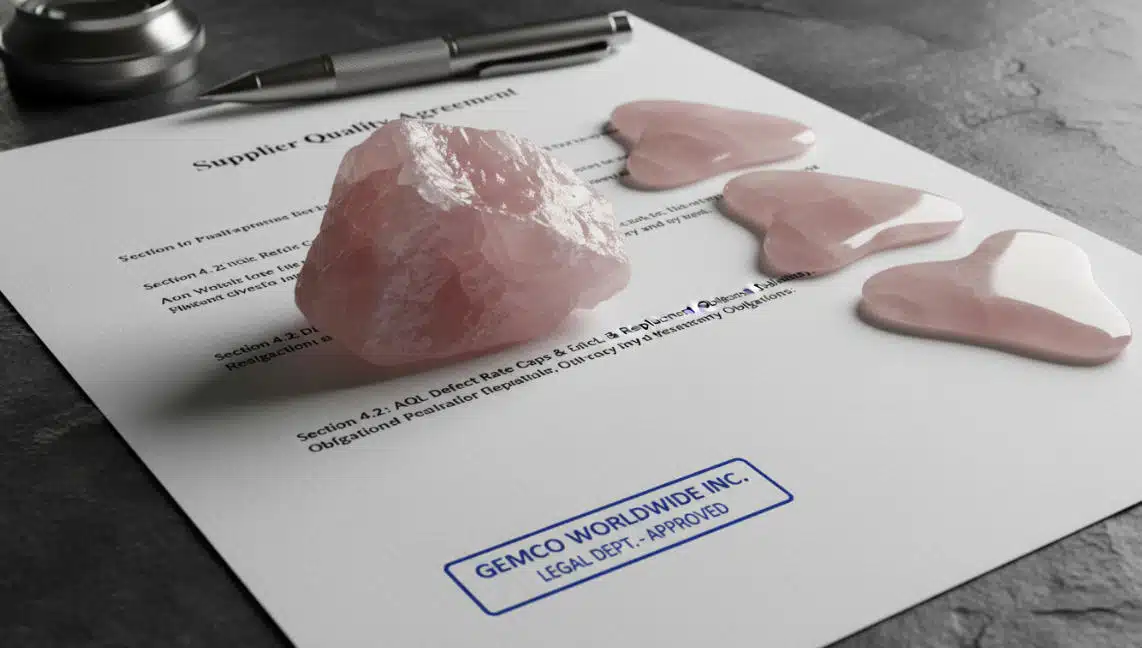
A purchase order is not a contract. A pro forma invoice is not a contract. In rose quartz gua sha custom manufacturing relationships, the document that actually protects your investment is a supplier agreement that defines quality standards, inspection rights, delivery obligations, and remedies for non-performance with enough specificity that neither party can credibly claim ambiguity when something goes wrong. Most quality disputes in rose quartz gua sha wholesale sourcing are not resolved by the facts — they are resolved by whoever has the clearer written record. Make sure that’s you.
Quality Standard Clauses — How to Write Terms a Gua Sha Manufacturer Can Be Held To
The quality clauses in your supplier agreement need to reference your specification sheet directly — by document title, version number, and date — and state explicitly that the specification sheet is incorporated into the agreement as a binding exhibit. This single structural choice transforms your specification from a document that a gua sha manufacturer can treat as advisory into one they are contractually obligated to meet. Without this incorporation, a supplier who delivers product that deviates from your specification can reasonably argue that the specification was a guideline, not a requirement.
Your quality clauses should define acceptance criteria at three levels: critical defects (any single instance causes unit rejection — examples include visible fractures, sharp edges that fail the tactile test, or dimensions outside tolerance by more than 15%), major defects (aggregate rate above 2.5% causes batch-level action — examples include surface blemishes visible at 30cm viewing distance, weight outside specified range), and minor defects (aggregate rate above 4.0% triggers documented corrective action — examples include slight color variation within the defined acceptable range). These thresholds align with standard AQL practice and give both you and your gua sha supplier a shared, objective language for discussing quality outcomes. This means every quality conversation starts from data rather than competing subjective impressions.
Specify inspection rights explicitly. Your agreement should state that you or your designated third-party inspector have the right to conduct pre-shipment inspection at the gua sha factory at any point during the final production week, with 48 hours notice. This right should exist whether or not you intend to exercise it on every order — the fact that it exists changes how a supplier manages production quality throughout the run, not just at the end.
Defect Rate Caps, Return Policies, and Replacement Obligations
The remedy structure in your supplier agreement determines what happens when goods arrive and don’t meet specification — which, across a multi-year sourcing relationship, will happen at least once regardless of how well everything else is managed. A gua sha factory that accepts no returns and offers no replacements for non-conforming goods is not a manufacturing partner; it is a one-transaction vendor. Your agreement should define remedies that scale with the severity of non-conformance.
For critical defect rates above 1% of delivered units, the appropriate remedy is either full replacement of non-conforming units at the supplier’s cost — including inbound and outbound freight — or a proportional price credit applied to the next order, at your election. For major defect rates above 2.5%, the appropriate remedy is partial replacement or a negotiated price adjustment. For minor defects within defined tolerances, no remedy is required — but the supplier’s corrective action documentation should address root cause and prevention measures for future orders. According to data published by the International Trade Centre, suppliers who operate under clearly defined defect-remedy frameworks show 34% lower repeat defect rates compared to suppliers operating under vague “we’ll make it right” verbal commitments. This means the time you invest in writing precise remedy clauses now directly reduces the probability that you’ll ever need to invoke them.
Price Lock Strategies for Rose Quartz Gua Sha Custom Orders — Managing Raw Material Volatility
Rose quartz raw material pricing is not as volatile as precious gemstones, but it is not stable either. Prices fluctuate based on quarry output from primary producing regions — predominantly Brazil, Madagascar, and South Africa — as well as global demand cycles driven by wellness industry trends. Between 2020 and 2023, raw rose quartz prices on the wholesale market increased by approximately 28–35% in response to sustained demand growth in the crystal wellness category, according to gem market tracking data from the Gemological Institute of America. A gua sha supplier who quotes you today based on current raw material costs may face genuine pressure to adjust pricing if your production date is three or four months away.
The practical approach is to negotiate a price lock period at order placement — typically 60–90 days from purchase order confirmation — during which the supplier commits to hold the quoted unit price regardless of raw material movement. In exchange, you commit to a defined payment schedule that provides the supplier with enough working capital to purchase raw material promptly rather than waiting for production funding. For rose quartz gua sha wholesale orders with longer lead times, consider splitting the order into two production runs spaced 60–90 days apart, with pricing renegotiated between runs based on actual market conditions at the time. This approach balances price certainty against market reality and is generally more sustainable for both parties than attempting to lock prices over periods long enough that one side inevitably absorbs an unfair cost. This means structuring your payment and production schedule thoughtfully protects your margins without creating adversarial pricing dynamics with your gua sha manufacturer.
Delivery Timeline Clauses and Late Shipment Penalties
Delivery timeline clauses need to define three dates: the production completion date, the pre-shipment inspection date, and the cargo ready date. Each should carry its own consequence for non-performance. A gua sha factory that misses production completion delays the inspection window, which delays cargo ready, which delays your receipt date — and the cascade effect can be significant if your product launch, retail buyer delivery commitment, or seasonal inventory cycle depends on a specific arrival date.
A reasonable late shipment penalty structure for rose quartz gua sha custom orders is a 0.5% reduction in invoice value per week of delay beyond the contracted cargo ready date, capped at 5% of total order value. This structure is punitive enough to incentivize on-time performance without being so aggressive that it creates adversarial dynamics or makes the supplier unwilling to communicate proactively about delays. The more important clause is the notification requirement: your agreement should require the gua sha supplier to notify you in writing within 48 hours of identifying any condition that is likely to cause a delivery delay, with a revised timeline and the reason for the delay. Early notification preserves your options — you can adjust your own commitments, expedite shipping, or source a partial quantity elsewhere. Late notification eliminates those options. This means the notification clause is often more valuable in practice than the penalty clause.
Managing Color Variation and End-User Expectations — The Communication Layer That Prevents Returns
Everything covered in the preceding sections addresses risks within your supply chain. This final section addresses a risk that exists between you and your end customers: the gap between what buyers of natural stone wellness products expect and what natural stone actually delivers. For rose quartz gua sha custom products specifically, color variation is the single most common source of consumer complaints — and it is almost entirely preventable through proactive communication rather than product modification.
How to Communicate Natural Stone Variation Without Undermining Your Product’s Appeal
Natural color variation in rose quartz is not a flaw — it is a characteristic. The challenge is that most consumers who haven’t purchased natural stone products before interpret variation as inconsistency, which they associate with quality control failures. A gua sha supplier or brand that doesn’t address this expectation proactively will find itself fielding returns and negative reviews from customers who received exactly what they ordered but didn’t understand what they were ordering.
The most effective approach is to incorporate variation disclosure directly into your product listing copy, in language that frames variation as a feature rather than a disclaimer. Phrases like “each piece is individually formed by nature and will vary slightly in color and pattern — no two are identical” perform significantly better in consumer research than legalistic disclaimer language. According to consumer behavior research published by the Nielsen Norman Group, product descriptions that acknowledge natural variation authentically generate 22% fewer returns and higher post-purchase satisfaction scores compared to descriptions that present an idealized version of the product. This means your product copy is a quality management tool, not just a marketing asset.
Include physical variation examples in your product photography. Showing three or four pieces from the same product line side by side — with visible, honest color variation between them — sets accurate expectations before purchase and significantly reduces the surprise factor that drives return decisions. A rose quartz gua sha custom product line photographed this way also communicates authenticity and natural origin more effectively than a single “hero” image of the most perfect piece in the batch.
Rose Quartz Gua Sha Care Instructions — What Your Retail Packaging Should Always Include
End-user care instructions serve two purposes: they extend the functional life of your product, and they reduce the probability of damage-related complaints that are actually caused by user behavior rather than manufacturing defects. For rose quartz gua sha wholesale products, the care requirements are straightforward but not intuitive to consumers unfamiliar with natural stone.
Rose quartz should not be exposed to prolonged high heat — temperatures above approximately 150°C can cause thermal stress fractures along internal inclusion planes, and while most users won’t approach this threshold in normal use, leaving a stone tool on a heated surface or in direct summer sunlight in an enclosed space can generate localized temperatures that exceed safe thresholds. Chemical exposure is a more common practical risk: acidic skincare products, alcohol-based sanitizers, and strongly alkaline cleansers can etch polished stone surfaces over time, dulling the finish and creating microscopic surface roughness that affects both appearance and tactile feel during use.
Your care instruction card — which should be included in every retail unit regardless of whether it’s legally required — should cover three areas: cleaning method (warm water, mild soap, soft cloth; no ultrasonic cleaners or steam), storage (individual soft pouch or padded storage to prevent piece-to-piece contact and surface scratching), and exposure limitations (avoid prolonged heat, direct sunlight storage, and contact with acidic or strongly alkaline substances). Keep the language simple and direct. A care card that reads like a technical manual will not be read. A care card with three clear bullet points and one illustrative icon per point will be followed. This means your care instructions directly reduce the rate of damage complaints that would otherwise create customer service burden and return processing costs for your business.
Building a Long-Term Sourcing Relationship With a Gua Sha Manufacturer That Grows With You
The frameworks in this guide — specification sheets, sampling protocols, inspection checklists, contract clauses, and communication standards — are not one-time tools. They are the foundation of a sourcing relationship that compounds in value over time. A gua sha manufacturer who has worked through two or three production cycles with a buyer who operates this way develops a precise understanding of that buyer’s standards and expectations. Rejection rates typically decrease by 20–30% from the first to the third production run with the same supplier, because the supplier has learned exactly what the buyer accepts and what they don’t.
The investment in establishing these systems pays dividends that are easy to quantify: lower rework costs, shorter approval cycles, reduced inspection overhead, fewer customs complications, and a dramatically lower rate of customer complaints and returns. Less easy to quantify but equally real is the sourcing stability that comes from being the kind of buyer that a good gua sha factory wants to retain. Suppliers allocate their best raw material batches, their most experienced production staff, and their most reliable delivery scheduling to buyers who pay on time, communicate clearly, and provide feedback that helps them improve. The operational frameworks described in this guide are how you become that buyer — and that position, once established, is genuinely difficult for competitors to replicate.
Rose quartz gua sha custom production at scale is manageable when approached systematically. The risks are real, but they are known risks with known mitigations. Apply the specification, sampling, inspection, and contractual frameworks in this guide, and you will find that what looks from the outside like a complex and opaque sourcing category is actually highly predictable — and highly rewarding for buyers who do the groundwork.
Faqs About Rose Quartz Gua Sha Custom
1. What is the minimum order quantity for rose quartz gua sha custom production?
Most gua sha manufacturers require a minimum of 50–100 pieces per shape. Starting with a small trial run is strongly recommended to verify color, dimensions, and edge finish before committing to bulk volume.
2. How do I verify that my gua sha supplier is using genuine natural rose quartz?
Request a material certificate from an independent lab and confirm Mohs hardness of 7. Dyed or synthetic substitutes typically test below 6.5 and show uneven UV fluorescence that natural stone does not produce.
3. Can a gua sha factory match a specific color for large wholesale orders?
Not precisely. Natural rose quartz gua sha wholesale production allows color range control — not exact matching. Establish a physical reference swatch set before production begins to define your acceptable color range contractually.
4. What packaging standard should I require from my gua sha supplier for international shipping?
Each piece should be individually wrapped in bubble wrap, placed in a divided inner carton, and shipped in double-walled outer boxes. Fragile labeling on all four sides reduces mishandling rates significantly during transit.
5. How long does a typical rose quartz gua sha custom order take from specification to delivery?
Allow 30–45 days for standard orders: 3–5 days sampling, 15–20 days full production, 5–7 days inspection and packaging, plus shipping transit time. Complex shapes or large volumes may require additional lead time.