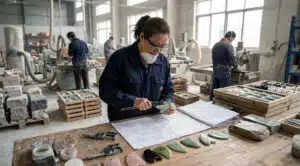
If you have ever compared quotes from three different suppliers and gotten three different answers about “polishing difficulty,” you are not imagining things. After twelve years running polishing lines for stainless steel, quartz, agate, jade and eight other materials, one lesson stands out above the rest: difficulty and final quality are not the same variable, and no honest gua sha manufacturer should tell you otherwise. Resin scores roughly 1 star out of 5 for processing difficulty, stainless steel sits at 2, natural quartz and jade climb to 4, and fluorite and calcite top out near 5 — yet the hardest material to process is rarely the one that gives you the best-looking finish. This article walks through what actually happens on a gua sha factory floor when twelve different materials go through gua sha polishing, and what each outcome means for your next order.
Why Every Gua Sha Manufacturer Should Rate Five Risks, Not One

Ask ten factories what “good polishing” means, and you will likely get ten different answers, because most of them are only measuring one thing: how shiny a sample looks under a showroom light. That single-axis thinking is exactly why so many wholesale buyers get burned on reorders. A gua sha factory that only tracks gloss will happily ship you a batch that looks flawless in a sample box and falls apart in consistency by unit 2,000, because gloss alone says nothing about how repeatable that gloss is at scale. So what does this mean for you? It means the sample you approve should never be graded on brightness alone — ask for defect-rate history across real production runs, not a single hand-picked piece.
The Five Indicators That Predict Your Order Outcome
Serious gua sha production planning runs on five separate scores, not one: processing difficulty, mirror-finish potential, natural visual depth, batch-to-batch consistency, and polishing defect risk. Resin, for example, posts a processing-difficulty score near 1 out of 5, yet its natural-visual-depth score is also close to 1, because a mold can only replicate surface texture — it cannot replicate what light does inside a translucent crystal. Stainless steel flips that pattern almost exactly. Its processing difficulty sits around 2, but its mirror-finish potential and batch consistency both reach the top of the scale, close to 5, because the metal carries no internal fractures, color banding, or mineral inclusions to fight against during gua sha polishing.
Natural quartz and agate sit at the opposite end of that spectrum. Both carry a processing-difficulty score near 4 to 4.5 and a defect-risk score around 4, yet their natural-visual-depth score also reaches 5, because light behaves differently inside a crystal lattice than it does on a molded or painted surface. This means that when you order quartz or agate tools, you are not simply buying a material — you are buying an optical property that resin and steel cannot reproduce at any price point.
How Deyi Gems Scores Twelve Materials Side by Side
At Deyi Gems, every material entering the workshop is scored against those same five indicators before a single unit ships to a wholesale buyer. Stainless steel, glass, resin, clear quartz, rose quartz, amethyst, agate, jade and related nephrite-family stones, fluorite, calcite, malachite and lapis lazuli all pass through the identical five-point evaluation, so the numbers on a spec sheet stay comparable across the whole catalog instead of being invented per product. That consistency is what lets a guasha tools wholesale buyer compare a low-cost resin tool against a premium amethyst tool on the same scale, rather than comparing marketing adjectives that mean nothing on a production floor.
Here is a question worth asking before your next purchase order: if two suppliers show you the same “high gloss” sample, which one actually controls unit-to-unit variance once volume climbs? A mirror-finish photo will not answer that for you. Only a documented, five-indicator score — tracked across real batches rather than a single showroom piece — answers it honestly, and that documentation is something you are entitled to request from any gua sha manufacturer before you commit to a container-sized order.
Stainless Steel: The Fastest Mirror Finish Any Gua Sha Factory Can Deliver

Stainless steel is not the softest material on the list, but it is the most uniform one, and uniformity is what actually drives polishing outcomes in volume production. Unlike natural stone, steel carries no internal cracks, cavities, color bands, or mineral inclusions, so a polishing line can push toward a consistent mirror finish without fighting the raw material at every step. This is the core reason stainless steel remains a default choice for large-volume gua sha production runs. The typical process moves through rough grinding, medium grinding, fine grinding, buffing, and a final mirror pass, and each stage is measurable with the same tooling every time a new coil comes in.
That measurability is the real advantage. Surface flatness is easy to control, reflectivity comes out strong and even, edges can be machined to tight, consistent tolerances, and CNC-finished parts hold matching dimensions from the first piece to the ten-thousandth. Based on Deyi Gems production data, CNC-finished stainless steel lines typically hold rework rates under roughly 3 percent of units, compared with rework rates that often run into double digits on hand-finished natural stone. This means your unit cost stays predictable even at high volume, because you are not paying to re-polish a meaningful share of every batch.
How a Gua Sha Manufacturer Controls Batch Consistency in Steel
Consistency in steel comes down to process discipline rather than material luck, which is a very different risk profile than natural stone carries. A gua sha manufacturer running steel lines can standardize grit progression, buffing wheel speed, and compound choice across an entire order, because every coil of 304 or 316 steel behaves almost identically to the last one. That is not true of two blocks of rose quartz cut from different parts of the same rough, which is exactly why steel remains the benchmark for buyers who need thousands of visually identical units for retail packaging or spa-chain distribution.
What Mirror Polish Costs You in Lead Time and Rework
Cost and lead time are usually the first two questions a buyer asks, so let’s answer them directly. A stainless steel mirror finish generally reaches production-ready quality in fewer polishing passes than natural stone requires to hit a comparable gloss level, which shortens the time between tooling approval and shipment. It also means your quality-control team spends less time sorting rejects, because the defect population on steel skews toward surface scratches rather than structural cracking — scratches are fixable with an extra buffing pass, while a cracked crystal is not. If your product line is priced for volume retail rather than collector-grade natural stone, this cost structure is usually the deciding factor, and it is worth asking your gua sha factory partner for actual rework percentages rather than accepting “very low” as an answer.
Natural Crystal: The Point Where Gua Sha Manufacturer Risk Rises Past Mohs 7

Clear quartz, rose quartz, and amethyst share a Mohs hardness of roughly 7, which sounds like a small number until you compare it to resin or even mild steel. The Gemological Institute of America explains the Mohs scale as a measure of scratch resistance rather than a simple linear ranking, and that distinction matters here: a jump from a 2-star to a 4-star polishing difficulty rating is not a small step, it is a real change in tooling, time, and skill required on the shop floor — exactly the stage where a gua sha production schedule slips if a factory underestimates crystal’s demands. Polishing crystal is not simply “making the surface shinier.” It requires progressively reducing surface roughness in controlled stages — rough grinding, fine grinding, precision grinding, polishing powder or polishing liquid, and a final mirror stage — because skipping a stage leaves microscopic scratching that no amount of buffing at the end can hide.
The Physics Behind Crystal’s Optical Depth
What you get at the end of that process is different from anything resin or metal can produce. Well-polished quartz shows what the trade calls “optical depth” — a glass-like surface shine combined with internal light transmission that makes the crystal appear to glow from within rather than merely reflect light off its surface. This effect is most visible in high-clarity clear quartz and amethyst, and it is the single biggest visual difference between a natural crystal gua sha tool and a resin lookalike sitting next to it on a shelf. This means that when a customer picks up your product and turns it in the light, the depth they see is doing marketing work that no packaging copy can replace.
How to Read a Crystal Polishing Report Before You Order
Because crystal carries real processing risk, it is worth asking your gua sha factory for polishing-stage documentation rather than a finished-sample photo alone. Industry polishing surveys compiled by the International Gem Society show that experienced lapidaries treat quartz-family material as a distinct category requiring its own grit sequence and polish compound, not a generic “stone polishing” recipe borrowed from softer material. If a supplier cannot describe which grinding stages and polishing compounds they use on quartz specifically, that is a signal worth taking seriously before you place a bulk guasha tools wholesale order, because a shortcut at any stage shows up as haze or micro-scratching that only becomes visible after the product has already shipped. At Deyi Gems, crystal batches follow a documented five-stage grinding and polishing log for exactly this reason.
Agate: High Gloss With a Hidden Consistency Risk

Agate is, in many ways, the easiest high-end stone to sell and the hardest one to keep consistent. Its hardness supports a strong, stable mirror finish, its color deepens noticeably once polished, and its natural banding becomes more dramatic and more visible under a glossy surface. That last point is also where the real risk lives. The same gua sha polishing process applied to two pieces of agate from different sections of the same rough can produce noticeably different results — one region glows, another sits duller, a band of texture becomes more prominent, or an inclusion that was invisible in the rough suddenly stands out under high gloss.
Why Natural Banding Defeats Uniform Gua Sha Production
This is not a processing mistake; it is a property of the material itself. Chalcedony-family quartz, the mineral group agate belongs to, is described by the International Gem Society as having “tough” tenacity — meaning it resists breaking reasonably well, but that toughness says nothing about visual uniformity once color and banding enter the picture. Gua sha production at scale therefore has to solve a problem stainless steel never faces: the raw material itself is not visually uniform before polishing even starts, so the finishing process can only reveal what is already there, not correct it.
How a Gua Sha Manufacturer Reduces Batch Variance in Agate
Reducing that variance is a sourcing and sorting discipline as much as a polishing one. A gua sha manufacturer serious about agate consistency pre-sorts rough material by band pattern and color saturation before cutting, rather than polishing first and grading after the fact, because grading after polishing wastes finishing labor on pieces that were never going to match the approved sample. This means that when you are comparing agate quotes for a guasha tools wholesale order, the supplier who talks about pre-sort grading is usually giving you a more honest picture of your actual batch consistency than the one who only shows you a single glossy hero sample.
Jade and Soft Stones: When Brighter Is Actually Worse

Jade breaks a rule that applies almost everywhere else on this list: more polish is not automatically better. Most jade and jade-adjacent products — including nephrite-family “eastern jade” and aventurine — are not judged primarily on reflectivity at all. Buyers and end users evaluate jade on warmth, softness, and what the trade calls an oily or unctuous luster, and pushing a piece toward a harder mirror shine can actually strip away the quality that made the material desirable in the first place.
The Difference Between Oily Luster and Over-Polishing
Over-polished jade often looks technically brighter in a photo and technically worse in hand, because the surface loses the soft light-scattering quality that reads as “warmth” to a buyer holding the product. Achieving a genuine oily luster typically requires a lighter, more controlled gua sha polishing pass than a full mirror sequence, tuned to the specific hardness and structural evenness of that particular piece of rough, since jade’s hardness and internal structure can vary noticeably even within the same block. This means the right finishing target for jade is not “as bright as possible” — it is “as close to the material’s natural character as the rough allows,” which is a much harder instruction to standardize across a large order.
What a Responsible Gua Sha Manufacturer Discloses About Jade Grade
Jade is also one of the few materials on this list where treatment disclosure genuinely matters, and this is where sourcing and polishing overlap with compliance. Gemological labs such as the Swiss Gemmological Institute SSEF classify jade by species and by treatment category — natural material versus bleached-and-polymer-impregnated or dyed material — because the treatment status changes durability, color stability, and long-term appearance in ways that surface polish alone will not reveal. A transparent gua sha manufacturer should be able to tell you, in plain terms, whether a jade product is natural or treated, because that answer affects how the finish will hold up after months of retail handling. If your supplier cannot answer that question directly, that gap is worth flagging before the order confirms, not after the container arrives. At Deyi Gems, every jade and nephrite-family order ships with that species-and-treatment answer confirmed in writing.
Resin: Why a Gua Sha Manufacturer Still Recommends It for Entry Lines

Resin deserves a fair hearing here, because “easiest to process” is not the same as “worst option.” Resin’s hardness sits well below stone or metal, so shaping and finishing move quickly, and injection-molded resin can pick up much of its final surface quality directly from a well-finished mold rather than from hours of hand polishing afterward. For entry-price product lines, promotional giveaways, or high-volume retail packs where unit cost drives the decision, resin remains a sound recommendation within a broader gua sha production lineup, and there is no reason to pretend otherwise.
The Defect Pattern Behind “High Gloss” Resin Tools
The catch is durability of finish, not achievability of finish. Resin surfaces are relatively soft, so during and after polishing they are more prone to fine scratching, orange-peel texture, localized haze, heat distortion from friction, and edge sagging near thin sections than harder materials are. This means a resin tool can leave the gua sha factory floor looking genuinely glossy and still lose that shine faster in daily use than a quartz or steel equivalent would, simply because the surface itself offers less scratch resistance. If your buyers expect years of daily use rather than a seasonal promotional cycle, that durability gap is worth pricing into your product positioning up front.
How Mold Quality Determines Your Finish, Before Polishing Even Starts
Here is the detail most buyers skip: with resin, your gua sha factory relationship with the mold matters as much as the gua sha polishing step that follows it. A mold with a poor surface finish transfers that flaw into every unit it produces, no matter how much post-polishing labor goes into the piece afterward, while a properly finished mold can cut your post-processing time significantly because less correction is needed per unit. This means the smartest cost question to ask a resin supplier is not “how do you polish,” but “what is the surface condition of the mold you are running,” because that single answer predicts more about your finished product than any polishing description that follows it.
Fluorite and Calcite: Why a Gua Sha Manufacturer Treats This as the Real Danger

Fluorite and calcite prove a point that surprises a lot of first-time stone buyers: low hardness does not mean easy processing. Both materials sit relatively low on the Mohs scale compared with quartz or agate, yet both post the highest processing-difficulty and defect-risk scores on this entire list, close to 5 out of 5. Why? Because hardness and toughness are not the same property, and these two materials are exactly where that distinction becomes expensive. This is one part of gua sha production where cutting corners saves the least money and costs the most in rejected units.
How to Vet a Gua Sha Manufacturer’s Brittle-Stone Process
Fluorite has well-developed cleavage planes, and calcite has even more pronounced ones, which means both materials can chip, crack, or shear along a clean internal plane under exactly the kind of mechanical pressure a polishing wheel applies. For these materials, the real challenge during gua sha polishing is not reaching a glossy surface — it is reaching that surface without first losing a corner, an edge, or an entire piece to a hairline fracture that was invisible before finishing began. A gua sha manufacturer working with fluorite or calcite needs slower feed rates, lighter pressure, and more frequent inspection between grinding stages than a comparable quartz or agate run would require, and that additional labor time is a legitimate reason those two materials carry a higher unit cost.
Cleavage, Cracking and What GIA Durability Data Says About Risk
This distinction is not a marketing claim; it is documented gemological science. The Gemological Institute of America notes that gem durability depends on three separate factors — hardness, toughness, and stability — and that a material can rank moderately on hardness while still being highly vulnerable to chipping or cracking because of poor toughness. Fluorite and calcite sit precisely in that gap: moderate-to-low hardness paired with weak toughness due to strong cleavage. This means that if a supplier quotes you a fast turnaround and a low price on fluorite or calcite tools for a guasha tools wholesale order, it is fair to ask directly how they are controlling breakage during finishing, because a rushed process on brittle material typically shows up as a higher percentage of rejected units, not a lower one.
Compliance and Documentation: What Wholesale Buyers Should Require

“Compliant” is a word that gets used loosely in this industry, so it is worth being specific about what documentation actually protects you as a buyer. Gua sha tools are not fine jewelry, and they are not routinely graded by labs the way engagement-ring diamonds are, but the underlying identification and disclosure logic those labs use is still the right benchmark to ask your gua sha factory partner to meet. That logic covers three things: what the material actually is, whether it has been treated, and how consistent that answer is across the batch you are buying, not just the sample you were shown.
Material Certification a Gua Sha Manufacturer Should Provide
At minimum, a transparent gua sha manufacturer should be willing to confirm species identification for natural stone products — for example, whether a “jade” listing is genuine nephrite or jadeite rather than a dyed substitute — using the same species-and-treatment disclosure framework that labs like SSEF apply to jewelry-grade jade — the same framework Deyi Gems references internally when sourcing raw jade. You do not need a formal gemological certificate for a wellness tool, but you do need a supplier who can answer the question honestly and consistently across reorders, because a wholesale buyer’s reputation is on the line every time a customer holds the product up to the light and asks what it actually is.
How to Evaluate a Sample Before You Place a Guasha Tools Wholesale Order
Before you commit to a guasha tools wholesale order, run the sample through a short, repeatable check rather than relying on visual impression alone. First, ask for the five-indicator score — processing difficulty, mirror potential, visual depth, batch consistency, and defect risk — for the specific material you are ordering, not a generic catalog average. Second, request photos or documentation from at least three separate production batches, not one hero sample, so you can see real unit-to-unit variance. Third, for natural stone, ask directly whether the material is treated and get that answer in writing. This means your approval process takes an extra day or two up front, and it typically saves far more time than that once the full container arrives and matches what you actually expected.
Twelve Years on the Production Floor: How This Shapes Every Deyi Gems Order
Every rating in this article — the star scores, the five indicators, the material-specific risks — comes from real production history rather than a marketing brochure, because that is the only kind of data that actually protects a buyer placing a bulk order. Gua sha production teams that only talk about finished-sample gloss are, whether they intend to or not, hiding the part of the story that determines whether your reorder looks like your first order. Any gua sha factory can photograph one perfect sample; fewer will show you the batch that did not make the cut. The goal of publishing these numbers is simple: you should be able to compare materials on the same terms you would use to compare any other manufacturing input, with real defect data instead of adjectives standing in for evidence.
Why This Gua Sha Manufacturer Publishes Its Risk Ratings Instead of Hiding Them
Deyi Gems has spent more than twelve years processing, designing, and manufacturing gua sha and related crystal tools at the source, across the same twelve materials covered in this article, and that history is exactly why the ratings above are specific rather than vague. A gua sha manufacturer that hides its defect data is usually hiding a number it does not want you to see before you sign a purchase order; publishing the same five-indicator scoring used internally, rather than only the flattering parts, is a small thing that tends to save both sides a difficult conversation three months into a reorder.
What This Means for Your Next Order
None of this means one material is simply “better” than another — it means each material earns its place on a different part of your product line, and your buying decision should match the material to that role rather than chasing the highest gloss number on a spec sheet. If your priority is unit cost and volume, steel and resin remain sound choices. If your priority is a visual signature your competitors cannot copy with a mold, natural quartz, agate, and jade justify their higher gua sha polishing cost. Either way, you are the one who should be asking for the five-indicator breakdown before your next guasha tools wholesale order ships — not after it lands on your dock.