A gua sha manufacturer can cut the cost of a natural stone board by about 12% without touching material grade, polishing steps or final inspection. In our demonstration costing, one piece drops from $3.00 to $2.64, and every cent of the saving comes from layout, machining, logo method and packaging. The remaining $0.04 above a $2.60 target is where honest suppliers and risky ones part ways.
Here is the part most quotes leave out. If you compare a gua sha wholesale price by raw-stone cost per kg, you can pick the wrong supplier and still pay more for every piece that passes inspection. This article shows you where savings are real, where the risks hide, and what you should demand in writing before you approve a change.
- Why Every Gua Sha Manufacturer Faces the Same Price Gap
- How a Gua Sha Manufacturer Controls Material Risk Before It Reaches Your Order
- What Drives a Gua Sha Wholesale Price, and Where Does a Gua Sha Manufacturer Find Real ROI?
- How to Cut Rework at a Gua Sha Manufacturer Without Weakening Inspection
- What Compliance Means for a Gua Sha Manufacturer Shipping to the US and EU
- Gua Sha OEM or Gua Sha ODM: What a Gua Sha Manufacturer Offers When Your Target Price Sits Below Cost
- Five False Savings a Gua Sha Manufacturer Should Never Offer You
- How to Start a Cost Project With a Gua Sha Manufacturer in Seven Steps
Why Every Gua Sha Manufacturer Faces the Same Price Gap

Every gua sha manufacturer you contact will quote one number, and almost every buyer arrives with a lower one in mind. The distance between the two is rarely greed; it is usually the way the cost was built. After more than twelve years of making crystal and jade boards, we have learned that the build should be on the table before any discount is.
How a Gua Sha Manufacturer Splits $3.00 Into Six Cost Lines
A natural stone board is priced in six lines. In the demonstration costing used throughout this article, raw material and loss take $1.20 (40%), CNC and cutting take $0.45 (15%), grinding and polishing take $0.45 (15%), logo work takes $0.15 (5%), packaging takes $0.45 (15%), and inspection plus management take $0.30 (10%). The total is $3.00 per piece. These figures are illustrative, but they show how a gua sha manufacturer spends money: stone, machining and packaging add up to 70% of the bill. This means you can start your questions with those three lines, because that is where a price gap is most likely to be explained.
Notice what the list does not contain: a line called “quality.” Inspection and management hold 10%, and that line stays at $0.30 in the optimized version. If a quote for a cheaper gua sha shows that line shrinking, ask what disappeared. This means you can use one line item as a fast test of whether a lower price came from engineering or from skipped checks.
Why a Cheaper Gua Sha Starts With Cost Lines, Not Discounts
Suppose your target price is $2.60 per piece. Against $3.00, that leaves a $0.40 gap, or 13.3%. Asking every department to cut 13.3% sounds fair, yet it would push inspection below its agreed level and polishing toward visible scratches. A better route for a gua sha manufacturer takes small, defensible savings from lines that have slack: $0.12 from stone layout and loss, $0.07 from CNC time, $0.06 from polishing, $0.05 from logo method and $0.06 from packaging. Those five changes bring the piece to $2.64, a 12% reduction with inspection untouched. This means you can negotiate from a documented $0.36 saving instead of a vague request to “do better.”
On a gua sha custom order, the remaining $0.04 is not a failure. A gua sha factory that shows you the gap openly gives you three levers to close it: order size, packaging style or a small design change. Will every lever suit your brand? No, and that is exactly why you should see them side by side before choosing.
What a Gua Sha Manufacturer Should Disclose Before You Sign Off
Price is one of three risks you carry as a buyer; material and compliance are the other two. A gua sha manufacturer should state in writing which stone grade is quoted, which processes are included and which inspection plan applies. GIA’s gem treatment guide makes the same point for gemstones: dyeing, bleaching and similar treatments are hard to see, so sellers are expected to disclose them. The International Gem Society also notes that rose quartz rates 7 on the Mohs scale with no cleavage, so a board that chips at a thin edge usually points to cutting or structure rather than to the stone itself. This means you can ask for a one-page spec sheet that names grade, process and inspection plan, and compare every supplier on the same terms.
How a Gua Sha Manufacturer Controls Material Risk Before It Reaches Your Order

Raw stone and loss take 40% of the demonstration cost, so material is where a gua sha manufacturer has the most room to save and the most room to disappoint you. A wrong grade, a hidden treatment or a quiet substitution each costs more than any polishing shortcut. The three checks below keep that risk visible.
Why Rose Quartz Grade Changes Yield More Than Price per kg
In one set of purchasing data, A-grade rose quartz rough cost about 15 RMB per kg and B-grade about 11 RMB per kg, a 36.4% difference on paper. That difference does not carry through to the finished board. Cracks and inclusions lower the yield, sorting adds labor, and every rejected blank has already used cutting time. The number worth comparing is material cost per qualified piece, not rough price per kg. This means you can ask any gua sha factory for yield and pass rate by grade before you accept a cheaper gua sha built on B-grade stone.
Grade should follow positioning. A high-end line keeps strict color and veining limits, a mid-range line accepts natural variation inside an agreed range, and a price-sensitive line widens the usable range once the appearance standard is written down. A gua sha manufacturer also controls cost through layout: in the demonstration costing, a $0.12 saving on the $1.20 material line equals 10%, and it comes from nesting boards on the stone, not from a lower grade. This means you can reach a lower gua sha wholesale price by agreeing on an appearance range instead of dropping the stone class.
What a Gua Sha Manufacturer Must Never Substitute Without Your Approval
A look-alike stone is the quietest way for a gua sha manufacturer to cut cost, and the hardest to spot by eye. GIA explains that jade is a generic term covering nephrite, jadeite and, under certain conditions, green omphacite, so the word alone does not tell you which mineral you are buying. The International Gem Society adds that rose quartz is sometimes sold under misleading names such as “American Ruby,” although quartz and ruby are different species. GIA’s laboratory notes on green jadeite also describe acid bleaching, polymer impregnation and dyes used to reach a sought-after color. This means you can treat any change in stone name, variety or treatment as a change that needs your written approval before cutting starts.
How to Verify a Gua Sha Manufacturer’s Stone Claims in Four Steps
Verification takes less effort than most buyers expect. Follow these steps on your next gua sha custom project:
- Ask the gua sha manufacturer to name the mineral or variety and the grade on the spec sheet, not just “jade” or “crystal.”
- Request a written treatment statement: untreated, waxed, dyed, impregnated or not tested.
- For high-value or jade orders, send a retained sample to an independent lab. SSEF is an independent Swiss non-profit foundation, and its reports can be checked online at myssef.ch.
- Keep a golden sample and photographs tied to the batch number, so later shipments can be compared with the approved piece.
Will a lab report on every order make sense? Rarely; for many rose quartz runs, steps one, two and four are enough. This means you can match the depth of checking to the value of the order instead of paying for testing you do not need.
What Drives a Gua Sha Wholesale Price, and Where Does a Gua Sha Manufacturer Find Real ROI?

A gua sha wholesale price is the sum of six cost lines plus the margin that keeps a workshop running, and each line carries a different amount of slack. A gua sha manufacturer that trims all six equally is guessing, while one that trims where slack exists is doing engineering. The table shows the demonstration piece before and after optimization.
| Cost line | Before | After | Saving | Share of line |
|---|---|---|---|---|
| Raw material and loss | $1.20 | $1.08 | $0.12 | 10.0% |
| CNC and cutting | $0.45 | $0.38 | $0.07 | 15.6% |
| Grinding and polishing | $0.45 | $0.39 | $0.06 | 13.3% |
| Logo work | $0.15 | $0.10 | $0.05 | 33.3% |
| Packaging | $0.45 | $0.39 | $0.06 | 13.3% |
| Inspection and management | $0.30 | $0.30 | $0.00 | 0% |
| Total | $3.00 | $2.64 | $0.36 | 12.0% |
How a Gua Sha Manufacturer Turns $0.36 Into a 12% Price Cut
Material layout delivers the largest dollar share: $0.12 of the $0.36, exactly one third. Logo work shows the largest percentage, 33.3%, because laser engraving needs no plate making, although very thin lines or multi-color gradients may not hold up on stone. Packaging adds another $0.06, and a smaller carton can also reduce freight charged by volume. A gua sha manufacturer cannot take these savings from inspection, which is why that row stays at zero. This means you can rank any saving request by dollar impact, starting with layout and packaging, which together supply half of the total.
What a 12% Saving Is Worth on a Gua Sha Custom Order
Per-piece savings only matter once they are multiplied by your quantity. On 5,000 pieces, $0.36 equals $1,800; on 20,000 pieces it equals $7,200. Optimization is not free, though, because it needs a revised sample and often a trial run. Divide the validation cost by the per-piece saving to find the break-even quantity: a hypothetical $180 re-sampling charge pays for itself after 500 pieces ($180 ÷ $0.36). Ask your gua sha manufacturer for that calculation before you approve a redesign. This means you can decide with a number whether your order size justifies the change.
Why a Cheaper Gua Sha Quote Can Still Be Underpriced
A manufacturing cost is not a quotation. Depreciation, plant and energy costs, management and sales expenses, exchange-rate swings, raw-material price changes and a reasonable profit all sit on top of the $2.64. A gua sha factory that quotes only direct cost has no buffer, so any disruption pushes it toward shortcuts. Who absorbs that shortfall? Usually the lines you cannot see from the outside: polishing time and inspection. A gua sha manufacturer should be able to show that the quote carries the agreed inspection plan and still earns a margin. This means you can treat an unusually low number as a risk to test, not as a win to lock in.
How to Cut Rework at a Gua Sha Manufacturer Without Weakening Inspection

Rework is the cost buyers rarely see on a quotation. If a gua sha manufacturer finds a dimension error only after polishing, cutting, CNC and hand labor are already spent, and an unrepairable defect loses the whole piece. That is why first-pass yield matters more than any single machine’s speed. This means you can judge a supplier by how early it catches problems, not by how fast it polishes.
How a Gua Sha Manufacturer Shortens the Process Without Skipping Steps
A typical flow for a natural stone board has seven steps: rough cutting, CNC machining, hand shaping, first grinding, second grinding, polishing and inspection. The optimized route has six: rough cutting, precise CNC machining, local shaping, one fine grinding, polishing and inspection. The saving is real only because tighter CNC work leaves less to correct later, which is how the demonstration costing lowers CNC and cutting from $0.45 to $0.38 and grinding and polishing from $0.45 to $0.39. A gua sha manufacturer that removes the second grinding without improving the CNC step has not optimized anything; it has moved the defect onto your edge. This means you can approve a shorter route only after a revised sample matches the golden sample on edge feel and surface finish.
Tooling choices follow quantity. Small orders must limit programming and fixture investment, while large orders can justify dedicated fixtures and path optimization that cut idle tool movement. Which one fits your order? That depends on volume, so ask for both options to be priced. This means you can match tooling spend to your real quantity instead of paying for automation you will not use.
Four Checkpoints a Gua Sha Factory Should Run Before Final Inspection
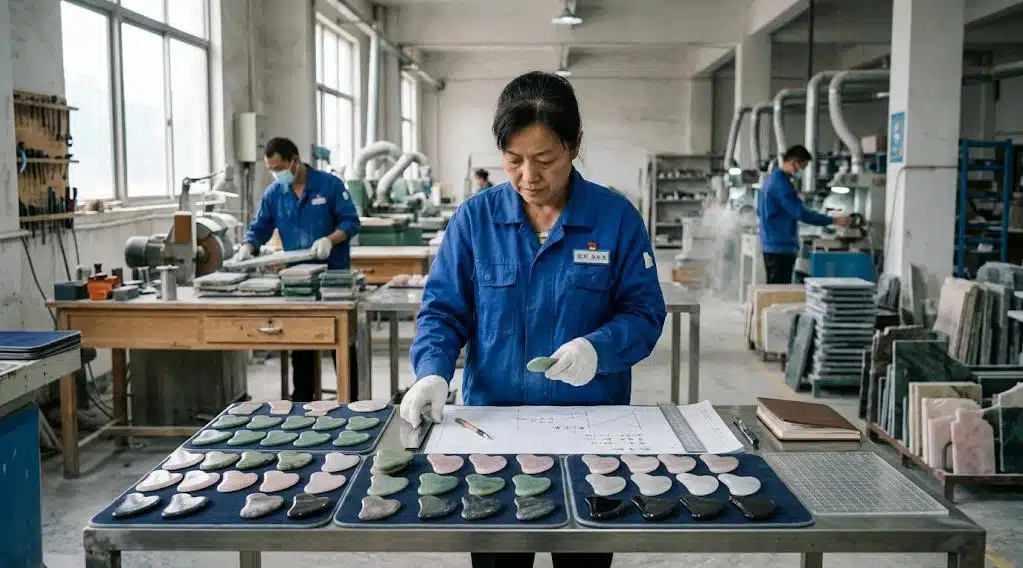
Checks belong where a defect first becomes visible, not at the end of the line. After cutting, a gua sha factory should inspect for cracks. After CNC machining, it should measure dimensions and outline. After grinding, it should check edges and surface, and after polishing, gloss and scratches. Each checkpoint stops a flawed piece before more labor is added to it.
The golden sample ties these checks together. It is the physical piece you approved, recorded with size, weight, color, surface finish and allowed tolerance, and kept as the reference for every later batch. A gua sha manufacturer that keeps one can also separate the causes of a defect: raw-material cracks, fixture positioning errors, scratches from polishing or handling, and logo placement drift each need a different fix. This means you can ask for a defect log sorted by cause, which shows whether problems are being solved or only sorted at the end.
How to Keep Final Inspection Intact on a Gua Sha Custom Order
Process control reduces defects upstream, yet it does not replace the lot check. ISO 2859-1 defines sampling schemes indexed by acceptance quality limit (AQL) for lot-by-lot inspection, and its third edition was published in January 2026. Write the AQL level, the critical dimensions and the appearance criteria into your purchase agreement so both sides inspect against the same sheet. A gua sha manufacturer that offers a cheaper gua sha by dropping this check has moved cost to your warehouse, where a rejected carton is far more expensive to fix. This means you can keep the sampling plan fixed and negotiate price through layout, tooling and packaging instead.
On small batches, a gua sha manufacturer pays for programming, fixture changes and packing preparation almost as if the run were large, because these costs do not shrink in proportion to quantity. Scheduling similar items in one production cycle spreads them thinner. A lower gua sha wholesale price on a repeat order often comes from fewer setups, not thinner inspection, and batch labels keep every shipment traceable. This means you can consolidate orders and still trace each carton back to its approved sample.
What Compliance Means for a Gua Sha Manufacturer Shipping to the US and EU

Compliance is the one line of the cost model that no gua sha manufacturer may trim, because the rules follow the destination market, not the workshop’s address. A stone board shipped to California meets different rules from one shipped to Germany, and the brand that sells it carries real responsibility. The notes below summarize public rules as general information, not legal advice, so confirm the details with a compliance specialist before you ship.
How a Gua Sha Manufacturer Handles California Proposition 65
California’s Proposition 65 requires businesses to give a “clear and reasonable” warning before they knowingly and intentionally expose people to chemicals the state lists as causing cancer or reproductive harm. OEHHA, the lead agency, publishes the statute and the warning regulations, and its business Q&A notes that it has set more than 300 safe harbor levels to help businesses decide whether a warning is needed. Consumer product warnings under the 2018 rules say a product “can expose you to” a listed chemical rather than that it “contains” one. A gua sha manufacturer that ships boards with metal inlays, coatings, dyes or cords should be able to tell you what those parts contain. This means you can ask for a material declaration on every non-stone component and decide with your advisor whether a warning or a test is needed.
Which EU Rules Reach a Gua Sha Manufacturer’s Product: REACH and GPSR
In the EU, two instruments matter most. REACH Annex XVII sets binding restrictions on substances in products, and the ECHA restricted-substances list includes entries for metals such as cadmium, nickel and arsenic. The General Product Safety Regulation (EU) 2023/988 has applied since 13 December 2024 and calls for a responsible economic operator in the EU, which can be an EU manufacturer, importer, authorised representative or fulfilment service provider, according to the European Commission’s trade portal. A gua sha manufacturer based outside the EU generally needs an EU importer or authorised representative to fill that role. On a gua sha OEM project, your brand name goes on the box, and under EU product-safety rules a business that markets a product under its own name is generally treated as the manufacturer. This means you can plan for a named EU contact, a label with the required identification and safety information, and a file of test records before the first pallet leaves the port.
| Market | Rule | What to ask the gua sha manufacturer for |
|---|---|---|
| California, US | Proposition 65 | Declaration for non-stone parts; test results where a listed chemical is possible |
| EU | REACH Annex XVII | Declaration against restricted substances; details on coatings and dyes |
| EU | GPSR (EU) 2023/988 | Label content, EU operator details, batch and test records |
What to Ask a Gua Sha Factory to Document Before Shipment
Documentation costs little compared with a rejected shipment. Ask the gua sha factory for four items: the mineral name and treatment statement from your spec sheet, a declaration covering coatings, dyes and fittings, test reports from an accredited laboratory for your destination market, and batch records tied to the golden sample. Test fees belong in the gua sha wholesale price quote, not in a surprise invoice. Who pays when a pallet is held at the border? Usually the importer. On a gua sha custom order, repeat the declaration whenever a coating, dye or fitting changes, because a new component can change the answer.
Any gua sha manufacturer can quote without these files, but few can ship without them. A cheaper gua sha that arrives without records can cost more than a full-price one that clears customs on the first attempt. This means you can keep material safety on the non-negotiable list and still lower the piece price through layout, process and packaging. Rules change, so ask a compliance specialist to confirm which ones apply to your product and market.
Gua Sha OEM or Gua Sha ODM: What a Gua Sha Manufacturer Offers When Your Target Price Sits Below Cost

A target price below cost is a common starting point, and “that price is impossible” is the least useful answer a gua sha manufacturer can give. The better answer is a set of priced options that show how each one moves the gua sha wholesale price. Both gua sha OEM projects (you supply the design) and gua sha ODM projects (the factory supplies or co-develops it) can use the same three-plan structure, so you can compare them side by side.
How a Gua Sha Manufacturer Frames Plans A, B and C
| Plan | What changes | Best fit |
|---|---|---|
| A: Original design | Nothing; full grade, size, surface, logo, packaging and inspection are kept | Brands with fixed positioning |
| B: Engineering optimization | Layout, CNC and grinding flow, logo method and packaging structure; core quality stays | Buyers who want lower cost without a design change |
| C: Redesign | Size, non-critical decoration, optional materials and packaging; a new sample is required | A large gap between target and original cost |
Plan A keeps everything you specified, so it suits a gua sha OEM order where design and positioning are already fixed. Plan B keeps the core quality requirements and trims cost through layout, process, logo method and packaging, which is the route that produced the $3.00 to $2.64 example earlier. Plan C starts from your target price and works backward, re-evaluating size, non-critical decoration, optional stone choices and packaging, then re-sampling to validate the result. This means you can pick the plan by the size of your price gap: a small gap points to Plan B, a large one to Plan C.
Plan C can produce a cheaper gua sha, but it is not permission to lower the stone grade or relax inspection quietly. No gua sha manufacturer should change material, appearance, function or acceptance criteria without your written approval.
Where Gua Sha ODM Saves Money: Standard Bases and Targeted Custom Parts
A gua sha ODM program starts from a proven shape instead of a blank sheet, so you skip the cost of developing a new outline. A gua sha manufacturer that offers a standard base can then spend your budget on the parts customers actually notice. The table shows how the split works.
| Part | Standard option | Custom option |
|---|---|---|
| Base outline | Existing proven structure | New outline |
| Size | Existing sizes | Adjusted length, width, thickness |
| Logo | Standard laser engraving | Multi-color UV or complex process |
| Surface | Standard polish | Special texture or color |
| Packaging | Common structure | Exclusive structure and printing |
Laser engraving needs no plate making, which suits small gua sha custom runs, although very thin lines or multi-color gradients may not reproduce on stone. This means you can concentrate custom spending on one or two features, such as the logo or the carton, and use standard options everywhere else.
Example: Three Ways to Hit the Target on a Thick Natural Jade Board
Suppose your brand wants a thick natural jade board, but the target price does not cover the stone and machining of the current design. A gua sha manufacturer can offer three paths. Option one keeps the thickness and works on stone layout and process. Option two reduces the thickness, but only if strength and hand feel still pass your approval. Option three suggests a different natural stone that fits your positioning, which also needs your approval.
Each option should arrive with its price difference and its practical effect on use, so you compare facts rather than promises. Which one protects your brand best? Only a physical sample can answer that. This means you can ask for all three to be priced, and sampled where the change is physical, before you commit to a quantity.
Which Changes Need Written Approval in a Gua Sha Manufacturer Contract?
Four categories need written approval before production starts: material (stone variety, grade, treatment), appearance (color range, surface finish, logo position), function (thickness, strength, edge shape) and acceptance standards (AQL level, tolerances). On a gua sha OEM project you own the design, so approvals are usually quick. On a gua sha ODM project, the gua sha factory’s base design is part of the deal, so record exactly which parts you may change and which you may not.
Keep the approved sample, the signed spec sheet and the revision date in one folder. A gua sha manufacturer that works this way gives you a clean record when a shipment is questioned. This means you can settle any later dispute by comparing the goods with a document both sides signed.
Five False Savings a Gua Sha Manufacturer Should Never Offer You

Some savings are real, and some only move cost to a place you cannot see. A gua sha manufacturer can lower a quote overnight by changing the stone, skipping a grinding pass, loosening screening, thinning inspection or squeezing lead time. Each of the five shows up as a lower number now and a higher cost per qualified piece later. This means you can use the five as a checklist whenever a cheaper gua sha quote looks too good to be true.
Why Stone Shortcuts Cost More Than They Save at a Gua Sha Manufacturer
Unapproved material changes and looser screening hurt a brand most. A gua sha manufacturer may swap in a similar-looking stone that differs in mineral or treatment, and GIA’s laboratory notes on green jadeite describe how acid bleaching, polymer impregnation and dyes are used to reach a sought-after color. Looser screening lets in blanks with cracks and inclusions, which are rejected at the final stage, when the piece has already absorbed its full $2.64 of cost. In a hypothetical run of 100 pieces, saving $0.05 each on screening gives $5.00, while five extra rejects lose $13.20. A lab report also does not follow the goods on its own: SSEF warned that some emeralds were treated after certification and then sold with the original report, so tie any report to a batch number and a retained sample. This means you can compare suppliers per qualified piece and refuse any stone change that is not in writing.
How a Gua Sha Manufacturer’s Shortcuts on Grinding, Inspection and Lead Time Backfire
Removing a needed grinding pass leaves rough edges or scratches that your customer feels on first use. Thinning final inspection, which holds 10% of the demonstration cost at $0.30 per piece, sends defects into your stock and returns into your support queue. Compressing lead time forces rushed polishing and raises rework, so the gua sha manufacturer loses the very time it claimed to save. The real test of any gua sha wholesale price is cost per qualified piece after returns, not the figure on page one. On a gua sha custom order, the cheapest safe path is a documented process change, such as one fine grinding pass after tighter CNC work, because it removes labor without removing quality. This means you can accept a shorter flow only when the sample proves that edge and surface still match the golden sample.
How to Spot Red Flags When Comparing Gua Sha OEM and Gua Sha ODM Suppliers
Five signals deserve a second question. The quote shows no cost breakdown. The supplier cannot name the stone variety or its treatment. No golden sample or spec sheet is offered. Lead time shrinks with no change in process. And a material swap is described as “the same thing.” Any one of these on a gua sha OEM quote means the price may rest on something you have not seen; on a gua sha ODM quote, it may mean the base design hides a downgrade. Ask whether the gua sha factory will put each answer in writing, and treat silence as an answer. A gua sha manufacturer that answers all five clearly has earned a sample order. This means you can screen suppliers with one email, before you spend money on samples.
How to Start a Cost Project With a Gua Sha Manufacturer in Seven Steps

A good cost project is a sequence, not a haggle. The seven steps below follow the order that produced the 12% saving in this article, and each one leaves you with a document you can keep. This means you can run the whole process by email and still know what you approved at every stage.
Seven Steps to Run With Your Gua Sha Manufacturer
- Send your requirements: drawings, material and appearance standards, size, quantity, logo, packaging, quality criteria and target price.
- Ask for a cost model that splits material and loss from machining, polishing, logo, packaging and inspection.
- Find the lines with slack, which are usually stone layout, machining time and packaging.
- Request at least one engineering plan that keeps core quality, with every design change named.
- Approve a sample and file it as the golden sample after checking size, appearance, function and material.
- Recalculate cost per qualified piece after a trial run, not from theoretical machine time.
- Sign the final sample, spec sheet, quality standard and quote together before mass production.
Steps five and six protect you most, because they replace estimates with measured results. A shorter grinding flow, a new carton or a different logo method should all pass through them. This means you can enter mass production with numbers you checked instead of promises you hoped for.
What to Prepare Before You Ask for a Gua Sha Wholesale Price
A gua sha manufacturer can only optimize what it can see, so a complete brief shortens every later round. Include your target purchase price and your target retail price, because the gap between them tells the supplier how much room your channel leaves. Name the channel too: wholesale, salon, e-commerce or gift sets each call for different packaging, and packaging holds 15% of the demonstration cost. State the destination market so compliance records match it, and give the AQL level you expect at inspection. For a gua sha custom logo, send a vector file and the number of colors, since line thickness and color count decide whether laser engraving will hold. This means you can receive a first quote that already reflects your channel and market, with fewer revisions.
The Bottom Line on Working With a Gua Sha Manufacturer
Price gaps close through layout, process, logo method and packaging; they do not close by lowering stone grade, polishing or inspection. In the demonstration, $3.00 became $2.64, a 12% reduction worth $0.36 per piece, and the remaining $0.04 became a talk about order size or design. Yan Cheng, a crystal and jade gua sha maker with more than twelve years of production experience, builds quotes from these same cost lines. A gua sha manufacturer worth your order will show you the cost lines, name the stone and its treatment, document compliance and put every change in writing. Ask for a cheaper gua sha only after you have asked for those four. This means you can send your drawings and target price today and expect a quote you can verify line by line.