
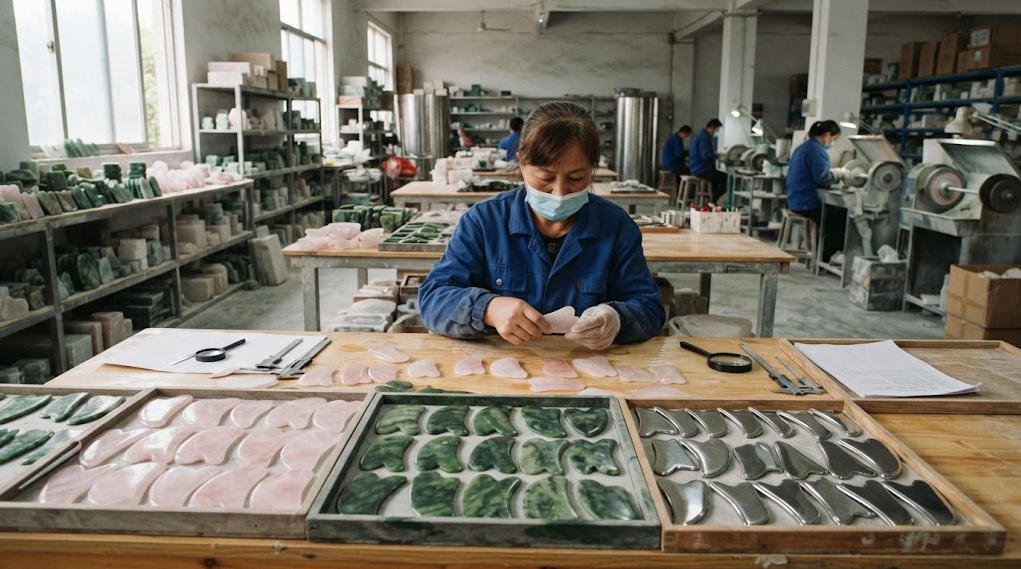
Rose quartz and stainless steel are the safest gua sha material choices when you need stable bulk supply, while green jade (serpentine) and resin cut unit cost the most. In our factory data, rose quartz still accounts for about 55% of shipments at $1.8–4 per piece, while green jade ships at $0.5–1.5 per piece. If you plan to buy guasha tools wholesale, this article shows you which risks sit behind each price. You will see where cost, capacity and batch consistency can hurt your margin, and how to brief a guasha supplier before you place an order. All figures come from one gua sha factory, so treat them as a reference point, not an industry benchmark.
- Which Gua Sha Material Should You Choose for Guasha Tools Wholesale? Quick Answers by Buyer Goal
- How Much Does Each Gua Sha Material Cost at a Gua Sha Factory? Price Ladder and ROI
- Which Gua Sha Material Can a Guasha Supplier Deliver at Volume? Capacity and Batch Risk
- What Do Shipment Data Say About Gua Sha Material Demand? A Gua Sha Manufacturer’s View
- Which Gua Sha Material Is Hardest to Process and Most Likely to Break?
- Is Your Gua Sha Material Compliant? Nickel Limits and Naming Rules
- How Do You Brief a Guasha Supplier and Choose a Gua Sha Material Step by Step?
- FAQ: Real Jade, Starting Points and Savings
Which Gua Sha Material Should You Choose for Guasha Tools Wholesale? Quick Answers by Buyer Goal
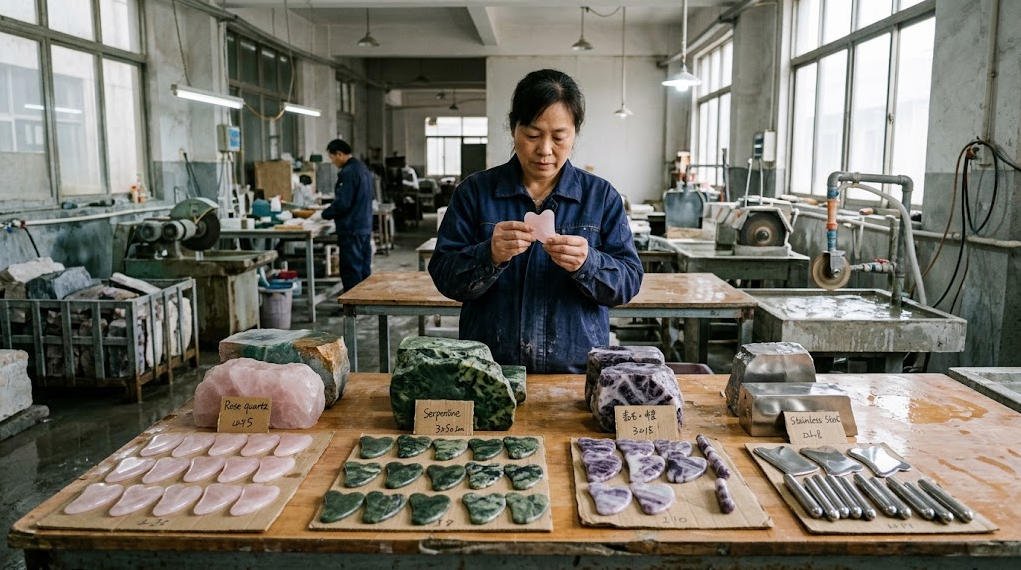
Most buyers ask the same question first: which material should I order? Any experienced gua sha manufacturer will ask you three things before quoting: your target cost per piece, your quarterly volume, and how much batch variation your brand can tolerate. Answer those three, and twelve options shrink to two or three.
What Is the Cheapest Gua Sha Material for Bulk Orders?
Resin is the lowest-cost option, followed by green jade, which is serpentine rather than true jade. Green jade wholesales at $0.5–1.5 per piece in our factory data, while rose quartz sits at $1.8–4. At the midpoints ($1.00 versus $2.90), switching a 5,000-piece order from rose quartz to green jade saves about $9,500 before freight. The trade-off is surface quality, because serpentine is softer than quartz and cannot reach the same polish. This means you can cut unit cost sharply, but you need to budget for a duller finish.
Green jade also carries a labeling risk. The GIA defines jade as a generic term for nephrite, jadeite and, under certain conditions, green omphacite, and serpentine is not on that list, as GIA’s jade description explains. If you print “jade” on packaging, check how your target market treats that word before the first print run.
Which Gua Sha Material Gives You Stable Supply and Batch Consistency?
Rose quartz has the largest raw-material volume of any natural option, so your reorders rarely stall. GIA lists it at 7 on the Mohs scale in its rose quartz overview, which helps it keep a polish in daily use. Stainless steel (usually grade 304, sometimes 316) comes out of automated production with strong batch-to-batch consistency. This means you can plan quarterly reorders around either material without worrying about a stock gap.
White jade behaves differently. Its raw material is limited, and because it is not a single mineral, a new purchasing cycle can change the look of the stone. Ask your guasha supplier to hold one raw-material lot for the full order, and approve a sample from that same lot.
How Do You Match a Gua Sha Material to Your Order Size?
Work backward from your landed cost per piece. First, set your retail price and subtract freight, packaging and margin, which gives you a ceiling for the factory price. Second, pick the tier that fits under it: resin or green jade at the bottom, rose quartz or green aventurine in the middle, stainless steel or amethyst above. Third, ask for capacity confirmation on that exact material, because a stone with limited reserves can price well and still run out.
Since every price here is factory data, compare at least two quotes on the same shape and finish. This means you can use these ranges as a starting point without mistaking them for a market average.
How Much Does Each Gua Sha Material Cost at a Gua Sha Factory? Price Ladder and ROI
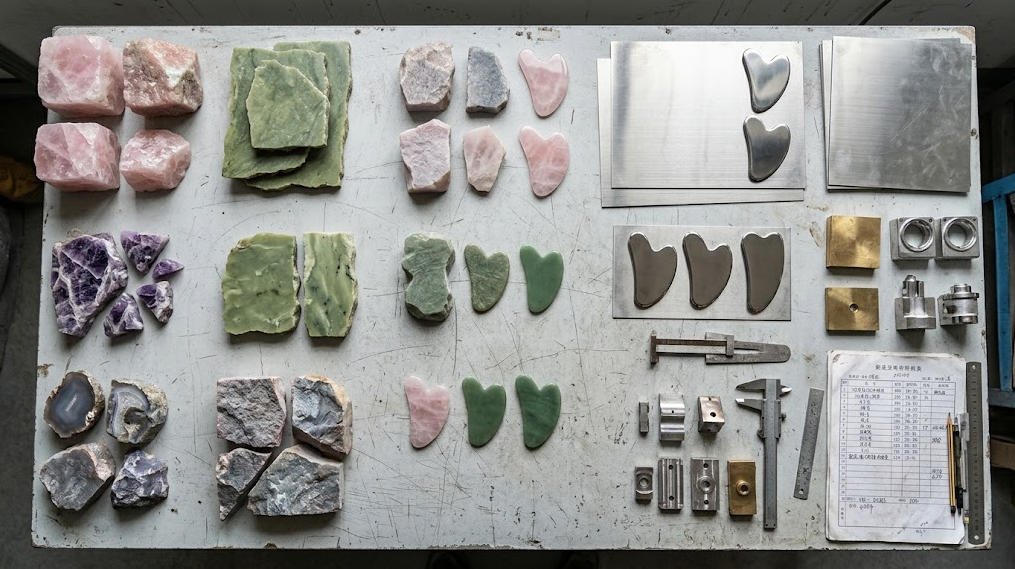
Price settles most orders before shape or finish even enters the conversation, so it helps to see the whole ladder of gua sha material costs in one place. The ranking below comes from one gua sha factory, and your final quote will still move with shape, finish and quantity. A gua sha manufacturer can only give exact numbers once shape and finish are fixed.
What Is the Wholesale Price Ladder for Each Gua Sha Material?
At the bottom sit resin and green jade. Green jade wholesales at $0.5–1.5 per piece, and resin comes in below it. Obsidian and opalite, a synthetic opal-look glass, land slightly under rose quartz, while white jade sits a little below rose quartz and green aventurine but above green jade. Rose quartz and green aventurine share the middle at $1.8–4 per piece, gray agate sits slightly above them, and amethyst runs at about twice the rose quartz price for the same shape. This means you can build a three-tier line of entry, core and accent products, and know which materials fit each price band before you request a single quote.
Why Does Amethyst Cost About Twice as Much as Rose Quartz?
The gap comes from supply, not from durability. GIA lists amethyst at 7 on the Mohs scale in its amethyst overview, the same hardness it lists for rose quartz, so you are not paying for a tougher tool. You are paying for a gua sha material with very low output. At the midpoint rose quartz price of $2.90, doubling the cost adds $2.90 per piece, or $5,800 on a 2,000-piece order. To recover that, each amethyst piece must sell for at least $2.90 more than the rose quartz version, before fees and freight. This means you should treat amethyst as an accent product with its own story, not as a drop-in replacement for your core item.
Which Gua Sha Material Pays Back Best: Stainless Steel, Zinc Alloy or Brass?
Stainless steel costs slightly more than rose quartz, but automated production gives it far higher output than any stone. Most pieces use grade 304, and some brands ask for 316, which adds 2–3% molybdenum for better corrosion resistance, according to Metal Supermarkets. Ask your guasha supplier to quote both grades on the same shape, so you see the real price of that upgrade. Brass costs more than stainless steel and needs alloying because pure copper is too soft, so choose it for its look and corrosion resistance, not for savings.
Zinc alloy deserves a return-rate calculation before you pick it. It costs less than stainless steel, but its electroplated layer wears off in daily use. As an illustration, if zinc alloy saves you $0.60 per piece and each plating complaint costs $9 in refund and shipping, the return rate must stay under 6.7% for you to come out ahead. This means you should run the same calculation with your own numbers before you commit to guasha tools wholesale volume in zinc alloy.
Which Gua Sha Material Can a Guasha Supplier Deliver at Volume? Capacity and Batch Risk
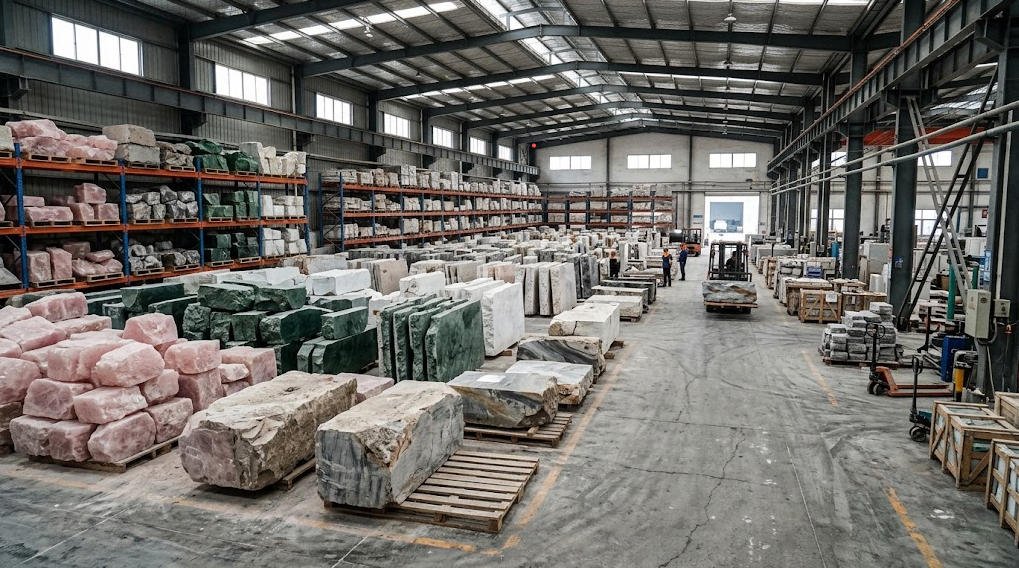
Low price means little if the material runs out in month three. Capacity and batch consistency decide whether a bestseller stays a bestseller, and they differ sharply from one gua sha material to the next. The ratings below come from production experience at one gua sha factory.
Which Gua Sha Material Has the Highest Production Capacity?
Five materials give you the most room to scale. Rose quartz has abundant raw material and strong demand, so makers are happy to build stock even before orders arrive. Green jade combines large reserves, low processing difficulty and steady demand. Opalite is synthetic, so deposits do not limit it, and resin out-produces every natural stone. Stainless steel goes furthest, because automated production lifts unit output well above anything a stone workshop can run. This means you can scale a proven SKU in any of these five gua sha material choices without renegotiating raw supply each time.
High capacity still does not equal stock on the shelf. Ask for the current lead time on your exact shape and finish, because a material with plenty of reserves can still queue behind other orders.
Why Are Green Aventurine, White Jade and Amethyst Supply-Limited?
Green aventurine looks similar to rose quartz on paper, since both enjoy strong demand and makers like to produce them. The difference is reserves: good-grade green aventurine rough is scarcer than rose quartz. White jade, gray agate and amethyst face the same ceiling, and white jade is only 4.7% of shipments, so each purchasing lot stays small. This means a sudden sales spike in these materials can leave you waiting, so forecast these gua sha material choices one season ahead. Ask your gua sha manufacturer how many finished pieces its current raw-material lot can still cover before you promise dates on a guasha tools wholesale order.
How Do You Control Batch Differences in a Gua Sha Material That Is Not One Mineral?
White jade is the clearest case. It is sold as a quartz-type rock that resembles white jade, or as marble such as Afghan white jade, so two purchasing cycles can deliver stones that look different. GIA notes that the word “jade” has sometimes been misapplied to look-alike materials, in its jade description, which is why you should verify what you are really buying. The Swiss lab SSEF tests coloured gemstones as an independent foundation, and sending one sample from each lot lets you confirm the material before you print its name on packaging.
Control the variation in three moves. First, ask your guasha supplier to reserve one raw-material lot for the whole order. Second, approve a sample from that lot and keep it sealed as your reference. Third, treat every reorder from a new lot as a new product, and approve it again with photos taken under the same light. This means you can reorder white jade with a clear pass-or-fail standard instead of arguing about “close enough” after 3,000 pieces arrive.
What Do Shipment Data Say About Gua Sha Material Demand? A Gua Sha Manufacturer’s View
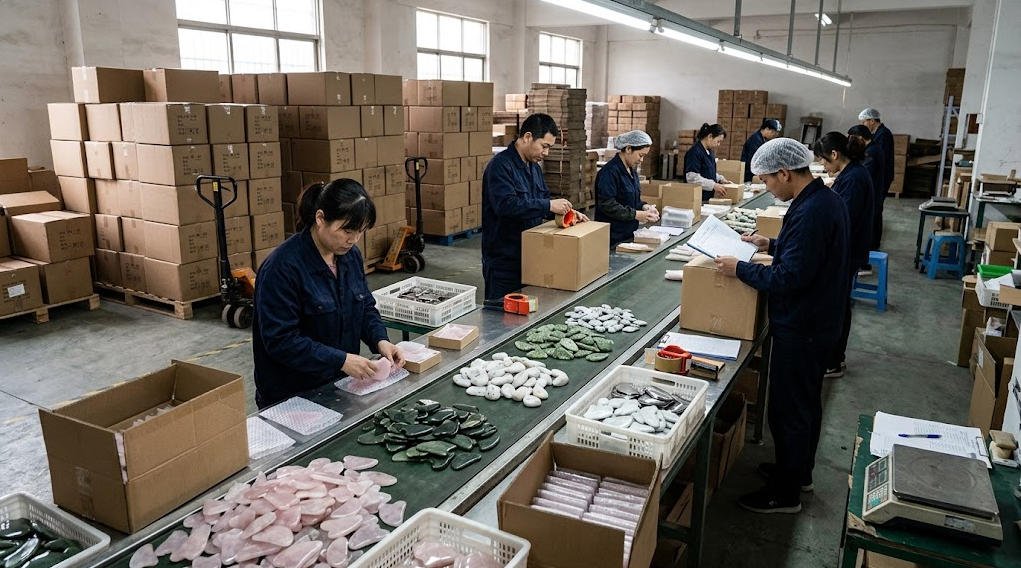
Shipment records show what buyers actually reorder, which is more reliable than what they say they want. The numbers below come from one factory’s records through June 2026, so read them as one production line’s view of the market. They still show where the crowding is and where the gaps are.
Is Rose Quartz Still the Best-Selling Gua Sha Material in 2026?
Yes, by a wide margin. Rose quartz still makes up about 55% of this factory’s total shipments, even though its share keeps slipping as new materials arrive. In our experience, a search for gua sha on a major sales platform can return close to half of its listings in rose quartz. This means shoppers recognize the product at once, but you also enter the most crowded shelf in the category. When one gua sha material fills that much of the page, buyers compare price first, and a $1.8–4 wholesale range is a 2.2x spread they can easily shop.
How Do You Avoid Homogenization When Three Stones Hold 85% of Orders?
Rose quartz, green jade and green aventurine together account for roughly 85% of shipments here, and rose quartz alone is 55%. Add white jade at 4.7%, and every other option shares about 10%. That pool covers stainless steel, resin, obsidian, gray agate, amethyst and opalite. This means fewer competitors may list those options, so your line can stand out simply by offering a gua sha material that most rivals do not stock.
Treat that opening as a test, not a bet. A common rule of thumb is to put about 10% of your order into a new material, then compare its sell-through and return rate against your rose quartz line before you scale. Tell your guasha supplier the order is a pilot, so both sides plan lot size and lead time around it.
Is White Jade Gaining Share, and Is Stainless Steel Catching Rose Quartz?
White jade moved from 1.2% of shipments in 2022 to 4.7% today, almost a fourfold rise in four years. That is still a small slice, but steady growth means it is no longer a fad. Stainless steel is a different case: its market sales are closing in on rose quartz, helped by a modern look and long service life. At this stone-focused factory, metals remain a small share, so the market may be moving toward steel faster than these records show.
This means you can use white jade as a low-risk upgrade to a stone line and stainless steel as a separate, easy-to-reorder family. Ask any gua sha factory for the same two data points: current share by gua sha material, and the three-year trend. If a guasha tools wholesale quote comes with no share data, you are buying on price alone.
Which Gua Sha Material Is Hardest to Process and Most Likely to Break?
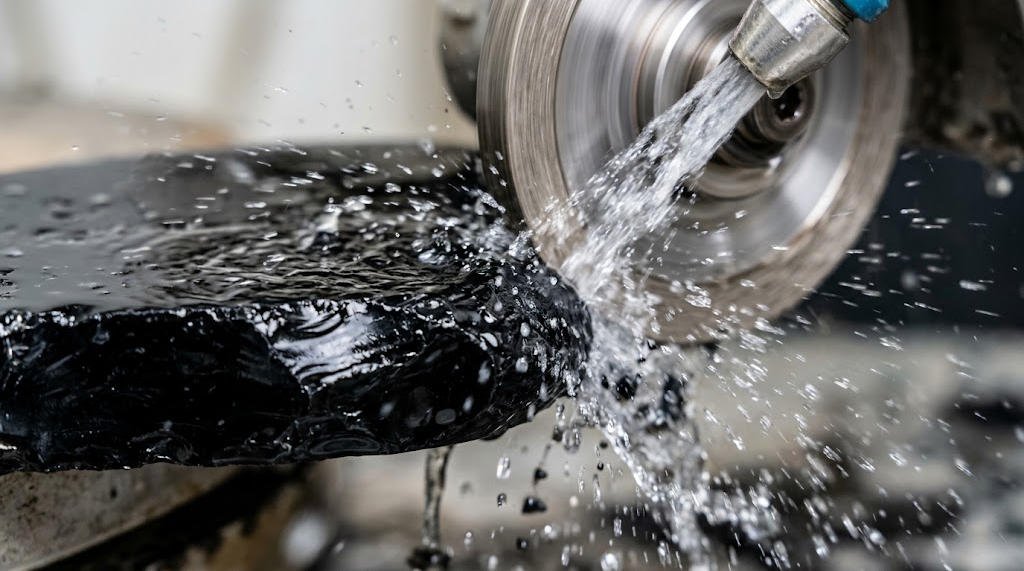
A price list says nothing about how many pieces survive polishing. Processing difficulty shows up later as breakage, rework and delays, so it belongs in your cost model from the start. Each gua sha material fails in its own way, and knowing the pattern lets you question a quote before you sign it.
Why Do Obsidian and Opalite Chip During Production?
Both are glass-based gua sha material options, and glass is brittle. Obsidian is natural volcanic glass that can take a mirror-like polish, but it breaks easily, and Wikipedia’s obsidian entry lists a Mohs hardness of 5–6, below the 7 that GIA gives rose quartz in its rose quartz overview. Opalite, the synthetic opal-look glass, cracks the same way and can also hold gas bubbles left over from manufacturing. As an illustration, if a glass-type piece costs $2.50 and 6% crack in production, a 5,000-piece order loses 300 pieces, or $750. This means you should ask your gua sha factory to state the expected breakage in writing, and to say who absorbs it.
Why Can’t Green Jade Reach a Quartz-Level Polish as a Gua Sha Material?
Green jade is serpentine, which is softer than quartz. That softness makes it tougher against cracking and easier to cut, but harder to polish, so overall difficulty ends up close to rose quartz. The finish stays duller, and current stock also runs darker than buyers expect. This means you can use green jade as a budget gua sha material at $0.5–1.5 per piece, as long as your product photos and descriptions do not promise a glassy shine.
Before you approve it, ask for a polished production sample and compare it side by side with a rose quartz piece under daylight. A guasha supplier who sends only a studio photo leaves out the one thing you need to see.
How Do You Prevent Scratches on Stainless Steel and Wear on Zinc Alloy?
Stainless steel is an easy gua sha material to cut and shape, yet its surface is not hard, so a polished finish can scratch during handling. The polishing stage also takes skill and experience, which is where workshops differ most. Zinc alloy adds a second risk: its electroplated layer wears away with use, which lowers its durability below stainless steel. This means a metal piece that looks flawless on the day of inspection can still arrive scratched or lose its coating in a customer’s hands.
Reduce that risk in three steps with your gua sha manufacturer. First, approve the finish on a piece from the production line, not a prototype. Second, ask for individual sleeves or soft packaging, so pieces never rub together in the carton. Third, order a small test batch of zinc alloy and track returns for a full selling season before you move into guasha tools wholesale volume. The savings in unit price rarely repay a wave of coating complaints.
Is Your Gua Sha Material Compliant? Nickel Limits and Naming Rules
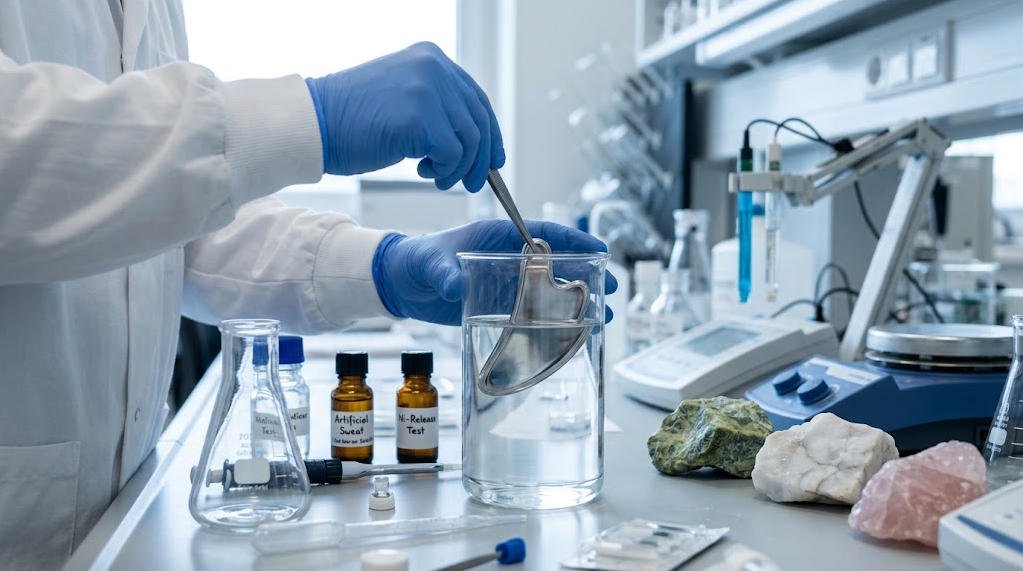
Compliance questions about each gua sha material come down to two things: what a metal piece releases onto skin, and what you call a stone on the label. This section is general information, not legal advice, so confirm the final details for each market with a qualified lab or counsel.
What Nickel Limit Applies to a Metal Gua Sha Material in the EU?
REACH Annex XVII, entry 27, restricts nickel in articles intended for direct and prolonged skin contact when the release rate exceeds 0.5 µg/cm² per week, as set out in ECHA’s guidance on prolonged skin contact. Prolonged contact is generally read as more than 10 minutes on three or more occasions within two weeks, or more than 30 minutes on one or more occasions, a definition reviewed in this clinical paper. A facial routine can easily pass 10 minutes, so treat metal tools as in scope unless a lab or counsel says otherwise. Nickel also appears in stainless steel alloys and in plating layers, so every metal gua sha material goes on the checklist. This means you should request a nickel release test report for every metal SKU you plan to sell in Europe.
A non-nickel coating only helps if it keeps nickel release under the limit for at least two years of normal use, per an SGS technical summary. Since plating on zinc alloy wears with daily use, ask the lab to test the finished, coated piece, not a bare sample.
How Should You Name a Green Jade or White Jade Gua Sha Material on Packaging?
Name the mineral behind each stone gua sha material, not just the trade name. GIA describes jade as a generic term for nephrite, jadeite and, under certain conditions, green omphacite, in its jade description. Green jade gua sha is serpentine, and white jade gua sha is a quartz-type rock or a marble such as Afghan white jade, so neither matches that definition. The FTC’s Jewelry Guides warn against any term that misrepresents a product, and they are administrative guidance, not statute. Ask counsel whether they reach a gua sha tool; a label such as “green jade (serpentine)” removes the doubt. This means you avoid reprinting every box after a marketplace or customer challenges the name.
How Do You Build a Compliance File Before the First Order?
Ask your guasha supplier for one sheet per SKU that lists the exact gua sha material and its mineral or alloy name. Next, collect a nickel release report matched to each metal finish. Then ask your gua sha manufacturer to record the raw-material lot behind every stone SKU, so a lab such as SSEF can confirm identity on a sample if your market requires it. Finally, check each market separately, because other regions set their own limits. This means a customs hold or listing takedown meets a prepared answer, and any gua sha factory can quote guasha tools wholesale orders faster when your specifications are already clear.
How Do You Brief a Guasha Supplier and Choose a Gua Sha Material Step by Step?
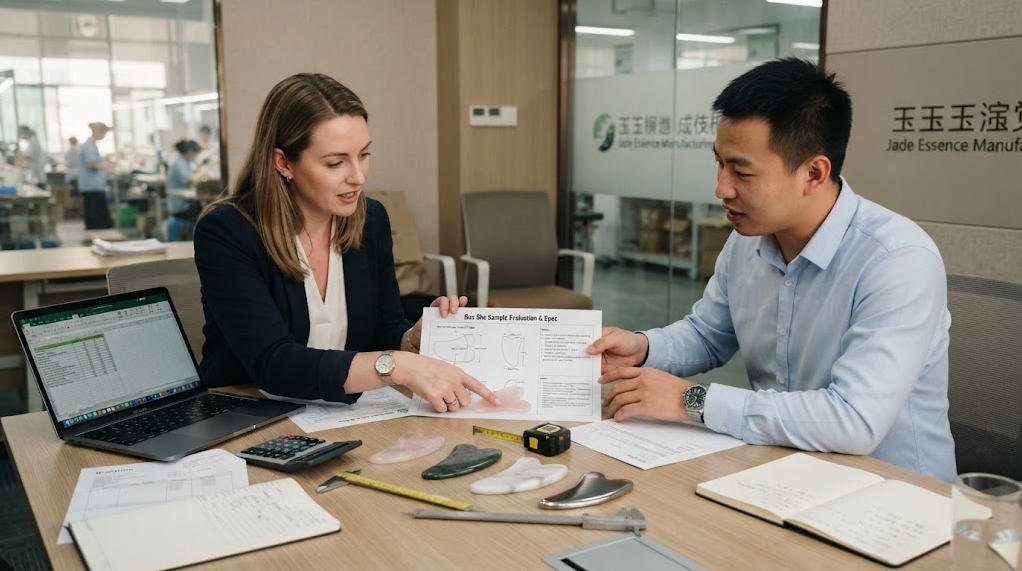
A clear brief takes about half an hour and prevents most of the problems in the earlier chapters. It also makes quotes comparable, which is the only way to see which offer is actually cheaper. Work through the three steps below in order.
1: How Do You Set a Target Cost and Shortlist Two Gua Sha Material Options?
Start from your retail price and work backward. As an illustration, take a $15 retail price and a 70% gross margin target, which leaves $4.50 for landed cost. Subtract $0.80 for packaging and $0.60 for freight and duty, and your factory ceiling is $3.10 per piece. Rose quartz at the $2.90 midpoint fits under that ceiling, while amethyst at about $5.80 does not. This means you can cross out a gua sha material on price before you spend time on samples.
Then shortlist two options: one core gua sha material that fits your budget and one challenger that sets you apart. A common pairing is rose quartz as the core and white jade or stainless steel as the challenger, based on the shipment trends covered earlier.
2: How Do You Request Comparable Quotes for Each Gua Sha Material?
Send the same written specification to every gua sha factory you contact. List the shape, size, finish, packaging, quantity, material name, lot-hold request, nickel report for metals, and who absorbs breakage. Ask for the same spec in both shortlisted materials, so the only difference on the page is the gua sha material itself.
Compare quotes on effective cost, not unit price. Divide the unit price by one minus the breakage rate: a $2.50 glass-type piece with 6% breakage costs $2.66 per usable piece, and the gap grows with volume. Add lead time as the third number. This means a quote that looks 8% cheaper can lose to a slightly higher price that includes lot control and a clear breakage term.
3: How Do You Approve Samples and Run a Pilot Order?
Approve a sample from the production line, not a prototype, and keep it sealed as your reference. Place a pilot order of about 10% of your planned volume: on a 5,000-piece plan at roughly $2.90 each, that is 500 pieces and $1,450 of exposure instead of $14,500. Track sell-through and returns for a full selling season, and compare both against your core gua sha material.
If the challenger passes, scale it in stages and approve each new raw-material lot with a fresh sample. If you plan guasha tools wholesale volume, confirm in writing that your gua sha manufacturer will hold the lot and the agreed finish for reorders. This means you can grow a new product line with a capped downside, instead of discovering a problem on a full container.
FAQ: Real Jade, Starting Points and Savings
1. Is green jade gua sha real jade?
No. It is serpentine, and GIA’s jade overview lists the jade minerals as jadeite, nephrite and green omphacite. Label this gua sha material with the mineral name next to the trade name.
2. Is white jade gua sha real jade?
Usually not. It is a quartz-type rock or a marble such as Afghan white jade, and its look can change between purchasing cycles.
3. Which gua sha material should a new brand start with?
Start with rose quartz or stainless steel for stable supply, then add a challenger through a pilot order. This means you learn from real sell-through before you commit a full container.
4. How much does switching to green jade save?
At the midpoints, $1.00 versus $2.90, a 5,000-piece order saves about $9,500 before freight. You trade that saving for a duller finish and a darker tone, so keep this gua sha material for budget lines.