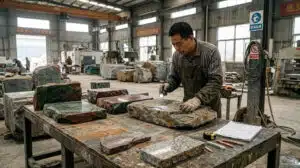
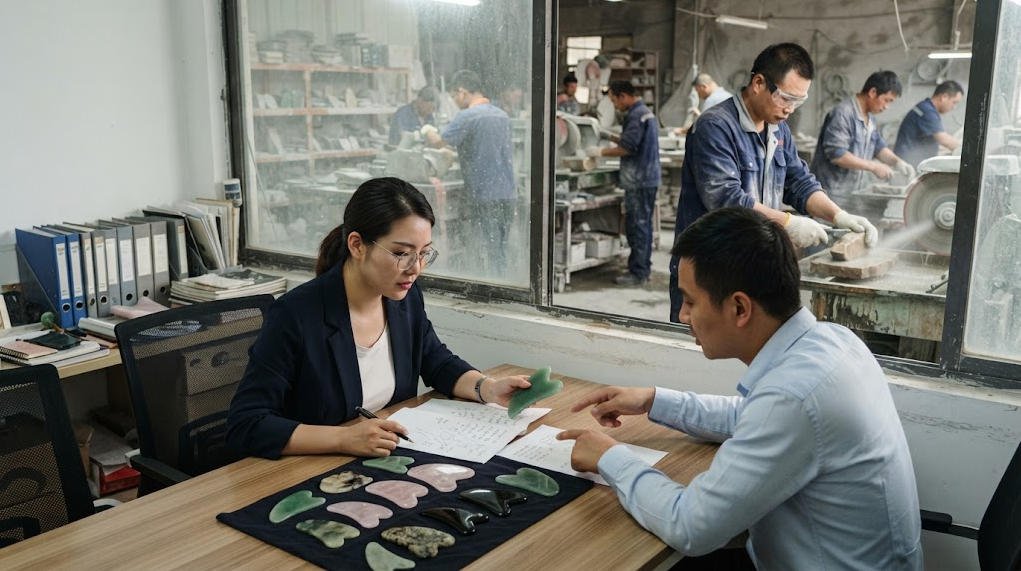
A gua sha manufacturer controls your raw stone, your tooling and your final inspection, while a trading company controls your paperwork and your coordination. That difference decides who answers when part of a 10,000-piece order arrives with uneven polish. If you run a brand with repeat orders or guasha custom designs, sourcing direct usually gives you tighter specs and a visible cost breakdown. If you buy 200 pieces each of five product types, a trading partner can save you months of supplier hunting. In one illustrative quote, a $2.00 factory price becomes $2.40 through a trader, which adds $4,000 on 10,000 pieces. This article shows you how to decide, how to verify who runs your gua sha production, and which risks to put in writing before you pay a deposit.
- Which Gua Sha Manufacturer or Trading Partner Fits Your Order?
- How Do You Verify a Real Gua Sha Manufacturer Before You Pay a Deposit?
- Is Buying Gua Sha Wholesale Directly From a Gua Sha Manufacturer Always Cheaper?
- Why Do Guasha Custom Projects Fail, and How Does a Gua Sha Manufacturer Prevent It?
- Which Compliance Documents Should You Ask a Gua Sha Manufacturer For?
- How Do You Choose Between a Gua Sha Manufacturer and a Trading Partner?
- Frequently Asked Questions About Choosing a Gua Sha Manufacturer
Which Gua Sha Manufacturer or Trading Partner Fits Your Order?
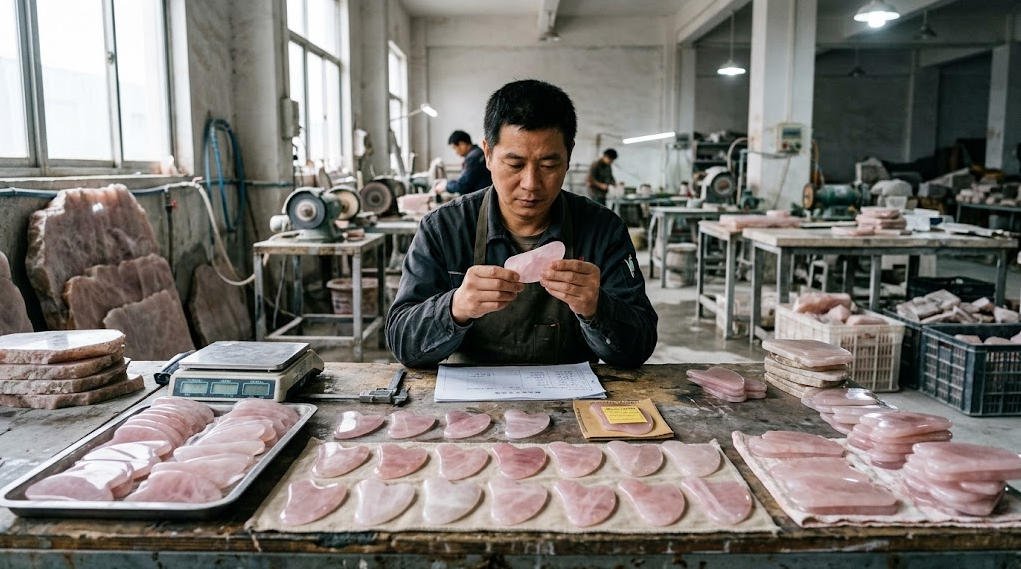
Most buyers open with the same question: should you go straight to the factory or buy through a trader? The answer depends on four things: order size, product complexity, how much customization you need, and how much supply-chain work your team can carry. Neither route is wrong. Each one moves risk to a different point in your order, and your job is to know where that point sits before you choose a gua sha manufacturer or a trader.
When a Gua Sha Manufacturer Gives You the Edge
If you own a brand and reorder the same line, a gua sha manufacturer can lock down the details that make your second order look like your first: stone grade, size, weight, colour range, logo position and packaging. Those details need someone at the cutting table, not someone relaying messages by email, which matters most for guasha custom shapes. A factory can also tell you whether your design is realistic before you pay for samples. Thin edges on natural stone, for example, depend on hardness, brittleness and how much material is left for polishing. This means you can hear about breakage risk at the quote stage instead of finding it in a finished carton.
Natural stone also changes from block to block. GIA describes rose quartz colour as ranging from very light pink to medium-dark pink, and that spread is wide enough to show up between two production runs. A gua sha manufacturer that sorts rough stone by grade can set a colour and texture window for each batch and measure samples against it. This means you can approve one Golden Sample and hold every reorder to the same visual range.
When Gua Sha Trading Makes Sense for Small, Mixed Orders
Picture a test launch: 200 rose quartz boards, 200 amethyst boards, 200 stainless steel boards, 200 face rollers and 200 brushes. That is five product types and, in many cases, five different workshops, each with its own minimums and schedule. Gua sha trading companies put those workshops behind one gua sha supplier contact, one consolidated shipment and one set of export documents. If you run a gua sha wholesale business with a wide catalogue, that single point of contact can cut weeks of back-and-forth. This means you can launch five lines on one purchase order, provided you ask the trader which items are in stock and which are made to order.
The cost of that convenience is easy to calculate. In an illustrative quote, a $2.00 factory price plus $0.40 for service and margin gives a $2.40 offer, which is 20% higher. On 10,000 pieces the gap is $4,000, and on 500 pieces it is $200. A trader may also carry stock risk that a gua sha manufacturer would pass on to you through a minimum order, so the markup is not pure margin. This means you can weigh that $4,000 against the cost of hiring a sourcing agent or flying out to audit five factories yourself.
Can You Pair a Gua Sha Manufacturer With a Trading Partner?
Many buyers use both routes. They send the hero product, usually the natural stone board, to a gua sha manufacturer, and buy brushes, accessories and add-on packaging through a trader. The item your customers judge first gets direct quality control, while the trader absorbs the long tail of small SKUs. This means you can protect your core product without managing a dozen workshops on your own.
Why does a factory minimum exist at all? Tooling, machine setup, raw stone purchasing and scheduling are the hidden costs of gua sha production, and they have to be spread across pieces. At 100 pieces a custom setup is hard to absorb. At 500, some materials and processes still do not pay off. At 2,000, batch runs become easier to schedule, and at 10,000 a gua sha manufacturer has room to tune efficiency. Those quantities are examples, not fixed thresholds, because every material and finish has its own economic size. This means you can ask a factory at what quantity your specific design stops being expensive per piece, instead of accepting a generic MOQ.
How Do You Verify a Real Gua Sha Manufacturer Before You Pay a Deposit?
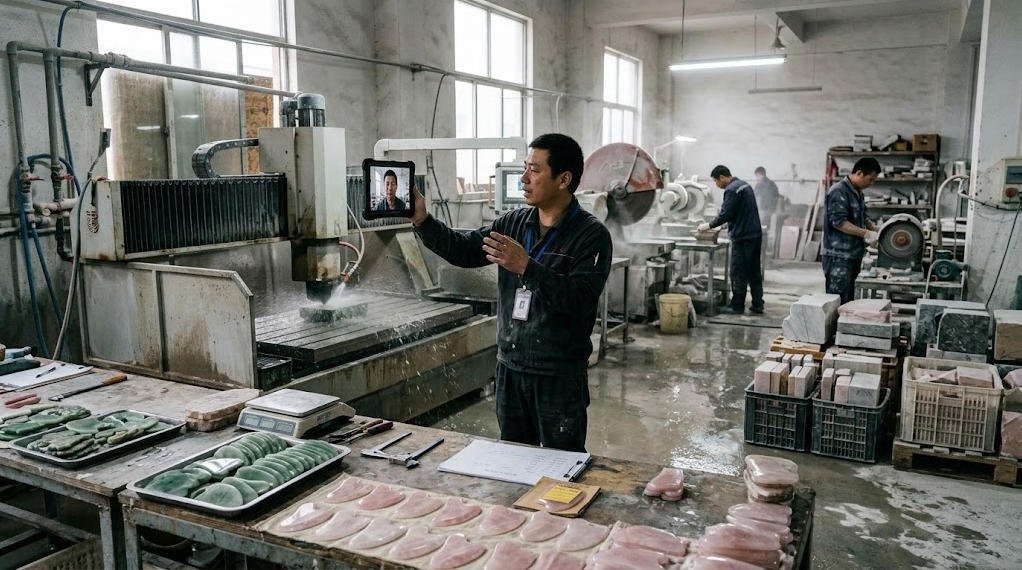
Words like “Factory” and “Source Factory” on a website prove nothing, because trading companies use them too. A business licence tells you a company exists, not that it owns a polishing line. You need checks that only a working gua sha manufacturer can pass, and the three steps below take about a week to run.
Step 1: Ask a Gua Sha Manufacturer for a Live Video Tour
Request real-time video, not a recorded promo. Ask to see the raw stone store, the cutting saws, the CNC machines, the grinding and polishing area, the inspection table and the finished-goods warehouse. Then ask your guide to pick up one of your sample boards and show which station it came from. A gua sha manufacturer that runs its own line can walk you through it without preparation, while an office desk or a showroom says nothing about gua sha production. This means you can tell within thirty minutes whether the company owns the machines your order needs.
Check the business licence in the same call: company name, unified social credit code, registered and operating address, and scope of business. Treat it as a first filter only, because a scope that says “manufacturing” does not guarantee a workshop, and some real factories sell through an affiliated export company. This means you can screen out obvious mismatches before you spend a week on samples.
Step 2: Test Your Gua Sha Manufacturer With Technical Questions
Ask questions that a stone cutter can answer and a message relay cannot. How does rose quartz grade change your yield? Where do natural stone boards crack during CNC work? How is thickness held, and how are colour differences sorted between batches? For guasha custom shapes in stainless steel, ask how 304 differs from 316L, how PVD colour is controlled and how burrs are removed. A real gua sha manufacturer answers with numbers and failure examples, while a gua sha supplier who only forwards your questions answers with a brochure. This means you can separate a workshop from a middleman in one email thread.
Then verify the material itself. GIA lists rose quartz at Mohs hardness 7 and a specific gravity of about 2.66, so a piece sold as natural rose quartz should land near that density when you weigh it and measure its volume by water displacement. The International Gem Society warns that rose quartz is sometimes sold under misleading names such as “American Ruby,” and GIA adds that the stone is occasionally treated with radiation to intensify colour. Ask your gua sha manufacturer for the exact material name and any treatment in writing, and for large lots send one sample to a lab such as SSEF, a Basel institute known for treatment and origin analysis. This means you can catch a mislabelled or treated stone for the price of one lab test instead of one returned container.
Step 3: Confirm Who Signs, Who Gets Paid and Which Steps Are Outsourced
A real gua sha manufacturer may outsource packaging or surface treatment, and that is normal. What matters is which key steps stay in-house, who inspects the outsourced ones, whether outside shops accept third-party inspection, and who pays when they fail. Contract structures also vary. Company A may sign the contract, Company B may cut the stone, and Company C may export and collect payment. A gua sha trading firm often works exactly this way, and it is not automatically a problem as long as the relationship is on paper.
Ask for the contract party, the producer, the payee, the exporter and the party liable for quality to be listed in one document. Then ask for inspection records at six points: incoming stone, in-process size and thickness, polish, final check, packing and batch traceability. This means you can name one responsible party before the first defect instead of arguing about it after your gua sha wholesale shipment has landed.
Is Buying Gua Sha Wholesale Directly From a Gua Sha Manufacturer Always Cheaper?
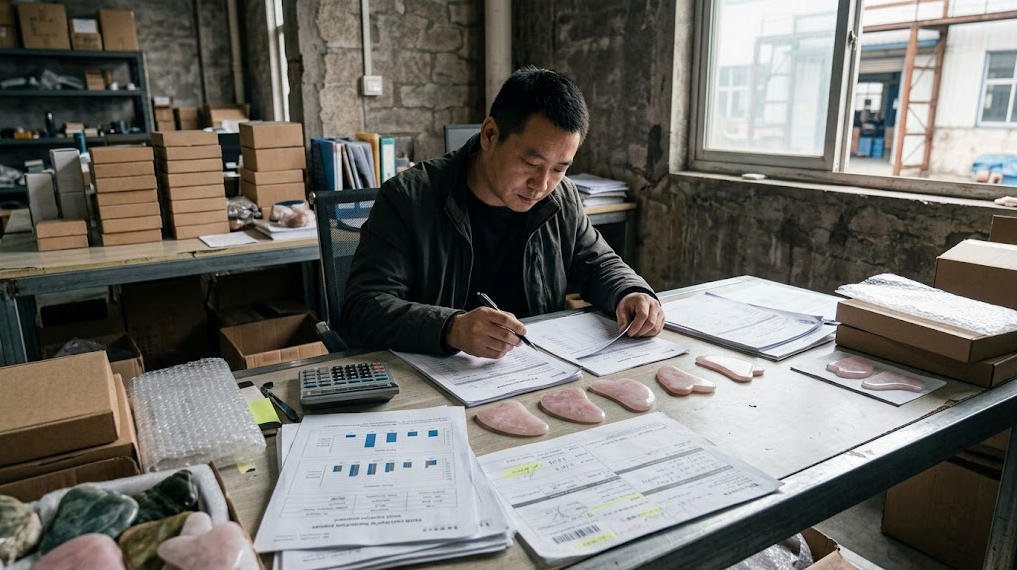
Not always. Going direct removes the trader’s margin, but it adds work that someone has to pay for: sample rounds, inspection, freight booking and your own time. The honest way to compare is to calculate your break-even quantity. If you plan gua sha wholesale volumes, run the model below with your own quotes, and treat every figure here as an illustrative assumption, not a market rate. This means you can test any quote in about ten minutes with a calculator.
What Drives the Price a Gua Sha Manufacturer Quotes?
Start with the stone. A board measuring 8 × 5 × 0.6 cm has a volume of 24 cm³, and with the specific gravity of about 2.66 that GIA lists for rose quartz, it weighs roughly 64 g. If a gua sha manufacturer turns 45% of the rough stone into finished boards, you pay for about 142 g of rough per piece, and at 35% yield you pay for about 182 g. At an assumed $8 per kilogram of rough, that is $1.14 against $1.46, a $0.32 gap per board before any labour or polishing. This means you can ask every gua sha supplier for its yield assumption and see why two quotes for the “same” board differ.
Breakage adds a second layer. On a 5,000-piece run, a 3% loss costs you 150 boards and an 8% loss costs you 400, and the 250-board difference is about $500 at a $2.00 unit cost. Quartz scores 7 on the Mohs scale, but GIA separates hardness from toughness, and thin edges are where toughness gets tested during CNC work and polishing. Breakage rate is where gua sha production skill shows up in your invoice. This means you can treat yield and breakage as the two numbers that separate a cheap quote from a cheap result.
How Much Does Gua Sha Trading Add to Your Landed Cost?
Take the earlier example: a $2.00 factory price and a $2.40 trader price, so gua sha trading adds $0.40 per piece, or 20%. Now price your own side of the direct route. Assume $600 for third-party inspection, $400 for sample couriers and revisions, and $500 for forwarder fees and documents, which totals $1,500. Divide $1,500 by $0.40 and you get a break-even point of 3,750 pieces. Below that quantity the trader’s margin can cost you less than managing the process yourself, and above it going direct starts to win. This means you can use 3,750 as a first yardstick and replace each assumption with a real quote.
The trader’s margin also pays for inspection, export paperwork and after-sales handling, so a smaller order is not a mistake. If your order is guasha custom, expect your overhead to rise, because every sample round adds courier fees and waiting time.
When Does Direct Gua Sha Manufacturer Sourcing Pay Back?
The table shows how the same assumptions play out across four order sizes.
| Order size | Markup avoided ($0.40/pc) | Assumed direct overhead | Net result |
|---|---|---|---|
| 500 pcs | $200 | $1,500 | −$1,300 |
| 3,750 pcs | $1,500 | $1,500 | $0 |
| 5,000 pcs | $2,000 | $1,500 | +$500 |
| 10,000 pcs | $4,000 | $1,500 | +$2,500 |
At 10,000 pieces, $2,500 of net saving on $1,500 of extra effort is a return of about 167%. The table also understates repeat orders, because your Golden Sample and specs are paid for once. If a second run needs only the $600 inspection, break-even drops to 1,500 pieces. A gua sha manufacturer relationship therefore gets cheaper every time you reorder, which is why brands with monthly volume lean toward direct sourcing. This means you can decide by your reorder plan, not by the size of a single purchase.
Why Do Guasha Custom Projects Fail, and How Does a Gua Sha Manufacturer Prevent It?
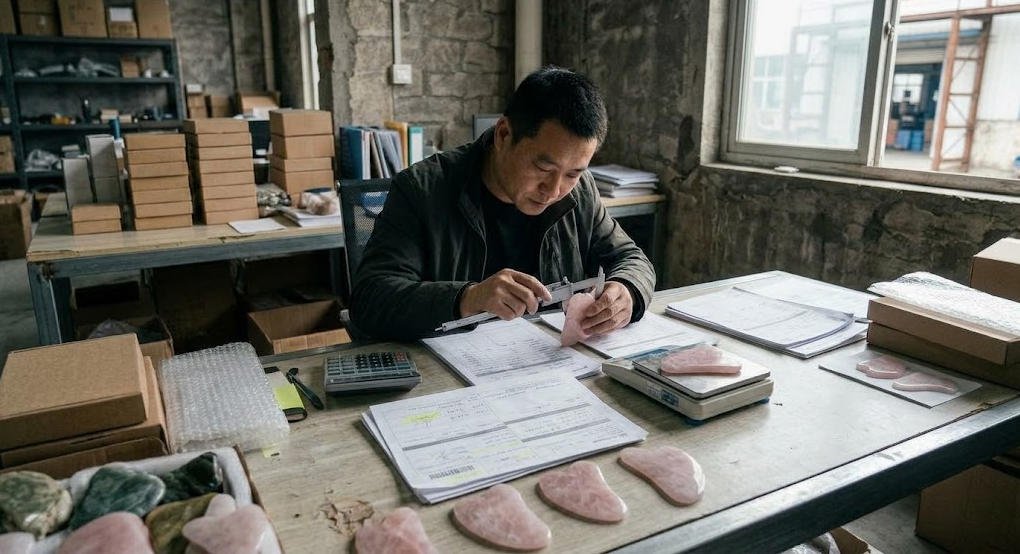
Most guasha custom problems do not start on the factory floor. They start in an email thread where a phrase like “thin, smooth edge” gets read three different ways. In our experience, the projects that go wrong share three gaps: a spec that cannot be measured, a sample that is not locked, and a workshop that changes without notice. Close those gaps and a gua sha manufacturer can repeat your product on every run.
How Do You Write a Spec Your Gua Sha Manufacturer Can Build?
Replace adjectives with measurements. “Thin” becomes a thickness of 6 mm ±0.3 mm, “smooth” becomes an edge radius of at least 1.0 mm, and “natural look” becomes a written rule for how much cloud, vein and inclusion you accept. Add a weight window, for example 61–67 g for the 8 × 5 × 0.6 cm board used in the cost example, plus a crack rule such as zero visible cracks on the working edge. Finish with a drop-test height and surface. These numbers are examples, so ask your gua sha manufacturer which of them its stone and machines can hold. This means you can turn a vague wish into a pass-or-fail check that an inspector can run without calling you.
Natural stone needs its own clause. GIA explains that rose quartz owes its cloudy look to microscopic mineral inclusions, and its buyer’s guide notes that evenly coloured gems are the most desirable while microscopic fractures can create a translucent appearance. The International Gem Society lists rose quartz as having no cleavage, so a crack at a thin edge is more likely tied to existing fractures, inclusions or machining stress than to a built-in splitting plane. Write down which inclusions and veins you accept, and which crack types you reject. This means you can settle the “natural variation” argument before the first carton ships.
How Do You Lock a Golden Sample Before Gua Sha Production Starts?
Approve one board, then turn it into a physical contract. Ask the factory to make three identical signed samples, one for you, one for the workshop and one for the inspector. Add two limit samples, one at the lightest and one at the darkest colour you will accept, because GIA describes rose quartz colour as running from very light pink to medium-dark pink, and that range is wide enough to cause disputes. Photograph all five under the same daylight lamp and attach the images to the purchase order. This means you can reject a batch against something you hold in your hand, not against a memory.
Then lock the paperwork around the sample: material name, weight window, tolerances, finish, logo position and three defect classes (critical, major, minor). A sampling plan such as AQL 2.5 for major defects and 4.0 for minor ones is often used in consumer-goods inspections, but your contract should state your own limits. This means you can hand any inspector one page and get the same verdict you would reach yourself.
What Happens If Your Gua Sha Manufacturer Moves the Order to Another Workshop?
Take an illustrative case. Run one comes from Workshop A, and run two, delayed by a busy season, goes to Workshop B at a lower cost. The photos and the quote match, yet the second run weighs 4 g less, polishes duller and has a rougher edge. At $2.00 per piece, a 2,000-piece run you cannot sell is $4,000 of stock, before storage and freight. A gua sha trading chain adds a step where this can happen unseen, but a factory can also outsource quietly when its schedule fills up.
Add one clause to every gua sha supplier agreement: repeat orders come from the same production site, and any change of site, material or process needs your written approval and an inspection right at the new site. If your gua sha wholesale customers expect the same board every quarter, that clause protects your reputation as much as your margin. This means you can keep control of your product even when your supplier’s schedule changes, and you decide whether a new workshop gets a trial run first.
Which Compliance Documents Should You Ask a Gua Sha Manufacturer For?
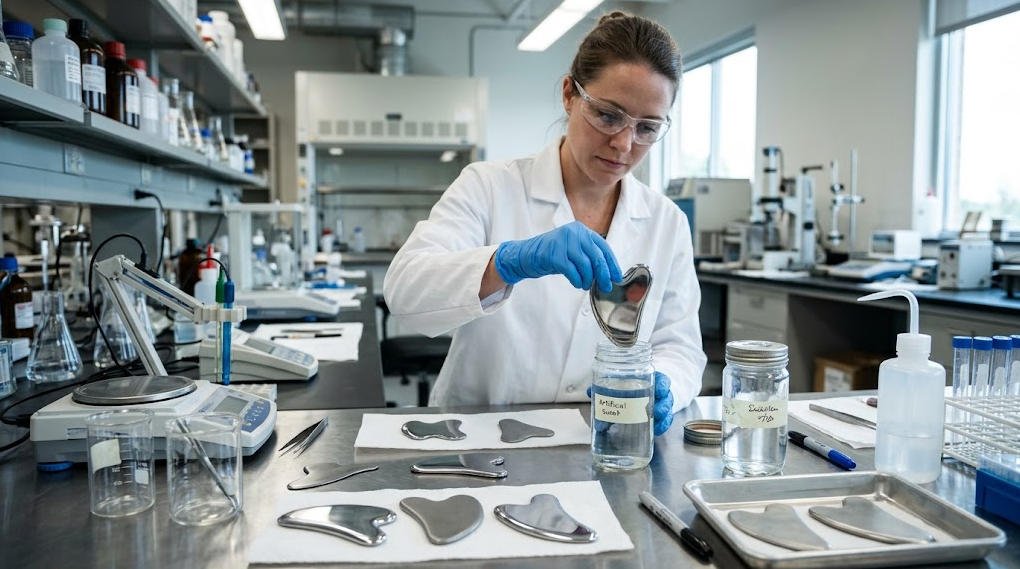
Compliance sounds like a legal topic, but for you it comes down to paperwork you can request before the first deposit. Rules differ by market and change over time, so treat this section as a checklist for a conversation with a testing lab or compliance adviser, not as legal advice. These three areas come up most often when a gua sha manufacturer ships to the EU and the US.
Which EU Rules Reach Your Gua Sha Manufacturer’s Products?
Since 13 December 2024, Regulation (EU) 2023/988, the General Product Safety Regulation, has applied to consumer products sold in the EU. EUR-Lex explains that each covered product needs a responsible economic operator inside the EU, such as an importer, an authorised representative or a fulfilment service provider. Belgium’s economy ministry adds that the product must carry the manufacturer’s identification and contact details, plus those of the EU operator when the manufacturer sits outside the EU. A gua sha manufacturer in China cannot fill that EU role alone, so someone on your side of the border has to. This means you can avoid a customs hold or a marketplace takedown by naming your EU responsible party and printing its details before the first carton leaves the factory.
Ask your gua sha supplier for a technical file as well: material list, test reports, safety assessment and batch records. Whoever acts as the EU operator needs that documentation when a market-surveillance authority asks. This means you can answer an inquiry in days instead of weeks, which matters if you sell gua sha wholesale to EU retailers who will ask the same questions.
How Do You Check Nickel Release on Metal Gua Sha Tools?
If your line includes stainless steel or coated metal boards, nickel is the test to request. Entry 27 of REACH Annex XVII restricts nickel in articles meant for direct and prolonged skin contact when release exceeds 0.5 µg/cm² per week, and a non-nickel coating must keep release under that limit for at least two years of normal use. The reference method, EN 1811, soaks the sample in artificial sweat for one week. The 2023 edition calls for both EN 1811 and a wear test when you cannot be sure whether nickel sits in the outer coating. This means you can ask your gua sha manufacturer for a nickel report on the finished, coated tool, not on raw steel, before you approve a PVD colour.
Does a face tool count as “prolonged contact”? ECHA’s proposed definition is roughly ten minutes of contact on three or more occasions within two weeks, and a regular facial routine can plausibly reach that. The final call belongs to your lab or adviser, but you should not assume an exemption. For guasha custom colours, retest whenever the plating recipe changes. This means you can keep a colour change from silently invalidating last quarter’s report.
What Claims Should a Gua Sha Manufacturer Keep Off Your Packaging?
In the US, what a product claims often matters more than what it is made of. FDA’s general wellness policy, revised on 6 January 2026, says low-risk products intended only for general wellness fall outside medical-device oversight, while products marketed with disease or condition claims can be regulated as devices. Text printed on your box is your claim, because you are the one selling the product. Ask every gua sha supplier to print only wording you have approved in writing. This means you can keep a factory’s copied marketing line from turning your massage tool into a regulatory problem.
Material names are claims too. GIA notes that rose quartz is occasionally treated with radiation to intensify colour, and the International Gem Society warns about misleading trade names like “American Ruby.” A gua sha trading partner may relabel stones for catalogue appeal, so require the exact material name and any treatment in writing. Before gua sha production starts, collect five items:
- A signed material name and treatment statement.
- Your EU responsible-party details for labels.
- A nickel release report for metal products.
- Your sign-off on all packaging text.
- Batch inspection records.
This means you can open any customs, marketplace or retailer inquiry with a folder instead of an apology.
How Do You Choose Between a Gua Sha Manufacturer and a Trading Partner?
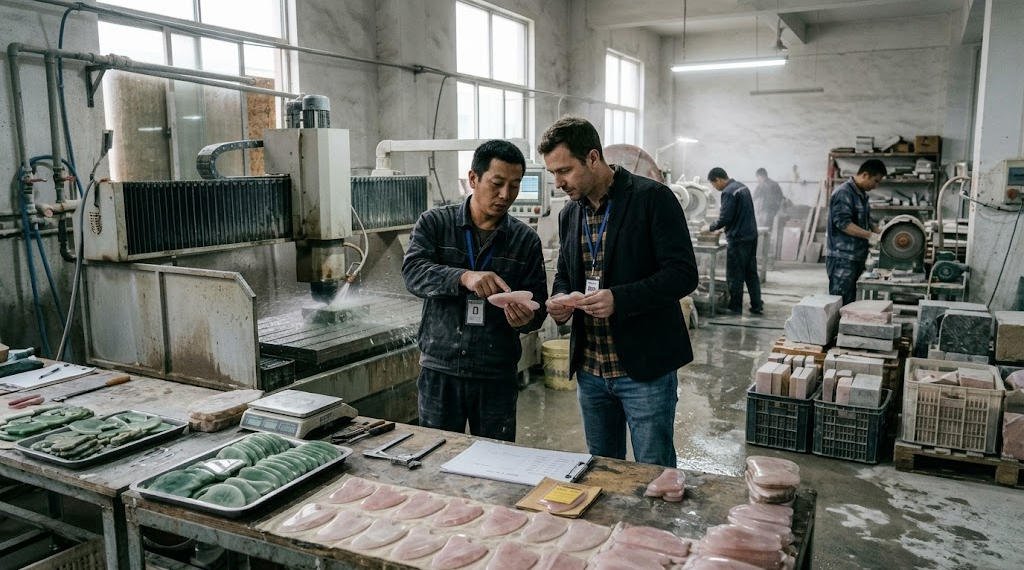
You now have the verification steps, the cost model, the spec rules and the compliance checklist. The last step is turning them into a decision you can defend to your partners and your accountant. A gua sha manufacturer earns trust through answers it can back with records, and a trader earns it the same way. Start with the questions below, then match your answers to your order stage.
Which Twelve Questions Should You Send a Gua Sha Manufacturer Before Ordering?
Paste these into your first email. Any real gua sha manufacturer can answer them in one working day, and the way it answers tells you as much as the content.
- Are you a gua sha manufacturer, a gua sha trading company, or a manufacturer with outsourced processes?
- Where is the actual production facility located?
- Which gua sha production processes are completed in-house?
- Do you have your own raw material sourcing and inspection procedures?
- Can you provide a live video tour of your gua sha production facility?
- Can you develop guasha custom products based on our designs?
- What is your MOQ for existing designs and for guasha custom products?
- How do you control material consistency between different batches?
- Do you have documented quality inspection procedures?
- Can we arrange third-party inspections during production and before shipment?
- Will the same factory manufacture our repeat orders?
- Which company will sign the contract and take responsibility for product quality?
In our experience, vague answers to questions 2, 3 and 12 are the strongest warning signs, because they point to who really controls your order. This means you can drop weak candidates in a day and spend your sample budget only on the ones that answer plainly.
Which Gua Sha Manufacturer Route Fits Your Order Stage?
Match your stage to the model. If you are testing five product types at 200 pieces each, a gua sha supplier that consolidates samples and ships one parcel will usually save you time. If you run a fixed line with repeat volume, you will usually win by buying from a gua sha manufacturer, because the earlier cost model put break-even near 3,750 pieces and showed a $2,500 net saving at 10,000 pieces, a 167% return on $1,500 of extra effort. Those numbers are illustrative, so replace them with two real quotes. This means you can decide with a calculator and a spreadsheet instead of a hunch.
Custom work tips the balance further. Metal with PVD plating, thin-edged natural stone and branded packaging all raise technical questions, and direct work with a gua sha manufacturer gets them answered at the machine instead of relayed through an inbox. A catalogue-style gua sha wholesale assortment is different, and a trader may carry that admin load more cheaply than your own team can. Many buyers pair a gua sha manufacturer for the core board with a gua sha trading partner for accessories. This means you can keep control where customers judge your brand and keep convenience where they do not.
What Is the Real Difference Between a Gua Sha Manufacturer and a Trading Company?
Here is the short background for readers who skipped straight to this section. A gua sha manufacturer sources or manages raw material, develops products, runs production, controls quality and delivers. A gua sha trading company integrates suppliers, coordinates orders, communicates with buyers and handles export paperwork. Both have value, and the line blurs in practice: a stone factory may outsource packaging, and a trader may station staff inside a factory to approve samples.
So a title on a website settles nothing, and any gua sha supplier can call itself a factory. Ask who controls gua sha production, who carries the quality liability and who can fix a technical problem at the machine before you sign a gua sha wholesale order. From the gua sha manufacturer side, we see traders as useful partners for language, consolidation and export. If your direction is clear and your volume is steady, though, a gua sha manufacturer that explains why a board is priced as it is, how it is made and how it is checked will serve you longer. This means you can judge any partner by its answers, not its label.
Your next step is small: send the twelve questions to every gua sha manufacturer on your shortlist this week and compare the replies side by side. That one email is the cheapest due diligence you will do, and it protects every order that follows.
Frequently Asked Questions About Choosing a Gua Sha Manufacturer
1. What is the difference between a gua sha manufacturer and a gua sha trading company?
A gua sha manufacturer controls raw stone, production, quality control and delivery, while a gua sha trading company coordinates suppliers, orders and export paperwork. The line can blur, because factories outsource some steps and traders sometimes station staff inside workshops. This means you can judge a partner by who controls production and carries quality liability, not by the label on its website.
2. Is buying gua sha wholesale directly from a manufacturer always cheaper?
No. In an illustrative quote, a $2.00 factory price becomes $2.40 through a trader, so going direct avoids $0.40 per piece. If direct sourcing adds $1,500 in inspection, sample courier and freight handling, break-even sits near 3,750 pieces, and at 10,000 pieces you save about $2,500. These figures are examples, so replace them with real quotes. This means you can choose your gua sha wholesale route with a calculator instead of a guess.
3. How can you tell whether a gua sha supplier is a real manufacturer?
Request a live video tour of the stone store, cutting saws, CNC machines, polishing area, inspection table and warehouse. Check the business licence as a first filter only, then ask technical questions such as how stone grade affects yield or how PVD colour is controlled. Finally, get the contract signer, producer, payee and exporter listed in one document. A gua sha supplier that owns the line can answer all of this in about a day. This means you can separate a workshop from a middleman before you pay a deposit.
4. What MOQ should you expect for guasha custom orders?
There is no single number, because MOQ depends on material, process and tooling. As examples, a custom setup is hard to absorb at 100 pieces, batch runs become easier to schedule around 2,000, and at 10,000 a factory has room to tune efficiency. For guasha custom shapes, ask the factory at what quantity your specific design stops being expensive per piece. This means you can negotiate from your design’s economics instead of a generic minimum.
5. Can you work with a gua sha manufacturer and a trading partner at the same time?
Yes, and many buyers do. They send the core natural stone board to a gua sha manufacturer for direct quality control, and buy brushes, rollers and packaging add-ons through a trader. This means you can protect the item customers judge first while avoiding the admin load of managing a dozen small workshops.