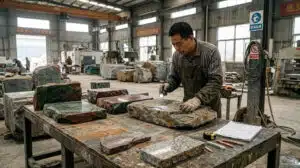
A gua sha manufacturer should call a new design “ready” only after a pilot run produces numbers you can check. In a 500-piece example, 450 pieces passed inspection the first time (a 90% first-pass yield), 30 passed after rework, 20 were scrapped, and the final yield landed at 96%. Raw material is the second risk: when amethyst supply tightened in 2022, delivery times stretched from 25–30 days to 38–60 days. The third risk hides in your cost sheet, where one-time gua sha R&D fees for fixtures and CNC programs can blur the real price of a new gua sha wholesale order.
This disclosure ranks those risks by how much money they can cost you, and it shows how to test each one before you sign a gua sha custom or private gua sha order. It comes from Yan Cheng, a jade and crystal gua sha factory with more than 12 years of processing, design and manufacturing experience. Read it as a checklist for the questions you should put to any supplier, including us.
Why Does a Gua Sha Manufacturer Run a Pilot Before Your Gua Sha Custom Order Ships?
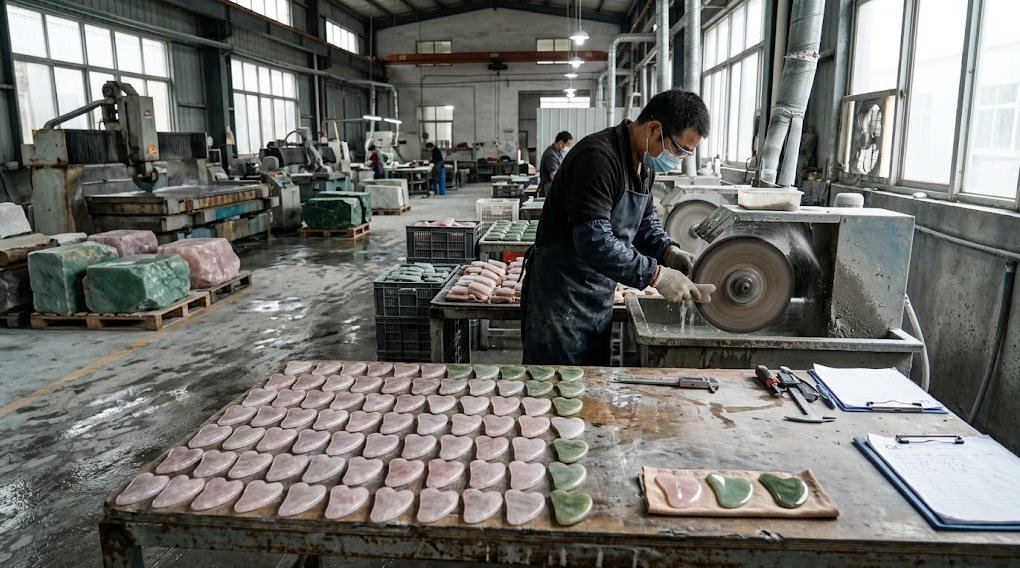
A sample proves that a gua sha manufacturer can make one good piece. A pilot run proves whether the factory can repeat that piece hundreds of times without surprises. Mixing up those two things is a common and costly mistake in a gua sha custom project. Pilot batches expose chipped edges, uneven polish and material waste while the order is still small enough to fix. This means you can find a design problem at 500 pieces instead of at 5,000.
What Does a Gua Sha Manufacturer’s Pilot Report Measure?
A pilot report tracks seven numbers: material consumption, first-pass yield, final yield, scrap rate, production efficiency, batch consistency and production cycle time. Two of them decide your budget. The American Society for Quality defines first-pass yield as the percentage of units that finish a process and meet quality guidelines without being scrapped, rerun, retested or diverted to repair. Final yield counts every piece that eventually passes, including pieces saved by rework.
Take the 500-piece pilot again. Of those pieces, 450 passed first time, 30 passed after rework and 20 were scrapped, which gives a 90% first-pass yield (450 ÷ 500) and a 96% final yield (480 ÷ 500). The first number shows how stable the process is, and the second shows how many sellable pieces reach you. This means you can calculate your real cost per sellable piece instead of trusting a quote that assumes every piece passes.
How Do You Read Yield Numbers on a New Gua Sha Wholesale Order?
Start with the gap between the two yields, because that gap is the rework you pay for. In the example, the gap is 6 percentage points, or 30 pieces that needed another round of grinding or polishing. Next, check the scrap rate: 20 of 500 pieces is 4%. Then scale the result to your volume. If the same rates held on a 5,000-piece new gua sha wholesale order, about 500 pieces would fail first inspection, about 300 would be recovered by rework and about 200 would be scrapped.
Those rates can move when volume, material batches or operators change. That is why a pilot should be repeated after any of those changes. This means you can ask your supplier for the first-pass figure and the scrap figure, not only the final yield, before you approve a purchase order.
What Should a Gua Sha Manufacturer Do When the Pilot Fails?
A failed pilot should send the project back to the material, the design or the process, never forward to the shipping dock. Pushing a failed pilot into full production to hit a launch date locks the same defects into thousands of pieces. So ask your supplier one direct question: which of the three causes did the pilot expose, and what changed before the next run?
Yan Cheng re-evaluates before releasing volume on every gua sha R&D project, which costs days but keeps your gua sha branded launch from needing an expensive correction later. A pilot also has limits: 500 pieces rarely cover every raw material batch, so color and vein variation in natural stone can still shift later. This means you can write a natural-variation standard into your approval documents before mass production begins.
How Does a Gua Sha Manufacturer Protect Your Gua Sha Branded Line From Raw Material Shortages?
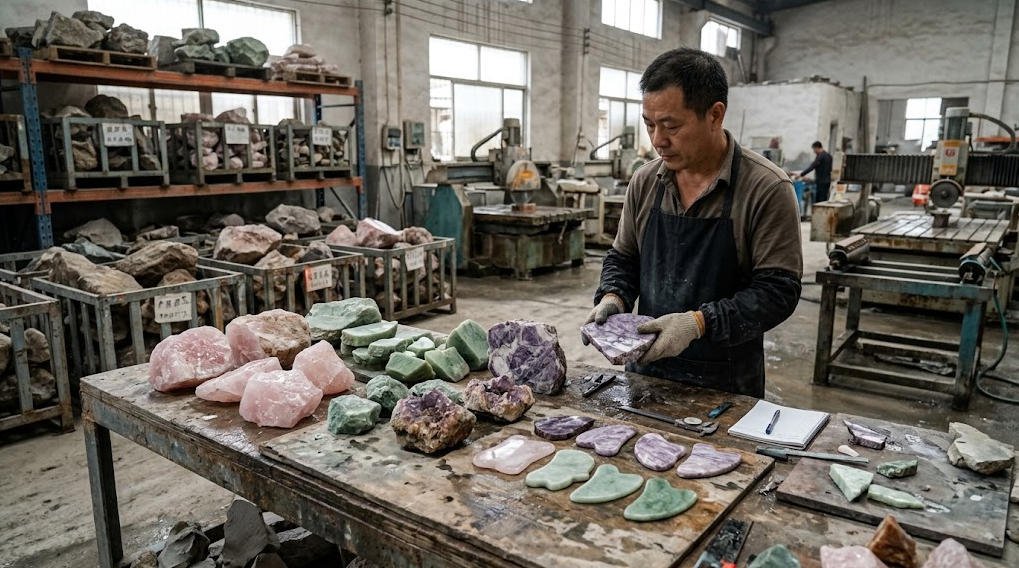
Natural stone cannot be made on demand, so every gua sha branded product that depends on one stone carries a supply risk you should price in. A gua sha manufacturer can reduce that risk by testing materials early and tracking suppliers, but nobody can remove it. The clearest case is amethyst, where rising orders in 2022 ran into tighter raw material supply. This means you should treat material supply as a launch-date risk, not as a purchasing detail.
What Happened to Lead Times When Amethyst Supply Tightened?
As demand for amethyst gua sha grew through 2022, orders at the factory rose with it. From mid-2022, amethyst raw material became harder to source and purchasing costs climbed. Lead times on some orders stretched from 25–30 days to 38–60 days, so the low end rose by 13 days (52%) and the high end doubled.
Picture a brand that planned its campaign around a 30-day production window. That brand would have received goods between 8 and 30 days late. This means you can size your launch buffer to the worst case in this example: 30 extra days for any gua sha that depends on a single natural stone.
How Does a Gua Sha Manufacturer Test a New Stone Before Gua Sha R&D Moves to Production?
A stone that looks good as raw material can still fail on the machine. Hardness, brittleness, internal cracks and batch stability all change how it cuts and polishes. So gua sha R&D should put the material through real processing before anyone recommends it to your brand. Ask your supplier to show you this sequence:
- Buy raw material from several batches, not from one lot.
- Inspect every batch for internal defects.
- Test cutting and CNC machining on real pieces.
- Grind and polish samples, then compare the finish.
- Calculate the usable-material rate after cutting losses.
- Confirm the supplier can deliver enough volume for your repeat orders.
Step 6 decides whether your second and third orders look like your first. This means you can reject a beautiful stone on paper before it costs you a failed order.
Purple Stone Is Not Amethyst: How Should Your Private Gua Sha Listing Name It?
When amethyst supply tightened, Yan Cheng’s R&D team looked at a different natural stone with a similar purple look. The goal was not to find a cheaper purple rock. The team checked color and texture, cutting and CNC behavior, internal defects and processing loss, polishing results, raw material supply and finished cost. Purple stone is an independent natural stone, and it is not amethyst.
So name it for what it is on your private gua sha listing, because calling it amethyst would misdescribe the product. This means you can sell a purple stone line honestly and keep your product pages accurate.
Which Treatments Should a Gua Sha Manufacturer Disclose About Amethyst, Jade and Other Stones?
Treatments exist even where they are rare, and you deserve to know about them. The Gemological Institute of America says amethyst is rarely treated, yet its quality factors page notes that heat can lighten very dark stones, that light-colored amethyst and even light quartz have been dyed purple, and that surface-reaching fractures are sometimes filled. The International Gem Society adds that heat and irradiation can change amethyst color and that synthetic rough is sometimes sold as natural. For jade, its treatment cheat sheet warns that “C” jade contains dye and that some jade gets acid and dyed polymer treatment.
When nature or origin is in doubt, both sources point to independent laboratories, and the Swiss Gemmological Institute SSEF is one independent, non-profit option for colored gemstone testing. GIA also notes that its identification report for amethyst is rarely requested because the report can cost a lot relative to the value of most amethyst. So should you test every batch? Compare the test fee with the value of the order you are about to place. This means you can ask a gua sha manufacturer for a written material statement on every order and reserve laboratory testing for the orders where the stakes justify it.
What Does a Gua Sha Manufacturer Charge for Gua Sha Custom Development, and Where Does the Money Go?
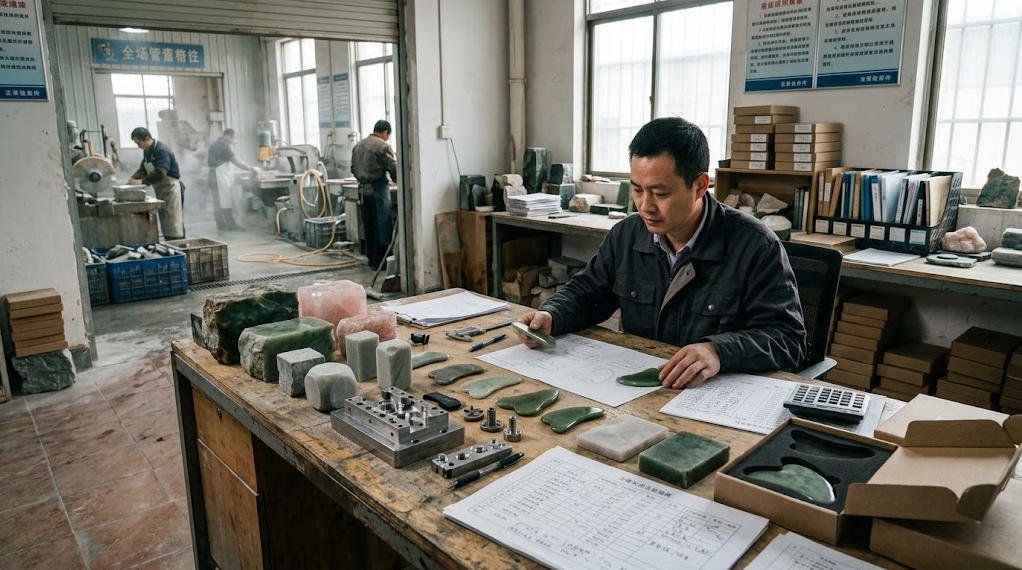
Most brands compare quotes by looking at one number: the price per piece. That number hides at least seven cost items and one one-time fee, and a gua sha manufacturer who folds them all into a single figure makes the comparison harder for you. A gua sha custom project is easier to budget when each cost has its own line. This means you can compare two suppliers on the same basis instead of on whichever quote looks smaller.
Why Does a Gua Sha Manufacturer Separate One-Time R&D Fees From Unit Price?
A new design often needs fixtures, a CNC program and development samples before the first sellable piece exists. Those items are gua sha R&D costs, and they are paid once, not once per piece. Yan Cheng calculates them apart from the regular production cost, so you can see what a repeat order will cost without the development charge.
Here is a hypothetical figure, used only for the arithmetic and not as a quote: a $2,000 one-time fee. Spread over 500 pieces it adds $4.00 to each piece, and spread over 5,000 pieces it adds $0.40. This means you can ask for the fee and the unit price as two separate lines and see what your second order will really cost.
How Does Order Volume Change the Price of a New Gua Sha Wholesale Order?
A product that looks expensive at 500 pieces can look different at 5,000, because the one-time fee is shared across ten times as many pieces. In the example above, the per-piece share of the fee falls by 90%, from $4.00 to $0.40. Material, processing and labor do not fall by the same proportion, so the saving applies only to the development portion. Ask for a quote at your first-order volume and at your likely repeat volume before you decide whether a new gua sha wholesale line is worth launching.
Yield moves the price as well. Suppose a hypothetical production cost of $4.00 for every piece started. At a 96% final yield, each sellable piece costs about $4.17, and at a 90% final yield it costs about $4.44, which is 28 cents more (6.7%). This means you can test any quote by dividing the unit price by the final yield from the pilot report.
Which Seven Cost Items Does a Gua Sha Manufacturer Add Beyond Raw Material?
Raw material price is only the first line. The table below shows what a complete estimate covers.
| Cost item | What it covers |
|---|---|
| Material | Raw stone or metal, plus cutting and processing loss |
| Processing | Cutting, CNC, grinding and polishing |
| Labor | Hand finishing, assembly and inspection |
| Surface treatment | PVD, plating and special finishes |
| Packaging | Custom boxes, inserts and accessories |
| R&D | Fixtures, tooling and sample development |
| Quality | Inspection, rework and possible scrap |
The last line deserves attention. The American Society for Quality describes internal failure costs as the money spent fixing defects found before the product reaches the customer, including rework. A gua sha manufacturer who leaves that line blank is not removing the cost, only moving it to a later order. This means you can ask every supplier what scrap and rework allowance sits inside the quote.
Which Design Features Raise Defect Rates and Gua Sha Custom Cost?
Some designs cost more to make than they appear to cost on screen. A very thin edge looks light, but it raises the risk of chipping during CNC work and polishing. A complex curved surface can add CNC operations, and a special edge structure can need more hand finishing. Each of those features raises processing time, polishing difficulty or the share of rejected pieces.
Using the same hypothetical $4.00 production cost, every percentage point of scrap on a 5,000-piece order is 50 pieces, or about $200. A thicker edge or a rounder edge curve that cuts scrap by two points would save roughly $400 on that order, while keeping the overall look of the design. This means you can ask for a design review before sampling and trade a small shape change for a lower reject rate.
How Does a Gua Sha Manufacturer Review Your Design Before Gua Sha Custom Sampling Starts?
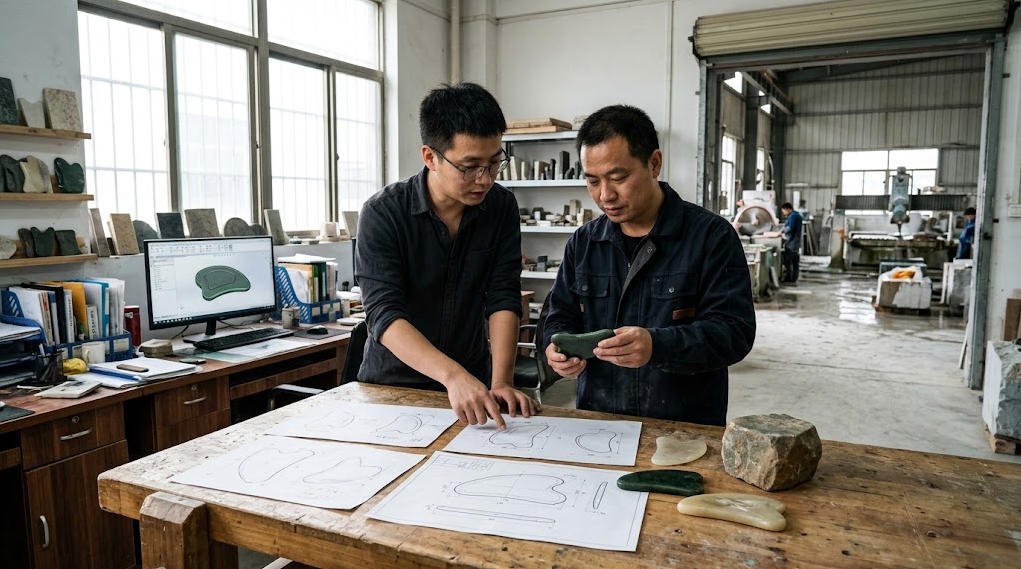
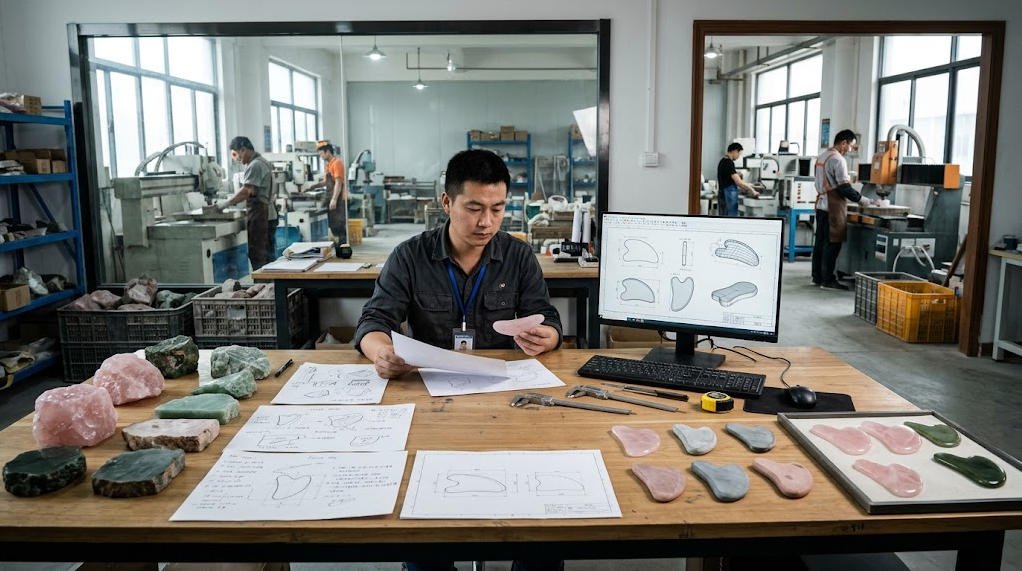
A design that looks right on screen can still fail on a CNC machine, so the review stage exists to catch those failures before any stone is cut. You do not need finished drawings to begin. A gua sha manufacturer can start from five different inputs, and the review then follows a fixed path: design check, sample rounds and an approved standard. This means you can begin a gua sha custom project with a photo or a rough sketch and still get a manufacturing opinion before you commit to tooling.
What Should You Send a Gua Sha Manufacturer to Start a Design Review?
Any one of these is enough to open the conversation:
- An existing sample you want to copy or improve
- A reference photo or hand sketch
- CAD drawings with technical parameters
- A current product you want to redesign
- A new concept with no drawing yet
From there, the technical team looks at your design through four lenses. The first is appearance and structure: outline, size, thickness, curved surfaces, edge radius and weight distribution. The second is use: how the piece sits in the hand, the working angle and how the edge feels on skin. The third is manufacturability, meaning whether current equipment can make it or whether new fixtures and CNC programs are needed. The fourth is cost: which features add machining time, material loss, polishing difficulty or rejects. The American Society for Quality describes a similar habit in its definition of failure mode and effects analysis, which is a systematic way to evaluate potential failures and record the actions that reduce them. This means you can expect specific risks and fixes to be named in the review, not a simple yes or no.
Why Does a Gua Sha Manufacturer Flag Thin Edges Before CNC Work Begins?
Thin edges are a typical example. A very thin edge gives a light look, yet it raises the risk of chipping during CNC shaping and polishing, especially in natural stone. The usual fix is to adjust the thickness or the edge radius while keeping the design style as close as possible to the original. Hardness does not solve the problem: the Gemological Institute of America lists amethyst at Mohs hardness 7, and Mohs hardness measures scratch resistance, while brittleness is a separate property that decides whether an edge chips. This means you can accept a slightly thicker edge in exchange for fewer broken pieces during production.
How Many Sample Rounds Does Gua Sha R&D Need Before You Approve?
Plan for three rounds with any gua sha manufacturer. The first is a functional sample, built to check shape, size, thickness, weight and structure against your concept. Its job is to find design and manufacturing problems, so do not judge it on mass-production finish. The second is a process-optimized sample, where gua sha R&D tunes six things: CNC parameters, cutting and grinding methods, edge structure, polishing, material loss and dimensional consistency. Each problem found in this round is written down so the improved method can be repeated on the factory floor.
The third round is the final confirmation sample, which you review and sign off. If you are building a new gua sha wholesale range with several shapes, plan the rounds for each shape separately. This means you can budget for three sample cycles per design instead of hoping the first piece is the last.
What Is a Golden Sample, and How Do You Set Natural Variation Limits for a Private Gua Sha?
Once you approve the final sample, it becomes the Golden Sample, and the gua sha manufacturer records it as the physical standard for every later order. The record covers material, appearance, dimensions, weight, surface finish, logo and packaging. For natural stone, it must also state how much color and pattern variation you will accept, because no two stone pieces match exactly. Nobody can promise identical veins, and a private gua sha line sold as natural stone should say so on the product page.
Write the acceptance range in plain terms, with approved photos of the lightest, darkest and most patterned pieces you will take. That document protects your gua sha branded products from disputes over what “the same as the sample” means. This means you can reject or accept a delivery against a written standard instead of against memory.
What Quality and Compliance Checks Should a Gua Sha Manufacturer Complete Before Mass Production?
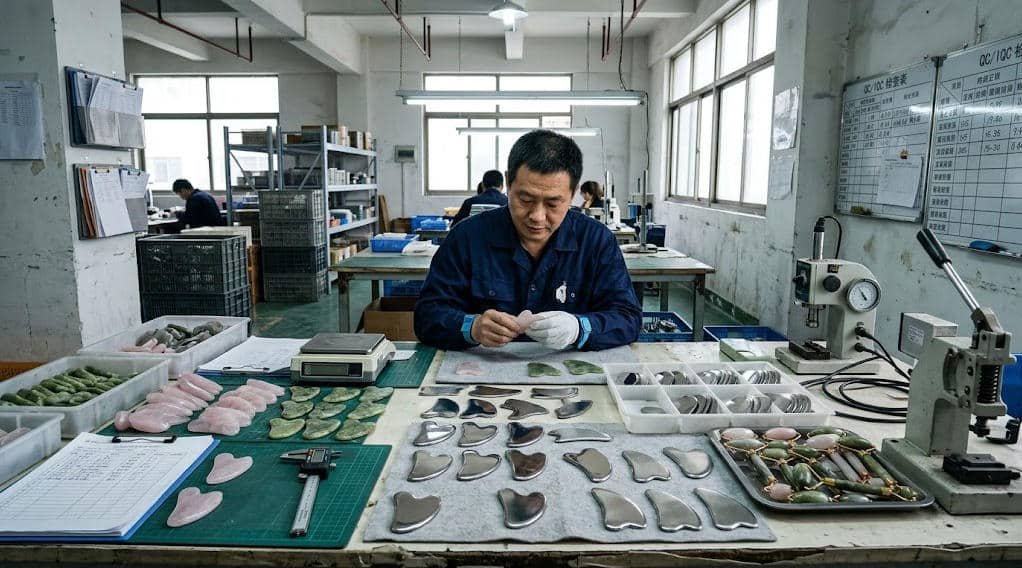
Quality requirements belong in the contract before the first production piece is cut, not in an argument after delivery. Which tests apply depends on the material and the structure, so a gua sha manufacturer should give you a different checklist for stone, stainless steel and mixed-material products. Be clear about one limit: a factory inspection tells you the product meets the standard you agreed, and it is not a legal certificate for your market. This means you can use the checks below to write acceptance terms, and you should confirm market rules with your own compliance advisor.
Which Tests Does a Gua Sha Manufacturer Run on Natural Stone Gua Sha?
Natural stone fails in ways metal does not, so the checks target hidden structure and fragile edges. Six items cover most of the risk: internal cracks and structural flaws, edge chipping and breakage risk, polish quality, size consistency, weight consistency, and a reasonable drop and handling test. Size and weight matter more than they sound, because pieces of different weight feel different in the hand, and pieces of different size look inconsistent on a shelf. This means you can ask for the measured size and weight range of a batch, not only a pass or fail result.
Which Compliance Rules Apply to a Stainless Steel Private Gua Sha?
Stainless steel products are checked on five points: the verified material grade, edge smoothness and burr removal, surface finish consistency, PVD coating adhesion and durability, and any material compliance rule that applies to your market. Nickel is the rule most brands meet first. Entry 27 of Annex XVII to REACH caps nickel release at 0.5 µg/cm² per week for listed articles in direct and prolonged skin contact. It also requires that a non-nickel coating keep release under that figure for at least two years of normal use, and it names CEN standards as the test methods.
The entry lists jewelry-type items as examples, so whether your private gua sha counts as an article in prolonged skin contact is a question for your advisor and your target market, not for this article. The reference method, EN 1811, was republished in 2023, so ask any test lab which edition it applied. This means you can ask your gua sha manufacturer for a nickel-release report on a coated sample and see whether the coated surface stays within the limit, instead of relying on a verbal assurance.
How Do You Test Bonded and Mixed-Material Gua Sha?
Mixed-material products add three checks: bond strength, assembly stability and the risk of parts coming loose during use. A bond that passes on day one can fail after repeated handling, so ask your gua sha manufacturer how the test simulates use. Failure here is a user-safety issue as well as an appearance issue. This means you can ask for these three results before approving any gua sha custom design that joins stone to metal or any other material.
How Should a Gua Sha Manufacturer and Brand Agree on Defect Limits?
Agree on acceptance standards and defect tolerances with your gua sha manufacturer before production begins. A useful standard names each defect type, such as chips, scratches, burrs and color bands, and attaches a photo or limit sample showing the largest flaw you will accept. For a new gua sha wholesale range, put the limits in the purchase terms so that inspection, rework and rejection follow rules both sides signed.
Yan Cheng agrees these standards with the brand before production, which keeps gua sha R&D findings from turning into disputes at delivery. That document also supports your gua sha branded claims, because every statement on your packaging then traces back to a written check. This means you can accept or reject a shipment by the numbers you approved.
How Does a Gua Sha Manufacturer Keep Your Gua Sha Branded Products Consistent After the First Order?

A good first order proves little if the second one arrives looking different. Consistency across repeat orders is what a gua sha manufacturer has to prove, and it is the reason the pilot, the Golden Sample and the written standards exist. The American Society for Quality defines first time quality as the percentage of good parts at the start of a production run, and that figure is the one to ask for on every repeat order. This means you can compare the start of order two against order one with a number, not with a feeling.
What Goes Into the Standard Production File a Gua Sha Manufacturer Keeps for You?
Once the pilot meets the agreed targets, the factory builds a standard file for your product. It holds eight things: technical drawings, raw material specifications, the process flow, key process parameters, inspection standards, the Golden Sample, packing and carton requirements, and a list of common defects with the fix for each. A gua sha manufacturer who keeps this file can hand the same instructions to any operator on any date. This means you can expect a later reorder to follow the same recipe as the first batch.
How Does a Gua Sha Manufacturer Cut Cost Without Lowering the Approved Standard?
Production feedback shows where the next saving sits. If a piece needs a lot of hand polishing, the team can study whether a small structural change reduces that labor. If a stone loses too much material in cutting, a better screening step or a different cutting method can cut the waste. The rule that protects you is simple: improvements must not lower the standard you approved. This means you can ask your gua sha manufacturer to show you any process change that touches the approved sample before it goes into your next order.
Who Owns the Design, Tooling and Confidentiality in a Private Gua Sha Project?
A brand and its gua sha manufacturer each carry different work, and the split below keeps decisions clear.
| Stage | Brand | Manufacturer |
|---|---|---|
| Concept and design | Sets the idea, reviews and confirms direction | Checks feasibility, develops and refines the technical plan |
| Material and cost | Sets appearance, positioning and target cost | Judges material fit, supply capacity and manufacturing cost |
| Samples | Gives feedback | Builds and optimizes samples |
| Quality and pilot | Confirms requirements, reviews pilot results | Runs tests and proves the process is stable |
| Mass production | Confirms specifications and places the order | Produces and controls quality |
For a private gua sha or an exclusive design, settle design ownership, tooling arrangements, confidentiality and R&D fees before development starts. WIPO notes that design protection generally requires an application in each country where you want it, and that its Hague System can cover up to 100 designs in one international application. This means you can ask your own IP counsel which markets to register in before a gua sha R&D budget is spent.
What Should You Prepare Before Contacting a Gua Sha Manufacturer for Gua Sha Custom Work?
You do not need complete drawings to begin, and a feasibility conversation can start from an idea alone. Eight items speed up an accurate estimate: a product reference (photo, sample, sketch or CAD), your preferred material, target length, width and thickness, your target unit cost, first-order quantity, logo requirements, packaging requirements and your launch date. Add a short note on your target market and where you place the product, whether mass market, mid-range or high-end, because that decides whether the first priority is cost, finish or differentiation. This means you can get a first assessment of a new gua sha wholesale line from a single message.
Yan Cheng has made jade and crystal gua sha tools for more than 12 years, and this article lists the checks it runs on its own projects. Send your reference and target cost, and ask for the pilot figures, the material statement and the cost split before you place an order for your gua sha branded line.