
A gua sha manufacturer that inspects only the finished product lets cracks and impurities travel through every production step before anyone catches them. This factory runs three inspections instead: one before cutting, one before polishing, and one before shipping. The first removes about 11% of raw material, the second removes about 8% (both measured against total raw material), and the final check covers 100% of finished pieces, with about 92% passing. If you buy gua sha wholesale orders, these numbers show you where defects get removed and what that means for the pieces that reach your warehouse. Standards differ between factories, so everything below describes this factory’s own requirements, not an industry rule.
- Why Does a Gua Sha Manufacturer Need Three QC Checkpoints?
- How Does 100% Final Gua Sha QC Protect Your Gua Sha Wholesale Orders?
- What Are the Gua Sha QC Standards and Tolerances at Final Inspection?
- How Does Early-Stage Inspection Improve Guasha Tools Production Yield?
- Is Skipping Two QC Stages Cheaper? The Real Cost of Guasha Tools Production Without Early Inspection
- What Should Buyers Ask a Gua Sha Manufacturer Before Placing a Gua Sha Wholesale Order?
- About Gua Sha Manufacturer 3 QC Faqs
Why Does a Gua Sha Manufacturer Need Three QC Checkpoints?

A single final inspection sounds efficient, but it only tells you what went wrong after the money and labor are already spent. Each of the three checkpoints targets a different kind of risk at the moment it is cheapest to fix. Once you see what each stage does, the extra steps look less like overhead and more like insurance.
Gua Sha Manufacturer QC at a Glance: 3 Stages, 3 Purposes, 3 Rejection Rates
Gua sha qc at this factory happens in three stages, and each has a different job. The first takes place before any shape is cut. The second takes place after cutting but before the pieces go into the polishing drum. The third takes place before a piece enters the warehouse or leaves on a truck.
| Stage | Purpose | Method | Result (share of total raw material) |
|---|---|---|---|
| Pre-cutting | Avoid internal flaws and plan cutting zones | Strong light through the sheet, pencil marks | About 11% removed |
| Pre-polishing | Stop cracked pieces from breaking in the drum | Manual sorting with strong light | About 8% removed |
| Final (stock/shipping) | Keep every shipped piece consistent | 100% inspection line, white cloth, white light | About 92% of finished pieces pass |
Add the first two numbers and roughly 19% of raw material is removed before polishing even begins. That is a combined figure of two separate checks, so treat it as an approximation. This means you can read the 92% final pass rate as the result of material that was already filtered twice, not a number that depends on luck.
Which Gua Sha Defects Are Caught at Which Production Stage?
Cracks, impurities, and color blocks are caught first, while the stone is still a flat sheet. Inspectors shine strong light through the material, mark each problem area with a pencil, and plan the cut around it. Gem laboratories such as GIA document inclusions and fractures in crystals as a routine part of their work, and the same logic applies here: light reveals what the naked eye misses.
Chips and hairline cracks from the cutting process are caught second, before polishing. Size deviation, pits, remaining impurities, and color difference are caught last, on the final inspection line. Why does the order matter? A flaw found on a sheet costs you a pencil mark, while a flaw found on a polished piece costs you hours of machine time and labor. This means you pay for fewer pieces whose defects were visible long before they reached the finish line.
What Does a Three-Stage Gua Sha Manufacturer Process Mean for Your Gua Sha Wholesale Risk?
Three stages reduce risk, but they do not remove it. About 8% of finished pieces still fail the final check, and the A, B, and Bc grades exist because natural stone never comes out uniform. Any gua sha manufacturer that promises zero defects in natural crystal or jade is describing something the material does not allow.
That is why a gua sha wholesale buyer should ask for the inspection standard in writing and compare it against a documented quality framework such as ISO 9001. Written tolerances let you check a delivered carton against numbers rather than impressions. This means you can reject a non-conforming batch with evidence instead of an argument.
How Does 100% Final Gua Sha QC Protect Your Gua Sha Wholesale Orders?

Final inspection is the stage you feel directly, because it decides what is in the carton when it arrives. This factory checks every piece that enters the warehouse or ships out, and it never samples. If you place gua sha wholesale orders, that single rule shapes your return rate more than any other step in the process.
100% Inspection vs. 20% or 50% Sampling: What a Gua Sha Manufacturer’s Choice Means for Wholesale Buyers
Some factories inspect 20% of a lot, and others inspect 50%. Picture 1,000 pieces with a 5% defect rate, which means 50 flawed pieces. A 20% sample looks at about 200 pieces and finds roughly 10 of those flaws, so around 40 can still reach your customers. Full inspection looks at all 1,000, so those 50 are pulled before packing.
Full inspection costs more time and labor, and this factory accepts that cost to keep a consistent reputation and a predictable buying experience. The numbers above are an illustration, not this factory’s measured defect rate. This means you can plan your gua sha wholesale stock without padding every order for replacements.
What Are Grade A, B and Bc Gua Sha Tools?
Every piece that passes final gua sha qc is sorted into a grade. All three grades must meet the size tolerance, so the difference between them is appearance, not fit.
| Grade | Size | Pits and cracks | Color | Impurities |
|---|---|---|---|---|
| A | Within tolerance | No visible pits | Close to the golden sample | No visible impurities |
| B | Within tolerance | A few within the allowed limit | Within the color range | Within the allowed limit |
| Bc | Within tolerance | Visible pits that do not affect use | May slightly exceed the range | May exceed the allowed limit |
Natural stone never comes out uniform, so a grading system is more honest than a promise of perfection. This means you can match each grade to a price point, such as A for premium lines and Bc for budget lines, instead of paying A-grade prices for every piece.
How Does a Gua Sha Manufacturer Rank Defects: Size, Cracks, Impurities, Color?
Not every defect carries the same weight. This factory ranks them as size first, pits and cracks second, impurities third, and color difference last. A piece that is 1.5 mm too wide cannot be fixed, while a slight color shift usually only changes the grade.
A gua sha manufacturer that publishes its ranking gives you a way to judge a dispute before it starts. This means you can tell your buyers which defects are deal-breakers and which ones are cosmetic.
Why Do Gua Sha QC Tables Use White Cloth and White Light?
Inspection tables here are covered in white cloth under bright white light. Colored cloth or tinted lamps shift how a stone looks, and color is one of the four judged criteria. Gem laboratories such as SSEF also rely on controlled lighting when they assess color, because the light source changes what the eye sees.
Standard lighting also lets two inspectors on different shifts reach the same verdict on the same piece. Ask any supplier what lamps and table surfaces their inspectors use. This means you can expect a batch shipped in March to match the color of one shipped in June.
What Are the Gua Sha QC Standards and Tolerances at Final Inspection?

Numbers are what let you compare one gua sha manufacturer against another. The standards below are this factory’s defaults for the final inspection line. Any of them can be replaced by your own specification, so treat them as a starting point you can check against your spec sheet.
Gua Sha Manufacturer Tolerance: ±1 mm for Length and Width, ±0.5 mm for Thickness
The default size standard is ±1 mm for length and width and ±0.5 mm for thickness. A piece specified at 80 mm long is accepted anywhere from 79 to 81 mm, while a piece specified at 6 mm thick must measure between 5.5 and 6.5 mm. Thickness gets the tighter limit, and size is also the highest-ranked criterion, so an out-of-tolerance piece cannot be saved by good color or a clean surface.
Tolerance bands like these follow the same logic as general-tolerance standards such as ISO 2768, which define how far a measured dimension may drift from the drawing. This means you can measure a few pieces from any carton with a caliper and know within minutes whether the batch meets the agreed size.
How Do You Judge Pits and Cracks on a Gua Sha Tool? (The 0.5 mm / 2 mm Rule)
Pits and cracks are judged by two numbers. A pit with a diameter over 0.5 mm fails. A crack narrower than 0.5 mm still fails if it runs longer than 2 mm. A pit or crack on the side edge that feels sharp or catches the finger also fails, whatever its size.
The edge rule exists because that part of the tool touches skin and gets gripped constantly. A tiny pit on a flat face is cosmetic, while the same pit on the edge is a comfort problem. This means you can write the 0.5 mm and 2 mm limits into your purchase agreement and settle any dispute with a ruler instead of an opinion.
How Much Impurity Is Acceptable in Gua Sha Stone?
The general rule is that impurities up to 2 mm pass. That figure is a baseline, not a universal limit, because some stones are naturally busy. Blue spot stone, for example, carries many visible impurities by nature, so judging it by the standard for a clear crystal would reject almost everything.
If you want to set a standard for a new material, start from a physical sample. Ask the factory to pick several typical pieces, agree on the largest impurity you will accept, and write that size down next to the material name. Gemological bodies such as GIA grade natural inclusions relative to what each stone type normally contains, and the same principle applies here. This means you can avoid paying for rejected pieces that were never defective for that material.
How Do You Control Gua Sha Color Difference With Golden Samples?
Color is judged against a golden sample, a physical reference piece kept for each material. Inspectors hold a production piece next to the sample under white light and decide whether it falls within the accepted range. Each material has its own color standard, because a pale rose quartz and a deep green jade cannot share one rule.
A written description of a color drifts over time, but a physical sample does not. Color difference is the lowest-ranked criterion, so a piece that sits slightly outside the range usually drops a grade rather than being scrapped. This means you can keep repeat gua sha wholesale orders visually consistent by approving one sample and referring to it on every reorder.
Can Buyers Set Custom QC Standards for Guasha Tools Production?
Yes. If you have your own tolerance or color requirement, the factory follows yours instead of its defaults. The sequence is simple: send your specification, approve a golden sample, and confirm both in writing before guasha tools production begins for your order.
Tighter standards usually raise the rejection rate, and a higher rejection rate can raise the unit price. I can’t give you a universal figure, so ask the factory what rejection rate it expects at your tolerance before you commit. A gua sha manufacturer that answers with a number is easier to plan around than one that says “no problem.” This means you can set your gua sha qc requirements knowing their cost before the first piece is cut.
How Does Early-Stage Inspection Improve Guasha Tools Production Yield?

The two inspections before final gua sha qc do the quiet work that decides how many good pieces you end up with. They happen while a flaw is still cheap to deal with, before hours of cutting and polishing get invested in it. If you want to understand why this gua sha manufacturer removes about 19% of raw material before polishing starts, the explanation lives in this chapter.
Pre-Cutting Inspection: How Light Transmission Finds Cracks, Impurities and Color Blocks
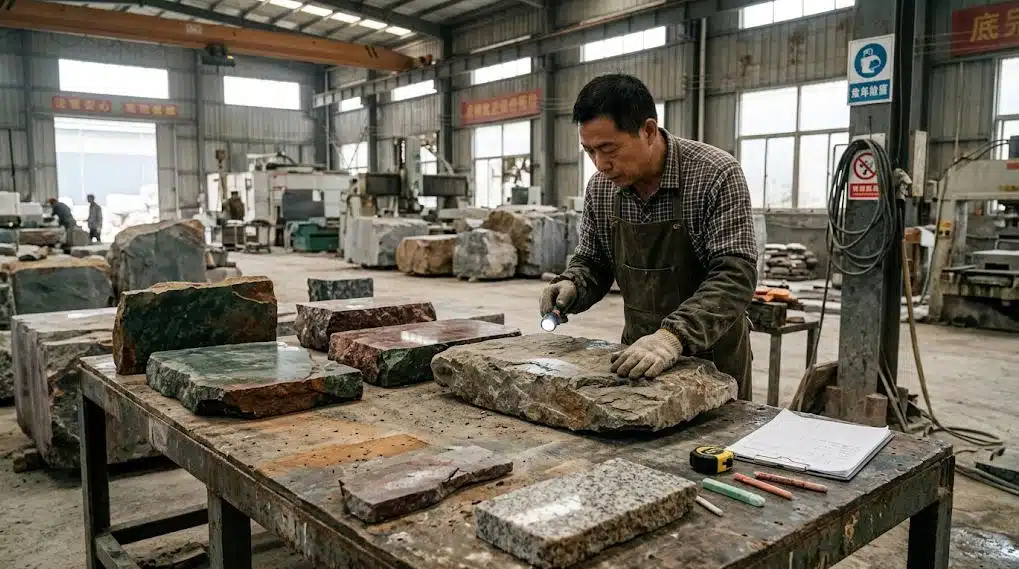
Before any shape is cut, an inspector holds the flat sheet of raw material in front of a strong light. Light passes through the stone and exposes internal cracks, impurities, and off-color areas that look invisible on the surface. The inspector marks each problem with a pencil and then plans the cutting layout so the finished pieces avoid those zones.
The goal is simple: fewer pieces breaking later and a better finished product. Gem laboratories such as GIA and SSEF use transmitted and controlled light when they study inclusions and fractures in natural stone, and this step borrows the same basic idea. About 11% of raw material is removed at this stage, measured against total raw material. This means you get guasha tools production that spends machine time only on stone that was worth cutting.
What Impurity and Color Block Sizes Must Be Marked or Removed Before Cutting?
The thresholds at this stage are specific, so inspectors do not have to guess. Every crack must be found, with no minimum size. For impurities, any particle with a diameter over 1 mm must be marked, and so must any square centimeter that holds more than two impurities smaller than 1 mm each. Color blocks that are clearly visible and wider than 3 mm are removed.
The color rule depends on the material, and white crystal is the best example. A pale yellow block inside white crystal blends into the stone and counts as a natural companion of that material, so it stays. A brown-yellow or black block contrasts sharply with the stone, so it is cut out of the plan. Why does this distinction matter? A blanket rule would either waste good stone or let ugly stone through. This means you can expect a gua sha manufacturer to reject based on how a block looks against its host stone, not just on its size.
Pre-Polishing Inspection: How to Handle Cracked and Chipped Gua Sha Blanks
After cutting, the pieces are still rough blanks. Before they go into the vibratory polishing drum, inspectors sort through basket after basket by hand. They pull out anything already damaged, anything with an obvious crack, and anything with a chipped edge, which can be a crack created during cutting. Strong light is used again to look for cracks inside the stone.
Here is why this step exists. A cracked blank can break apart in the drum, and the sharp fragments then knock against good pieces and spoil their polish. About 8% of raw material is removed at this stage. This means your gua sha wholesale order does not carry pieces that were scuffed by a neighbor’s broken edge.
How Do You Decide Whether a Chipped Gua Sha Can Be Repaired?
The dividing line is the minimum thickness standard for that product. If the remaining thickness at the chipped area meets or exceeds the minimum, the piece can be repaired and sent back into polishing. If the thickness at the chip falls below the minimum, the piece is scrapped.
Take a product with a minimum thickness of 5 mm. A chip that leaves 4 mm at its thinnest point fails, while a chip that leaves 5.5 mm can be repaired. The numbers are examples, so your own minimum will set the actual line. A simple way to apply this is to measure the thinnest point of the chip with a caliper and compare it to the minimum. This means you can ask your supplier for the repair-or-scrap rule in a single sentence and confirm it before guasha tools production starts.
What Happens to Rejected Pieces From a Gua Sha Manufacturer?
Rejected blanks are packed separately instead of being mixed back into good stock. Some are recycled into other products, such as fish tank sand. Separate packing also means a scrapped piece cannot slip into your carton by accident.
Is Skipping Two QC Stages Cheaper? The Real Cost of Guasha Tools Production Without Early Inspection

On paper, dropping two inspections saves labor and shortens the schedule. In practice, those savings tend to move into a different line of the budget, which is scrap, rework, and customer complaints. If you are weighing the price of a gua sha manufacturer that checks only at the end against one that checks three times, the comparison below shows where the money actually goes.
What Happens If a Gua Sha Manufacturer Skips Pre-Cutting Inspection?
Without the pre-cutting check, sheets with hidden cracks and impurities go straight to the cutting table. Nobody has marked the problem areas, so the cutting layout runs right through them. Pieces then break during shaping, and the ones that survive carry more impurities and more pits into the finished batch.
Think about the chain of cost. Every piece that cracks mid-process has already used cutting time, operator time, and a slice of expensive stone. Compare that with a pencil mark on a flat sheet, which costs seconds. This means you avoid paying, inside your unit price, for stone that was never going to make a sellable piece.
What Happens If Cracked Blanks Enter the Polishing Drum?
The polishing drum tumbles hundreds of pieces together for hours. When a cracked blank breaks inside it, the new fracture surface is sharp. Those fragments strike healthy pieces over and over, leaving scratches and chips that the polishing was supposed to remove.
The damage does not stay with the cracked piece. It spreads across the whole load, which is why this factory pulls cracked and chipped blanks out first, and why about 8% of raw material is removed at that point. Ask yourself how many perfect pieces you would trade for one cracked blank. This means your gua sha wholesale shipment arrives with a consistent surface finish instead of random scuffing.
Three-Stage Gua Sha QC vs. Final-Only QC: Cost, Efficiency and Quality Trade-offs
Final-only inspection wins on the cost of inspection itself. It needs fewer people, fewer tables, and less handling time. The trade is that every defect gets discovered at the most expensive moment, after cutting, polishing, and finishing are already paid for.
| Factor | Final-only QC | Three-stage gua sha qc |
|---|---|---|
| Inspection labor | Lower | Higher |
| Breakage during cutting | Higher, flaws are unmarked | Lower, flaws are marked in advance |
| Damage in the polishing drum | Cracked blanks can harm good pieces | Cracked blanks are removed first |
| Defects reaching final inspection | More | Fewer |
| Scrap cost at the end | Higher, full processing already spent | Lower, scrap happens early |
I do not have this factory’s cost-per-piece figures, so I will not put a percentage on the savings. What the comparison shows is the direction: early removal moves the loss to a point where it costs less. If you want a number for your own order, ask the supplier for its scrap rate at each stage and multiply it by the processing cost accumulated at that point. This means you can calculate which approach is cheaper for your volume instead of trusting a slogan.
A simple worked method helps. Take your planned order quantity, apply the stage rejection rates of 11% and 8% of raw material, and you can estimate how much stone must be bought to deliver the finished count you need. The same arithmetic applied to a final-only process would show a higher share of defects in the last stage, where each rejected piece is the most expensive to lose. For guasha tools production, that is the practical meaning of the saying that quality is cheaper than rework.
Why Three Checks Are the Best Balance for a Gua Sha Manufacturer
Three checkpoints are a trade-off between quality, speed, and cost, not a maximum-inspection philosophy. Pre-cutting protects the stone, pre-polishing protects the batch, and the final check protects your reputation with your own customers. Each one stops a different kind of loss, so removing any one of them reopens a gap the other two cannot cover.
If a gua sha manufacturer tells you that one final inspection is enough, ask how it handles cracks that form during cutting and what happens to cracked blanks in the polishing drum. The answers will tell you how the factory thinks about cost. This means you can pick a supplier whose process was built around total cost, not only the cost of inspection.
What Should Buyers Ask a Gua Sha Manufacturer Before Placing a Gua Sha Wholesale Order?

Everything above turns into a checklist once you are the one signing the purchase order. The questions below are the ones that separate a gua sha manufacturer with a documented process from one that only describes it. You can send them by email before you ever request a quote, and the answers will tell you more than a catalog does.
6 QC Questions to Ask Any Gua Sha Manufacturer
Start with the structure of the process. Ask whether the supplier inspects every piece or only a sample, and ask how many inspection points exist before final packing. A factory that checks only at the end cannot tell you what happens to a cracked blank in the polishing drum, so its answer to that follow-up question is revealing.
Then move to the numbers. Ask for the written tolerances on length, width, and thickness, the limits on pits, cracks, and impurities, and the color standard for your specific material. Ask whether a physical golden sample exists and whether you can approve one before guasha tools production begins. Finally, ask how grades are defined and whether the supplier will follow your own gua sha qc standard instead of its defaults.
Here are the six questions in short form, so you can paste them into an email:
- Do you inspect 100% of finished pieces, or a sample?
- How many inspection stages happen before final packing, and what does each one check?
- What are your written tolerances for size, pits, cracks, and impurities?
- Do you keep a golden sample for color, and can I approve it before production?
- How do you define Grade A, B, and Bc, and what happens to pieces that fail?
- Will you follow my specification if it differs from yours, and how does it change the price?
A supplier who answers all six with specific numbers is easy to plan around. One who answers with “no problem” and nothing else leaves you carrying the risk. This means you can compare two quotes on inspection quality, not only on unit price.
How Do You Turn the Answers Into a Gua Sha Wholesale Purchase Agreement?
Answers are only useful if they end up on paper. Copy the agreed tolerances, the pit and crack limits, the impurity size, the golden sample reference, and the grade definitions into your purchase agreement or order confirmation. Keep a photo of the approved sample with the order number written beside it.
When the carton arrives, check it against those numbers. Measure a handful of pieces with a caliper, look at the edges for sharp pits, and compare color to your sample under white light. Quality-management frameworks such as ISO 9001 are built around this habit of documenting requirements first and verifying against them afterward. This means a disputed gua sha wholesale shipment becomes a measurement exercise rather than an argument about opinions.
One more point deserves a warning. Natural stone varies, so no inspection process, including three stages and full final checks, can promise a batch with zero flaws. About 92% of finished pieces pass the final check at this factory, which also means about 8% do not. Why would you want a supplier who hides that fact? Ask for the pass rate, and treat a supplier who refuses to share one as a risk.
What Does a Gua Sha Manufacturer Offer Beyond QC? (Optional Background)
This factory is a source manufacturer of crystal and jade gua sha tools with more than 12 years of experience in processing, design, manufacturing, and sales. It balances quality control with production efficiency, and it runs the three inspection stages described above. You can use the questions in this article on any supplier, including this one, and the answers should hold up either way.
About Gua Sha Manufacturer 3 QC Faqs
1. Why does a gua sha manufacturer use three QC stages instead of one final check?
A final-only check finds defects after cutting, polishing, and finishing are already paid for. This factory inspects before cutting, before polishing, and before shipping, so each flaw is caught at the cheapest moment. About 11% of raw material is removed before cutting and about 8% before polishing, both measured against total raw material. This means you pay for fewer pieces that were never going to be sellable.
2. What does gua sha QC check before the stone is cut?
Inspectors pass strong light through the flat sheet to find internal cracks, impurities, and off-color areas, then mark them with a pencil and plan the cutting layout around them. Every crack must be found. Impurities over 1 mm, or more than two impurities under 1 mm within one square centimeter, are marked. Clearly visible color blocks wider than 3 mm are removed. This means the cutting stage spends time only on stone worth shaping.
3. Does this gua sha manufacturer inspect every piece or only a sample?
Every piece. Some factories check 20% or 50% of a lot, but this factory runs 100% inspection on everything that enters the warehouse or ships out. About 92% of finished pieces pass. This means your gua sha wholesale stock arrives with every piece already checked, so you do not need to pad orders for replacements.
4. What are the size tolerances for finished gua sha tools?
The default is ±1 mm for length and width and ±0.5 mm for thickness. A piece specified at 6 mm thick, for example, must measure between 5.5 and 6.5 mm. If you have your own tolerance, the factory follows yours instead. This means you can verify a carton with a caliper and know quickly whether it meets your spec.
5. How are pits, cracks, and impurities judged at final inspection?
A pit with a diameter over 0.5 mm fails. A crack narrower than 0.5 mm still fails if it is longer than 2 mm. Any pit or crack on the side edge that feels sharp also fails. For impurities, up to 2 mm generally passes, though the limit changes by material, since stones like blue spot stone naturally contain more. This means you can write these limits into your purchase agreement and settle disputes with a ruler.