
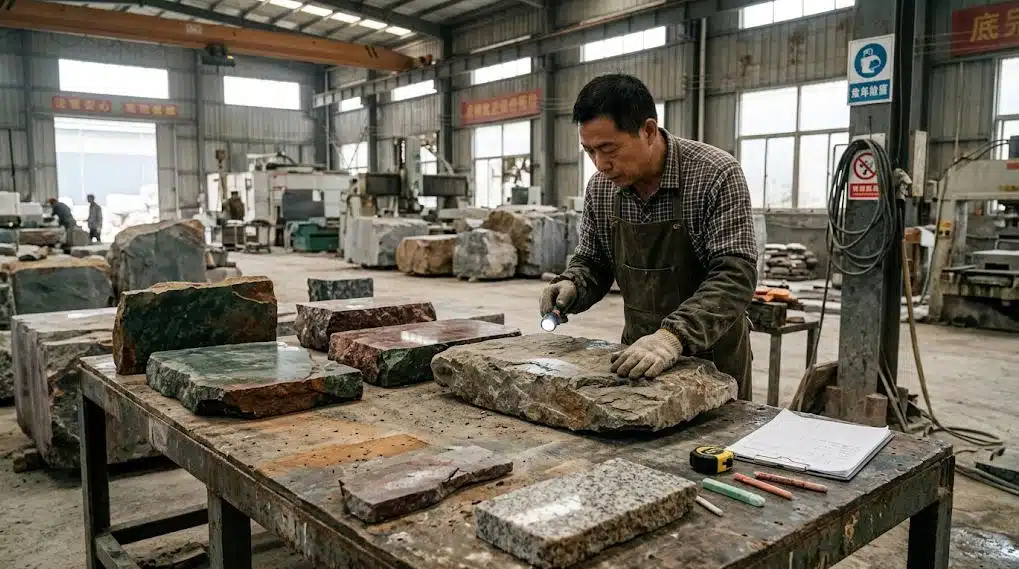
Gua Sha Manufacturer QC: Why a Factory Uses 3 Inspection Stages Instead of Just a Final Check
A gua sha manufacturer that inspects only the finished product lets cracks and impurities travel through every production step before anyone catches them. This factory runs three inspections instead: one before cutting, one before polishing, and one before shipping. The first removes about 11% of raw material, the second removes about 8% (both measured against total raw material), and the final check covers 100% of finished pieces, with about 92% passing. If you buy gua sha wholesale orders, these numbers show you where defects get removed and what that means for the pieces that reach your warehouse. Standards differ between factories, so everything below describes this factory’s own requirements, not an industry rule. Why Does a Gua Sha Manufacturer Need Three QC Checkpoints? A single final inspection sounds efficient, but it only tells you what went wrong after the money and labor are already spent. Each of the three checkpoints targets a different kind of risk at the moment it is cheapest to fix. Once you see what each stage does, the extra steps look less like overhead and more like insurance. Gua Sha Manufacturer QC at a Glance: 3 Stages, 3 Purposes, 3 Rejection Rates Gua sha qc at this factory happens in three stages, and each has a different job. The first takes place before any shape is cut. The second takes place after cutting but before the pieces go into the polishing drum. The third takes place before a piece enters the warehouse or leaves on a truck. Stage Purpose Method Result (share of total raw material) Pre-cutting Avoid internal flaws and plan cutting zones Strong light through the sheet, pencil marks About 11% removed Pre-polishing Stop cracked pieces from breaking in the drum Manual sorting with strong light About 8% removed Final (stock/shipping) Keep every shipped piece consistent 100% inspection line, white cloth, white light About 92% of finished pieces pass Add the first two numbers and roughly 19% of raw material is removed before polishing even begins. That is a combined figure of two separate checks, so treat it as an approximation. This means you can read the 92% final pass rate as the result of material that was already filtered twice, not a number that depends on luck. Which Gua Sha Defects Are Caught at Which Production Stage? Cracks, impurities, and color blocks are caught first, while the stone is still a flat sheet. Inspectors shine strong light through the material, mark each problem area with a pencil, and plan the cut around it. Gem laboratories such as GIA document inclusions and fractures in crystals as a routine part of their work, and the same logic applies here: light reveals what the naked eye misses. Chips and hairline cracks from the cutting process are caught second, before polishing. Size deviation, pits, remaining impurities, and color difference are caught last, on the final inspection line. Why does the order matter? A flaw found on a sheet costs you a pencil mark, while a flaw found on a polished piece costs you hours of machine time and labor. This means you pay for fewer pieces whose defects were visible long before they reached the finish line. What Does a Three-Stage Gua Sha Manufacturer Process Mean for Your Gua Sha Wholesale Risk? Three stages reduce risk, but they do not remove it. About 8% of finished pieces still fail the final check, and the A, B, and Bc grades exist because natural stone never comes out uniform. Any gua sha manufacturer that promises zero defects in natural crystal or jade is describing something the material does not allow. That is why a gua sha wholesale buyer should ask for the inspection standard in writing and compare it against a documented quality framework such as ISO 9001. Written tolerances let you check a delivered carton against numbers rather than impressions. This means you can reject a non-conforming batch with evidence instead of an argument. How Does 100% Final Gua Sha QC Protect Your Gua Sha Wholesale Orders? Final inspection is the stage you feel directly, because it decides what is in the carton when it arrives. This factory checks every piece that enters the warehouse or ships out, and it never samples. If you place gua sha wholesale orders, that single rule shapes your return rate more than any other step in the process. 100% Inspection vs. 20% or 50% Sampling: What a Gua Sha Manufacturer’s Choice Means for Wholesale Buyers Some factories inspect 20% of a lot, and others inspect 50%. Picture 1,000 pieces with a 5% defect rate, which means 50 flawed pieces. A 20% sample looks at about 200 pieces and finds roughly 10 of those flaws, so around 40 can still reach your customers. Full inspection looks at all 1,000, so those 50 are pulled before packing. Full inspection costs more time and labor, and this factory accepts that cost to keep a consistent reputation and a predictable buying experience. The numbers above are an illustration, not this factory’s measured defect rate. This means you can plan your gua sha wholesale stock without padding every order for replacements. What Are Grade A, B and Bc Gua Sha Tools? Every piece that passes final gua sha qc is sorted into a grade. All three grades must meet the size tolerance, so the difference between them is appearance, not fit. Grade Size Pits and cracks Color Impurities A Within tolerance No visible pits Close to the golden sample No visible impurities B Within tolerance A few within the allowed limit Within the color range Within the allowed limit Bc Within tolerance Visible pits that do not affect use May slightly exceed the range May exceed the allowed limit Natural stone never comes out uniform, so a grading system is more honest than a promise of perfection. This means you can match each grade to a price point, such as A for premium lines and Bc for budget lines, instead of paying A-grade prices for every […]
A gua sha manufacturer that inspects only the finished product lets cracks and impurities travel through every production step before anyone catches them. This factory runs three inspections instead: one before cutting, one before polishing, and one before shipping. The first removes about 11% of raw material, the second removes about 8% (both measured against total raw material), and the final check covers 100% of finished pieces, with about 92% passing. If you buy gua sha wholesale orders, these numbers show you where defects get removed and what that means for the pieces that reach your warehouse. Standards differ between factories, so everything below describes this factory’s own requirements, not an industry rule. Why Does a Gua Sha Manufacturer Need Three QC Checkpoints? A single final inspection sounds efficient, but it only tells you what went wrong after the money and labor are already spent. Each of the three checkpoints targets a different kind of risk at the moment it is cheapest to fix. Once you see what each stage does, the extra steps look less like overhead and more like insurance. Gua Sha Manufacturer QC at a Glance: 3 Stages, 3 Purposes, 3 Rejection Rates Gua sha qc at this factory happens in three stages, and each has a different job. The first takes place before any shape is cut. The second takes place after cutting but before the pieces go into the polishing drum. The third takes place before a piece enters the warehouse or leaves on a truck. Stage Purpose Method Result (share of total raw material) Pre-cutting Avoid internal flaws and plan cutting zones Strong light through the sheet, pencil marks About 11% removed Pre-polishing Stop cracked pieces from breaking in the drum Manual sorting with strong light About 8% removed Final (stock/shipping) Keep every shipped piece consistent 100% inspection line, white cloth, white light About 92% of finished pieces pass Add the first two numbers and roughly 19% of raw material is removed before polishing even begins. That is a combined figure of two separate checks, so treat it as an approximation. This means you can read the 92% final pass rate as the result of material that was already filtered twice, not a number that depends on luck. Which Gua Sha Defects Are Caught at Which Production Stage? Cracks, impurities, and color blocks are caught first, while the stone is still a flat sheet. Inspectors shine strong light through the material, mark each problem area with a pencil, and plan the cut around it. Gem laboratories such as GIA document inclusions and fractures in crystals as a routine part of their work, and the same logic applies here: light reveals what the naked eye misses. Chips and hairline cracks from the cutting process are caught second, before polishing. Size deviation, pits, remaining impurities, and color difference are caught last, on the final inspection line. Why does the order matter? A flaw found on a sheet costs you a pencil mark, while a flaw found on a polished piece costs you hours of machine time and labor. This means you pay for fewer pieces whose defects were visible long before they reached the finish line. What Does a Three-Stage Gua Sha Manufacturer Process Mean for Your Gua Sha Wholesale Risk? Three stages reduce risk, but they do not remove it. About 8% of finished pieces still fail the final check, and the A, B, and Bc grades exist because natural stone never comes out uniform. Any gua sha manufacturer that promises zero defects in natural crystal or jade is describing something the material does not allow. That is why a gua sha wholesale buyer should ask for the inspection standard in writing and compare it against a documented quality framework such as ISO 9001. Written tolerances let you check a delivered carton against numbers rather than impressions. This means you can reject a non-conforming batch with evidence instead of an argument. How Does 100% Final Gua Sha QC Protect Your Gua Sha Wholesale Orders? Final inspection is the stage you feel directly, because it decides what is in the carton when it arrives. This factory checks every piece that enters the warehouse or ships out, and it never samples. If you place gua sha wholesale orders, that single rule shapes your return rate more than any other step in the process. 100% Inspection vs. 20% or 50% Sampling: What a Gua Sha Manufacturer’s Choice Means for Wholesale Buyers Some factories inspect 20% of a lot, and others inspect 50%. Picture 1,000 pieces with a 5% defect rate, which means 50 flawed pieces. A 20% sample looks at about 200 pieces and finds roughly 10 of those flaws, so around 40 can still reach your customers. Full inspection looks at all 1,000, so those 50 are pulled before packing. Full inspection costs more time and labor, and this factory accepts that cost to keep a consistent reputation and a predictable buying experience. The numbers above are an illustration, not this factory’s measured defect rate. This means you can plan your gua sha wholesale stock without padding every order for replacements. What Are Grade A, B and Bc Gua Sha Tools? Every piece that passes final gua sha qc is sorted into a grade. All three grades must meet the size tolerance, so the difference between them is appearance, not fit. Grade Size Pits and cracks Color Impurities A Within tolerance No visible pits Close to the golden sample No visible impurities B Within tolerance A few within the allowed limit Within the color range Within the allowed limit Bc Within tolerance Visible pits that do not affect use May slightly exceed the range May exceed the allowed limit Natural stone never comes out uniform, so a grading system is more honest than a promise of perfection. This means you can match each grade to a price point, such as A for premium lines and Bc for budget lines, instead of paying A-grade prices for every […]