
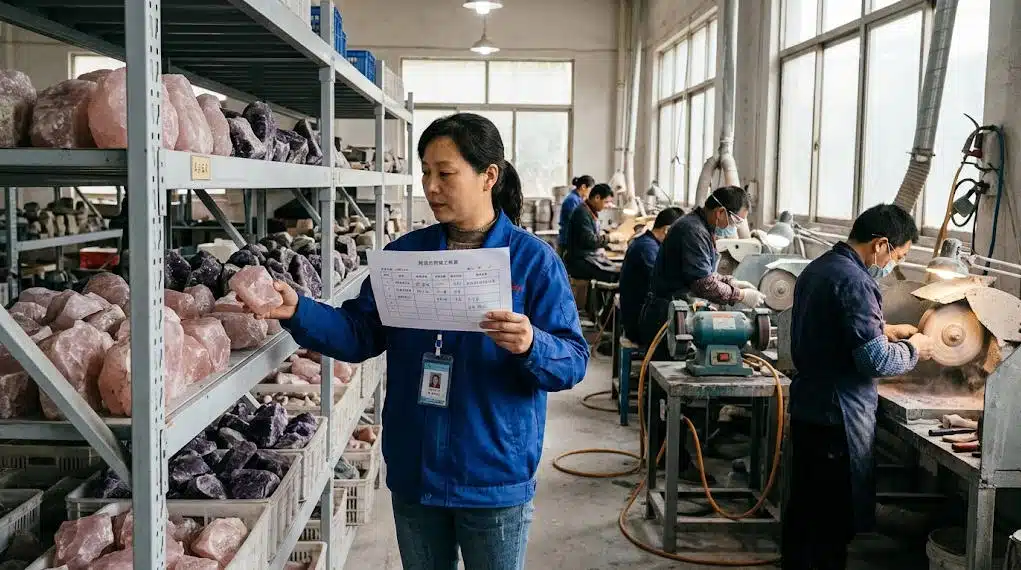
Gua Sha wholesale Lead Time for a 5,000 pcs order runs from about 30 days for an existing rose quartz design to 38-60 days for amethyst. Two factors move that number more than anything else: how much suitable raw material is available, and how strict a quality standard you set. A gua sha manufacturer can only give you a dependable date after checking material stock, the production queue, and your acceptance criteria.
This article walks you through each factor using real order records from a gua sha factory with over 12 years of jade and crystal processing. Every figure comes from one factory’s own data, so treat the numbers as reference points rather than industry standards. By the end, you will be able to estimate your own delivery date before you send an RFQ.
- What Is a Typical Gua Sha Wholesale Lead Time? A Quick Reference
- Why Does Raw Material Supply Decide Your Gua Sha Wholesale Lead Time?
- How Does Your Quality Standard Change Gua Sha Wholesale Lead Time?
- Why Doesn’t Gua Sha Wholesale Lead Time Increase in Proportion to Order Quantity?
- How Much Extra Time Does Custom Gua Sha R&D Add to Gua Sha Wholesale Lead Time?
- How Do Production Schedule and Policy Changes Affect Your Gua Sha Wholesale Lead Time?
- How to Get an Accurate Gua Sha Wholesale Lead Time Quote from a Gua Sha Manufacturer
- Gua Sha Wholesale Lead Time FAQs
What Is a Typical Gua Sha Wholesale Lead Time? A Quick Reference
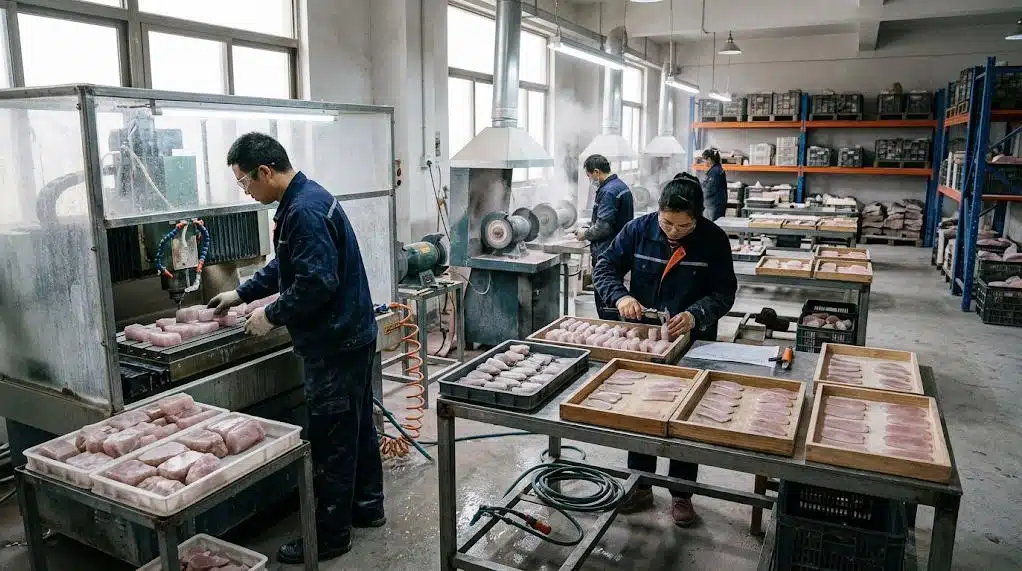
Start with the numbers, because they frame everything that follows. At this gua sha factory, the Gua Sha wholesale Lead Time for 5,000 pcs of an existing rose quartz design is about 30 days. The same quantity in amethyst now takes 38-60 days. Do those two figures give you one “standard” lead time to plan around? They don’t, and the sections below show you why.
How Long Does a 5,000 pcs Rose Quartz Gua Sha Order Take?
A 5,000 pcs order of an existing rose quartz design takes about 30 days. Existing designs skip the design review, sampling, and worker learning curve that custom designs need, so production moves straight into the schedule. Rose quartz is also less scarce than amethyst, which means raw material rarely holds the order back. This means you can plan a rose quartz reorder around a firm 30-day window with only a small buffer.
One caution applies to any quote you receive: confirm where the clock starts. A gua sha manufacturer may count from deposit, from material arrival, or from sample approval, and that choice changes the answer. Ask for the start point in writing before you compare two quotes. This means you can compare suppliers on equal terms instead of picking the shorter number that simply starts counting later.
How Long Does a 5,000 pcs Amethyst Gua Sha Order Take Now?
Amethyst tells a different story. Before mid-2022, orders of 5,000 pcs or fewer took 25-30 days. Reserves then shrank and origin-country policy tightened, so even stone once judged weak was bought up quickly. The same order now takes 38-60 days, the top of that range is double the old 30-day ceiling, and the finished quality is lower than before at a higher price.
GIA’s amethyst quality factors guide lists the color and clarity traits buyers use to grade the stone. Those terms are useful vocabulary when you write your specification. This means you can budget 38-60 days for amethyst today and ask for material confirmation first, since that step decides where in the range your order lands.
Does a 10,000 pcs Order Double Your Gua Sha Wholesale Lead Time?
It does not. For existing rose quartz designs, 5,000 pcs takes about 30 days, while 10,000 pcs takes 40-45 days instead of 60. Many steps run side by side rather than one after another, and polishing is the clearest example, covered in a later section. Doubling the quantity therefore adds only about 33-50% to your Gua Sha wholesale Lead Time. This means you can combine two 5,000 pcs orders into one 10,000 pcs order and save 15-20 days compared with running them back to back.
Gua Sha Wholesale Lead Time Table by Material and Quantity
The table below puts each real case on its own row. The rows come from different materials and different orders, so compare within a row’s context, not across rows.
| Material | Quantity | Lead Time | Condition |
|---|---|---|---|
| Rose quartz | 5,000 pcs | About 30 days | Existing product line |
| Rose quartz | 10,000 pcs | 40-45 days | Existing product line |
| Amethyst | Up to 5,000 pcs | 25-30 days | Before mid-2022 |
| Amethyst | Up to 5,000 pcs | 38-60 days | After mid-2022 |
| Green jade | 5,000 pcs | 35 days | Pass rate of 95% or higher (2025 order) |
| Green jade | 5,000 pcs | 45 days | Pass rate of about 80% (2025 order) |
Custom designs sit on top of these numbers, adding 3-7 days of lead time and 10-30% more production time through gua sha R&D and learning-curve effects. Write the exact material in your RFQ too. GIA’s jade buyer’s guide explains that “jade” is an umbrella term covering two different minerals, jadeite and nephrite. This means you can get a quote that matches the stone you actually want and avoid a re-quote that costs you days.
Why Does Raw Material Supply Decide Your Gua Sha Wholesale Lead Time?
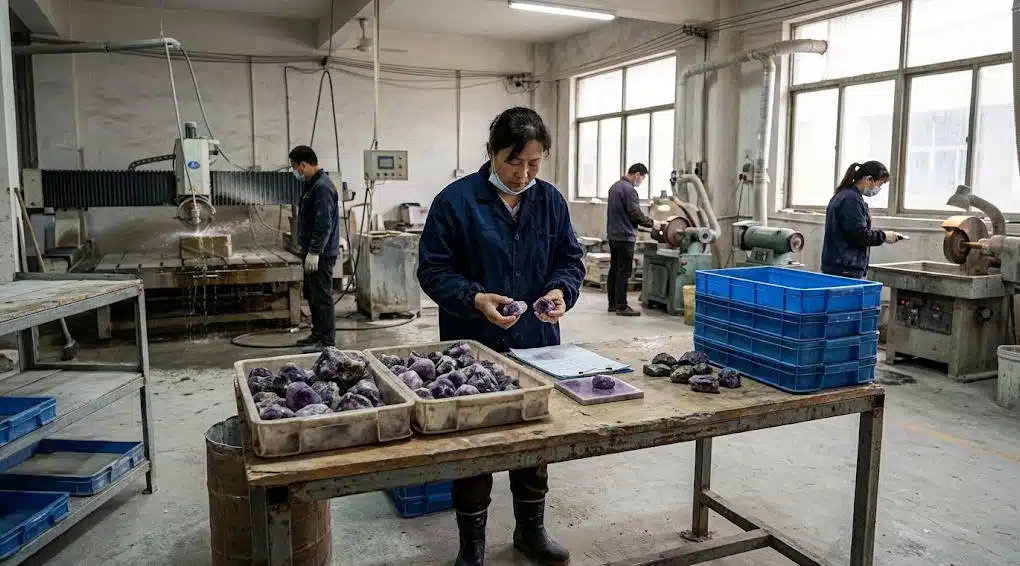
Raw material is the single biggest variable in any Gua Sha wholesale Lead Time estimate. When the market holds no stone that matches your specification, production does not slow down, it stops, and it stays stopped until suitable stone appears. A faster polishing line cannot fix that, and neither can extra shifts. This means you can treat the material question as the first line of your schedule, ahead of quantity, design, or shipping.
Case Study: How Amethyst Lead Time Grew After Mid-2022
Before mid-2022, amethyst was scarcer than rose quartz but still available in workable volumes. Orders of 5,000 pcs or fewer took 25-30 days at this gua sha factory. Then reserves shrank and origin-country policy tightened, and the raw material trading center ran short for a long stretch. Even stone once rated as poor quality was bought up quickly, so demand outran supply.
The result hit three things at once. Lead time for 5,000 pcs or fewer rose to 38-60 days, finished quality came in below earlier orders, and prices went up. A buyer who planned around 30 days now misses the launch by 8 to 30 days. This means you can no longer read a scarce material’s lead time as a schedule issue alone, so ask for time, quality, and price together in every quote.
Scarcity brings a second risk that is easy to overlook. GIA reports that lower-quality, light-colored amethyst and even light-colored quartz have been dyed to produce a purple color. When good stone is hard to find, the pull toward substitutes grows. Independent labs such as SSEF offer treatment detection for colored stones, which gives you a neutral way to check a sample. This means you can write “natural color, no dye” into your specification and have a disputed sample tested instead of arguing over it.
What Does a Gua Sha Manufacturer Check Before Quoting Gua Sha Wholesale Lead Time?
A reliable gua sha manufacturer works through two checks, in a fixed order. The first is its own stock: does the warehouse hold enough stone of your type and grade? The second is the raw material trading center: if own stock falls short, can the market supply it, and at what pace?
Those two answers form the starting point of the Gua Sha wholesale Lead Time quote, and every other factor gets added afterward. If neither check turns up suitable stone, the order waits. A quote that arrives within an hour, with no mention of material, should make you ask what it was based on. This means you can judge a supplier’s estimate by whether the material check came first.
How Can You Reduce Raw Material Risk in Gua Sha Wholesale Lead Time Planning?
Start by naming the exact material and the color range you will accept in your RFQ. GIA’s jade buyer’s guide shows how many distinct materials hide behind one word, so vague wording invites a vague quote. Next, ask for the current stock status before you pay a deposit, and ask what happens if the stone cannot be found: who decides on a substitute, and how fast do you hear about it?
Then build a buffer from the real data. For amethyst, plan around the top of the 38-60 day range if your launch date is fixed, and around the bottom only if the material is already confirmed. For rose quartz in an existing design, a 30-day window with a small cushion has held up well. This means you can protect a fixed launch date by choosing your buffer from observed numbers instead of a guess.
How Does Your Quality Standard Change Gua Sha Wholesale Lead Time?
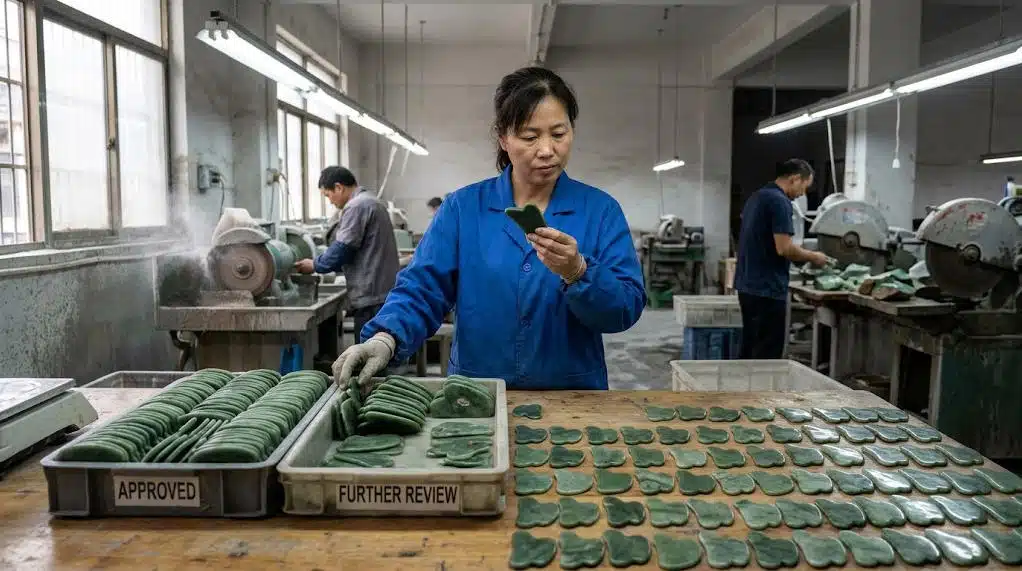
Many buyers assume quality and delivery date are separate topics, and that assumption costs them weeks. Your acceptance standard changes how many pieces the factory must make, inspect, and polish before 5,000 good ones are ready. That makes it a direct input into your Gua Sha wholesale Lead Time, and unlike raw material supply, it is a variable you control before you place the order. This means you can shorten your own delivery date by deciding what counts as acceptable before the quote, not after.
Pass Rate 95% vs 80%: Why Two 5,000 pcs Green Jade Orders Took 35 and 45 Days
In 2025, this gua sha factory produced two orders of the same item: 5,000 pcs of green jade gua sha. One took 35 days and the other took 45. The difference was the quality standard. The first customer accepted a looser standard, and the pass rate came in at 95% or higher. The second customer set a much tighter one, and the pass rate landed near 80%.
The arithmetic explains the gap. To end up with 5,000 good pieces at a 95% pass rate, the line must produce about 5,264 pieces, which leaves roughly 264 rejects. At an 80% pass rate, it must produce 6,250 pieces, which leaves 1,250 rejects. That is 986 extra pieces to cut, shape, polish, and inspect, and nearly five times as many rejects to repair or replace. This means you can expect a 15-point drop in pass rate to cost you about 10 extra days on a 5,000 pcs order.
Extra QC and Longer Polishing: The Hidden Gua Sha Wholesale Lead Time Cost
Extra pieces are only part of the story. A tighter standard also adds inspection time, because every piece gets examined against a narrower tolerance, and rejected pieces must be re-inspected after repair. Polishing time usually grows as well, since a surface that must pass a stricter check often needs a longer polishing cycle. Each of these steps adds days to the Gua Sha wholesale Lead Time quoted for your order.
Most gua sha manufacturer quotes treat this as a single line, “lead time,” which hides the cause. If you ask what pass rate the quote assumes, you see where the days come from. A quote built on a 95% pass rate and a quote built on 80% can differ by 10 days for the same stone and the same quantity. This means you can compare two quotes fairly by asking each supplier to state the pass rate behind its number.
How to Set a Realistic Quality Standard to Shorten Your Gua Sha Wholesale Lead Time
Start by writing down what a defect is. Natural stone varies, and GIA’s jade quality factors guide lists color, texture, and transparency among the main traits buyers evaluate. Because those traits differ from piece to piece, decide in advance which range is normal variation and which is a reject.
Next, approve a physical sample as your reference, so both sides inspect against the same piece instead of a description. Then ask the supplier which inspection method it uses and what pass rate it expects at your standard. If a tighter standard matters for a premium line, accept the longer schedule on purpose. If it does not, loosen the standard on surfaces customers rarely notice. This means you can trade a few cosmetic tolerances for up to 10 days of delivery time, and you decide which trade makes sense for your product.
Why Doesn’t Gua Sha Wholesale Lead Time Increase in Proportion to Order Quantity?
Doubling your order does not double your wait. For existing rose quartz designs, 5,000 pcs takes about 30 days and 10,000 pcs takes 40-45 days, not 60. The reason is simple: gua sha production is not a single line where each piece waits for the one before it. This means you can order larger quantities with a delivery estimate that grows much more slowly than the order itself.
How Parallel Production Shortens Gua Sha Wholesale Lead Time on Large Orders
Many production steps run on large batches at the same time. Cutting, shaping, polishing, and inspection can each be set up to handle a high volume together, so the clock does not restart for every extra piece. Polishing is the clearest example, and it is where this gua sha factory sees the biggest gap between small and large orders.
Look at the numbers per 1,000 pieces. A 5,000 pcs order at 30 days works out to 6 days per 1,000 pieces. A 10,000 pcs order at 40-45 days works out to 4-4.5 days per 1,000 pieces. That is a drop of 25-33% in time per piece, and it explains why your Gua Sha wholesale Lead Time grows slower than your quantity. This means you can lower your waiting time per unit by consolidating orders instead of splitting them.
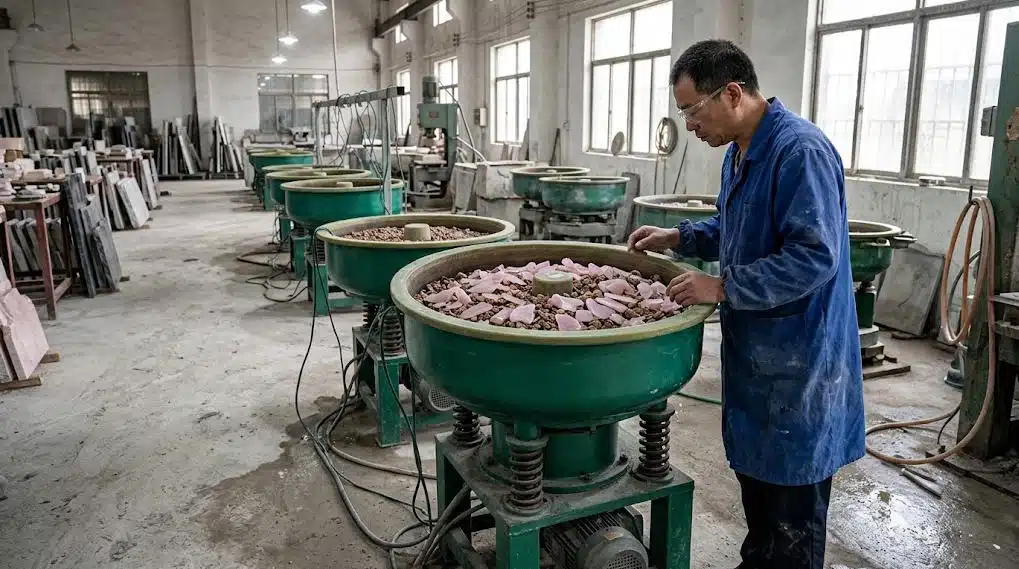
How Does a Vibratory Polishing Machine Handle Thousands of Gua Sha at Once?
The machine behind this effect is easy to picture if you think of a wine glass. The top part is the bowl, a container that holds the gua sha. The bottom part is a set of several metal supports connecting the bowl to the floor, and a motor drives them to produce high-speed vibration. It is not a rotating drum like a cement mixer, and nothing tumbles end over end.
To run it, the operator loads the cut gua sha into the bowl together with polishing media and abrasive grit. The vibration makes the pieces rub against the media and the grit, and that friction smooths each surface. One bowl holds several hundred pieces, and this factory runs several dozen machines at the same time. Together they can polish thousands, even over ten thousand, gua sha in one cycle. This means you can place a 10,000 pcs order without waiting for pieces to be polished in small groups.
How to Use Order Quantity to Plan Your Gua Sha Wholesale Lead Time
Put the numbers into your purchasing calendar. If you need 10,000 pcs over the next quarter, one 10,000 pcs order of an existing rose quartz design takes 40-45 days, while two separate 5,000 pcs orders run back to back take about 60. The single order saves you 15-20 days.
Before you commit, ask your gua sha manufacturer three questions. How many pieces can be polished in one cycle? Does the larger quantity change the pass rate? And does the quoted time assume the factory’s queue is clear? These figures come from rose quartz in an existing design only, so ask for the same comparison in your own material. This means you can choose between one large order and several small ones using a real time difference, not a rule of thumb.
How Much Extra Time Does Custom Gua Sha R&D Add to Gua Sha Wholesale Lead Time?

A custom design adds two things to your schedule: 3-7 days of lead time before production, and 10-30% more production time once it starts. Both figures come from this factory’s own records and do not represent other manufacturers or an industry standard. Existing designs avoid both costs, which is why custom orders always carry a longer Gua Sha wholesale Lead Time. This means you can estimate the extra time for a custom order with simple arithmetic before you request a quote.
Gua Sha R&D and Design Review: 3-7 Days
The first step in gua sha R&D is a design review. The factory checks whether your design is reasonable to produce, looking at shape, thickness, edge curves, and the way the chosen stone will behave when cut. Where something is likely to crack or polish poorly, the factory proposes changes and optimizes the design with you. This stage usually takes 3-7 days.
How long it lasts depends mostly on your drawing. A clear drawing with dimensions and a reference photo shortens the review, and a rough sketch lengthens it. This means you can save several days by sending a dimensioned drawing in your first message.
Sample Production and Mold Design: 3-5 Days
Once the design is settled, the factory makes one standard sample. The sample serves two purposes: you confirm the shape and finish, and the factory uses it to design the molds for mass production. Making the sample takes 3-5 days, and it can run alongside the design review instead of waiting for it to finish.
Because the two stages overlap, a good gua sha manufacturer will not add them together. A design review of 3-7 days and a sample of 3-5 days do not equal 6-12 days of waiting. The extra lead time for a new design lands at 3-7 days overall. This means you can ask your supplier to run design review and sampling in parallel, and you can check that the quote reflects it.
How Quality Negotiation Affects Your Gua Sha Wholesale Lead Time
A new design also opens a conversation about quality: which defects are acceptable, how tight the tolerances should be, and what happens to rejected pieces. That conversation takes time, and the time depends on how quickly you and the factory agree. The records do not give a fixed number of days for this step, because it varies with each customer.
The standard you agree on carries forward into production, as the green jade case showed: a pass rate of 95% versus 80% meant 35 versus 45 days. Settle the standard while the sample is being made, not after it is approved. This means you can keep negotiation from adding a separate delay on top of the sample stage.
Why a New Design Adds 10-30% to Your Gua Sha Wholesale Lead Time
New products run slower on the shop floor. Workers need time to build experience with a shape they have not made before, and during that learning period the factory’s processing efficiency runs 10-30% below existing designs.
Here is a rough illustration, not a quote. Take an existing design that needs 30 days. A custom design of the same quantity would need 33-39 days of production, plus 3-7 days of lead time, for a total of about 36-46 days. This means you can add 6-16 days to an existing-design benchmark when you plan a custom order.
How Do Production Schedule and Policy Changes Affect Your Gua Sha Wholesale Lead Time?
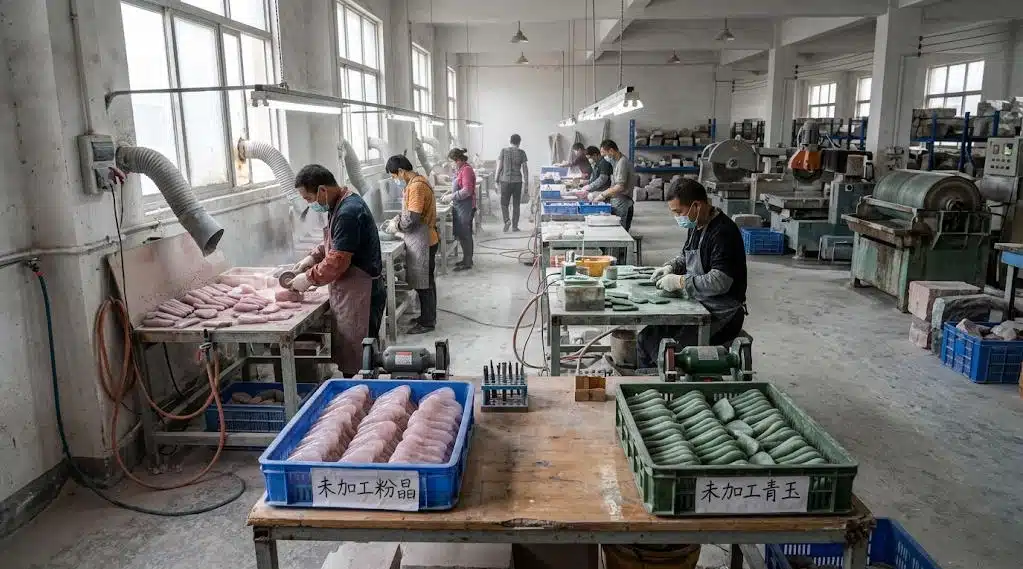
Two factors sit outside your order and outside the stone itself: how full the factory’s schedule is, and what local regulation does to production. Neither shows up on a product page, and both can add weeks to a Gua Sha wholesale Lead Time that looked fine on paper. Buyers rarely see them coming, because the factory’s calendar and the local rule book are not part of a quotation. This means you can avoid unpleasant surprises by asking about both before you pay a deposit.
How the Factory Order Queue Adds Waiting Time to Gua Sha Wholesale Lead Time
In certain periods, orders pile up at a factory, and a new order cannot start production right after it is placed. It joins the queue and waits for its turn. The delivery estimate then becomes two numbers added together: the waiting time in the queue plus the normal production time.
Here is a simple illustration, using made-up numbers to show the logic. If an existing rose quartz order needs 30 days of production and the queue ahead of it needs 10 days to clear, you wait about 40 days, not 30. A gua sha manufacturer who quotes only the production time leaves the first number out, and you only discover it after your deposit is paid. This means you can ask for the queue status in writing and request a start date as well as a finish date.
2025 Environmental Inspections in Huizhou and Dongguan
In 2025, local governments in Huizhou and Dongguan began enforcing environmental rules strictly. Most gua sha makers had to respond with internal changes. Some optimized their production lines and added environmental measures, while others moved the whole operation into an industrial zone to solve the problem at the root.
Either route had the same side effect: a large share of manufacturers could not produce normally for several months during 2025. That hit delivery dates across the industry at once, and it is a variable buyers rarely have any way to see. Relocate-or-close orders are not new in this region. In 2011, the Dongguan Environmental Protection Bureau set an end-2012 deadline for highly polluting industries to move to specialized environmental bases or close, according to a Hong Kong Trade and Industry Department circular. That case covered electroplating, printing, and dyeing rather than stone processing, so it shows the mechanism, not the current rules. This means you can treat environmental enforcement in this region as a recurring risk and not a one-time event.
How to Check a Gua Sha Factory’s Compliance Status Before You Order
You can make this check in three questions. First, ask whether the gua sha factory passed its most recent local environmental inspection and whether any rectification work or relocation is planned. Second, ask whether any part of the production line has been paused in the last 12 months. Third, ask what the factory would do if a pause hit your order midway, including whether it can move production and who pays for the delay.
Keep the answers in writing, since a verbal assurance is hard to rely on if a delay occurs. A factory that answers these questions plainly gives you something to plan around, and one that avoids them tells you something as well. This means you can set a delivery date you trust, or choose a different supplier before the money is committed.
How to Get an Accurate Gua Sha Wholesale Lead Time Quote from a Gua Sha Manufacturer

An accurate quote starts with an accurate request. Every factor in the earlier chapters, from material and quantity to quality standard and design type, is information the supplier needs from you before it can name a date. Leave a field blank and the supplier fills it with its own assumption, which usually favors a shorter number that later grows. This means you can get a more reliable Gua Sha wholesale Lead Time by sending a complete RFQ, not a one-line inquiry.
RFQ Checklist: What to Tell a Gua Sha Factory to Get a Faster, More Accurate Lead Time
Begin with the material, named exactly, and the treatment status you accept. GIA’s jade buyer’s guide explains that in a classification used in China, “B” jade is bleached and impregnated with polymer resin, while “C” jade is dyed, so a plain “jade” in your RFQ can mean several things. State whether the product is an existing design or a custom one, and if it is custom, attach your drawing and any reference photos so the gua sha R&D team can start the design review at once.
Then give the quantity, your quality standard, and your target delivery date. For quality, state the defect types you will reject and, if you have one, attach an approved sample. For the date, say whether it is fixed, as with a trade show, or flexible. Finally, say whether you can accept partial shipments, since that can change when your first pieces arrive. This means you can receive a quote that already accounts for your stone, your standard, and your deadline, and you avoid a round of follow-up emails.
Questions to Ask Your Gua Sha Manufacturer About Gua Sha Wholesale Lead Time
Once the quote arrives, test it with direct questions. Does the number assume your material is already in stock, or does it include time to buy it? How many orders sit in the queue ahead of yours? What pass rate does the schedule assume at your quality standard? If your order is custom, how many days does the gua sha R&D stage take, and does it run in parallel with sampling?
Add one question about compliance: has any part of the production line been paused or relocated in the past year? As chapter six showed, 2025 inspections in Huizhou and Dongguan left many makers unable to produce normally for months. A gua sha manufacturer who answers all five questions with specifics gives you a quote you can plan around. This means you can sort suppliers into those who have checked their numbers and those who are guessing.
How to Estimate Your Own Gua Sha Wholesale Lead Time Before You Ask
You can build a rough estimate yourself from the benchmarks in this article, then use it to judge any quote. Take an existing rose quartz design at 5,000 pcs: about 30 days. If you need 10,000 pcs, use 40-45 days. For a custom design, add 3-7 days for gua sha R&D plus 10-30% more production time. Then add your queue time and a buffer for material risk.
Check the result against the quote in front of you. If the supplier’s number is far below your estimate, ask which step it skips. If it is far above, ask which step it is padding. Remember that every benchmark comes from one gua sha factory’s records, so treat your estimate as a range, not a promise. This means you can negotiate from facts and spot an unrealistic promise before it becomes a missed launch date.
Gua Sha Wholesale Lead Time FAQs
1. How Long Does Gua Sha Wholesale Lead Time Take for a 5,000 pcs Order?
It depends on the material and on whether the design already exists. An existing rose quartz design takes about 30 days, and amethyst takes 38-60 days under current supply conditions. A custom design adds 3-7 days of lead time on top of either figure. This means you can read your own timeline off those three numbers once you know your material and design type.
2. Why Is Amethyst Lead Time Longer Than Rose Quartz?
Amethyst supply shrank sharply after mid-2022, because reserves fell and origin-country policy tightened. The raw material trading center stayed short for a long period, and even stone once rated poor was bought up. Rose quartz did not face the same squeeze, so its schedule held at about 30 days. This means you can expect a wider range and a bigger buffer when you order amethyst.
3. Does Doubling the Order Quantity Double Your Gua Sha Wholesale Lead Time?
No. For existing rose quartz designs, 5,000 pcs takes about 30 days and 10,000 pcs takes 40-45 days, because steps such as polishing run on large batches at once. The result is about 4-4.5 days per 1,000 pieces at the larger size, against 6 days at the smaller one. This means you can save 15-20 days by combining two 5,000 pcs orders into one.
4. How Does My Quality Standard Affect Gua Sha Wholesale Lead Time?
A stricter standard lowers the pass rate and raises the number of pieces that must be made, inspected, and polished. In two 2025 green jade orders of 5,000 pcs, a pass rate of 95% or higher took 35 days, and a pass rate near 80% took 45 days. This means you can shorten delivery by defining acceptable defects clearly before you order.
5. How Long Does Custom Gua Sha R&D Take Before Production Starts?
Design review takes 3-7 days and sample production takes 3-5 days, and the two can run in parallel. Overall, a new design adds 3-7 days of lead time, and production then runs 10-30% slower than an existing design while workers build experience. Treat these as one factory’s figures, not an industry standard. This means you can plan the first week or two of a custom order around design and sampling, not production.
6. Can a Rush Order Shorten Gua Sha Wholesale Lead Time?
The records in this article do not include a confirmed rush-order option, so ask your supplier directly. What the data does show is where time is won or lost: material that is already in stock, a short queue, a realistic quality standard, and an existing design. If a supplier promises a much shorter date, ask which of those four it is relying on. This means you can test a rush promise against facts instead of accepting it at face value.