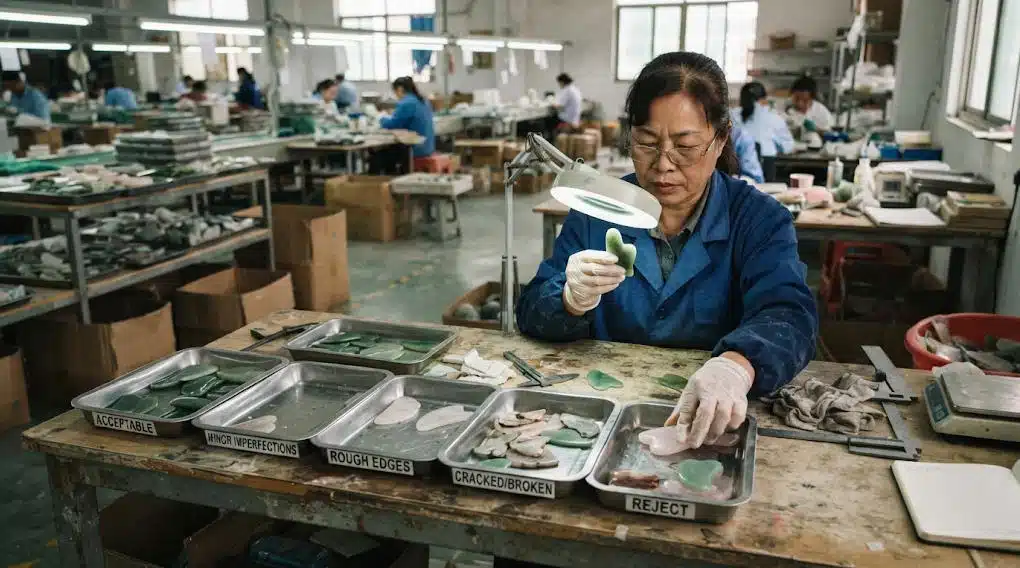
A gua sha factory with 12 years of production history learns one lesson early: defects happen, so what matters is where each defective piece ends up. Every flagged piece goes into one of five outcomes: rework, repair, regrade, customer-approved release, or scrap. Across 14 common defect types, only surface issues such as under-polished faces and rough edges are usually fixable, while cracks, breakage and undersized pieces go to scrap. This article shows you how a gua sha manufacturer makes that call, how gua sha QC keeps rejects out of your shipment, and which risks you should still verify before you sign a gua sha wholesale order. Start with the decision table below, then read the reasoning behind each row.
How Does a Gua Sha Factory Decide Between Rework, Repair and Scrap?

A gua sha factory does not decide by how bad a flaw looks. It decides by four things: where the flaw sits, how deep it goes, how much material allowance remains, and how the stone behaves under further grinding. Two pieces with the same visible scratch can end up in different bins, because one still has spare thickness and the other does not. Of the 14 defect types, four usually end in rework, four lean toward scrap, two go to you for a decision, and four depend on allowance and the size of the error. That means you can ask any gua sha manufacturer for its disposition logic by defect type, instead of accepting a vague promise that problems get handled.
| Defect | Usual route | Why |
|---|---|---|
| Under-polished surface | Rework | Room remains for fine grinding and polishing |
| Rough edge | Rework | The edge can be smoothed further |
| Slightly oversize | Evaluate rework | Depends on remaining allowance |
| Undersized or too thin | Scrap or other use | Stone cannot be added back |
| Stone crack | Scrap | The structural risk stays under the polish |
| Deep chip | Depends on allowance | Small chips can be trimmed, large ones cannot |
| Color deviation | Regrade or your approval | Function is intact, but the order standard is missed |
| Broken piece | Scrap | Cannot be restored reliably |
Which Defects at a Gua Sha Factory Can Be Reworked?
Rework fits problems that sit on the surface. A rose quartz board with uneven gloss but correct shape, thickness and structure goes back to the polishing station and then through inspection again. The same applies to rough edges and light machining marks, as long as grinding removes them without cutting into the finished curve. You can check a rework claim in three steps. First, ask where the defect sits. Second, ask how much material remains after the fix. Third, ask to see the re-inspection result. That means you can accept reworked pieces only when the record shows they match your original standard, and not just because they look smoother.
Why a Gua Sha Factory Scraps Cracked, Broken and Undersized Pieces
Some defects cannot be polished away. GIA’s rose quartz buyer’s guide notes that the stone often contains microscopic internal fractures, and GIA’s care page rates it 7 on the Mohs scale. Hardness measures scratch resistance, not crack tolerance, so a tool that resists scratching can still split along a stress line. A crack that polishing hides carries the same structural risk, which is why a gua sha factory with sound QC scraps it instead of selling it at a discount. Undersized and thin pieces follow the same logic, because no process adds stone back. This means you can treat any offer of “polished-over” stock at a lower price as a warning sign.
One risk deserves honest disclosure here. Scrap calls involve judgment, and a hairline mark may be a surface feature or a true crack. Two inspectors can disagree, so borderline pieces should be photographed and the decision recorded. Ask to see those photos.
Logo Problems on Guasha Custom Orders: Repair or Scrap?
A logo that sits slightly off position can sometimes be re-engraved, provided the surface has allowance for it. A logo cut too deep usually cannot be fixed, because removing it means cutting into thickness and shape. On guasha custom orders, a re-engraved piece is no longer the piece you approved, so it needs a fresh check against your artwork file. That means you can write a depth and position tolerance into your guasha custom specification, and a bad engraving gets rejected before packing.
Color and Texture Variation: Who Makes the Call?
Color shifts and texture differences rarely affect how the tool works, but they do affect the standard you approved. In that case a gua sha factory either regrades the pieces into a labeled B-grade lot or sends you photos and quantities for written approval. Natural stone varies, so the practical fix is an approved reference sample that separates a natural feature from a defect. Would you rather learn about a darker batch from a photo before shipping, or from a customer review after launch?
How Does a Gua Sha Supplier Keep Rejected Pieces Out of Your Order?

The question behind any defect policy is whether a rejected piece can reach your pallet. ISO 9001:2015 clause 8.7 requires producers to identify and control nonconforming output so it is not used or delivered by mistake. A gua sha supplier that follows this rule treats separation, decision authority and records as three different controls. That means you can audit a factory’s reject handling by asking for proof of each one.
Isolation and Tagging: How a Gua Sha Factory Prevents Mixed Packing
When an inspector flags a piece, the defect type, quantity, batch and process step go on record, and the piece moves to a marked hold area. Physical separation matters more than a label alone, because mixed bins are how a rejected board ends up in a carton. At a gua sha factory, the hold area is where pieces wait for a joint call from QC, production and, when needed, technical staff, and nothing ships from it without sign-off. That means you can request a photo of the hold area with its tags, and you will know within a minute whether the system exists.
“Use as Is” Releases on Guasha Custom Orders Need Your Written Approval
Some pieces work normally but miss a standard you confirmed: stone slightly darker than your reference sample, a texture outside the agreed range, or a logo shifted a little. A gua sha factory cannot decide alone that this is acceptable. On guasha custom orders, the right path is a written notice with photos, quantity and likely impact, followed by your yes or no. ISO language calls this acceptance under concession, and it should leave a record.
Here is how you can set it up in three moves. First, name the person on your side who can approve deviations. Second, agree on a reply deadline so shipping does not stall. Third, require that approved pieces are tagged and counted apart from the rest. The risk to watch is a deviation notice that sits unanswered for a week, which can delay your ship date, so name a backup approver. That means you can accept a deviation without losing track of how many pieces carry it.
Are Scrapped Pieces Resold? What a Gua Sha Factory Does Before Disposal
A sound system says no. Structurally damaged stone is physically broken so it cannot return as a finished tool, and the cause, quantity and batch are logged. Scrap sits apart from pieces waiting for inspection or rework, so nothing drifts back into production. Some broken stone can be crushed and sold for plant top dressing or aquarium gravel, provided the material suits that use and no fragment returns to tool production. That means you can ask for the scrap log by batch and confirm that your order contains no recycled pieces. If a supplier keeps no scrap log, how would either of you ever know?
Why Doesn’t a Gua Sha Factory Rework Every Defective Piece in Gua Sha Wholesale Orders?

Rework looks like the thrifty option, so why would a gua sha factory scrap pieces it could technically fix? Four costs stack up: hidden damage, shape drift, extra spend and schedule disruption. In gua sha wholesale volumes, those costs multiply across hundreds of pieces. A gua sha supplier that promises to fix everything is protecting its material cost, not your order. That means you can treat a blanket “everything gets repaired” claim as a risk signal.
Why Rework Cannot Fix Hidden Cracks in Natural Stone
Polishing changes the surface, not the interior. GIA’s rose quartz overview lists a Mohs hardness of 7, yet the buyer’s guide also describes internal microscopic fractures in the same stone, and a hardness number says nothing about whether a crack will spread. A deep crack polished smooth is still a crack. That means you can require reworked pieces to be checked against your original standard for structure, not only for shine.
How Over-Polishing Changes the Shape a Gua Sha Factory Approved
Every grinding pass removes thickness, edge radius and curve. At a gua sha factory, a piece already near its lower thickness limit can fall under spec after one more pass, ending with thin edges, a changed curve or a new chip. A board that could have been regraded then becomes scrap. That means you can ask for a minimum thickness tolerance and insist that reworked pieces get re-measured.
Rework Cost vs. Remake Cost: A Hypothetical ROI Example
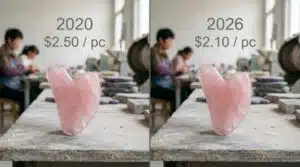
Take a gua sha board that costs $2.00 to produce, with rework adding $0.50 to $0.80 per piece. These figures are illustrations, not industry prices. Rework beats remaking only when its success rate exceeds the ratio of rework cost to remake cost, which is 25% at $0.50 and 40% at $0.80, and inspection and handling time push that bar higher.
Now apply it to 60 defective pieces in a 1,000-piece batch. Remaking all 60 costs $120. Reworking them at $0.65 with a 70% success rate costs $39, plus $36 to remake the 18 failures, for $75 in total and a saving of $45. For cracked pieces the success rate is close to zero, so the same math says remake. That means you can ask any gua sha factory for its rework success rate by defect type before you accept a rework-first policy.
How a Gua Sha Factory Protects Your Delivery Date
Rework pulls polishing capacity, inspector time and scheduling effort away from good production. When repair loops run unchecked, the shipping date slips and batch consistency suffers. A gua sha factory that limits each piece to a set number of rework passes, then remakes it, keeps the schedule predictable. The trade-off is real: a remake costs material, while endless repair costs time, and you pay for one or the other. That means you can write a rework limit and a remake deadline into your purchase order.
How Does Gua Sha QC Stop the Same Defect From Coming Back?

Handling today’s rejects only solves today’s batch. Say 10 boards show uneven polish and all 10 go back to the polishing station: the batch is saved, but whatever caused the unevenness is still running. Real gua sha QC asks why the defect appeared, then changes the process so the next batch does not repeat it. That means you can judge a supplier less by its scrap rate and more by whether the same defect shows up twice.
Five Root-Cause Questions a Gua Sha Factory Asks After a Polishing Defect
After a polishing defect, a gua sha factory with working gua sha QC walks through five checks. Was the operator following the written method? Did the machine, the abrasive consumable or the process settings drift? Is this stone harder to polish than the others in the batch? Was the polishing standard unclear in the first place? Do other pieces from the same batch carry the same hidden problem? Each answer points to a different fix: training, equipment maintenance, a stone-specific setting, a clearer work instruction, or a wider batch check. That means you can ask for the root-cause note on any defect that affected more than a handful of your pieces.
Defect Disposal vs. Corrective Action: What’s the Difference?
Disposal and corrective action answer two different questions, and a factory needs both.
| Layer | Question it answers | Example |
|---|---|---|
| Disposal | What happens to these pieces? | Rework, repair, regrade, approved release or scrap |
| Corrective action | Why did this happen, and how is it stopped? | Adjust polishing settings, retrain, change the inspection method |
A gua sha factory that shows you only the first row is cleaning up, not improving. Run the hypothetical numbers from earlier: a 6% polishing defect rate on a 1,000-piece batch means 60 pieces and about $39 in rework per batch at $0.65 each. Repeat that across 12 batches and the bill reaches $468 a year, before counting polishing capacity and lost days. That means you can ask whether a recurring defect triggers a documented corrective action and a follow-up check that the change worked.
How a Gua Sha Supplier Uses AQL Sampling and Batch Records
ISO 2859-1 defines sampling plans indexed by acceptance quality limit, or AQL, which is the maximum average percentage of defective items accepted during random sampling. Its switching rules move inspection to a tighter level when defects rise and allow lighter inspection when quality stays stable. A gua sha supplier that records defects by batch and process step can feed that data into the same logic. Know the limit, though: ANSI’s overview describes the standard as capping the risk of accepting an occasional poor lot, not removing it. That means you can agree on an AQL in your contract, set separate limits for critical, major and minor defects, and request the gua sha QC report for each lot.
What Are the Five Ways a Gua Sha Manufacturer Disposes of Defective Pieces?

Five outcomes cover every defective piece: rework, repair, regrade, release with your approval, or scrap. In practice, two side routes sit under them, re-cutting a piece to a smaller size and crushing heavy scrap for non-tool uses. Each route has limits, and the limits are where buyers get hurt. That means you can use this section as a checklist when a gua sha manufacturer tells you a defective piece “has been handled.”
Rework vs. Repair: What a Gua Sha Factory Can and Cannot Promise
Rework returns a piece to the original specification. Repair makes it usable but may leave it outside the specification. Picture a stainless steel board with a non-critical cosmetic flaw: a technician can fix it enough to work, but its look still differs from the approved standard, so it does not count as conforming. If the specification covers appearance, size, material or function, a repaired piece needs your sign-off. Defects that touch structure or sharp edges never get a repair of unknown risk just to save cost. That means you can ask your supplier to label each fix as rework or repair, because only repair needs your approval.
Regrading Defective Pieces as B-Grade Stock for Gua Sha Wholesale Buyers
Some pieces work fine but miss the standard of the order they were made for. A gua sha factory can move them into a labeled B-grade, remnant or alternate-spec lot, but only if they meet that lot’s own written standard. Natural variation makes this tricky: GIA notes that typical rose quartz owes its cloudy look to inclusions, so a texture difference may be a natural feature rather than a flaw. Regraded pieces should never slide back into the original order, and for guasha custom pieces carrying your logo, regrading needs your consent because the design is yours. That means gua sha wholesale buyers can request B-grade lots that are priced and labeled separately.
How a Gua Sha Factory Re-Cuts a Large V-Shape Into a Medium Size
V-shaped boards usually come in large, medium and small sizes. When a large V has a small flaw, the piece can be cut and ground down to the medium size, provided the result meets the medium specification for dimensions and thickness. This only works for small flaws, since a deep one leaves nothing to save. The re-cut piece should be re-inspected and counted as medium stock. That means you can accept re-cut pieces only as the smaller size, never as the original one.
Crushed Scrap: Where Heavily Flawed Pieces Go
Pieces with large flaws are crushed into small granules and sold as plant top dressing or aquarium gravel. This keeps the stone out of the tool supply chain for good, which is the main point. Check that the material suits the end use, since a destination outside tool production is the best proof that rejects never come back to your order. That means you can ask where scrap goes and expect a clear answer.
When Scrap Is the Right Call at a Gua Sha Factory
Scrap is correct for cracked stone, broken pieces, deep notches that grinding cannot remove, severe size errors with no material left, and repairs that cost more than a remake. As the earlier math showed, rework needs a success rate above roughly 25–40% in the hypothetical example to pay off. Defects that touch structure or safety are never sold at a lower price, because a discount does not change the risk. That means you can expect a gua sha supplier to say “scrap” without pressure when the stone cannot be saved.
What Is the Standard Workflow When a Gua Sha Factory Finds a Defect?

A gua sha factory that handles defects well follows the same sequence every time, whether the flaw is a scratch or a split. A fixed sequence removes the temptation to improvise under deadline pressure. It also matches what clause 8.7 of ISO 9001:2015 asks for: identification, control, a decision by someone with authority, and a record. That means you can compare any supplier’s process against these steps and spot the gaps in minutes.
The Five-Step Gua Sha Factory Defect Workflow
Step one is identification: the inspector records the defect type, quantity, batch and process step. Step two is isolation, so at a gua sha factory flagged pieces move to a marked hold area and cannot be packed by mistake. Step three is evaluation, where QC, production and, when needed, technical staff judge severity, repair chances, remaining material, cost and risk. Step four is the decision: rework, repair, regrade, release with your approval, or scrap. Step five is re-inspection and records, covering the quantity handled, the result and who authorized it. Skipping step five is the easiest gap to hide, because a reworked piece that is never rechecked looks like a finished one. That means you can ask for the step-five record on any reworked or repaired lot.
How to Trace a Defect to Its Process Step at a Gua Sha Factory
Defects can start at raw material, cutting, CNC machining, grinding and polishing, logo work, assembly or packaging. The batch and process step recorded in step one let a factory trace which stage caused the problem. You can test traceability with one request: pick a past defect and ask the gua sha factory which station produced it and what changed afterward. A gua sha manufacturer with real batch records answers in minutes, while one without them answers with general statements. That means you can separate documented control from verbal reassurance before you place a deposit.
What the Workflow Means for Your Gua Sha Wholesale and Guasha Custom Orders
On compliance, be precise about what a quality standard covers. ISO 9001 certification is a voluntary system standard, and clause 8.7 describes how nonconforming output is controlled, not what a gua sha tool must pass in your market. A gua sha factory can hold the certificate and still ship a flawed batch if its records are thin, so ask for the gua sha QC report for each lot, not just the certificate. Rules for skin-contact tools in your destination market are separate, and this guide does not cover them, so confirm them with your importer or a testing lab. That means you can use the workflow to judge process discipline and rely on separate checks for regulatory requirements.
What Should You Ask a Gua Sha Supplier About Defect Handling Before You Order?

Buyers who ask a gua sha factory about rejects before the order get fewer surprises after it. A gua sha supplier that answers clearly is showing you its system, while one that dodges is showing you its gaps. The questions below take about ten minutes and cost nothing. That means you can screen suppliers before you spend money on samples.
Seven Questions to Ask Any Gua Sha Manufacturer About Rejected Products
- How does the gua sha factory isolate and tag rejected pieces?
- Who can release a deviation, and how do you approve one?
- What happens to scrap, and can you see the scrap log?
- Which defects get reworked, and what is the success rate by defect type?
- Is rework limited to a set number of passes?
- How are reworked pieces re-inspected, and against which standard?
- How does the gua sha factory trace a defect to a batch and process step, and what corrective action followed the last one?
Score each answer as clear, vague or missing. The missing ones show you where to look first in the supplier’s gua sha QC system.
What to Confirm in Writing for Gua Sha Wholesale and Guasha Custom Orders
Put in the contract what the gua sha factory must do, so a dispute is settled by reading the page instead of arguing from memory. Cover the acceptance standard with tolerances, the reference sample for natural color and texture, and the AQL level under ISO 2859-1. For logo and artwork on guasha custom pieces, add the position and depth tolerance and the approved artwork file. Finish with the deviation notice process, a named backup approver, the rework limit, and the date after which a remake replaces further repair. That means you can resolve a disagreement in a day instead of a week.
Limits of a Gua Sha Factory Defect Policy: Risks You Should Still Check
No defect policy removes risk, and three limits deserve plain disclosure. First, borderline calls, such as a hairline mark that may be a surface feature or a crack, depend on inspector judgment. Second, sampling inspection accepts a small share of defects by design, and ANSI’s AQL overview describes the standard as limiting the risk of accepting an occasional poor lot, not eliminating it. Third, the cost figures in this guide are hypothetical illustrations, so your real numbers will differ. Even a gua sha factory with strong QC cannot promise zero defects, and a gua sha factory that discloses its limits is easier to trust than one that promises perfection. That means you can budget for a small defect allowance and add a pre-shipment inspection to your order.
Bottom Line for Buyers
A gua sha factory that earns your trust sorts defects by location, depth and allowance, keeps rejects away from your order, and fixes the cause behind repeat flaws. Apply those three tests to any gua sha supplier, any gua sha manufacturer, and any gua sha wholesale or guasha custom quote, and ask each one to show its gua sha QC records. If a gua sha factory cannot show them, you have your answer before the first order ships.