
What a Gua Sha Factory Does With Defective Gua Sha (A Gua Sha QC Guide for Buyers)
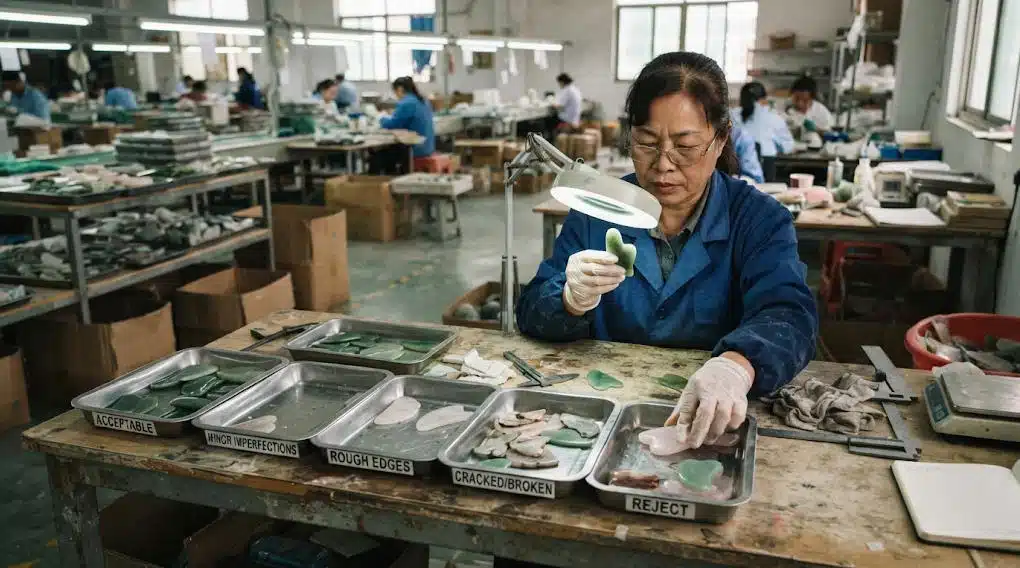
A gua sha factory with 12 years of production history learns one lesson early: defects happen, so what matters is where each defective piece ends up. Every flagged piece goes into one of five outcomes: rework, repair, regrade, customer-approved release, or scrap. Across 14 common defect types, only surface issues such as under-polished faces and rough edges are usually fixable, while cracks, breakage and undersized pieces go to scrap. This article shows you how a gua sha manufacturer makes that call, how gua sha QC keeps rejects out of your shipment, and which risks you should still verify before you sign a gua sha wholesale order. Start with the decision table below, then read the reasoning behind each row. How Does a Gua Sha Factory Decide Between Rework, Repair and Scrap? A gua sha factory does not decide by how bad a flaw looks. It decides by four things: where the flaw sits, how deep it goes, how much material allowance remains, and how the stone behaves under further grinding. Two pieces with the same visible scratch can end up in different bins, because one still has spare thickness and the other does not. Of the 14 defect types, four usually end in rework, four lean toward scrap, two go to you for a decision, and four depend on allowance and the size of the error. That means you can ask any gua sha manufacturer for its disposition logic by defect type, instead of accepting a vague promise that problems get handled. Defect Usual route Why Under-polished surface Rework Room remains for fine grinding and polishing Rough edge Rework The edge can be smoothed further Slightly oversize Evaluate rework Depends on remaining allowance Undersized or too thin Scrap or other use Stone cannot be added back Stone crack Scrap The structural risk stays under the polish Deep chip Depends on allowance Small chips can be trimmed, large ones cannot Color deviation Regrade or your approval Function is intact, but the order standard is missed Broken piece Scrap Cannot be restored reliably Which Defects at a Gua Sha Factory Can Be Reworked? Rework fits problems that sit on the surface. A rose quartz board with uneven gloss but correct shape, thickness and structure goes back to the polishing station and then through inspection again. The same applies to rough edges and light machining marks, as long as grinding removes them without cutting into the finished curve. You can check a rework claim in three steps. First, ask where the defect sits. Second, ask how much material remains after the fix. Third, ask to see the re-inspection result. That means you can accept reworked pieces only when the record shows they match your original standard, and not just because they look smoother. Why a Gua Sha Factory Scraps Cracked, Broken and Undersized Pieces Some defects cannot be polished away. GIA’s rose quartz buyer’s guide notes that the stone often contains microscopic internal fractures, and GIA’s care page rates it 7 on the Mohs scale. Hardness measures scratch resistance, not crack tolerance, so a tool that resists scratching can still split along a stress line. A crack that polishing hides carries the same structural risk, which is why a gua sha factory with sound QC scraps it instead of selling it at a discount. Undersized and thin pieces follow the same logic, because no process adds stone back. This means you can treat any offer of “polished-over” stock at a lower price as a warning sign. One risk deserves honest disclosure here. Scrap calls involve judgment, and a hairline mark may be a surface feature or a true crack. Two inspectors can disagree, so borderline pieces should be photographed and the decision recorded. Ask to see those photos. Logo Problems on Guasha Custom Orders: Repair or Scrap? A logo that sits slightly off position can sometimes be re-engraved, provided the surface has allowance for it. A logo cut too deep usually cannot be fixed, because removing it means cutting into thickness and shape. On guasha custom orders, a re-engraved piece is no longer the piece you approved, so it needs a fresh check against your artwork file. That means you can write a depth and position tolerance into your guasha custom specification, and a bad engraving gets rejected before packing. Color and Texture Variation: Who Makes the Call? Color shifts and texture differences rarely affect how the tool works, but they do affect the standard you approved. In that case a gua sha factory either regrades the pieces into a labeled B-grade lot or sends you photos and quantities for written approval. Natural stone varies, so the practical fix is an approved reference sample that separates a natural feature from a defect. Would you rather learn about a darker batch from a photo before shipping, or from a customer review after launch? How Does a Gua Sha Supplier Keep Rejected Pieces Out of Your Order? The question behind any defect policy is whether a rejected piece can reach your pallet. ISO 9001:2015 clause 8.7 requires producers to identify and control nonconforming output so it is not used or delivered by mistake. A gua sha supplier that follows this rule treats separation, decision authority and records as three different controls. That means you can audit a factory’s reject handling by asking for proof of each one. Isolation and Tagging: How a Gua Sha Factory Prevents Mixed Packing When an inspector flags a piece, the defect type, quantity, batch and process step go on record, and the piece moves to a marked hold area. Physical separation matters more than a label alone, because mixed bins are how a rejected board ends up in a carton. At a gua sha factory, the hold area is where pieces wait for a joint call from QC, production and, when needed, technical staff, and nothing ships from it without sign-off. That means you can request a photo of the hold area with its tags, and you will know […]
What a Gua Sha Factory Does With Defective Gua Sha (A Gua Sha QC Guide for Buyers) Read More »
A gua sha factory with 12 years of production history learns one lesson early: defects happen, so what matters is where each defective piece ends up. Every flagged piece goes into one of five outcomes: rework, repair, regrade, customer-approved release, or scrap. Across 14 common defect types, only surface issues such as under-polished faces and rough edges are usually fixable, while cracks, breakage and undersized pieces go to scrap. This article shows you how a gua sha manufacturer makes that call, how gua sha QC keeps rejects out of your shipment, and which risks you should still verify before you sign a gua sha wholesale order. Start with the decision table below, then read the reasoning behind each row. How Does a Gua Sha Factory Decide Between Rework, Repair and Scrap? A gua sha factory does not decide by how bad a flaw looks. It decides by four things: where the flaw sits, how deep it goes, how much material allowance remains, and how the stone behaves under further grinding. Two pieces with the same visible scratch can end up in different bins, because one still has spare thickness and the other does not. Of the 14 defect types, four usually end in rework, four lean toward scrap, two go to you for a decision, and four depend on allowance and the size of the error. That means you can ask any gua sha manufacturer for its disposition logic by defect type, instead of accepting a vague promise that problems get handled. Defect Usual route Why Under-polished surface Rework Room remains for fine grinding and polishing Rough edge Rework The edge can be smoothed further Slightly oversize Evaluate rework Depends on remaining allowance Undersized or too thin Scrap or other use Stone cannot be added back Stone crack Scrap The structural risk stays under the polish Deep chip Depends on allowance Small chips can be trimmed, large ones cannot Color deviation Regrade or your approval Function is intact, but the order standard is missed Broken piece Scrap Cannot be restored reliably Which Defects at a Gua Sha Factory Can Be Reworked? Rework fits problems that sit on the surface. A rose quartz board with uneven gloss but correct shape, thickness and structure goes back to the polishing station and then through inspection again. The same applies to rough edges and light machining marks, as long as grinding removes them without cutting into the finished curve. You can check a rework claim in three steps. First, ask where the defect sits. Second, ask how much material remains after the fix. Third, ask to see the re-inspection result. That means you can accept reworked pieces only when the record shows they match your original standard, and not just because they look smoother. Why a Gua Sha Factory Scraps Cracked, Broken and Undersized Pieces Some defects cannot be polished away. GIA’s rose quartz buyer’s guide notes that the stone often contains microscopic internal fractures, and GIA’s care page rates it 7 on the Mohs scale. Hardness measures scratch resistance, not crack tolerance, so a tool that resists scratching can still split along a stress line. A crack that polishing hides carries the same structural risk, which is why a gua sha factory with sound QC scraps it instead of selling it at a discount. Undersized and thin pieces follow the same logic, because no process adds stone back. This means you can treat any offer of “polished-over” stock at a lower price as a warning sign. One risk deserves honest disclosure here. Scrap calls involve judgment, and a hairline mark may be a surface feature or a true crack. Two inspectors can disagree, so borderline pieces should be photographed and the decision recorded. Ask to see those photos. Logo Problems on Guasha Custom Orders: Repair or Scrap? A logo that sits slightly off position can sometimes be re-engraved, provided the surface has allowance for it. A logo cut too deep usually cannot be fixed, because removing it means cutting into thickness and shape. On guasha custom orders, a re-engraved piece is no longer the piece you approved, so it needs a fresh check against your artwork file. That means you can write a depth and position tolerance into your guasha custom specification, and a bad engraving gets rejected before packing. Color and Texture Variation: Who Makes the Call? Color shifts and texture differences rarely affect how the tool works, but they do affect the standard you approved. In that case a gua sha factory either regrades the pieces into a labeled B-grade lot or sends you photos and quantities for written approval. Natural stone varies, so the practical fix is an approved reference sample that separates a natural feature from a defect. Would you rather learn about a darker batch from a photo before shipping, or from a customer review after launch? How Does a Gua Sha Supplier Keep Rejected Pieces Out of Your Order? The question behind any defect policy is whether a rejected piece can reach your pallet. ISO 9001:2015 clause 8.7 requires producers to identify and control nonconforming output so it is not used or delivered by mistake. A gua sha supplier that follows this rule treats separation, decision authority and records as three different controls. That means you can audit a factory’s reject handling by asking for proof of each one. Isolation and Tagging: How a Gua Sha Factory Prevents Mixed Packing When an inspector flags a piece, the defect type, quantity, batch and process step go on record, and the piece moves to a marked hold area. Physical separation matters more than a label alone, because mixed bins are how a rejected board ends up in a carton. At a gua sha factory, the hold area is where pieces wait for a joint call from QC, production and, when needed, technical staff, and nothing ships from it without sign-off. That means you can request a photo of the hold area with its tags, and you will know […]