
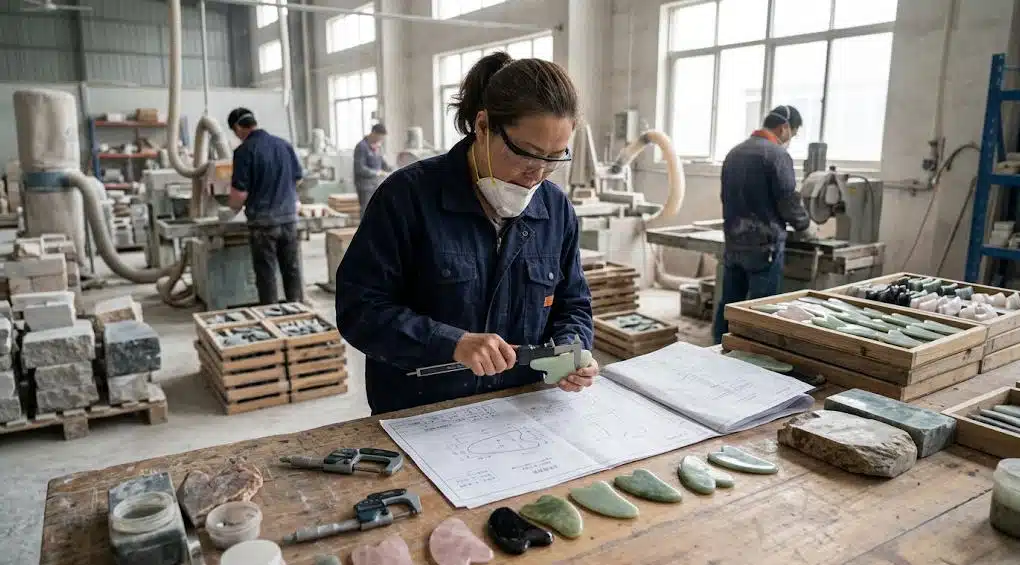
A gua sha custom project is decided long before the first stone is cut. According to the International Gem Society (IGS), nephrite rates 6–6.5 on the Mohs scale and jadeite 6.5–7, so a thin edge or a sharp inside corner can crack during grinding. After 12+ years as a gua sha manufacturer, our team has watched the same avoidable design mistakes repeat across projects. This means you can protect most of your sampling budget just by knowing where the risks sit.
This article walks you through the risks that show up most often in gua sha oem work, what each one costs you, and how to remove it before you pay for a sample. Think of it as the conversation we wish every buyer had with a gua sha factory before sending a drawing.
- Why a Gua Sha Custom Order Breaks at the Design Stage First
- Why Your Gua Sha Custom Order Won't Match the Sample Piece for Piece
- What a Gua Sha Custom Project Really Costs, and How to Calculate Your Return
- Compliance Checklist for a Gua Sha Custom Order: Materials, Nickel, and Claims
- How to Start Your Gua Sha Custom Project: A Step-by-Step Path From Sketch to Shipment
- Frequently Asked Questions About Gua Sha Custom Projects
Why a Gua Sha Custom Order Breaks at the Design Stage First

Most buyers expect trouble in production, but a gua sha custom order usually runs into it at the drawing stage. A shape that looks smooth on screen can turn out impossible to cut, polish, or hold at the thickness you specified. A design rejected after sampling costs you raw material, machine time, and calendar time, while a design question raised before sampling costs you one conversation. So why do so many projects still skip that conversation?
How Jade and Crystal Fail in a Gua Sha Custom Shape
The Gemological Institute of America (GIA) describes jade as a generic term covering nephrite, jadeite, and, under certain conditions, green omphacite, as listed in GIA’s jade research library. Both jade minerals are polycrystalline aggregates of interlocking grains or fibers, which gives them their toughness, yet the IGS is clear that the stone isn’t indestructible. Hardness and toughness are not the same thing: a stone rated 6.5–7 resists scratches well but can still chip along a thin, unsupported edge. This means you can keep a dramatic edge profile only if you leave enough thickness behind it to survive grinding.
Crystal and other natural stones add a second variable, which is internal structure. Fractures and inclusions that are invisible on the surface of a rough block can open up once you carve a groove or drill a hole. A deep groove or a sharp inside corner concentrates stress at the exact point where the wheel pushes hardest. Would you trust that corner if it were cut from a slab with a hidden flaw? Adding a radius to those corners in your gua sha custom drawing usually reduces breakage, which means you can get more finished pieces from every block you pay for.
What a Gua Sha Factory Checks Before Any Cutting Starts
For natural stone, the review starts with weak points. Thin sections, deep grooves, and sharp inside corners raise the chance of breakage during cutting and grinding, so each one gets checked against the actual thickness and structure of the raw material. The review also asks whether your target thickness survives polishing, because polishing removes material, and whether your color or pattern preference forces extra block selection and lowers material utilization. This means you can learn, before paying for a sample, which features raise your unit cost and which ones are free.
Stainless steel pieces get a different review in a gua sha oem project. The questions are which steel grade and sheet thickness suit the shape, and whether CNC machining, stamping, forming, or a combination fits the structure. A complex outline adds machining time, toolpath work, and fixture needs, and it raises the risk of deformation, surface scratches, and out-of-tolerance dimensions. This means you can choose a simpler outline wherever the extra machining time buys you nothing in use.
What to Do When a Gua Sha Manufacturer Flags a Risk
When a risk turns up, the right response is a decision, not a surprise invoice. Here is how you can handle it:
- Ask for the problem in writing, naming the exact feature, such as a groove depth or an inside corner.
- Request two or three alternatives, and compare how each one changes function, appearance, machining difficulty, cost, and production risk.
- Mark which dimensions affect how the tool works and which ones can tolerate normal manufacturing variation.
- Approve the revised drawing in writing before any sample is made.
A responsible supplier will not change your design without your consent. The job is to help you decide with full information before sampling or production money is spent. If your supplier says “no problem” to every drawing, treat that as a warning, not a compliment. This means you can walk into sampling knowing your drawing has already been tested against real cutting and polishing limits.
Why Your Gua Sha Custom Order Won’t Match the Sample Piece for Piece

Natural stone does not repeat itself. Two pieces cut from the same block can differ in color depth, translucency, and veining, and two blocks from the same supplier can differ even more. A gua sha custom buyer who expects identical twins from jade or crystal is setting up a dispute for the day the shipment lands. The better question is not “will every piece match?” but “what range of difference will you accept, and is that range written down?”
How Natural Variation Shows Up in a Gua Sha Custom Batch
The trade publication Jewellery Business notes that jadeite occurs in lavender, yellow, black, white, red, orange, blue, grey, and even colourless, while nephrite appears in white, grey, black, yellow, and brown. That is a wide palette before you add the shifts in texture and translucency inside a single block. When your gua sha custom order names a color such as “milky white” or “spinach green,” you are naming a range, not a single swatch. This means you can avoid arguments later by approving physical material swatches in advance instead of relying on photos alone.
Appearance requirements also drive your cost. A narrow color window forces more blocks to be sorted and rejected, which lowers material utilization and raises the price of every finished gua sha custom piece. A wider window with clear defect rules keeps utilization higher. In any gua sha oem negotiation, the width of your acceptable range is one of the few levers that moves price without touching function. This means you can lower your unit cost by widening the cosmetic range in places where your customers will never notice the difference.
What a Golden Sample Locks, and What It Cannot
Once your design is approved, the sample you sign becomes the Golden Sample, the physical reference for production and inspection. For natural stone, it defines a reference range for quality and appearance. It does not promise that every piece will repeat the same pattern, because no gua sha factory can cut identical veining out of a mineral. If a major change arrives after the design freeze, it gets a technical and commercial review first, and it may trigger a new sample. This means you can treat the Golden Sample as a benchmark you can hold production to, not as a pattern to be photocopied.
Here is how to make that benchmark useful when you brief a gua sha manufacturer. Ask for two or three boundary pieces alongside the Golden Sample, showing the lightest, darkest, and most heavily veined pieces you will still accept. Photograph all of them under the same light, and attach them to a spec sheet that lists thickness, size, surface finish, and logo position with tolerances. Then agree on how defects are classified before anything ships, because a cosmetic shade shift and a structural crack are not the same problem:
| Defect type | Example | Handling to agree in advance |
|---|---|---|
| Cosmetic difference | Shade within the boundary pieces | Accept |
| Structural flaw | Hairline crack near an edge | Reject and replace |
| Dimensional deviation | Thickness outside tolerance | Rework or reject per spec |
| Logo error | Wrong size or position | Rework or replace |
The handling column is a starting point for your negotiation, and the right answer depends on your product and your customers. This means you can settle every “is this acceptable?” question with a document instead of an email thread.
Treatment Disclosure: A Hidden Risk in Any Gua Sha Custom Material Spec
Jade carries a risk that plain quartz buyers rarely face: treatment. Jadeite is commonly sorted into Type A (natural and untreated), Type B (bleached and polymer-impregnated), and Type C (dyed), and a Jewellery Business feature warns that the polymer process damages the structure and makes the jadeite brittle. A brittle gua sha tool is a returns problem, not just a labeling problem. Nephrite is seldom treated because its structure rarely accepts dyes or resins, though heat treatment may be used to improve color. Your gua sha custom spec should therefore name the exact material (nephrite, jadeite, or the crystal type) and state that bleaching, polymer impregnation, and dyeing are not allowed. This means you can protect your brand from brittle stock and mislabeled material.
For higher-value stones, the market relies on independent laboratories to document treatment status. The Swiss Gemmological Institute, SSEF, introduced a full gem treatment disclosure policy in 1998, and labs such as SSEF and the GIA publish reports and research on jade treatments. You do not need a lab report for every tool, but you can request one for a sample piece or for the rough material when your gua sha custom product claims a specific mineral or an untreated origin. Any gua sha manufacturer that sources honestly will not resist the request. This means you can back your material claims with independent evidence instead of a supplier’s word.
What a Gua Sha Custom Project Really Costs, and How to Calculate Your Return

Quotes for a gua sha custom project confuse buyers because they mix two different kinds of money. One kind is spent once: design development, engineering work, samples, and any molds or fixtures. The other kind repeats on every order: raw material, machining or cutting, polishing, inspection, and packing. If you compare two quotes without separating them, a low unit price with hidden one-time fees can look cheaper than an honest quote that shows everything up front.
One-Time Fees vs. Per-Piece Cost in a Gua Sha OEM Order
Ask every supplier to split the quote into those two buckets, and ask what the sample fee actually covers. A sample fee might include the raw material, the machine time for the first piece, and a set number of revision rounds, after which extra rounds are charged. Those rules differ between suppliers, and you will only find out which rules apply if you ask before you pay. This means you can compare quotes on the same basis and catch a cheap-looking offer that makes up the difference through revision charges.
Quantity changes the picture too, because one-time costs are spread over every piece you order. The table below uses hypothetical figures (not a price list) to show how a $1,450 one-time total (development $600, three sample rounds $450, tooling and fixtures $400) behaves at three order sizes:
| Order quantity | Unit production price | One-time cost per piece | Landed cost per piece |
|---|---|---|---|
| 1,000 | $4.90 | $1.45 | $6.35 |
| 3,000 | $4.20 | $0.48 | $4.68 |
| 5,000 | $3.90 | $0.29 | $4.19 |
At a $12 wholesale price, the gross margin moves from about 47% at 1,000 pieces to 61% at 3,000 and 65% at 5,000. This means you can see why the first order is the most expensive one you will ever place, and why a repeat order of the same design costs less once development is paid off.
A Worked Example of Gua Sha Custom ROI
Numbers get more interesting when you add the design risks from the first chapter. Suppose a sharp inside corner raises stone breakage from 3% to 10% on a 3,000-piece run. That extra 7% is 210 pieces, and at $4.20 each you lose roughly $882 in material and machine time. Adding a corner radius costs you nothing on the drawing. Compare that with one avoided sample round at $150, and the review before sampling pays for itself several times over on this single feature. This means you can treat the design review as the cheapest line item in your gua sha custom budget, not an optional extra.
Now run the same logic across two orders. Your first 3,000 pieces carry the full $1,450 and land at $4.68 each. A second order of 3,000 pieces from the same approved design carries no development cost and lands at $4.20. Across both runs, your blended cost is about $4.44 per piece, which is $26,650 spread over 6,000 pieces. Are you planning only one order? Then your real cost is the first-order figure, and you should price your product with that number, not the repeat-order one.
Who Owns the Tooling, and Why Lead Times Stay Open
Tooling is where a gua sha custom contract most often goes quiet and later turns loud. Write down what the mold or fixture fee covers, how long it stays in use, who owns it, and whether it can be moved to another supplier if you leave. A gua sha factory that answers these questions in writing is easier to work with than one that answers them after a dispute starts. This means you can keep your tooling investment protected if your volumes grow or your sourcing changes.
Lead time deserves the same honesty. Total development time depends on design complexity, material supply, the number of sample revisions, and whether tooling must be built, so a reliable gua sha manufacturer will estimate it in stages instead of promising one fixed number of days on day one. A date only becomes reliable once the key specs, material, production method, and order quantity are confirmed. Before you issue a purchase order, agree on what happens if a design change arrives, if material supply is interrupted, or if the trial run fails inspection, and put payment terms, delivery arrangements, and acceptance rules in the same document. This means you can plan your launch around a schedule that has actual conditions attached to it, not a hopeful promise.
Compliance Checklist for a Gua Sha Custom Order: Materials, Nickel, and Claims

Compliance often gets treated as paperwork, yet it decides whether your first container clears customs and whether a marketplace keeps your listing live. There is no single “gua sha law.” A gua sha custom product touches rules on material chemistry, skin-contact safety, and the claims printed on your box. Requirements also differ by market, so treat what follows as a map rather than legal advice, and confirm the details for your destination with a testing lab or regulatory adviser. This means you can ask sharper questions before you spend money on testing.
Nickel Limits That Shape a Stainless Steel Gua Sha Custom Design
Under entry 27 of Annex XVII to EU REACH, articles intended for direct and prolonged skin contact must not release more than 0.5 µg of nickel per square centimetre per week, and a coated article has to hold that limit for at least two years of normal use, according to ECHA’s conditions of restriction. The reference test, EN 1811, soaks the item in artificial sweat for one week, and Wikipedia’s summary of the Nickel Directive notes that roughly 10% of people in Western Europe and North America are sensitive to nickel. Many stainless steel grades contain nickel, so the grade named in your gua sha custom design matters. Whether a facial tool used for a few minutes counts as “prolonged” contact is an interpretation question, and ECHA’s guidance on contact duration is summarised by SGS, so ask your adviser instead of assuming. This means you can decide early whether to test, rather than finding out at a customs hold.
Here is a practical sequence for any gua sha oem order in steel. State the exact grade and surface treatment in your spec. Ask your gua sha factory to send finished, polished samples to an accredited lab for EN 1811 testing, because raw sheet and a polished piece can behave differently. Then read the report carefully: the 2015 amendment EN 1811:2011+A1:2015 uses a pass level of 0.88 µg/cm²/week for such articles to allow for measurement uncertainty, according to Intertek, so ask which criterion your lab applied. Retest whenever the grade, coating, or polishing process changes. This means you can reuse one valid report across repeat orders without paying for a new one each time, as long as nothing in the product has changed.
What ISO 20308 Means for Natural Stone Gua Sha
ISO 20308:2017, titled “Traditional Chinese medicine — Gua Sha instruments,” was adopted by the Saudi Food and Drug Authority, and the foreword of its published copy lists topics such as instrument dimensions, biocompatibility, and radionuclide activity. The radionuclide point deserves your attention for natural stone, because mineral content varies by source. Check the current edition and its scope with ISO or your lab before quoting it in marketing. Ask your gua sha manufacturer whether a given stone batch can be tested against the requirements you plan to claim. This means you can turn a material claim into a document instead of leaving it as a slogan.
Claims, Labels, and the Line Between a Tool and a Device in Gua Sha Custom Orders
A plain manual stone tool and a device with extra functions are treated differently. The FDA’s database lists an LED-equipped gua sha cleared through the 510(k) pathway for treating wrinkles under 21 CFR 878.4810, as shown in record K252272. Adding light, heat, or vibration, or printing treatment claims on your packaging, can change which rules apply. So ask yourself before you approve the box copy: are you selling a tool or a treatment? Your gua sha custom label should describe what the product is, what it is made of, and how to care for it, and your regulatory adviser should review any benefit claim before it is printed. This means you can keep your product in the regulatory category you planned for.
Before your first purchase order, request these documents from your supplier and file them with your gua sha custom spec:
| Document | What it covers | When to request it |
|---|---|---|
| Material declaration | Mineral or steel grade, treatment status | Before sampling |
| EN 1811 nickel release report | Finished stainless steel pieces | Before the first order |
| Stone batch test report | Any safety or material claim you make | Per batch, where required |
| Final label and packaging proof | Every printed word and symbol | Before printing |
This means you can walk into a customs check or a marketplace review with documents in hand.
How to Start Your Gua Sha Custom Project: A Step-by-Step Path From Sketch to Shipment

You do not need a finished drawing to begin a gua sha custom project. A hand sketch, a reference photo, or a rough concept is enough for a supplier to start asking the right questions. Five things are worth settling first: what the tool does (face or body), what shape and ergonomics you want, which material you prefer, which market you sell into, and your targets for unit price, first order size, and launch window. This means you can start the conversation this week with what you already have.
Stages 1–4: From Brief to Feasibility Review in a Gua Sha OEM Project
Stage one is the Product Brief, a short document that records purpose, design direction, material preference, and development requirements. A responsible gua sha manufacturer will not assume every idea can be produced; it will fill in missing information and flag what needs more evaluation. Stage two turns the concept into drawings or a 3D model with overall size, thickness, edge curves, radii, grooves, and holes, and it separates the dimensions that affect function from the ones that can tolerate normal manufacturing variation. Stage three is the feasibility review described in the first chapter, and stage four confirms the material, with swatches for stone and a full grade-and-finish description for steel. Skipping any of these four stages in a gua sha oem project usually moves the problem to a more expensive stage. This means you can reach sampling with a drawing that has already been checked against cutting, polishing, and machining limits.
Stages 5–8: Sampling, Design Freeze, and Pilot Runs for a Gua Sha Custom Order
The first engineering sample of a gua sha custom order tests your drawing; it does not promise anything about bulk goods. Check overall size, thickness at key points, edge curves, surface finish, weight and grip, logo position, and any assembly fit, and log every round of feedback in writing. Batch related changes into one round, because each revision affects material use, sample cost, and your timeline. Once the sample meets your requirements, approve it in writing, and the design is frozen together with the final spec sheet and the Golden Sample. This means you can separate design problems from production problems and avoid paying twice to fix the same thing.
Before full production, ask for a pilot run or process validation. A technician can spend many hours making one sample by hand, but a production order has to be repeated at a workable cost, cycle time, and quality. A gua sha factory should confirm its equipment, process sequence, critical parameters, fixtures, cycle time, material utilization, expected yield, and inspection checkpoints. Any repeated defect should be traced to its source (design, material, tooling, process, or inspection method) and fixed before the full run starts. This means you can learn the true yield and lead time of your gua sha custom product from real data instead of estimates.
How to Judge a Gua Sha Factory Before You Commit
Across the ten stages from brief to shipment, ask three questions. Can the supplier spot design risks before cutting? Can it propose changes without altering your design behind your back? Can it turn the approved version into a repeatable production plan? A supplier that answers “no problem” to every drawing is telling you what you want to hear, not what the stone will tolerate. Ask for written feasibility feedback, the sample revision rules, tooling ownership terms, the quality standard, and the test reports covered in the compliance chapter, then compare what each gua sha factory sends back. This means you can choose a partner on evidence of engineering judgment, not on the lowest quote.
Your Next Step With Gua Sha Custom Development
Deyi Gems has worked as a gua sha manufacturer for 12+ years in jade and crystal tools, and its team reviews sketches, 3D files, and function requirements before any sample is cut. If you have an idea, a drawing, or a 3D model, send what you have, and the first reply will cover your project goals and the open questions that need answers, not a sales pitch. Your next gua sha custom project can start with that one message. This means you can learn what your idea will cost in risk and money before you commit to a single sample fee.
Frequently Asked Questions About Gua Sha Custom Projects
1. What do I need to start a gua sha custom project?
A hand sketch, a reference photo, or a rough concept is enough to begin. Your supplier will ask five things: whether the tool is for face or body, what shape and grip you want, which material you prefer, which market you sell into, and your targets for unit price, first order size, and launch window. This means you can open the conversation with what you already have, without waiting for a finished drawing.
2. How much does a gua sha custom order cost?
The cost splits into two parts: one-time fees (design development, engineering, samples, tooling) and per-piece costs (material, cutting or machining, polishing, inspection, packing). One-time fees get spread across your order, so the same project costs less per piece at 5,000 units than at 1,000. In the hypothetical example in this article, a $1,450 one-time total added about $1.45 per piece at 1,000 units and about $0.29 at 5,000. This means you can compare quotes fairly only after each supplier separates the two parts.
3. How long does a gua sha custom project take?
No honest supplier can give you a fixed total until the key details are settled. Timing depends on design complexity, material supply, the number of sample revisions, and whether tooling must be built. A date becomes reliable once the specs, material, production method, and order quantity are confirmed. This means you can ask for stage-by-stage estimates and build your launch plan around those, not around a single number promised on day one.
4. Will every natural stone piece match my sample exactly?
No. Color, translucency, and veining vary between pieces and between blocks, and even Jewellery Business lists a wide range of natural colors for both jadeite and nephrite. The Golden Sample defines a reference range for quality and appearance, not a pattern to copy. This means you can protect yourself by approving boundary pieces (lightest, darkest, most veined) alongside the Golden Sample.
5. Who owns the mold or tooling in a gua sha oem contract?
Whatever the contract says, so write it down. Specify what the tooling fee covers, how long it stays in use, who owns it, and whether it can move to another supplier. Many disputes start because these points were never discussed. This means you can keep your tooling investment protected if your volumes grow or your sourcing changes.
6. Can a stainless steel gua sha meet nickel release limits?
It can, but it needs testing on the finished piece. EU REACH Annex XVII entry 27 limits nickel release to 0.5 µg/cm² per week for articles in direct and prolonged skin contact, as set out in ECHA’s conditions of restriction. Whether a facial tool counts as “prolonged contact” is an interpretation question, so ask your testing lab or regulatory adviser. This means you can decide early whether an EN 1811 report is worth ordering for your gua sha custom design.