A gua sha manufacturer cannot repair a stone that finishes below its minimum thickness. If your spec is 5.0 mm with a 4.8–5.2 mm tolerance, a 4.6 mm piece goes to scrap or downgrade, while a 5.3 mm piece can often be re-ground. The better fix sits upstream: in gua sha production, the blank is cut thicker by a measured allowance, and gua sha manufacturer QC confirms thickness at every stage. In one illustrative model of 1,000 pieces, that single change recovers about RMB 515.20 in material value. This article shows how a gua sha factory handles each case, what the numbers look like, and which questions you should ask before you place an order.
- What a Gua Sha Manufacturer Does When Thickness Falls Out of Tolerance
- How a Gua Sha Manufacturer Sets Blank Thickness in Gua Sha Production
- What Thickness Control Is Worth to a Gua Sha Manufacturer and to You
- What Compliance and Quality Records You Can Expect from a Gua Sha Manufacturer
- Risk Disclosure: What a Gua Sha Manufacturer Cannot Promise
What a Gua Sha Manufacturer Does When Thickness Falls Out of Tolerance

Thickness is the one dimension on a stone gua sha that only moves in one direction. Grinding removes material, and nothing puts it back. That single fact drives every decision a gua sha factory makes once a measurement lands outside your tolerance. This means you can predict how a thickness problem will be handled before a single stone is cut.
Why a Gua Sha Manufacturer Cannot Repair Stone That Is Too Thin
When a finished piece measures below your lower limit, the material is already gone. Polishing it again only thins it further, and no shaping step can restore 0.2 mm of crystal or jade. With a 5.0 mm spec and a 4.8–5.2 mm tolerance, a 4.6 mm piece sits 0.2 mm under the floor, so it is rejected and pulled from your order. Raw stone, cutting, shaping and some labor have been paid for by then, and most of that cost does not come back. This means you can expect a clear reject rule from your supplier instead of a “close enough” shipment.
Material type raises the stakes. The International Gem Society hardness chart lists quartz at 7, jadeite at 6½–7 and nephrite at 6–6½ on the Mohs scale, and the same page warns that Mohs measures scratch resistance only, not toughness against impact. A thinner section also leaves less stone to absorb a knock. This means you can treat thickness tolerance as a durability check as well as a cosmetic one.
When Thicker Stones Can Be Re-Ground, and When They Cannot
A piece above the upper limit is a different story. At 5.3 mm it sits 0.1 mm over, so your supplier measures it, checks the remaining allowance and decides whether re-grinding is safe. The rework has to protect flatness, edge curvature, outline dimensions and polish, and it stops the moment any of those would suffer. Grinding adds hours, abrasive and machine time, yet it usually has a better chance of recovering value than scrapping the piece. The table shows how the logic plays out against a 4.8–5.2 mm tolerance.
| Finished thickness | Position vs. tolerance | Typical action |
|---|---|---|
| 4.6 mm | 0.2 mm under the lower limit | Reject; scrap or downgrade |
| 5.0 mm | Inside tolerance | Accept |
| 5.3 mm | 0.1 mm over the upper limit | Measure allowance, then re-grind |
| 5.5 mm | 0.3 mm over the upper limit | Evaluate rework feasibility and cost |
These values illustrate the logic and are not a universal standard. This means you can ask any gua sha manufacturer QC team for its written action rule at each of these four points before you approve a sample.
What Happens to Scrap Stone, and Why You Should Ask
Rejected stone does not always become waste. If it is uncontaminated, it can be crushed, sorted and sold as aquarium or garden decor, although that outlet pays far less than a finished tool. Not every fragment suits a fish tank, because mineral content, cleanliness, polishing residue and water safety all matter. GIA’s jade buyer’s guide notes that jade can be dyed, bleached, heated, waxed and impregnated, which is why treated offcuts need a check before any reuse. Every rejected piece is a cost in gua sha production that returns only in part. A gua sha manufacturer that keeps a scrap-sorting log can show you where its leftover stone goes. This means you can verify that treated offcuts stay apart from clean ones.
How a Gua Sha Manufacturer Sets Blank Thickness in Gua Sha Production

In gua sha production, the cheapest place to fix thickness is the saw, not the polishing wheel. Once a blank is cut too thin, every later step can only make it worse. So the real question is not how hard your supplier inspects at the end, but how much stone it leaves for the steps in between. This means you can judge a supplier by its blank-thickness rule rather than by its final-inspection promise.
How Much Thicker Should a Gua Sha Blank Be Cut?
Take your 5.0 mm spec with a 4.8–5.2 mm tolerance. Cutting, shaping and polishing all remove stone, and the saw blade itself turns part of the block into dust. Suppose a gua sha manufacturer‘s records show a combined removal of 0.30 mm with a swing of ±0.10 mm, a hypothetical figure used here to show the logic. A 5.0 mm blank then finishes between 4.6 and 4.8 mm, at or below your floor, while a 5.3 mm blank finishes between 4.9 and 5.1 mm, inside tolerance. This means you can see why a blank cut to the final spec fails by design.
Why a Gua Sha Factory Should Not Simply Cut Everything Thicker
Thicker is not automatically safer. Under the same assumptions, a 5.6 mm blank finishes between 5.2 and 5.4 mm, so most pieces land above your ceiling and need extra grinding. That adds cutting time, abrasive consumption and machine hours to every batch, and it can disturb outline dimensions and throughput. A gua sha factory that over-allows lowers its scrap rate but raises its grinding bill. This means you should expect the right allowance to be a calculated number, not the biggest one available.
Four Steps a Gua Sha Manufacturer Uses to Set Machining Allowance
You can run this method yourself or ask your gua sha manufacturer to show it. First, fix the finished standard: nominal thickness, tolerance limits and any position-specific requirements. Second, measure real loss from past orders at four points: cutting, shaping, finishing and polishing. Third, set the blank target by adding that average loss to the nominal thickness, then add a buffer for saw-blade loss, machine accuracy and material variation. Fourth, measure after cutting, after shaping and after polishing, so a drift shows up at the first stage instead of the last.
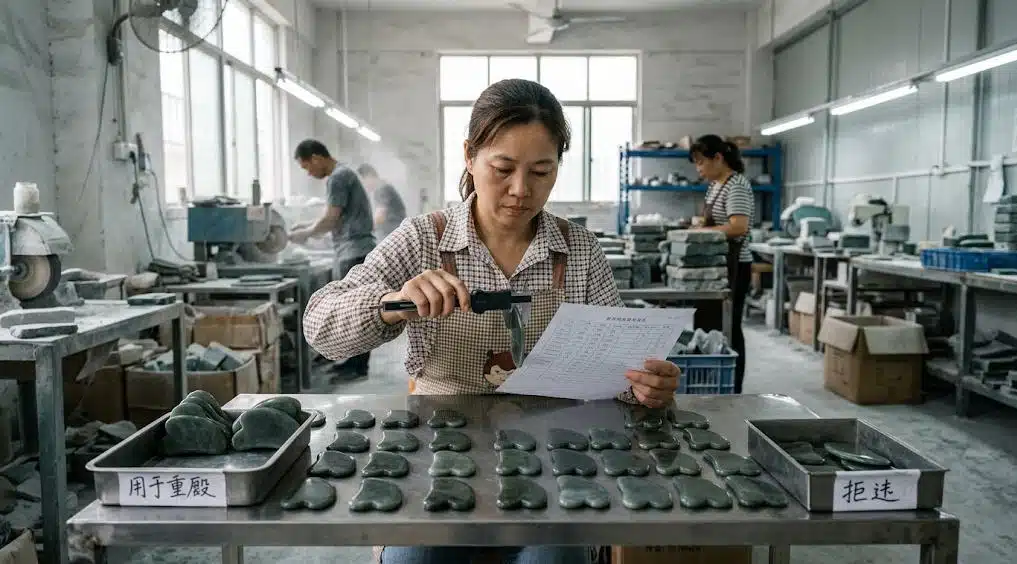
The fourth step is where gua sha manufacturer QC earns its keep. A first-piece check after cutting catches a blade or machine setting that is off before a whole batch is sliced at the wrong thickness. A sample check at shaping and polishing catches pieces heading toward the floor while you can still stop them. This means you can ask for the three measurement records for your batch, not just a final pass or fail.
What Extra Thickness Cannot Fix in Natural Crystal and Jade
Allowance changes the odds, not the nature of the stone. Natural crystal and jade carry internal cracks, veining and local structure differences, so a piece can fracture during cutting no matter how thick the blank is. SSEF’s free introduction to jade course covers how jade forms and how it is processed from rough to cut, and one of its lessons states that jade is a rock, which is why one slab can behave differently from the next. Even a well-run gua sha manufacturer cannot see a hidden crack from the outside, and a cracked piece found at the cutting stage costs less than one found after polishing, which is why gua sha manufacturer QC records matter. A supplier that quotes a realistic scrap range in gua sha production is easier to plan around than one that promises none. Why would any stone supplier promise zero breakage? This means you should read a “zero scrap” claim as a warning, and ask for the historical loss data instead.
What Thickness Control Is Worth to a Gua Sha Manufacturer and to You

Thickness control only earns its place if the arithmetic works. Below is the simplest version, built on a hypothetical gua sha factory batch rather than real shop data. Treat it as a template you can fill with your own numbers. This means you can test any gua sha manufacturer claim with four inputs: batch size, material cost, defect rate and extra processing cost.
Worked Example: 1,000 Gua Sha and RMB 515.20 Recovered
Assume a batch of 1,000 stone gua sha with RMB 10 of material cost per piece. If 8% finish too thin, 80 pieces are at risk. A gua sha manufacturer that corrects the blank thickness in gua sha production steers 70% of those away from the unrecoverable zone, so 56 pieces survive. Each rescued piece carries RMB 0.80 of extra grinding and abrasive cost, so the net recovery is 56 × (10 − 0.80) = RMB 515.20. Put another way, RMB 44.80 of extra processing protects RMB 560 of material, a net gain of about RMB 11.50 for every RMB 1 of extra spend. This means you can see how a change at the saw can pay back many times over within one batch.
Where the Model Breaks: Extra Cost on Every Piece
The example charges the extra cost only to the 56 rescued pieces. If a thicker blank adds RMB 0.80 of grinding to all 1,000 pieces, the extra spend becomes RMB 800 against RMB 560 of protected material, a net loss of RMB 240. Break-even in that case sits at RMB 0.56 per piece. A gua sha factory that over-allows can therefore lose money even when its scrap rate falls.
| Scenario | Pieces at risk | Pieces rescued | Net result |
|---|---|---|---|
| Base case: 8% defect, 70% avoided, extra cost on rescued pieces only | 80 | 56 | +RMB 515.20 |
| Defect rate drops to 4% | 40 | 28 | +RMB 257.60 |
| RMB 0.80 extra cost on all 1,000 pieces | 80 | 56 | −RMB 240.00 |
Does your supplier know which of these three rows describes its own shop? This means you should ask a gua sha manufacturer for a measured extra cost per piece, not a rounded estimate.
Yield, Material Use and Delivery Risk
The cash figure is only part of the picture. Material utilization improves when fewer finished pieces land in the unrecoverable zone, which matters most for stone with visible veining or an unstable usable-material rate. The International Gem Society publishes a guide to estimating gemstone faceting yield from rough, which applies the same yield thinking to a different product. Delivery also benefits, because a batch with many thin pieces forces re-cutting and top-up production, and that pushes back your ship date. Allowance lowers this risk but does not replace in-process checks. This means you can ask for a delivery plan that names the re-cut risk instead of discovering it on the ship date.
Checking the Gain with Gua Sha Manufacturer QC Data
Four numbers prove or disprove the model: thickness defect rate before and after the change, rework pass rate, material used per finished piece, and added processing cost per piece. A gua sha manufacturer that tracks these by material, product style and batch can show the trend in one table, and gua sha manufacturer QC records are the source of every figure. Without them, a claimed saving is an opinion. The allowance itself never repairs a piece that is already too thin, since it only lowers the share that ends up there. This means you can request a two-batch comparison, before and after the allowance change, and decide from the data.
What Compliance and Quality Records You Can Expect from a Gua Sha Manufacturer

Compliance on a stone gua sha has two layers. The first is the quality system that keeps dimensions inside your tolerance, and the second is the set of claims you make about the stone itself. Both leave paper trails, and a gua sha manufacturer that keeps them can show you the records before you order. This means you can split your supplier review into a process check and a claims check.
Six Checkpoints a Gua Sha Manufacturer QC Plan Should Cover
A workable plan has six steps, and each step should produce a record. The supplier writes down the finished thickness, tolerance and any position-specific requirements, then sets the blank thickness and machining allowance for gua sha production from historical loss data. It measures a first piece after cutting, samples pieces at shaping and polishing, and sorts failures into rework, downgrade or scrap with a logged cause. Last, it reviews loss rates by material, style and batch, and adjusts the blank rule. Any gua sha factory that runs this loop can hand you the records on request, and a gua sha manufacturer that cannot is telling you something. This means you can ask for one completed batch record and see the whole chain in a single document.
What the FTC Jewelry Guides Say About Stone Names and Treatments
The U.S. Federal Trade Commission’s Jewelry Guides, published as 16 CFR Part 23, apply to gemstones at every level of trade, including manufacturers, suppliers and retailers, and they cover claims in labeling, advertising and other marketing. Section 23.24 says a seller should disclose a gemstone treatment when it is not permanent, creates special care needs or significantly affects value, and for online sales that disclosure belongs in the product description. Section 23.27 warns against calling artificially produced products “natural” or “genuine,” and Section 23.26 treats an incorrect varietal name as deceptive. The Guides are not binding rules in themselves, yet the FTC can act under Section 5 of the FTC Act if a claim conflicts with them. Gua sha tools are not jewelry, so whether the Guides reach your product is a question for your counsel, and this article is not legal advice. This means you can use Part 23 as a checklist for how a gua sha manufacturer words stone names and treatment statements, while your lawyer confirms the legal reach.
Which Claims on Your Gua Sha Listing Need Evidence
Material identity comes first. GIA’s jade buyer’s guide explains that “jade” is an umbrella term for two minerals, jadeite and nephrite, and that jade can be dyed, bleached, heated, waxed or impregnated, with “B” jade meaning acid-bleached and polymer-impregnated jadeite. A listing that says “jade” without naming the mineral or the treatment status leaves gaps. SSEF’s jade course includes a lesson on the science of jade testing, which is the kind of lab work that confirms species and treatment. Thickness claims need evidence too: if your spec sheet says 5.0 mm ± 0.2 mm, the records from gua sha manufacturer QC should show measured values that match it. Which of your current listing claims could you back with a document today? This means you can ask your gua sha factory for a material statement and a measurement record for each claim before you print it on a label or a web page.
Risk Disclosure: What a Gua Sha Manufacturer Cannot Promise

Thickness control lowers risk; it does not remove it. Natural stone cracks, veins and internal structure vary from slab to slab, so any gua sha manufacturer will still lose some pieces to breakage in gua sha production, and extra blank thickness gives no protection against a hidden fracture. A supplier who tells you otherwise is selling certainty that stone does not offer. This means you should plan your order quantity and delivery date around a stated scrap range, not around a promise of zero loss.
Key Takeaways for Your Gua Sha Manufacturer Review
Four points carry most of the weight. A piece below your lower limit is rejected, because ground-off stone cannot be put back. A piece above your upper limit can be re-ground only when enough allowance remains and the shape, edges and polish survive. The cheapest correction happens at the saw, where the blank thickness is set from measured loss data, and the 8% defect example earlier showed RMB 515.20 recovered per 1,000 pieces under stated assumptions. Checks after cutting, shaping and polishing keep a problem visible while you can still act on it, and gua sha manufacturer QC records are the proof. This means you can reduce your own risk with four requests to your gua sha manufacturer: the blank-thickness rule, the action rule for each thickness band, one completed batch record, and a claims document for the stone.
Limits of This Article
Every currency figure here is an illustration. The 0.30 mm removal, the 8% defect rate, the 70% avoidance rate and the RMB 0.80 extra cost are hypothetical inputs, and your own results depend on material, product style and equipment. The legal discussion covers only the U.S. FTC Jewelry Guides, whose reach to gua sha tools your counsel should confirm. Treat this article as a framework for questioning any gua sha manufacturer, not as a quote from one. Deyi Gems has made stone gua sha tools for more than 12 years, and you can ask it, or any gua sha factory, for the records described above. Which of your four requests will you send first? This means you can verify claims with documents instead of taking them on trust.