Gua Sha Manufacturer Risk Disclosure: What Happens When Stone Thickness Falls Out of Tolerance
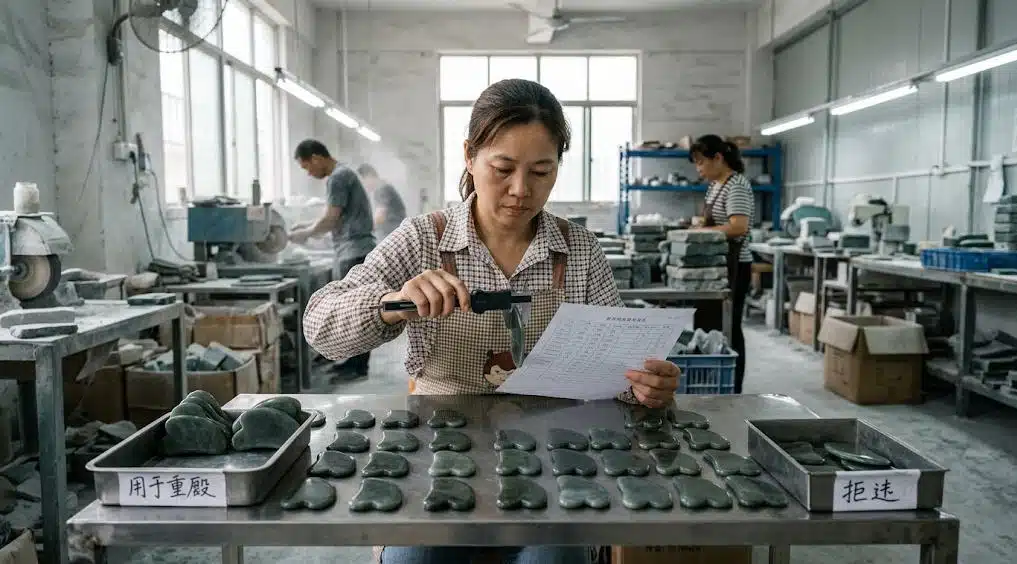
A gua sha manufacturer cannot repair a stone that finishes below its minimum thickness. If your spec is 5.0 mm with a 4.8–5.2 mm tolerance, a 4.6 mm piece goes to scrap or downgrade, while a 5.3 mm piece can often be re-ground. The better fix sits upstream: in gua sha production, the blank is cut thicker by a measured allowance, and gua sha manufacturer QC confirms thickness at every stage. In one illustrative model of 1,000 pieces, that single change recovers about RMB 515.20 in material value. This article shows how a gua sha factory handles each case, what the numbers look like, and which questions you should ask before you place an order. What a Gua Sha Manufacturer Does When Thickness Falls Out of Tolerance Thickness is the one dimension on a stone gua sha that only moves in one direction. Grinding removes material, and nothing puts it back. That single fact drives every decision a gua sha factory makes once a measurement lands outside your tolerance. This means you can predict how a thickness problem will be handled before a single stone is cut. Why a Gua Sha Manufacturer Cannot Repair Stone That Is Too Thin When a finished piece measures below your lower limit, the material is already gone. Polishing it again only thins it further, and no shaping step can restore 0.2 mm of crystal or jade. With a 5.0 mm spec and a 4.8–5.2 mm tolerance, a 4.6 mm piece sits 0.2 mm under the floor, so it is rejected and pulled from your order. Raw stone, cutting, shaping and some labor have been paid for by then, and most of that cost does not come back. This means you can expect a clear reject rule from your supplier instead of a “close enough” shipment. Material type raises the stakes. The International Gem Society hardness chart lists quartz at 7, jadeite at 6½–7 and nephrite at 6–6½ on the Mohs scale, and the same page warns that Mohs measures scratch resistance only, not toughness against impact. A thinner section also leaves less stone to absorb a knock. This means you can treat thickness tolerance as a durability check as well as a cosmetic one. When Thicker Stones Can Be Re-Ground, and When They Cannot A piece above the upper limit is a different story. At 5.3 mm it sits 0.1 mm over, so your supplier measures it, checks the remaining allowance and decides whether re-grinding is safe. The rework has to protect flatness, edge curvature, outline dimensions and polish, and it stops the moment any of those would suffer. Grinding adds hours, abrasive and machine time, yet it usually has a better chance of recovering value than scrapping the piece. The table shows how the logic plays out against a 4.8–5.2 mm tolerance. Finished thickness Position vs. tolerance Typical action 4.6 mm 0.2 mm under the lower limit Reject; scrap or downgrade 5.0 mm Inside tolerance Accept 5.3 mm 0.1 mm over the upper limit Measure allowance, then re-grind 5.5 mm 0.3 mm over the upper limit Evaluate rework feasibility and cost These values illustrate the logic and are not a universal standard. This means you can ask any gua sha manufacturer QC team for its written action rule at each of these four points before you approve a sample. What Happens to Scrap Stone, and Why You Should Ask Rejected stone does not always become waste. If it is uncontaminated, it can be crushed, sorted and sold as aquarium or garden decor, although that outlet pays far less than a finished tool. Not every fragment suits a fish tank, because mineral content, cleanliness, polishing residue and water safety all matter. GIA’s jade buyer’s guide notes that jade can be dyed, bleached, heated, waxed and impregnated, which is why treated offcuts need a check before any reuse. Every rejected piece is a cost in gua sha production that returns only in part. A gua sha manufacturer that keeps a scrap-sorting log can show you where its leftover stone goes. This means you can verify that treated offcuts stay apart from clean ones. How a Gua Sha Manufacturer Sets Blank Thickness in Gua Sha Production In gua sha production, the cheapest place to fix thickness is the saw, not the polishing wheel. Once a blank is cut too thin, every later step can only make it worse. So the real question is not how hard your supplier inspects at the end, but how much stone it leaves for the steps in between. This means you can judge a supplier by its blank-thickness rule rather than by its final-inspection promise. How Much Thicker Should a Gua Sha Blank Be Cut? Take your 5.0 mm spec with a 4.8–5.2 mm tolerance. Cutting, shaping and polishing all remove stone, and the saw blade itself turns part of the block into dust. Suppose a gua sha manufacturer‘s records show a combined removal of 0.30 mm with a swing of ±0.10 mm, a hypothetical figure used here to show the logic. A 5.0 mm blank then finishes between 4.6 and 4.8 mm, at or below your floor, while a 5.3 mm blank finishes between 4.9 and 5.1 mm, inside tolerance. This means you can see why a blank cut to the final spec fails by design. Why a Gua Sha Factory Should Not Simply Cut Everything Thicker Thicker is not automatically safer. Under the same assumptions, a 5.6 mm blank finishes between 5.2 and 5.4 mm, so most pieces land above your ceiling and need extra grinding. That adds cutting time, abrasive consumption and machine hours to every batch, and it can disturb outline dimensions and throughput. A gua sha factory that over-allows lowers its scrap rate but raises its grinding bill. This means you should expect the right allowance to be a calculated number, not the biggest one available. Four Steps a Gua Sha Manufacturer Uses to Set Machining Allowance You can run this method yourself or ask
A gua sha manufacturer cannot repair a stone that finishes below its minimum thickness. If your spec is 5.0 mm with a 4.8–5.2 mm tolerance, a 4.6 mm piece goes to scrap or downgrade, while a 5.3 mm piece can often be re-ground. The better fix sits upstream: in gua sha production, the blank is cut thicker by a measured allowance, and gua sha manufacturer QC confirms thickness at every stage. In one illustrative model of 1,000 pieces, that single change recovers about RMB 515.20 in material value. This article shows how a gua sha factory handles each case, what the numbers look like, and which questions you should ask before you place an order. What a Gua Sha Manufacturer Does When Thickness Falls Out of Tolerance Thickness is the one dimension on a stone gua sha that only moves in one direction. Grinding removes material, and nothing puts it back. That single fact drives every decision a gua sha factory makes once a measurement lands outside your tolerance. This means you can predict how a thickness problem will be handled before a single stone is cut. Why a Gua Sha Manufacturer Cannot Repair Stone That Is Too Thin When a finished piece measures below your lower limit, the material is already gone. Polishing it again only thins it further, and no shaping step can restore 0.2 mm of crystal or jade. With a 5.0 mm spec and a 4.8–5.2 mm tolerance, a 4.6 mm piece sits 0.2 mm under the floor, so it is rejected and pulled from your order. Raw stone, cutting, shaping and some labor have been paid for by then, and most of that cost does not come back. This means you can expect a clear reject rule from your supplier instead of a “close enough” shipment. Material type raises the stakes. The International Gem Society hardness chart lists quartz at 7, jadeite at 6½–7 and nephrite at 6–6½ on the Mohs scale, and the same page warns that Mohs measures scratch resistance only, not toughness against impact. A thinner section also leaves less stone to absorb a knock. This means you can treat thickness tolerance as a durability check as well as a cosmetic one. When Thicker Stones Can Be Re-Ground, and When They Cannot A piece above the upper limit is a different story. At 5.3 mm it sits 0.1 mm over, so your supplier measures it, checks the remaining allowance and decides whether re-grinding is safe. The rework has to protect flatness, edge curvature, outline dimensions and polish, and it stops the moment any of those would suffer. Grinding adds hours, abrasive and machine time, yet it usually has a better chance of recovering value than scrapping the piece. The table shows how the logic plays out against a 4.8–5.2 mm tolerance. Finished thickness Position vs. tolerance Typical action 4.6 mm 0.2 mm under the lower limit Reject; scrap or downgrade 5.0 mm Inside tolerance Accept 5.3 mm 0.1 mm over the upper limit Measure allowance, then re-grind 5.5 mm 0.3 mm over the upper limit Evaluate rework feasibility and cost These values illustrate the logic and are not a universal standard. This means you can ask any gua sha manufacturer QC team for its written action rule at each of these four points before you approve a sample. What Happens to Scrap Stone, and Why You Should Ask Rejected stone does not always become waste. If it is uncontaminated, it can be crushed, sorted and sold as aquarium or garden decor, although that outlet pays far less than a finished tool. Not every fragment suits a fish tank, because mineral content, cleanliness, polishing residue and water safety all matter. GIA’s jade buyer’s guide notes that jade can be dyed, bleached, heated, waxed and impregnated, which is why treated offcuts need a check before any reuse. Every rejected piece is a cost in gua sha production that returns only in part. A gua sha manufacturer that keeps a scrap-sorting log can show you where its leftover stone goes. This means you can verify that treated offcuts stay apart from clean ones. How a Gua Sha Manufacturer Sets Blank Thickness in Gua Sha Production In gua sha production, the cheapest place to fix thickness is the saw, not the polishing wheel. Once a blank is cut too thin, every later step can only make it worse. So the real question is not how hard your supplier inspects at the end, but how much stone it leaves for the steps in between. This means you can judge a supplier by its blank-thickness rule rather than by its final-inspection promise. How Much Thicker Should a Gua Sha Blank Be Cut? Take your 5.0 mm spec with a 4.8–5.2 mm tolerance. Cutting, shaping and polishing all remove stone, and the saw blade itself turns part of the block into dust. Suppose a gua sha manufacturer‘s records show a combined removal of 0.30 mm with a swing of ±0.10 mm, a hypothetical figure used here to show the logic. A 5.0 mm blank then finishes between 4.6 and 4.8 mm, at or below your floor, while a 5.3 mm blank finishes between 4.9 and 5.1 mm, inside tolerance. This means you can see why a blank cut to the final spec fails by design. Why a Gua Sha Factory Should Not Simply Cut Everything Thicker Thicker is not automatically safer. Under the same assumptions, a 5.6 mm blank finishes between 5.2 and 5.4 mm, so most pieces land above your ceiling and need extra grinding. That adds cutting time, abrasive consumption and machine hours to every batch, and it can disturb outline dimensions and throughput. A gua sha factory that over-allows lowers its scrap rate but raises its grinding bill. This means you should expect the right allowance to be a calculated number, not the biggest one available. Four Steps a Gua Sha Manufacturer Uses to Set Machining Allowance You can run this method yourself or ask