
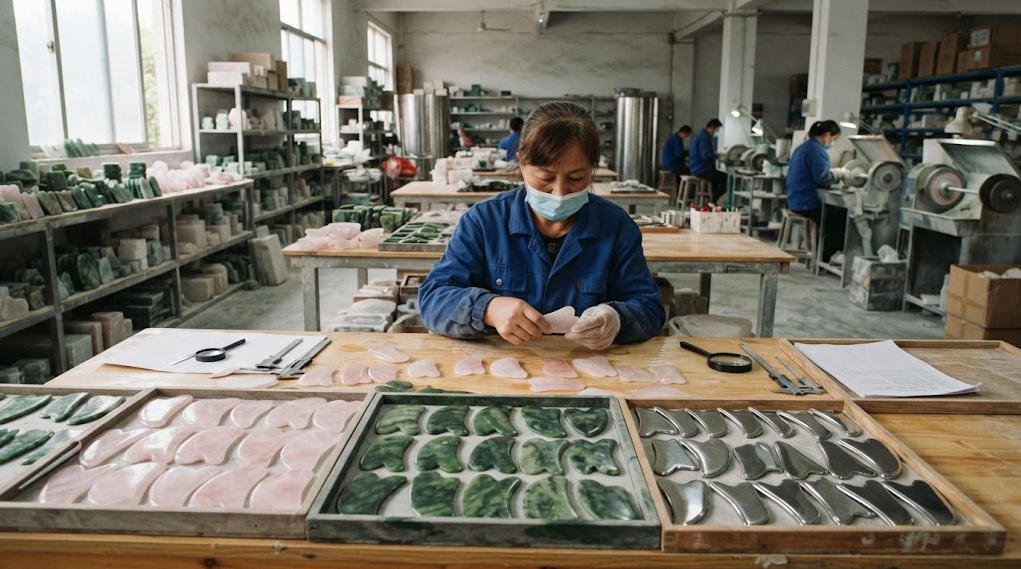
Gua Sha Material Industry Experience and Risk Disclosure: What Cost, Capacity and Consistency Mean for Your Orders
Rose quartz and stainless steel are the safest gua sha material choices when you need stable bulk supply, while green jade (serpentine) and resin cut unit cost the most. In our factory data, rose quartz still accounts for about 55% of shipments at $1.8–4 per piece, while green jade ships at $0.5–1.5 per piece. If you plan to buy guasha tools wholesale, this article shows you which risks sit behind each price. You will see where cost, capacity and batch consistency can hurt your margin, and how to brief a guasha supplier before you place an order. All figures come from one gua sha factory, so treat them as a reference point, not an industry benchmark. Which Gua Sha Material Should You Choose for Guasha Tools Wholesale? Quick Answers by Buyer Goal Most buyers ask the same question first: which material should I order? Any experienced gua sha manufacturer will ask you three things before quoting: your target cost per piece, your quarterly volume, and how much batch variation your brand can tolerate. Answer those three, and twelve options shrink to two or three. What Is the Cheapest Gua Sha Material for Bulk Orders? Resin is the lowest-cost option, followed by green jade, which is serpentine rather than true jade. Green jade wholesales at $0.5–1.5 per piece in our factory data, while rose quartz sits at $1.8–4. At the midpoints ($1.00 versus $2.90), switching a 5,000-piece order from rose quartz to green jade saves about $9,500 before freight. The trade-off is surface quality, because serpentine is softer than quartz and cannot reach the same polish. This means you can cut unit cost sharply, but you need to budget for a duller finish. Green jade also carries a labeling risk. The GIA defines jade as a generic term for nephrite, jadeite and, under certain conditions, green omphacite, and serpentine is not on that list, as GIA’s jade description explains. If you print “jade” on packaging, check how your target market treats that word before the first print run. Which Gua Sha Material Gives You Stable Supply and Batch Consistency? Rose quartz has the largest raw-material volume of any natural option, so your reorders rarely stall. GIA lists it at 7 on the Mohs scale in its rose quartz overview, which helps it keep a polish in daily use. Stainless steel (usually grade 304, sometimes 316) comes out of automated production with strong batch-to-batch consistency. This means you can plan quarterly reorders around either material without worrying about a stock gap. White jade behaves differently. Its raw material is limited, and because it is not a single mineral, a new purchasing cycle can change the look of the stone. Ask your guasha supplier to hold one raw-material lot for the full order, and approve a sample from that same lot. How Do You Match a Gua Sha Material to Your Order Size? Work backward from your landed cost per piece. First, set your retail price and subtract freight, packaging and margin, which gives you a ceiling for the factory price. Second, pick the tier that fits under it: resin or green jade at the bottom, rose quartz or green aventurine in the middle, stainless steel or amethyst above. Third, ask for capacity confirmation on that exact material, because a stone with limited reserves can price well and still run out. Since every price here is factory data, compare at least two quotes on the same shape and finish. This means you can use these ranges as a starting point without mistaking them for a market average. How Much Does Each Gua Sha Material Cost at a Gua Sha Factory? Price Ladder and ROI Price settles most orders before shape or finish even enters the conversation, so it helps to see the whole ladder of gua sha material costs in one place. The ranking below comes from one gua sha factory, and your final quote will still move with shape, finish and quantity. A gua sha manufacturer can only give exact numbers once shape and finish are fixed. What Is the Wholesale Price Ladder for Each Gua Sha Material? At the bottom sit resin and green jade. Green jade wholesales at $0.5–1.5 per piece, and resin comes in below it. Obsidian and opalite, a synthetic opal-look glass, land slightly under rose quartz, while white jade sits a little below rose quartz and green aventurine but above green jade. Rose quartz and green aventurine share the middle at $1.8–4 per piece, gray agate sits slightly above them, and amethyst runs at about twice the rose quartz price for the same shape. This means you can build a three-tier line of entry, core and accent products, and know which materials fit each price band before you request a single quote. Why Does Amethyst Cost About Twice as Much as Rose Quartz? The gap comes from supply, not from durability. GIA lists amethyst at 7 on the Mohs scale in its amethyst overview, the same hardness it lists for rose quartz, so you are not paying for a tougher tool. You are paying for a gua sha material with very low output. At the midpoint rose quartz price of $2.90, doubling the cost adds $2.90 per piece, or $5,800 on a 2,000-piece order. To recover that, each amethyst piece must sell for at least $2.90 more than the rose quartz version, before fees and freight. This means you should treat amethyst as an accent product with its own story, not as a drop-in replacement for your core item. Which Gua Sha Material Pays Back Best: Stainless Steel, Zinc Alloy or Brass? Stainless steel costs slightly more than rose quartz, but automated production gives it far higher output than any stone. Most pieces use grade 304, and some brands ask for 316, which adds 2–3% molybdenum for better corrosion resistance, according to Metal Supermarkets. Ask your guasha supplier to quote both grades on the same shape, so you see the real price of that upgrade. Brass […]
Rose quartz and stainless steel are the safest gua sha material choices when you need stable bulk supply, while green jade (serpentine) and resin cut unit cost the most. In our factory data, rose quartz still accounts for about 55% of shipments at $1.8–4 per piece, while green jade ships at $0.5–1.5 per piece. If you plan to buy guasha tools wholesale, this article shows you which risks sit behind each price. You will see where cost, capacity and batch consistency can hurt your margin, and how to brief a guasha supplier before you place an order. All figures come from one gua sha factory, so treat them as a reference point, not an industry benchmark. Which Gua Sha Material Should You Choose for Guasha Tools Wholesale? Quick Answers by Buyer Goal Most buyers ask the same question first: which material should I order? Any experienced gua sha manufacturer will ask you three things before quoting: your target cost per piece, your quarterly volume, and how much batch variation your brand can tolerate. Answer those three, and twelve options shrink to two or three. What Is the Cheapest Gua Sha Material for Bulk Orders? Resin is the lowest-cost option, followed by green jade, which is serpentine rather than true jade. Green jade wholesales at $0.5–1.5 per piece in our factory data, while rose quartz sits at $1.8–4. At the midpoints ($1.00 versus $2.90), switching a 5,000-piece order from rose quartz to green jade saves about $9,500 before freight. The trade-off is surface quality, because serpentine is softer than quartz and cannot reach the same polish. This means you can cut unit cost sharply, but you need to budget for a duller finish. Green jade also carries a labeling risk. The GIA defines jade as a generic term for nephrite, jadeite and, under certain conditions, green omphacite, and serpentine is not on that list, as GIA’s jade description explains. If you print “jade” on packaging, check how your target market treats that word before the first print run. Which Gua Sha Material Gives You Stable Supply and Batch Consistency? Rose quartz has the largest raw-material volume of any natural option, so your reorders rarely stall. GIA lists it at 7 on the Mohs scale in its rose quartz overview, which helps it keep a polish in daily use. Stainless steel (usually grade 304, sometimes 316) comes out of automated production with strong batch-to-batch consistency. This means you can plan quarterly reorders around either material without worrying about a stock gap. White jade behaves differently. Its raw material is limited, and because it is not a single mineral, a new purchasing cycle can change the look of the stone. Ask your guasha supplier to hold one raw-material lot for the full order, and approve a sample from that same lot. How Do You Match a Gua Sha Material to Your Order Size? Work backward from your landed cost per piece. First, set your retail price and subtract freight, packaging and margin, which gives you a ceiling for the factory price. Second, pick the tier that fits under it: resin or green jade at the bottom, rose quartz or green aventurine in the middle, stainless steel or amethyst above. Third, ask for capacity confirmation on that exact material, because a stone with limited reserves can price well and still run out. Since every price here is factory data, compare at least two quotes on the same shape and finish. This means you can use these ranges as a starting point without mistaking them for a market average. How Much Does Each Gua Sha Material Cost at a Gua Sha Factory? Price Ladder and ROI Price settles most orders before shape or finish even enters the conversation, so it helps to see the whole ladder of gua sha material costs in one place. The ranking below comes from one gua sha factory, and your final quote will still move with shape, finish and quantity. A gua sha manufacturer can only give exact numbers once shape and finish are fixed. What Is the Wholesale Price Ladder for Each Gua Sha Material? At the bottom sit resin and green jade. Green jade wholesales at $0.5–1.5 per piece, and resin comes in below it. Obsidian and opalite, a synthetic opal-look glass, land slightly under rose quartz, while white jade sits a little below rose quartz and green aventurine but above green jade. Rose quartz and green aventurine share the middle at $1.8–4 per piece, gray agate sits slightly above them, and amethyst runs at about twice the rose quartz price for the same shape. This means you can build a three-tier line of entry, core and accent products, and know which materials fit each price band before you request a single quote. Why Does Amethyst Cost About Twice as Much as Rose Quartz? The gap comes from supply, not from durability. GIA lists amethyst at 7 on the Mohs scale in its amethyst overview, the same hardness it lists for rose quartz, so you are not paying for a tougher tool. You are paying for a gua sha material with very low output. At the midpoint rose quartz price of $2.90, doubling the cost adds $2.90 per piece, or $5,800 on a 2,000-piece order. To recover that, each amethyst piece must sell for at least $2.90 more than the rose quartz version, before fees and freight. This means you should treat amethyst as an accent product with its own story, not as a drop-in replacement for your core item. Which Gua Sha Material Pays Back Best: Stainless Steel, Zinc Alloy or Brass? Stainless steel costs slightly more than rose quartz, but automated production gives it far higher output than any stone. Most pieces use grade 304, and some brands ask for 316, which adds 2–3% molybdenum for better corrosion resistance, according to Metal Supermarkets. Ask your guasha supplier to quote both grades on the same shape, so you see the real price of that upgrade. Brass […]