
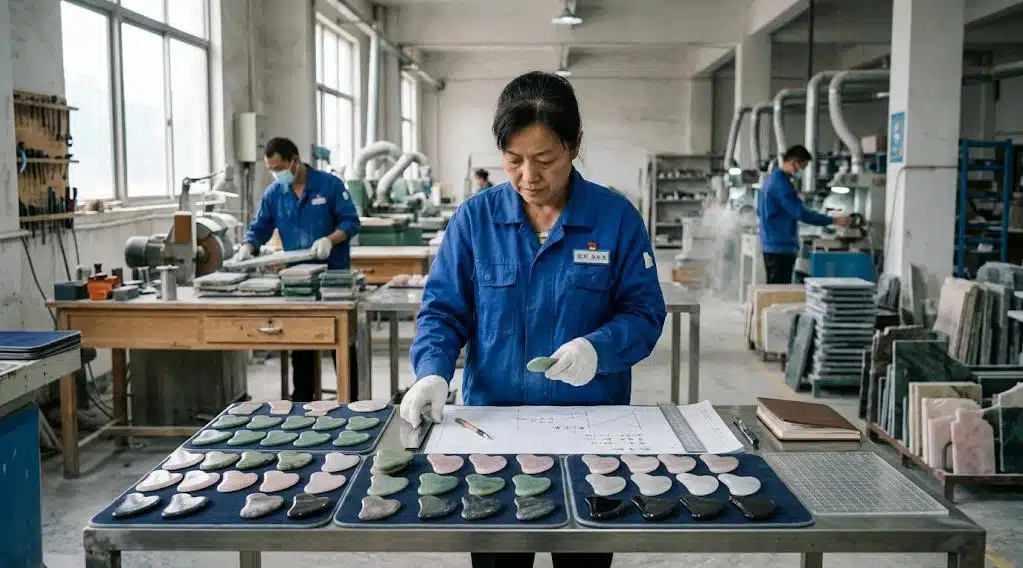
Gua Sha Manufacturer Risk Disclosure: What Twelve Years of Custom Orders Teach About Price, Quality and Compliance
A gua sha manufacturer can cut the cost of a natural stone board by about 12% without touching material grade, polishing steps or final inspection. In our demonstration costing, one piece drops from $3.00 to $2.64, and every cent of the saving comes from layout, machining, logo method and packaging. The remaining $0.04 above a $2.60 target is where honest suppliers and risky ones part ways. Here is the part most quotes leave out. If you compare a gua sha wholesale price by raw-stone cost per kg, you can pick the wrong supplier and still pay more for every piece that passes inspection. This article shows you where savings are real, where the risks hide, and what you should demand in writing before you approve a change. Why Every Gua Sha Manufacturer Faces the Same Price Gap Every gua sha manufacturer you contact will quote one number, and almost every buyer arrives with a lower one in mind. The distance between the two is rarely greed; it is usually the way the cost was built. After more than twelve years of making crystal and jade boards, we have learned that the build should be on the table before any discount is. How a Gua Sha Manufacturer Splits $3.00 Into Six Cost Lines A natural stone board is priced in six lines. In the demonstration costing used throughout this article, raw material and loss take $1.20 (40%), CNC and cutting take $0.45 (15%), grinding and polishing take $0.45 (15%), logo work takes $0.15 (5%), packaging takes $0.45 (15%), and inspection plus management take $0.30 (10%). The total is $3.00 per piece. These figures are illustrative, but they show how a gua sha manufacturer spends money: stone, machining and packaging add up to 70% of the bill. This means you can start your questions with those three lines, because that is where a price gap is most likely to be explained. Notice what the list does not contain: a line called “quality.” Inspection and management hold 10%, and that line stays at $0.30 in the optimized version. If a quote for a cheaper gua sha shows that line shrinking, ask what disappeared. This means you can use one line item as a fast test of whether a lower price came from engineering or from skipped checks. Why a Cheaper Gua Sha Starts With Cost Lines, Not Discounts Suppose your target price is $2.60 per piece. Against $3.00, that leaves a $0.40 gap, or 13.3%. Asking every department to cut 13.3% sounds fair, yet it would push inspection below its agreed level and polishing toward visible scratches. A better route for a gua sha manufacturer takes small, defensible savings from lines that have slack: $0.12 from stone layout and loss, $0.07 from CNC time, $0.06 from polishing, $0.05 from logo method and $0.06 from packaging. Those five changes bring the piece to $2.64, a 12% reduction with inspection untouched. This means you can negotiate from a documented $0.36 saving instead of a vague request to “do better.” On a gua sha custom order, the remaining $0.04 is not a failure. A gua sha factory that shows you the gap openly gives you three levers to close it: order size, packaging style or a small design change. Will every lever suit your brand? No, and that is exactly why you should see them side by side before choosing. What a Gua Sha Manufacturer Should Disclose Before You Sign Off Price is one of three risks you carry as a buyer; material and compliance are the other two. A gua sha manufacturer should state in writing which stone grade is quoted, which processes are included and which inspection plan applies. GIA’s gem treatment guide makes the same point for gemstones: dyeing, bleaching and similar treatments are hard to see, so sellers are expected to disclose them. The International Gem Society also notes that rose quartz rates 7 on the Mohs scale with no cleavage, so a board that chips at a thin edge usually points to cutting or structure rather than to the stone itself. This means you can ask for a one-page spec sheet that names grade, process and inspection plan, and compare every supplier on the same terms. How a Gua Sha Manufacturer Controls Material Risk Before It Reaches Your Order Raw stone and loss take 40% of the demonstration cost, so material is where a gua sha manufacturer has the most room to save and the most room to disappoint you. A wrong grade, a hidden treatment or a quiet substitution each costs more than any polishing shortcut. The three checks below keep that risk visible. Why Rose Quartz Grade Changes Yield More Than Price per kg In one set of purchasing data, A-grade rose quartz rough cost about 15 RMB per kg and B-grade about 11 RMB per kg, a 36.4% difference on paper. That difference does not carry through to the finished board. Cracks and inclusions lower the yield, sorting adds labor, and every rejected blank has already used cutting time. The number worth comparing is material cost per qualified piece, not rough price per kg. This means you can ask any gua sha factory for yield and pass rate by grade before you accept a cheaper gua sha built on B-grade stone. Grade should follow positioning. A high-end line keeps strict color and veining limits, a mid-range line accepts natural variation inside an agreed range, and a price-sensitive line widens the usable range once the appearance standard is written down. A gua sha manufacturer also controls cost through layout: in the demonstration costing, a $0.12 saving on the $1.20 material line equals 10%, and it comes from nesting boards on the stone, not from a lower grade. This means you can reach a lower gua sha wholesale price by agreeing on an appearance range instead of dropping the stone class. What a Gua Sha Manufacturer Must Never Substitute Without Your Approval A look-alike stone is the quietest way […]
A gua sha manufacturer can cut the cost of a natural stone board by about 12% without touching material grade, polishing steps or final inspection. In our demonstration costing, one piece drops from $3.00 to $2.64, and every cent of the saving comes from layout, machining, logo method and packaging. The remaining $0.04 above a $2.60 target is where honest suppliers and risky ones part ways. Here is the part most quotes leave out. If you compare a gua sha wholesale price by raw-stone cost per kg, you can pick the wrong supplier and still pay more for every piece that passes inspection. This article shows you where savings are real, where the risks hide, and what you should demand in writing before you approve a change. Why Every Gua Sha Manufacturer Faces the Same Price Gap Every gua sha manufacturer you contact will quote one number, and almost every buyer arrives with a lower one in mind. The distance between the two is rarely greed; it is usually the way the cost was built. After more than twelve years of making crystal and jade boards, we have learned that the build should be on the table before any discount is. How a Gua Sha Manufacturer Splits $3.00 Into Six Cost Lines A natural stone board is priced in six lines. In the demonstration costing used throughout this article, raw material and loss take $1.20 (40%), CNC and cutting take $0.45 (15%), grinding and polishing take $0.45 (15%), logo work takes $0.15 (5%), packaging takes $0.45 (15%), and inspection plus management take $0.30 (10%). The total is $3.00 per piece. These figures are illustrative, but they show how a gua sha manufacturer spends money: stone, machining and packaging add up to 70% of the bill. This means you can start your questions with those three lines, because that is where a price gap is most likely to be explained. Notice what the list does not contain: a line called “quality.” Inspection and management hold 10%, and that line stays at $0.30 in the optimized version. If a quote for a cheaper gua sha shows that line shrinking, ask what disappeared. This means you can use one line item as a fast test of whether a lower price came from engineering or from skipped checks. Why a Cheaper Gua Sha Starts With Cost Lines, Not Discounts Suppose your target price is $2.60 per piece. Against $3.00, that leaves a $0.40 gap, or 13.3%. Asking every department to cut 13.3% sounds fair, yet it would push inspection below its agreed level and polishing toward visible scratches. A better route for a gua sha manufacturer takes small, defensible savings from lines that have slack: $0.12 from stone layout and loss, $0.07 from CNC time, $0.06 from polishing, $0.05 from logo method and $0.06 from packaging. Those five changes bring the piece to $2.64, a 12% reduction with inspection untouched. This means you can negotiate from a documented $0.36 saving instead of a vague request to “do better.” On a gua sha custom order, the remaining $0.04 is not a failure. A gua sha factory that shows you the gap openly gives you three levers to close it: order size, packaging style or a small design change. Will every lever suit your brand? No, and that is exactly why you should see them side by side before choosing. What a Gua Sha Manufacturer Should Disclose Before You Sign Off Price is one of three risks you carry as a buyer; material and compliance are the other two. A gua sha manufacturer should state in writing which stone grade is quoted, which processes are included and which inspection plan applies. GIA’s gem treatment guide makes the same point for gemstones: dyeing, bleaching and similar treatments are hard to see, so sellers are expected to disclose them. The International Gem Society also notes that rose quartz rates 7 on the Mohs scale with no cleavage, so a board that chips at a thin edge usually points to cutting or structure rather than to the stone itself. This means you can ask for a one-page spec sheet that names grade, process and inspection plan, and compare every supplier on the same terms. How a Gua Sha Manufacturer Controls Material Risk Before It Reaches Your Order Raw stone and loss take 40% of the demonstration cost, so material is where a gua sha manufacturer has the most room to save and the most room to disappoint you. A wrong grade, a hidden treatment or a quiet substitution each costs more than any polishing shortcut. The three checks below keep that risk visible. Why Rose Quartz Grade Changes Yield More Than Price per kg In one set of purchasing data, A-grade rose quartz rough cost about 15 RMB per kg and B-grade about 11 RMB per kg, a 36.4% difference on paper. That difference does not carry through to the finished board. Cracks and inclusions lower the yield, sorting adds labor, and every rejected blank has already used cutting time. The number worth comparing is material cost per qualified piece, not rough price per kg. This means you can ask any gua sha factory for yield and pass rate by grade before you accept a cheaper gua sha built on B-grade stone. Grade should follow positioning. A high-end line keeps strict color and veining limits, a mid-range line accepts natural variation inside an agreed range, and a price-sensitive line widens the usable range once the appearance standard is written down. A gua sha manufacturer also controls cost through layout: in the demonstration costing, a $0.12 saving on the $1.20 material line equals 10%, and it comes from nesting boards on the stone, not from a lower grade. This means you can reach a lower gua sha wholesale price by agreeing on an appearance range instead of dropping the stone class. What a Gua Sha Manufacturer Must Never Substitute Without Your Approval A look-alike stone is the quietest way […]