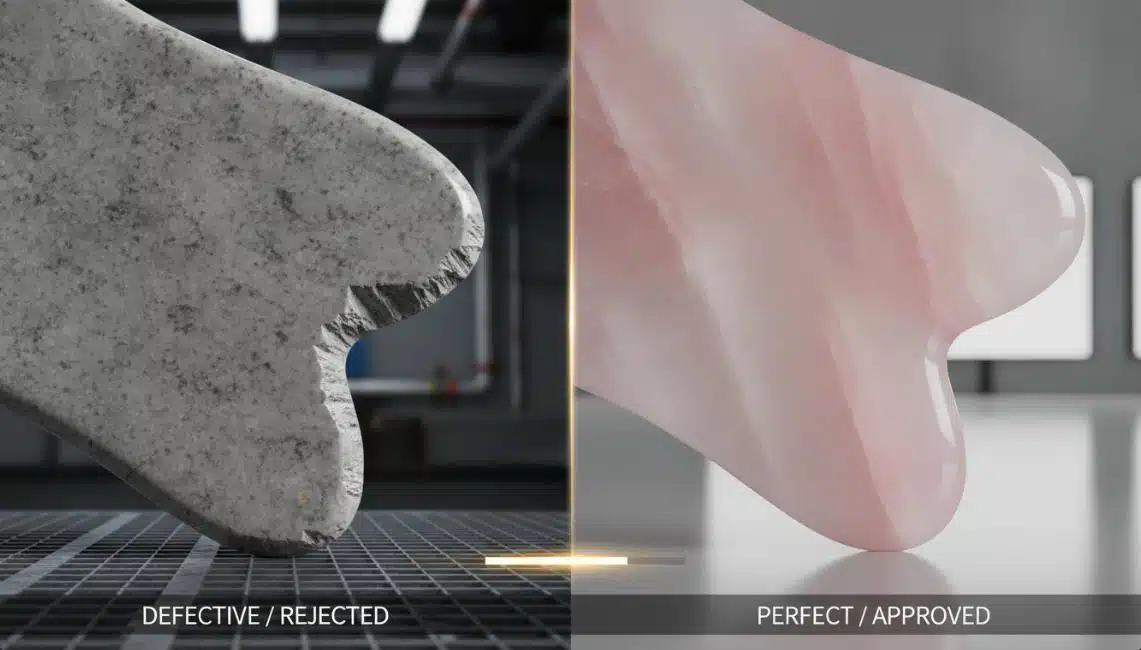
How a Gua Sha Manufacturer Handles Inner-Corner Chamfering: The 5-Second Process That Determines Whether Your Tool Is Safe or Hazardous
When you inspect a gua sha tool for the first time, your eyes are drawn to the overall silhouette — the curves, the polish, the translucency of the stone. What you are far less likely to examine, and what most suppliers will never volunteer information about, is the inner corner zone. Not the concave angle itself, but the two ridge lines where the tool’s front and back faces meet the side edge within that inner corner area. As a professional gua sha manufacturer with over 12 years of stone processing experience, we have documented what happens when those ridge lines are left sharp and unaddressed: the result is a tool that looks finished, passes visual inspection, and injures the people who use it. Here is the fact that should anchor every purchasing decision you make about stone gua sha tools: during the shaping phase of gua sha production, the side edge of the tool within the inner corner zone is ground to its final profile before any surface finishing takes place. The transition between that side edge and the front or back face of the tool — the ridge line running along the inner corner — emerges from shaping as a sharp, unrelieved edge. It is not a manufacturing defect in the traditional sense. It is a structural inevitability of how stone is shaped. What separates a professional gua sha supplier from a volume producer is whether that ridge line is systematically chamfered into a smooth r-angle before the tool reaches your customer. Why This Ridge Line Is More Dangerous Than It Looks The inner corner of a gua sha tool is a zone of curvature change. When a stroke passes through this area, the skin and underlying soft tissue do not respond uniformly — they are drawn inward by the geometry of the stroke, increasing contact pressure precisely at the points where the front and back faces meet the side edge. Contact mechanics research on curved mineral surfaces, including frameworks discussed in IGS resources on gemstone physical properties, consistently identifies angular ridge transitions as zones where localized contact force is disproportionately concentrated relative to what the surface appearance suggests. A ridge line that appears smooth under overhead lighting can generate meaningfully higher contact pressure than the surrounding curved surface during directional stroking — enough to mark skin under sustained use even when the rest of the tool surface causes no discomfort whatsoever. The 5-Second Step That Changes Everything Inner-corner chamfering — the process of grinding those two ridge lines from a sharp transition into a smooth, continuous r-angle — takes no more than 5 seconds per tool in the hands of a trained technician working with the correct equipment. Yet it is one of the most inconsistently performed steps across the gua sha stone factory landscape, particularly among manufacturers where inner-corner work is absorbed into the polishing phase rather than treated as an independent production stage. If your current gua sha tool manufacturer cannot describe this process to you in technical detail — specifying what equipment they use, what contact parameters they follow, and how they verify the result — that gap in their answer is information. This article explains exactly what the process involves, where it fails, and what you should be asking before your next order is confirmed. Why the Inner-Corner Ridge Line Cannot Be Fixed in Polishing To understand why inner-corner chamfering is a mandatory, dedicated stage in professional gua sha production, you need to understand the manufacturing sequence that creates the problem in the first place. Stone gua sha tools are shaped through a process of progressive material removal: rough cutting defines the gross form, intermediate shaping refines the profile and establishes the tool’s characteristic curves, and polishing brings the surface to its final finish. This sequence is deliberately structured so that each stage removes less material than the one before it. Polishing, by design, is a surface refinement operation — it smooths and brightens what is already there. It does not change geometry. How the Ridge Line Forms During Gua Sha Production During the shaping stage, the outer curves of a gua sha tool — the long convex sides and rounded tips — are addressed by grinding passes that move continuously along open, accessible surfaces. The inner corner presents a fundamentally different geometry. The side edge within the inner corner is narrower, more confined, and approached from an angle that limits the grinding wheel’s range of motion. As a result, the transition between the side edge and the front or back face — the ridge line — is the last feature to be refined in shaping, and it is typically the least refined. What the tool carries out of the shaping phase is a side edge that has been brought to its correct profile, front and back faces that have been smoothed to near-finished condition, and two ridge lines along the inner corner that remain as sharp, angular intersections between those surfaces. This geometry cannot be corrected in polishing. Polishing wheels and compounds work by removing microscopic surface irregularities from surfaces they can access and conform to. The ridge line in the inner corner is not a surface irregularity — it is a geometric transition between two surfaces, and polishing does not change the angle of that transition. A gua sha stone factory that relies on polishing to address inner-corner ridge lines will produce tools with a high-gloss, beautifully finished surface and unrelieved sharp edges precisely where users apply the most directional pressure. The polish makes the problem harder to detect, not easier to avoid. How the Ridge Line Affects Skin and Tissue During Use The gua sha stroke is a sustained, directional movement that applies lateral pressure along the skin’s surface. When that stroke enters the inner corner zone, the geometry of the tool causes soft tissue to be drawn inward — a predictable response to the changing curvature of the surface the tool is pressing against. At the moment of maximum
When you inspect a gua sha tool for the first time, your eyes are drawn to the overall silhouette — the curves, the polish, the translucency of the stone. What you are far less likely to examine, and what most suppliers will never volunteer information about, is the inner corner zone. Not the concave angle itself, but the two ridge lines where the tool’s front and back faces meet the side edge within that inner corner area. As a professional gua sha manufacturer with over 12 years of stone processing experience, we have documented what happens when those ridge lines are left sharp and unaddressed: the result is a tool that looks finished, passes visual inspection, and injures the people who use it. Here is the fact that should anchor every purchasing decision you make about stone gua sha tools: during the shaping phase of gua sha production, the side edge of the tool within the inner corner zone is ground to its final profile before any surface finishing takes place. The transition between that side edge and the front or back face of the tool — the ridge line running along the inner corner — emerges from shaping as a sharp, unrelieved edge. It is not a manufacturing defect in the traditional sense. It is a structural inevitability of how stone is shaped. What separates a professional gua sha supplier from a volume producer is whether that ridge line is systematically chamfered into a smooth r-angle before the tool reaches your customer. Why This Ridge Line Is More Dangerous Than It Looks The inner corner of a gua sha tool is a zone of curvature change. When a stroke passes through this area, the skin and underlying soft tissue do not respond uniformly — they are drawn inward by the geometry of the stroke, increasing contact pressure precisely at the points where the front and back faces meet the side edge. Contact mechanics research on curved mineral surfaces, including frameworks discussed in IGS resources on gemstone physical properties, consistently identifies angular ridge transitions as zones where localized contact force is disproportionately concentrated relative to what the surface appearance suggests. A ridge line that appears smooth under overhead lighting can generate meaningfully higher contact pressure than the surrounding curved surface during directional stroking — enough to mark skin under sustained use even when the rest of the tool surface causes no discomfort whatsoever. The 5-Second Step That Changes Everything Inner-corner chamfering — the process of grinding those two ridge lines from a sharp transition into a smooth, continuous r-angle — takes no more than 5 seconds per tool in the hands of a trained technician working with the correct equipment. Yet it is one of the most inconsistently performed steps across the gua sha stone factory landscape, particularly among manufacturers where inner-corner work is absorbed into the polishing phase rather than treated as an independent production stage. If your current gua sha tool manufacturer cannot describe this process to you in technical detail — specifying what equipment they use, what contact parameters they follow, and how they verify the result — that gap in their answer is information. This article explains exactly what the process involves, where it fails, and what you should be asking before your next order is confirmed. Why the Inner-Corner Ridge Line Cannot Be Fixed in Polishing To understand why inner-corner chamfering is a mandatory, dedicated stage in professional gua sha production, you need to understand the manufacturing sequence that creates the problem in the first place. Stone gua sha tools are shaped through a process of progressive material removal: rough cutting defines the gross form, intermediate shaping refines the profile and establishes the tool’s characteristic curves, and polishing brings the surface to its final finish. This sequence is deliberately structured so that each stage removes less material than the one before it. Polishing, by design, is a surface refinement operation — it smooths and brightens what is already there. It does not change geometry. How the Ridge Line Forms During Gua Sha Production During the shaping stage, the outer curves of a gua sha tool — the long convex sides and rounded tips — are addressed by grinding passes that move continuously along open, accessible surfaces. The inner corner presents a fundamentally different geometry. The side edge within the inner corner is narrower, more confined, and approached from an angle that limits the grinding wheel’s range of motion. As a result, the transition between the side edge and the front or back face — the ridge line — is the last feature to be refined in shaping, and it is typically the least refined. What the tool carries out of the shaping phase is a side edge that has been brought to its correct profile, front and back faces that have been smoothed to near-finished condition, and two ridge lines along the inner corner that remain as sharp, angular intersections between those surfaces. This geometry cannot be corrected in polishing. Polishing wheels and compounds work by removing microscopic surface irregularities from surfaces they can access and conform to. The ridge line in the inner corner is not a surface irregularity — it is a geometric transition between two surfaces, and polishing does not change the angle of that transition. A gua sha stone factory that relies on polishing to address inner-corner ridge lines will produce tools with a high-gloss, beautifully finished surface and unrelieved sharp edges precisely where users apply the most directional pressure. The polish makes the problem harder to detect, not easier to avoid. How the Ridge Line Affects Skin and Tissue During Use The gua sha stroke is a sustained, directional movement that applies lateral pressure along the skin’s surface. When that stroke enters the inner corner zone, the geometry of the tool causes soft tissue to be drawn inward — a predictable response to the changing curvature of the surface the tool is pressing against. At the moment of maximum